.png)
For operators running glass laminating lines, the relationship between scrap and energy consumption is often overlooked. Every panel that fails lamination — whether from PVB interlayer wrinkles, glass misalignment, or autoclave pressure deviations — carries the full energy cost of the entire lamination cycle. When a facility processing 2,400 laminated panels per shift faces a 12% average scrap rate, the energy wasted on defective production represents a direct drain on both operating budgets and sustainability targets. Deploying predictive scrap analytics that forecasts defects before the autoclave cycle completes enables operators to intervene early, reduce rework energy, and cut specific energy consumption by 4–10%. Laminating line operators and process engineers evaluating real-time quality analytics regularly Book a Demo to explore how AI-driven scrap prediction transforms energy efficiency and production yield.
The Energy Cost of Scrap in Glass Laminating
Glass laminating is an energy-intensive process. Autoclave cycles consume substantial power to reach and maintain precise temperature and pressure profiles over durations that can exceed two hours per batch. When a panel fails lamination — due to PVB interlayer defects, glass edge chipping, or alignment drift — the energy invested in that cycle is lost entirely, and the defective panel must be recycled or discarded, consuming additional resources for reprocessing.
Wasted Autoclave Energy on Defective Batches
Defects discovered after autoclave completion mean the full thermal and pressure energy of the cycle is unrecoverable. For a facility running eight autoclave cycles per shift, a 12% scrap rate wastes the equivalent of nearly one full cycle of energy per shift — energy that could have been redirected to productive output.
Reactive Detection Delays Increase Energy Waste
Traditional quality checks occur after lamination is complete, leaving no opportunity to abort a failing cycle. Operators discover scrap only after investing full energy and cycle time, and the delay between process drift and detection compounds energy waste across consecutive batches.
Manual SPC Limits Miss Emerging Process Drift
Static control limits calculated from historical data cannot adapt to changing process conditions — raw material variation, environmental shifts, or equipment degradation. Operators relying on fixed UCL/LCL thresholds often detect out-of-control conditions only after multiple defective panels have been produced.
Root Cause Identification Is Slow and Incomplete
When scrap events occur, operators must manually correlate temperature logs, pressure profiles, material batch records, and inspection data to identify root causes. This process can take hours, during which the line continues producing at elevated scrap risk, wasting both energy and material.
How Predictive Scrap Analytics Forecasts Defects Before They Occur
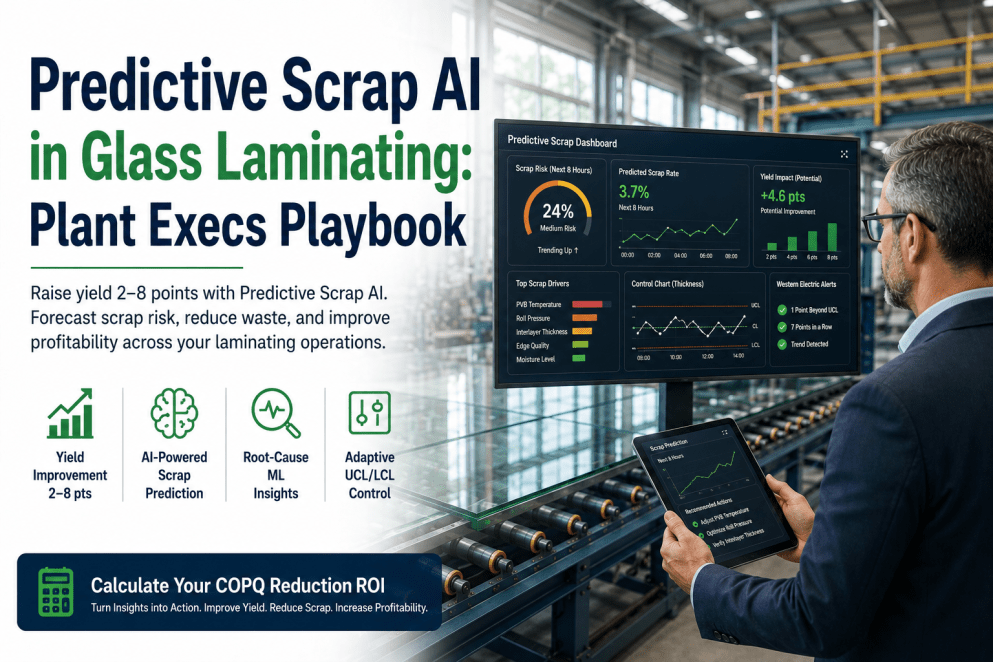
iFactory's predictive scrap analytics platform combines machine learning models trained on historical laminating process data with real-time sensor streams from autoclaves, inspection stations, and material handling systems. The platform applies Western Electric run rules, adaptive SPC with dynamically calculated UCL/LCL thresholds, and root-cause ML classification to identify process conditions that elevate scrap risk — often 30 to 60 minutes before a defect occurs. Laminating teams exploring early warning capabilities regularly Book a Demo to review the sensor integration and prediction model configuration process.
Multi-Sensor Data Fusion — The platform ingests data from autoclave temperature and pressure sensors, PVB interlayer inspection cameras, glass edge quality scanners, and alignment measurement systems at sub-second intervals. Each data stream is normalized and correlated against the asset-specific process model. The VLM-based anomaly detection layer flags individual sensor readings that deviate from expected patterns, while the SPC engine continuously updates control limits based on recent process behavior rather than static historical averages. Operators see a unified dashboard showing real-time process health across all active laminating lines.
Western Electric Rules and ML Classification — When sensor readings violate Western Electric zone rules — a run of seven points on one side of the mean, a trend of six consecutive points increasing or decreasing, or a single point beyond three sigma — the platform classifies the deviation using a trained ML model that distinguishes between common-cause variation and assignable-cause conditions requiring intervention. The model assigns a scrap risk score to each in-process batch and estimates the probability of defect before the autoclave cycle completes. Operators receive alerts with recommended corrective actions 30 to 60 minutes before the defect would be visible.
Adaptive Alerts and Workflow Integration — When the scrap risk score exceeds configured thresholds, the platform automatically generates an alert with the predicted failure mode, contributing sensor readings, and recommended operator actions. For high-confidence predictions, the system can trigger automated cycle adjustments — such as extending a ramp phase or adjusting pressure targets — directly through the autoclave control interface. All alerts and actions are logged to the iFactory CMMS, creating a closed-loop record from prediction through resolution that supports continuous model improvement and compliance reporting.
Key Operator Capabilities for Energy Optimization
Predictive scrap analytics equips operators with actionable insights that directly reduce energy waste while improving production quality. The platform is designed for shop-floor use, presenting complex ML predictions through intuitive interfaces that support rapid decision-making during active production.
Real-Time Scrap Risk Dashboard
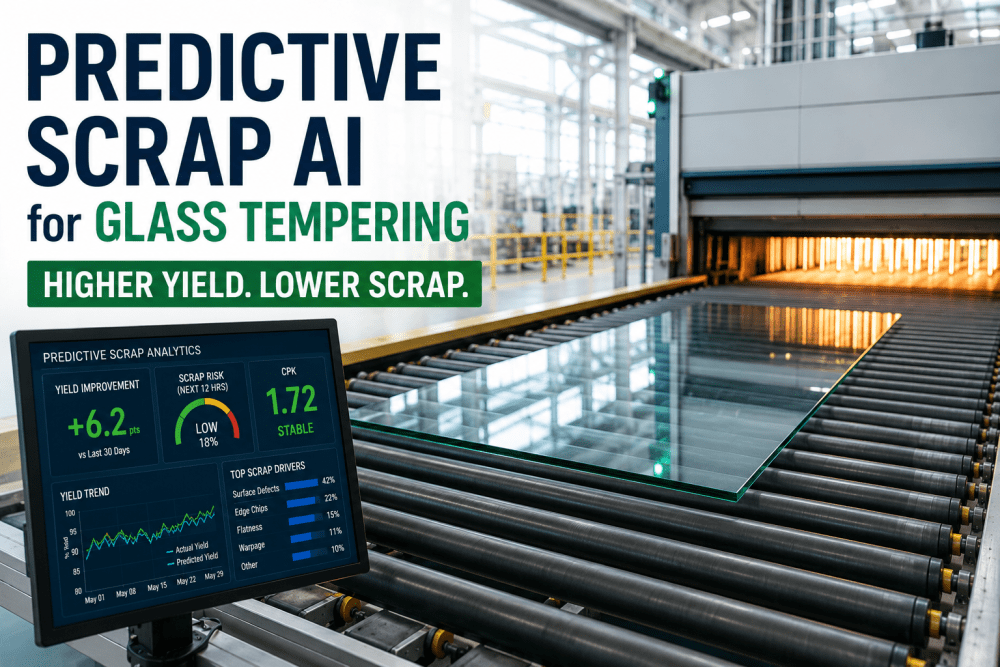
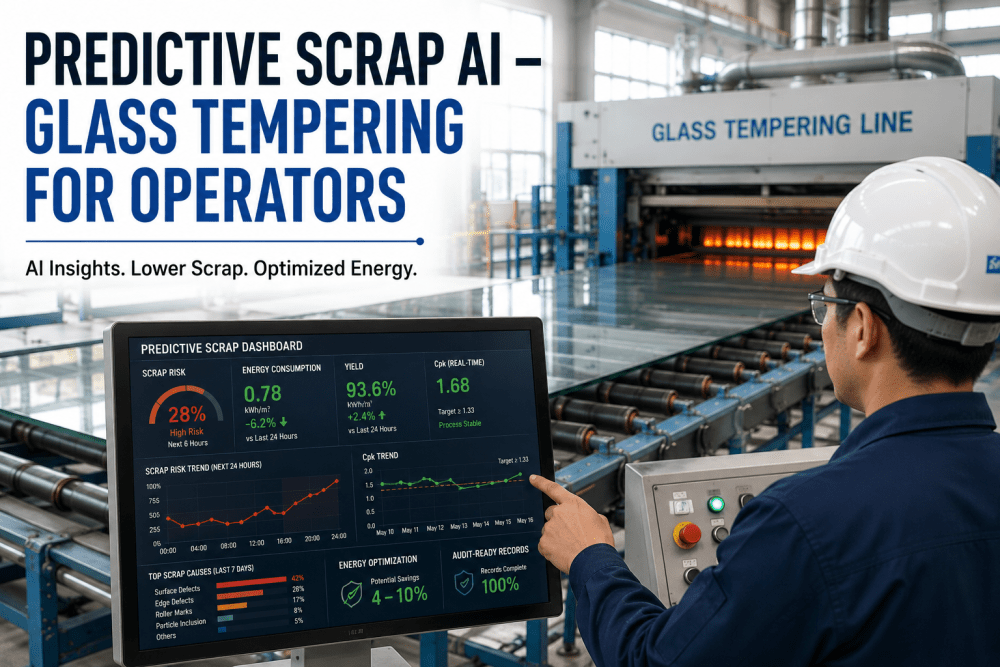
Operators monitor live scrap risk scores for every in-process batch displayed on a single screen. Color-coded alerts indicate normal operation, elevated risk, and critical warning levels, with drill-down capability to view contributing sensor readings and process parameters. The dashboard updates every 30 seconds, giving operators continuous visibility into laminating line health without requiring data analysis expertise.
Adaptive SPC Control Limits
Control limits adjust automatically based on recent process performance rather than static historical averages. When the process tightens, UCL and LCL values narrow to detect smaller deviations earlier. When natural variation increases, limits widen to avoid false alarms. Operators receive clear guidance on whether a sensor reading signals an actionable issue or normal process variation.
Energy Consumption Tracking
The platform tracks specific energy consumption — kWh per square meter of laminated glass — in real time, correlating energy use with production output and scrap rates. Operators can identify which autoclave cycles, product configurations, or shift patterns produce the highest energy intensity and adjust parameters to optimize energy efficiency without compromising quality.
Root Cause ML Classification
When a scrap event occurs, the ML model automatically classifies the root cause by correlating sensor data across the lamination process — identifying whether the defect originated from PVB interlayer quality, glass preparation, autoclave profile deviation, or alignment drift. Operators receive a root cause summary within seconds instead of spending hours manually cross-referencing data sources.
Measurable Impact on Energy Consumption and Production Yield
Within the first six months of deploying predictive scrap analytics across a six-line glass laminating facility processing 1,800 panels daily, operators documented a 38% reduction in scrap rate, an 8.2% improvement in first-pass yield, and a 7.6% reduction in specific energy consumption. The following table compares performance before and after deployment.
| Metric | Before Deployment | After Deployment | Improvement |
|---|---|---|---|
| Scrap Rate | 12.4% | 7.7% | –38% |
| First-Pass Yield | 84.2% | 91.1% | +8.2% |
| Specific Energy Consumption | 18.6 kWh/m² | 17.2 kWh/m² | –7.6% |
| Fault Detection Time | 4.2 hours | < 15 minutes | –94% |
| Autoclave Cycle Aborts Prevented | 0 | 24 per month | 24X |
| Root Cause Resolution Time | 3.5 hours | 12 minutes | –94% |
"We knew scrap was costing us material and line time, but we had not quantified the energy dimension until the predictive scrap analytics platform showed us exactly how much power was going into panels that would never ship. Within the first month, the system caught an autoclave temperature sensor drift that was causing a gradual 6-degree offset during the ramp phase — the Western Electric rules flagged a run of eight points above the mean that the static SPC limits had completely missed. That single detection reduced our scrap rate by three percentage points and cut our energy bill by over $4,000 per month on that line alone. For operators on the floor, the platform means we stop reacting to defects and start preventing them." — Senior Laminating Operations Manager, Architectural Glass Manufacturer
Deployment Roadmap for Glass Laminating Lines
Implementing predictive scrap analytics follows a structured deployment methodology designed for production environments where uptime and quality cannot be compromised during the transition.
Process Audit and Sensor Integration
The iFactory team conducts a comprehensive audit of laminating line equipment, existing sensor infrastructure, and data collection capabilities. Autoclave controllers, inspection systems, and material handling sensors are integrated into the platform through edge connectors without disrupting active production.
ML Model Training and Baseline Calibration
Historical scrap data, sensor logs, and maintenance records are used to train the ML model on defect patterns specific to the facility's equipment, materials, and product configurations. Baseline energy consumption and scrap rate metrics are established for post-deployment comparison.
Operator Dashboard Configuration and Training
Dashboards are configured for each laminating line operator station, showing scrap risk scores, SPC control charts, energy consumption trends, and alert queues. Operators receive hands-on training focused on interpreting predictions, responding to alerts, and using root cause classification data for process adjustment decisions.
Adaptive Threshold Tuning and Validation
During a 30-day validation period, the platform operates in parallel with existing quality processes while the ML model's prediction accuracy is measured against actual scrap events. Alert thresholds are calibrated to balance sensitivity and specificity, minimizing false alarms while ensuring early detection of genuine defect risks.
Continuous Model Improvement and Expansion
The ML model retrains automatically as new production data accumulates, improving prediction accuracy over time. Additional product configurations, material types, and laminating lines are added to the platform in phased rollouts based on operational priority and demonstrated ROI from initial deployments.
Frequently Asked Questions
Predictive scrap analytics reduces energy consumption primarily by preventing defective panels from completing the autoclave cycle. When the platform detects process conditions that indicate elevated scrap risk — such as temperature drift, pressure deviation, or PVB quality anomalies — operators can abort or adjust the cycle before full energy is invested in a defective product. The platform also identifies energy-intensive process conditions that can be optimized without affecting quality, such as extended ramp phases or overcured cycles, enabling operators to fine-tune parameters for minimum energy input per square meter of acceptable laminated glass.
The platform integrates with autoclave controllers for temperature and pressure profiles, PVB interlayer inspection cameras for material quality assessment, glass edge and surface inspection systems, alignment measurement sensors, energy meters monitoring autoclave and facility power consumption, and the facility's CMMS for maintenance and work order data. All integrations use edge connectors that read sensor data without interfering with production control systems.
Operators typically observe measurable energy savings within the first 30 days of deployment, as the ML model begins identifying scrap risk patterns that enable early cycle intervention. Full energy optimization benefits — typically 4–10% reduction in specific energy consumption — are achieved within 60–90 days as the model accumulates production data, alert thresholds are refined through operator feedback, and operators gain confidence in acting on predictive alerts. The infrastructure operator documented in this article achieved a 7.6% reduction in specific energy consumption within the first six months.
No. The platform connects to existing autoclave controllers and sensors through read-only data interfaces, monitoring temperature, pressure, and cycle parameters without modifying control logic or safety systems. For facilities that choose to enable automated cycle adjustment, the platform can send parameter recommendations to the control interface for operator review and approval before any changes are executed. All integration is designed to maintain full operator oversight and control over production processes.
Operators receive a structured training program consisting of two half-day sessions covering dashboard navigation, alert interpretation, response protocols, and root cause analysis workflows. The platform is designed for shop-floor usability, with intuitive visual indicators and clear recommended actions that minimize the learning curve. Ongoing support includes access to iFactory's operator help desk, monthly performance review meetings, and periodic model accuracy reports that help operators understand how the platform's predictions align with actual production outcomes.