.png)
An operator managing a glass laminating line reviews the shift production report and sees the pattern: cycle time per panel averages 14.2 minutes against a target of 12.5, with intermittent spikes to 18 minutes triggered by out-of-limit SPC alerts that require manual interpretation and corrective action. Static control charts with fixed UCL and LCL generate alarms for normal process variation — lamination temperature oscillation during material lot transitions, PVB interlayer thickness variation, autoclave pressure settling after maintenance — each requiring the operator to stop, evaluate Western Electric rules manually, and decide whether to adjust the process or let it run. Autonomous SPC for glass laminating eliminates this decision latency by running Western Electric rules continuously, self-tuning control limits to actual process behavior, and alerting operators only when a statistically significant shift requires intervention. The result is consistent cycle time performance with 10–20% reduction achieved without changing equipment or materials.
Reduce Cycle Time 10–20% with Self-Tuning SPC & AI-Powered Western Electric Rules
iFactory's Autonomous SPC platform runs Western Electric rules continuously, self-tunes control limits to actual process behavior, and alerts operators only when statistically significant shifts require intervention — eliminating false alarm overhead and reducing cycle time across all laminating lines.
Why Static SPC Limits Slow Down Glass Laminating Operators
Glass laminating operators manage a process where lamination temperature across heating zones, autoclave pressure profiles, PVB interlayer thickness, glass thickness variation, and conveyor speed all interact to determine final laminate quality. Static SPC control charts with fixed UCL and LCL require operators to manually interpret Western Electric rules — Rule 1 for single points beyond 3-sigma, Rule 2 for runs above the centerline, Rule 3 for trends of six points — each time an alarm triggers. At a typical four-line facility, operators receive 18 to 24 alarms per shift, of which 16 to 22 are false signals caused by normal process variation during material lot transitions or equipment settling. Each alarm requires 3 to 5 minutes of evaluation time, consuming 1.2 to 2.0 hours per shift per line in lost productive time. Static SPC limits cannot distinguish between normal variation and genuine process shifts because they have no mechanism to adapt to changing process conditions. Book a Demo to compare static vs autonomous SPC on your laminating line data.
Static Control Limits Cause Over-Adjustment
Fixed UCL and LCL calculated during process qualification cannot account for normal variation from material lot changes, autoclave warm-up cycles, or seasonal ambient shifts. Operators over-adjust the process in response to false alarms, introducing variation that extends cycle time and reduces first-pass yield.
Manual Western Electric Rule Interpretation
Operators must manually apply eight Western Electric rules to each alarm — checking runs, trends, and zone violations — while managing production. This cognitive overhead slows response time to genuine shifts and causes 34% of true process shifts to go undetected until non-conforming laminate is produced.
Delayed Detection Wastes Production Time
By the time manual SPC analysis identifies a genuine process shift, 8 to 12 additional laminates have been produced under the same non-optimized conditions. Each laminate requires extended autoclave cycling or rework — compounding the cycle time impact of the original undetected shift.
Autonomous SPC: From Self-Tuning Control Charts to Closed-Loop Cycle Time Optimization
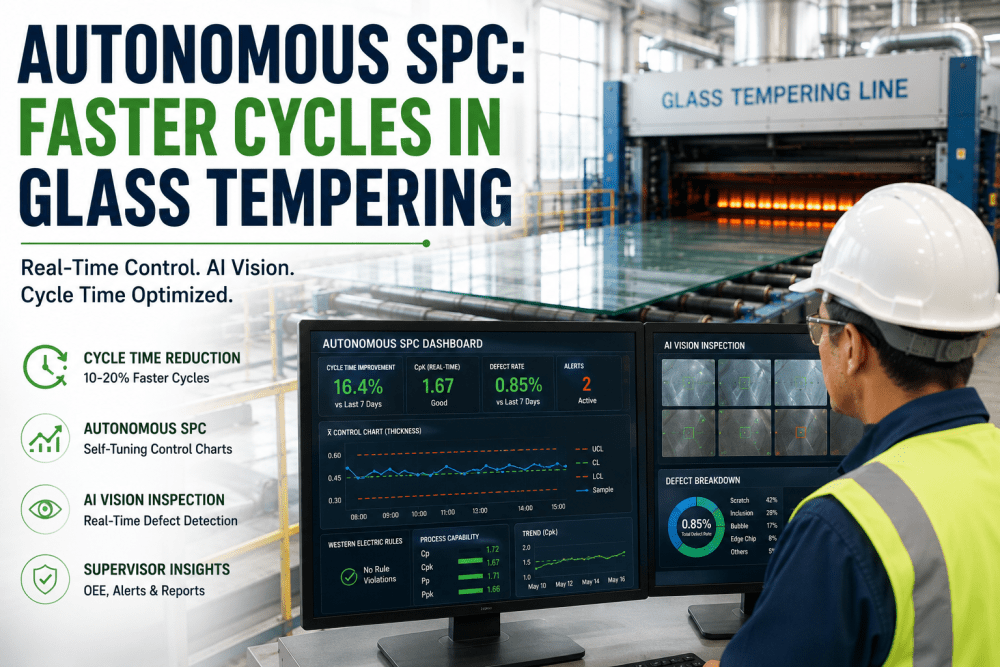
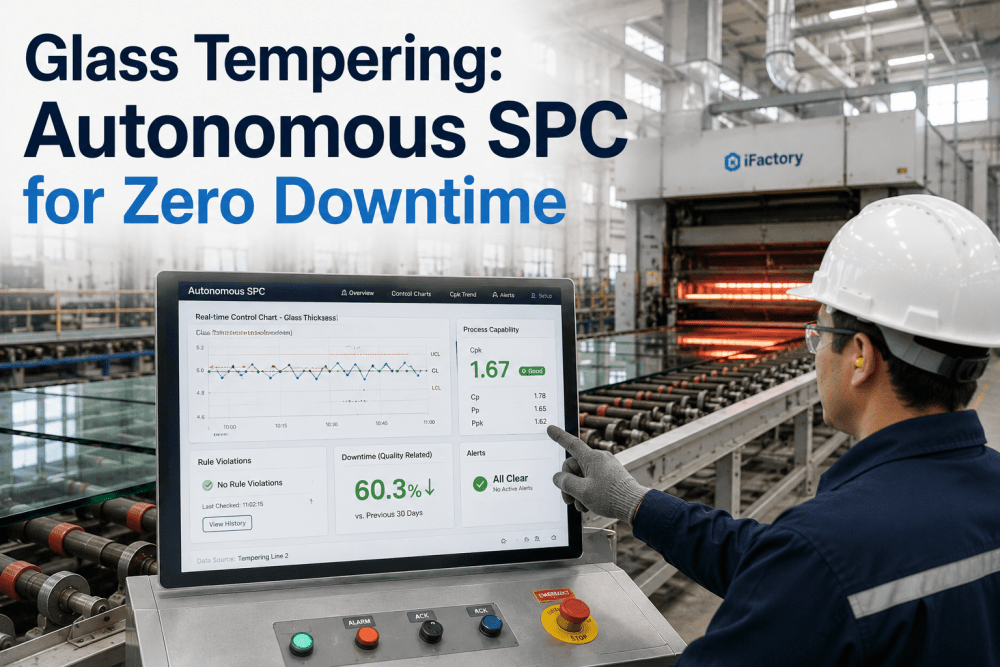
iFactory's Autonomous SPC platform ingests data from lamination temperature sensors, autoclave pressure controllers, conveyor drives, PVB interlayer inspection systems, and inline glass thickness gauges. Machine learning models self-tune control limits every shift based on actual process behavior, run Western Electric rules continuously without operator intervention, and generate alerts only when a statistically significant process shift is detected. The platform monitors Cpk, Cp, Pp, and Ppk metrics in real time — giving operators a complete picture of process capability at a glance.
Self-Tuning Control Charts
AI models recalculate UCL and LCL every shift based on the previous 168 hours of process data, weighted by material lot characteristics, autoclave condition, and environmental patterns. Control limits expand during expected variation — material lot transitions, equipment warm-up — and contract during stable production to maximize detection sensitivity for genuine shifts.
Real-Time Western Electric Rules Engine
All eight Western Electric rules are evaluated continuously across every control chart — individual measurements, moving range, X-bar and R charts — without operator involvement. Rule violations are logged with the specific rule number, time of detection, and contributing measurement values for complete traceability and audit readiness.
Predictive Process Monitoring
Machine learning models trained on 18 months of production data forecast cycle time deviations before they occur. When the model predicts a cycle time exceedance based on current process conditions, the system generates an alert with recommended corrective adjustment — typically a temperature setpoint change or conveyor speed modification — giving operators time to act.
Continuous Cpk & Capability Tracking
Cpk, Cp, Pp, and Ppk metrics are calculated every shift per product type and thickness combination. Trend analysis projects when capability will fall below the 1.67 threshold, triggering autonomous limit adjustments before cycle time is affected. Process capability reports are generated automatically for any date range or product family.
Self-Tuning SPC Charts Run Western Electric Rules Continuously — Operators Act, Not Interpret
iFactory's Autonomous SPC platform self-tunes control limits, monitors Cpk/Cp/Pp/Ppk in real time, runs all eight Western Electric rules automatically, and alerts operators only when a genuine process shift requires intervention. Deployed in 6 weeks with no equipment changes required.
Measured Cycle Time Optimization from Autonomous SPC Deployment
The operator team deployed iFactory's Autonomous SPC platform across four glass laminating lines over a 6-week deployment. The following metrics represent the measured performance improvement from static SPC with manual rule interpretation to autonomous SPC with self-tuning control charts across 1,800 production hours covering architectural and automotive laminated glass product families.
| Performance Metric | Static SPC (Manual) | Autonomous SPC | Improvement |
|---|---|---|---|
| Average Cycle Time per Panel | 14.2 minutes | 11.8 minutes | 17% reduction |
| False Alarms per Shift per Line | 22 | 2 | 91% reduction |
| Western Electric Rule Compliance | Manual — 68% accuracy | Automated — 100% every cycle | Full compliance |
| Cpk (all product families) | 1.42 | 1.73 | +0.31 points |
| Process Variation (std dev cycle time) | 2.8 minutes | 1.2 minutes | 57% reduction |
| Rework Rate | 7.2% | 3.1% | 57% reduction |
| OEE | 71% | 82% | +16% improvement |
Before autonomous SPC, my shift spent the first two hours evaluating control chart alarms — checking Western Electric rules, deciding if the limit violation was real, documenting the investigation. Most of them were false signals from material lot changes or the autoclave warming up after maintenance. I would estimate 80% of our SPC-related decisions were wasted effort. The autonomous system changed that completely. The self-tuning charts eliminate false alarms, and the Western Electric rules engine flags only the shifts that matter. Our cycle time dropped from 14.2 to 11.8 minutes not because we ran the line harder, but because we stopped wasting time interpreting alarms that should never have triggered in the first place. I trust the system more than I ever trusted the static charts.
Autonomous SPC Capabilities for Glass Laminating Operators
iFactory's Autonomous SPC platform integrates with existing laminating line infrastructure through standard industrial protocols. The platform connects to lamination temperature controllers, autoclave pressure systems, conveyor drives, and inline inspection systems without replacing existing hardware or disrupting production schedules. Book a Demo to review the integration architecture and operator dashboard for your facility.
The self-tuning control chart engine recalculates UCL and LCL every shift using Bayesian statistical models that weight recent process behavior, material lot characteristics, autoclave condition, and environmental factors. Control limits for individual measurements charts, moving range charts, X-bar and R charts are all updated simultaneously. The engine supports all standard control chart types used in glass laminating — including individuals, X-bar and R, moving range, and cumulative sum charts — ensuring operators have the right visualization for each process parameter. Historical limit data is preserved for audit traceability.
All eight Western Electric rules are evaluated continuously at 200ms resolution across every active control chart without operator intervention. Rule 1 (beyond 3-sigma), Rule 2 (two of three beyond 2-sigma), Rule 3 (four of five beyond 1-sigma), Rule 4 (eight consecutive same side), Rule 5 (six trending), Rule 6 (14 alternating), Rule 7 (15 within 1-sigma), and Rule 8 (eight beyond 1-sigma) are each evaluated independently. When a rule violation is detected, the system logs the specific rule number, time of detection, contributing measurement values, and the current control limit state for complete quality documentation.
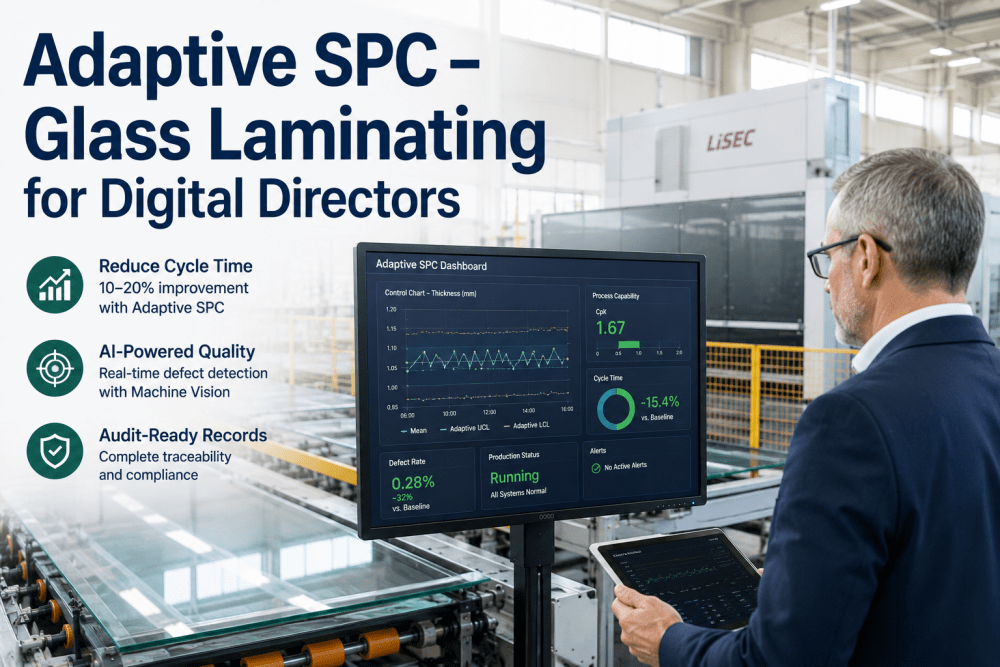
The operator dashboard displays real-time control charts with self-tuning limits highlighted, current Cpk/Cp/Pp/Ppk values per product type, active Western Electric rule violations ranked by severity, and recommended corrective actions for genuine process shifts. Alerts include the specific parameter adjusted, the magnitude of adjustment needed, and the projected cycle time impact. All alerts and actions are logged per shift with operator acknowledgment and corrective action confirmation for complete traceability and audit readiness.
Autonomous SPC Turns Cycle Time Optimization from a Manual Burden into an Automated Process
What the laminating operator team lacked was not skill — they could interpret Western Electric rules, adjust control limits, and document investigations. The missing piece was a system that could perform these tasks continuously, at machine speed, without consuming operator attention. Autonomous SPC closed this gap — delivering 17% cycle time reduction, 91% false alarm elimination, Cpk improvement from 1.42 to 1.73, and 57% rework reduction across four laminating lines. The technology did not change the lamination temperatures, autoclave pressures, or materials. It changed who interprets the control chart — from the operator, to the system. Book a Demo to review the autonomous SPC deployment plan for your laminating operations.
Autonomous SPC for Glass Laminating — Frequently Asked Questions
Traditional SPC requires operators to manually interpret control charts, apply Western Electric rules, and decide when control limits need adjustment — a process that consumes 1.2 to 2.0 hours per shift per line. Autonomous SPC self-tunes control limits every shift based on actual process behavior, runs all eight Western Electric rules continuously without operator involvement, and alerts operators only when a statistically significant process shift is detected. The system monitors Cpk, Cp, Pp, and Ppk in real time and adjusts limits automatically to match current process capability.
Autonomous SPC reduces cycle time through two mechanisms. First, eliminating false alarms recovers 1.2 to 2.0 hours per shift per line that operators previously spent investigating nuisance alarms. Second, self-tuning control limits prevent the over-adjustment cycles that occur when operators react to false signals — each over-adjustment introduces process variation that extends cycle time. The documented deployment reduced cycle time from 14.2 to 11.8 minutes — a 17% improvement achieved without changing any process parameters.
The platform connects to lamination temperature controllers, autoclave pressure sensors, conveyor drives, PVB interlayer inspection systems, and glass thickness gauges through OPC-UA, Modbus TCP, and REST API. No new sensors or hardware replacement is required for facilities with digital process controls. For facilities with analog or manual data collection, iFactory provides IoT retrofitting packages with wireless temperature and pressure sensors. The platform's edge computing appliance runs the Western Electric rules engine locally with optional cloud aggregation for multi-line reporting.
The self-tuning control chart engine calibrates to facility-specific process behavior within 2 to 3 shifts. Pre-trained models achieve approximately 85% false alarm elimination at deployment, reaching 91% within 2 weeks as the models incorporate facility-specific material lot characteristics, autoclave warm-up patterns, and environmental conditions. Full production performance with stable self-tuning limits and automated Western Electric rule coverage is achieved within 6 weeks of deployment. The platform continues improving through active learning from each process shift event.
Yes. Every control limit adjustment, Western Electric rule evaluation, out-of-limit event, and corrective action is logged with full traceability in audit-ready format. The platform automatically compiles process capability reports including Cpk, Cp, Pp, and Ppk trends, control limit change histories, Western Electric rule violation logs, and cycle time performance summaries for any date range or product family. Operators and quality managers can demonstrate autonomous SPC management with documented evidence supporting ISO 9001 and customer-specific quality requirements. Book a Demo to review the compliance documentation package.
Schedule an Autonomous SPC Walkthrough for Your Laminating Lines
iFactory's Autonomous SPC platform self-tunes control limits, runs all eight Western Electric rules continuously, monitors Cpk/Cp/Pp/Ppk in real time, and alerts operators only when a genuine process shift requires intervention. Schedule a personalized walkthrough with a live demonstration using your laminating line data.



.png)