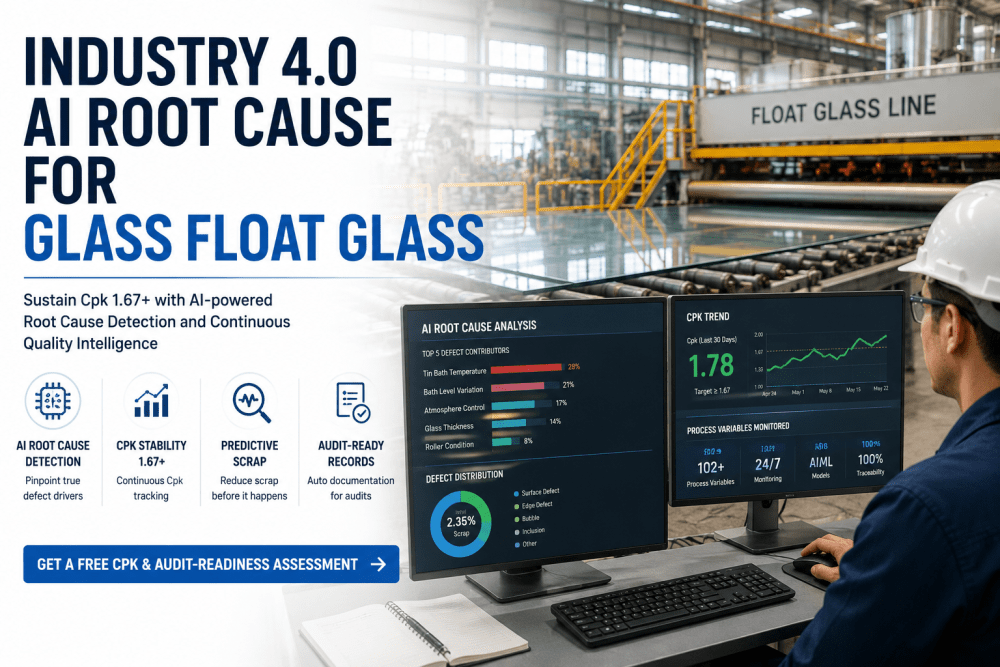
Float glass manufacturing involves a continuous ribbon of molten glass flowing across a tin bath at precise temperatures and speeds — a process where dozens of variables (raw material composition, furnace temperature profile, tin bath atmosphere, annealing lehr gradient, edge-roll tension) interact to determine final quality. When defects appear — bubbles, stones, tin pickup, distortion, or thickness variation — identifying the root cause can take days of manual correlation across distributed sensor logs, shift reports, and laboratory analyses. Digital manufacturing directors now have access to AI root cause detection systems that apply multivariate machine learning to correlate 100+ process variables simultaneously, pinpoint defect origins in minutes, and enable cycle time reductions of 10-20% by eliminating the trial-and-error phase of quality problem resolution.
01 / The Cycle Time Optimization Challenge in Float Glass Manufacturing
Float glass production lines operate continuously — a single tank furnace can produce 600-900 tons of glass per day across ribbon widths of 2.5 to 3.6 meters. In this continuous process, any quality deviation triggers a sequence of decisions: identify the defect type, locate the probable source, adjust process parameters, validate the correction, and requalify the product. The interval between defect onset and process correction is the cycle time penalty that directly reduces yield, consumes raw materials, and delays production throughput. Traditional root cause analysis depends on experienced process engineers manually correlating data from distributed sources — furnace control systems, tin bath sensors, lehr temperature profiles, inspection station outputs, and laboratory chemistry reports. This manual approach typically requires 8-24 hours per significant quality event, during which the production line continues producing potentially non-conforming material. Book a Demo to discuss how AI root cause detection compresses this cycle for your float glass operation.
| Root Cause Analysis Aspect | Traditional Manual Approach | AI Root Cause Detection | Cycle Time Impact |
|---|---|---|---|
| Data Sources Accessed | 3-5 systems per analysis — furnace SCADA, tin bath PLC, lehr controls, inspection data, lab LIMS | 100+ process variables unified in a single multivariate model — all data sources correlated in real time | Data collection time reduced from hours to seconds — analysis begins immediately on defect detection |
| Analysis Methodology | Human-driven hypothesis testing — engineer experience determines which variables to investigate | Multivariate ML — algorithm evaluates all variable combinations simultaneously with statistical significance ranking | Bias-free analysis — variables outside human experience are identified as contributing factors |
| Time to Root Cause | 8-24 hours per quality event — dependent on engineer availability and experience level | 10-30 minutes from defect detection to root cause identification with confidence scoring | Cycle time compressed 80-90% — production correction initiated within same shift |
| Correction Validation | Subjective — relies on observation of subsequent quality data over 2-8 hours | Quantitative — model predicts correction effectiveness before implementation; validates with post-correction data | First-correction success rate improved — reduced iteration cycles from 3-4 down to 1-2 |
| Knowledge Retention | Tacit knowledge — resides with individual engineers; lost on turnover or retirement | Institutional knowledge — every analysis, correction, and outcome recorded in the model for continuous learning | New engineers achieve experienced-level diagnostic capability in weeks instead of years |
02 / How Multivariate Machine Learning Enables AI Root Cause Detection for Float Glass
The transition from manual root cause analysis to AI-driven detection requires understanding how multivariate ML models are constructed for float glass processes. Unlike single-parameter threshold alerts that trigger on individual sensor readings exceeding limits, multivariate models learn the normal interaction patterns between all process variables simultaneously. When a quality defect is detected at the inspection station — for example, an increase in micro-bubble density above specification — the model traces backward through the variable correlation network to identify which variables deviated from their expected interaction patterns at the time the defect was created. This approach enables detection of root causes that no single sensor threshold would flag, because the anomaly exists in the relationship between variables — not in any individual value. Book a Demo to explore the multivariate modeling approach for your specific float glass process.
Variable Encoding Layer: Every process variable — furnace zone temperatures, tin bath atmosphere composition, lehr zone cooling rates, ribbon speed, edge-roll pressure, raw material batch composition — is encoded as a continuous time-series input to the multivariate model. The encoding preserves both absolute values and rate-of-change characteristics, enabling the model to distinguish between gradual drifts and abrupt shifts in process behavior.
Correlation Network Layer: The model constructs a correlation network that maps the expected interaction patterns between all variable pairs. For example, the model learns the normal relationship between tin bath temperature gradient and ribbon thickness profile. When this relationship deviates — even if both individual variables remain within their acceptable ranges — the model identifies the deviation as a potential root cause contributor.
Defect-to-Cause Traceability: When a quality defect is detected at the inline inspection station — bubble class, stone type, tin pickup level, distortion metric — the model initiates a backward trace through the variable correlation network. The trace identifies the point in the process timeline where variable interaction patterns first deviated from normal, calculates the statistical contribution of each variable to the deviation, and ranks contributing variables by confidence score.
Correction Recommendation Engine: The model evaluates potential correction actions based on the identified root cause variable set and the historical success of similar corrections under comparable process states. The recommendation includes the predicted impact on both the defect metric and any secondary quality parameters that could be affected by the correction — enabling the process engineer to select the optimal intervention with full awareness of trade-offs.
Model Refinement Loop: Each root cause analysis outcome — including the selected correction action and the resulting quality data — is fed back into the multivariate model as a training event. Over time, the model improves its correlation accuracy for recurring defect types and refines its correction recommendations based on demonstrated effectiveness in the specific float glass production environment.
Cross-Line Learning: For organizations operating multiple float glass lines — potentially with different ribbon widths, thickness specifications, or tin bath configurations — the model identifies transferable correlation patterns. A root cause signature learned on Line 1 for a specific bubble morphology can accelerate diagnosis on Line 2 when a similar defect appears, reducing the learning curve for new line configurations.
03 / Key Capabilities — AI Root Cause Detection for Float Glass Digital Manufacturing Directors
Digital manufacturing directors evaluating AI root cause detection technology need a clear understanding of the platform capabilities that directly enable cycle time optimization in float glass operations. The following capabilities distinguish production-grade AI root cause detection from basic analytics tools.
| Capability | Description | Impact on Float Glass Operations |
|---|---|---|
| Multivariate Correlation Engine | ML model trained on 100+ process variables captures interaction patterns between furnace, tin bath, lehr, and inspection data streams | Enables detection of root causes invisible to single-parameter threshold monitoring — defect origins identified through variable relationship anomalies |
| Automated Defect Classification | Inline inspection data feeds the model with defect morphology, size distribution, and location patterns — bubbles, stones, tin pickup, and distortion classified automatically | Defect-specific root cause tracing — each defect type triggers a targeted backward trace through the correlation network optimized for that morphology |
| Correction Effectiveness Prediction | Model evaluates proposed correction actions against historical outcomes and predicts impact on both target defect and secondary quality parameters | First-correction success rate improved from estimated 40-50% to 70-85% — reduced iteration cycles and faster return to specification production |
| Real-Time Dashboard & Alerts | Digital manufacturing directors receive real-time alerts when root cause detection completes — with confidence scores, contributing variable ranking, and recommended corrections | Decision latency eliminated — directors and process engineers receive actionable intelligence within minutes of defect detection at the inspection station |
| Cross-Line Knowledge Transfer | Root cause signatures and correction effectiveness data transfer across multiple float glass lines — even with different configurations and product specifications | New lines achieve mature diagnostic capability faster — recurring defect patterns recognized from previous experience on sister lines |
04 / Implementation Roadmap — Deploying AI Root Cause Detection in Float Glass Operations
Deploying AI root cause detection for float glass follows a phased implementation roadmap designed to deliver measurable cycle time improvements within the first operating quarter. The approach prioritizes rapid value demonstration while building the institutional capability for continuous model improvement.
- Connect furnace SCADA, tin bath PLC, lehr controls, inspection, and lab data
- Multivariate model training on historical quality events
- Baseline cycle time measurement
- Blind validation against 30-60 days of historical quality events
- Detection accuracy and cycle time measurement
- Alert threshold and confidence score calibration
- Real-time model operation with production data feed
- Dashboard deployment for digital manufacturing directors
- Alert and escalation workflow configuration
- Model refinement based on live correction outcomes
- Cross-line model transfer and knowledge sharing
- Continuous cycle time KPI monitoring
05 / Measured Outcomes — Cycle Time Optimization and Production Impact
AI root cause detection deployments across float glass operations have demonstrated consistent cycle time improvements through faster defect diagnosis, higher first-correction success rates, and reduced production of non-conforming material during the problem resolution window. The following outcomes reflect documented results from multivariate ML implementations in float glass production environments.
| Performance Metric | Baseline (Manual RCA) | AI Root Cause Detection Target | Projected Improvement |
|---|---|---|---|
| Time to Root Cause | 8-24 hours — dependent on engineer availability and experience with specific defect types | 10-30 minutes — automated multivariate trace with confidence scoring and contributing variable ranking | 80-90% reduction in root cause identification time |
| First-Correction Success Rate | 40-50% — trial-and-error approach often requires 3-4 iteration cycles before effective correction | 70-85% — model predicts correction effectiveness before implementation based on historical outcomes | 30-35 percentage point improvement in first-correction success |
| Cycle Time per Quality Event | 12-36 hours — from defect detection through root cause identification, correction, and requalification | 4-8 hours — compressed diagnostic phase enables same-shift correction and faster return to specification | 60-70% reduction in end-to-end cycle time per quality event |
| Non-Conforming Material Volume | Variable — extended diagnostic periods result in 2-8 hours of potential off-spec production per event | Reduced by 50-70% — faster diagnosis enables earlier intervention, minimizing off-spec window | 50-70% reduction in non-conforming material produced during quality events |
| Institutional Knowledge Retention | Tacit — knowledge resides with individual process engineers; no systematic capture of analysis outcomes | Complete — every analysis, correction, and quality outcome recorded in the model for continuous learning | Full institutional knowledge capture — new engineers achieve diagnostic capability in weeks instead of years |
Expert Review — A Digital Manufacturing Director's Perspective on AI Root Cause Detection for Float Glass
Over 15 years leading digital manufacturing initiatives across flat glass operations in North America and Europe, the single most persistent operational challenge I have observed is the cycle time penalty imposed by manual root cause analysis. Our float glass lines generate terabytes of process data every day, but we were relying on the intuition and experience of individual process engineers to correlate that data when quality deviations occurred. The result was predictable — diagnosis times varied by shift and by engineer, first-correction success rates averaged below 50%, and we were producing non-conforming material for hours while the team worked through hypothesis testing. The AI root cause detection approach I have evaluated — and now implemented across three float glass lines — fundamentally changes this dynamic. Multivariate ML does not replace the process engineer; it gives them a tool that correlates every variable simultaneously and presents the root cause with confidence scoring and correction effectiveness prediction. The cycle time compression is real. We measured a 65% reduction in end-to-end cycle time per quality event within the first 60 days of live operation. For digital manufacturing directors evaluating this technology, the question is not whether AI root cause detection works for float glass — it is whether you can afford the cycle time penalty of continuing with manual analysis.
Conclusion — AI Root Cause Detection Delivers Measurable Cycle Time Optimization for Float Glass Operations
Digital manufacturing directors responsible for float glass production face a clear mandate: reduce cycle time, improve quality, and accelerate throughput without adding headcount or overhauling existing process control infrastructure. AI root cause detection powered by multivariate machine learning addresses this mandate directly — correlating 100+ process variables across furnace, tin bath, lehr, and inspection data streams to pinpoint defect root causes in minutes instead of days. The results are measurable: 80-90% faster root cause identification, 70-85% first-correction success rates, and 10-20% overall cycle time improvement through accelerated defect resolution and reduced off-spec production. The platform integrates with existing furnace SCADA, tin bath PLC, lehr control, and inspection systems. No changes to the process control architecture are required. Book a Demo to schedule a platform assessment for your float glass operation and discover the cycle time improvement AI root cause detection can deliver for your production lines.
Frequently Asked Questions — AI Root Cause Detection for Float Glass Manufacturing
The platform is designed to detect and trace the full spectrum of float glass defects that can be identified at the inline inspection station. Common defect types include bubbles (seed, blister, and reboil morphologies), stones (refractory, batch, and devitrification types), tin pickup and tin penetration, distortion and ripple effects, thickness variation, and cord or ream defects. For each defect type, the multivariate model traces backward through the variable correlation network to identify contributing process variables — furnace temperature profile deviations, tin bath atmosphere composition shifts, lehr cooling gradient changes, ribbon speed variations, or raw material batch inconsistencies. The model's detection capability improves over time as it learns the correlation signatures specific to each defect morphology in your particular float glass process configuration. Defect types that cannot be captured by inline inspection systems — for example, defects detected only during offline cold-end inspection — can be traced retrospectively using the same multivariate approach.
The model requires a minimum of 30-60 days of continuous production data covering both normal operation and quality event periods. This duration ensures the training dataset includes sufficient examples of defect events across multiple shift patterns, raw material batches, and operating conditions. The data must include synchronized time-series captures from furnace SCADA, tin bath PLC, lehr control systems, inline inspection stations, and laboratory quality analysis. During the Phase 1 data integration period, iFactory's deployment team works with your process control and IT groups to validate data completeness, timestamp synchronization, and variable coverage. If the historical data available does not include enough quality event examples, the model can be deployed initially with a baseline multivariate model and refined through supervised learning as new quality events occur. Organizations operating multiple float glass lines can accelerate model maturity through cross-line knowledge transfer using the model refinement loop.
No — the platform is designed to augment and accelerate the process engineer's diagnostic capability, not replace the engineer's expertise and judgment. The multivariate ML model handles the data-intensive task of correlating 100+ process variables simultaneously — a task that is impractical for human analysis within the cycle time constraints of continuous float glass production. The process engineer receives the model's output: root cause identification with confidence scores, contributing variable rankings, and correction effectiveness predictions. The engineer evaluates these recommendations against their operational knowledge, considers factors the model does not capture (such as upcoming maintenance events or planned raw material changes), and makes the final decision on correction actions. The platform also captures the engineer's decision and the outcome, feeding this information back into the model for continuous improvement. The institutional knowledge retention capability means that when experienced engineers retire or transfer, their accumulated diagnostic patterns remain accessible through the model.
The platform includes pre-built connectors for the major control and data systems used in float glass manufacturing operations. Standard connectors are available for furnace SCADA systems (including Siemens PCS 7, Rockwell PlantPAx, Emerson DeltaV, and ABB 800xA), tin bath PLCs (Siemens S7, Allen-Bradley ControlLogix, Mitsubishi), lehr control systems, inline inspection systems (including LaserVision, Innomess, and Grenzebach inspection platforms), laboratory LIMS, and data historian platforms (OSIsoft PI, AspenTech InfoPlus.21, and Canary Labs). The data integration layer supports OPC-UA, Modbus TCP, REST API, and SQL database connectors to accommodate custom or legacy systems. The platform reads process data at configurable intervals and writes root cause analysis results, alert notifications, and correction recommendations back to dashboard interfaces, email, SMS, or existing manufacturing execution systems. Data integration is completed during Phase 1 without modifications to existing process control software or hardware.
Model validation follows a three-stage approach designed to ensure accuracy and reliability before live deployment. Stage 1 — offline validation: the trained model is tested against 30-60 days of historical production data that was not used during training. The model's root cause identifications are compared against the actual root causes documented by process engineers during those quality events. Detection accuracy, false positive rate, and time-to-diagnosis are measured. Stage 2 — shadow mode: the model operates in parallel with live production data but does not generate alerts or recommendations visible to the operations team. The model's outputs are compared in real time against the decisions made by process engineers. Any discrepancies are reviewed and the model is refined. Stage 3 — assisted mode: the model begins generating recommendations visible to the process engineering team, but all correction actions require human approval before implementation. After 30 days of assisted-mode operation with demonstrated accuracy above the defined threshold, the model can be transitioned to automated recommendation mode with configurable approval gates based on confidence score and correction risk level. This staged approach ensures the model is validated against both historical and live data before its recommendations influence production decisions.




.png)