AI Vision QC: Glass Float Glass Plant Execs Handbook

By Hannah Baker on June 12, 2026

ai-vision-quality-glass-float-glass-plant-executives-audit-readiness

Float glass manufacturing quality assurance has historically relied on human visual inspection at the cold end — operators examining glass ribbon for bubbles, stones, tin pickup, ream, and optical distortions as the product moves at line speed. IATF 16949, AS9100D, and ISO 9001 certification standards are raising the bar: audits now require complete traceability from raw material batch through melting, forming, annealing and cold-end inspection, with documented evidence of quality control at every process step. For plant executives managing audit readiness across multiple float lines, AI vision quality systems transform this compliance burden into an operational advantage — automatically inspecting every square meter of glass in real time, classifying defects by type and severity, and generating the digital quality records that auditors demand without manual inspection bottlenecks. Book a Demo to see how iFactory's AI Vision Quality platform delivers audit-ready float glass operations.

AI VISION QUALITY · FLOAT GLASS · AUDIT READINESS · PLANT EXECUTIVE HANDBOOK
Automated Defect Detection, Digital Traceability, and Audit-Ready Quality Records
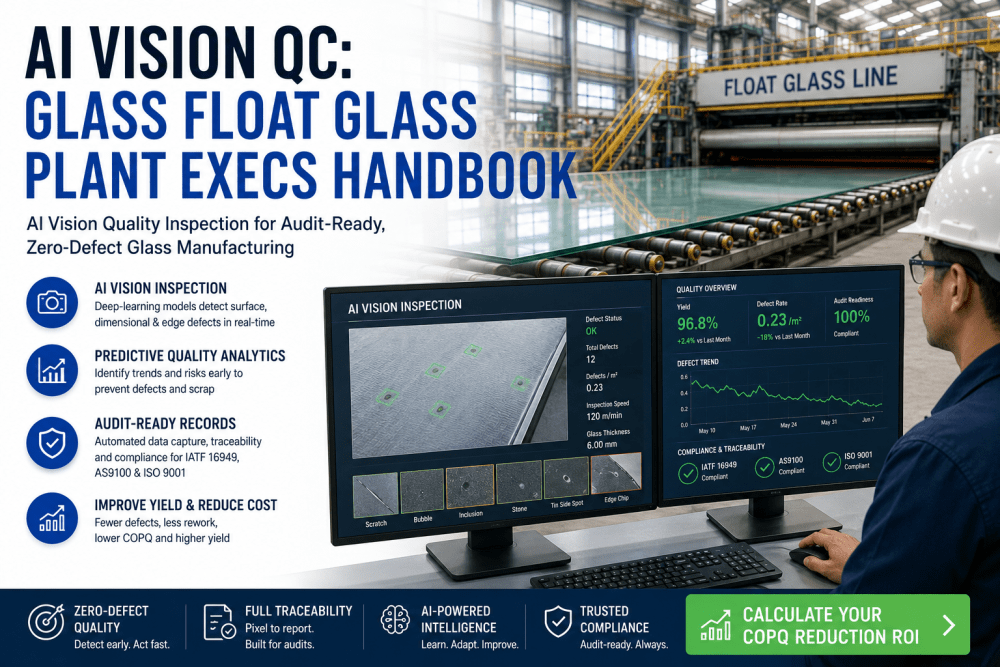
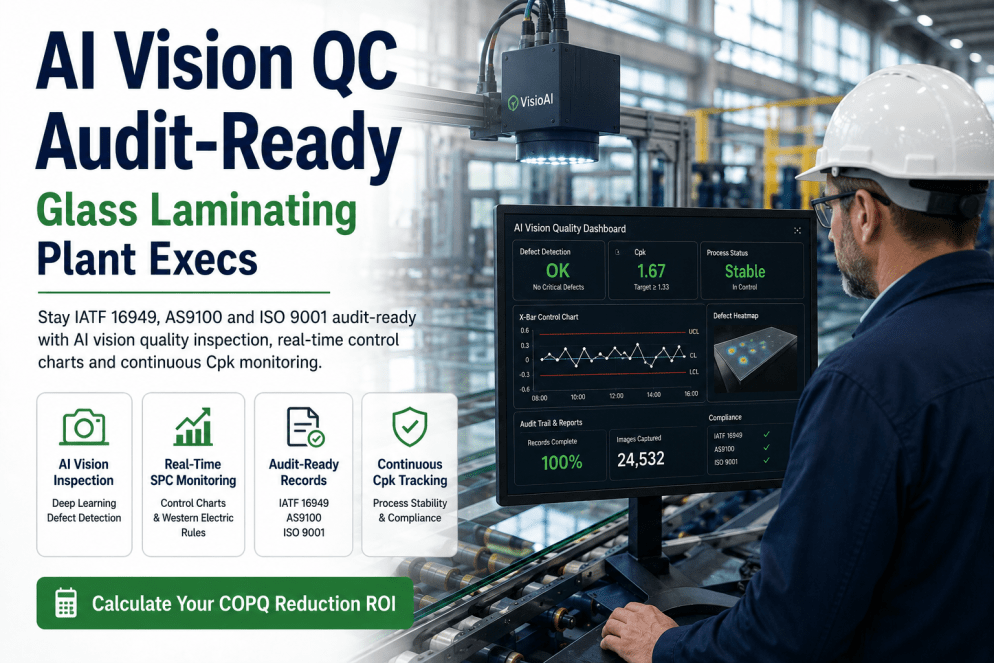
iFactory's AI Vision Quality platform deploys deep-learning vision models that inspect every square meter of float glass in real time, classify defects by type and severity, and generate complete digital quality records for IATF 16949, AS9100D, and ISO 9001 audit compliance — without manual inspection bottlenecks.
The Audit Readiness Gap

01 / The Audit Readiness Challenge in Float Glass Manufacturing

Manual visual inspection at the cold end — historically the gold standard for float glass quality — creates an unavoidable audit readiness gap. Human inspectors inspect samples, not every meter. Defect classification is subjective — two inspectors may classify the same ream streak or tin pickup differently. Inspection records are manual, paper-based, or entered into spreadsheets after the shift, introducing latency and transcription errors that auditors flag as documentation reliability concerns. Book a Demo to discuss how AI vision closes this gap for your float line certification requirements.

Sampling Gap
Human inspectors examine only 2–5% of the glass ribbon at the cold end. The remaining 95% passes through without any quality verification, creating a sampling gap that auditors identify as a documentation risk in every IATF 16949 and ISO 9001 assessment.
Classification Inconsistency
Inter-inspector agreement on defect classification ranges from 72% to 85% — two operators inspecting the same glass ribbon frequently classify the same defect into different severity categories, creating unreliable quality records that auditors challenge for objectivity.
Documentation Latency
Inspection records are handwritten on paper logs or entered into spreadsheets 4 to 24 hours after the inspection event. Transcription errors, missing entries, and delayed record creation create a traceability gap that undermines audit evidence quality.
Audit Preparation Burden
Quality engineers spend 3 to 6 weeks compiling inspection records, defect reports, and capability analyses before each IATF 16949 or ISO 9001 surveillance audit — time that could be invested in process improvement if quality records were generated automatically and continuously.
Platform Architecture

02 / AI Vision Quality Platform Architecture

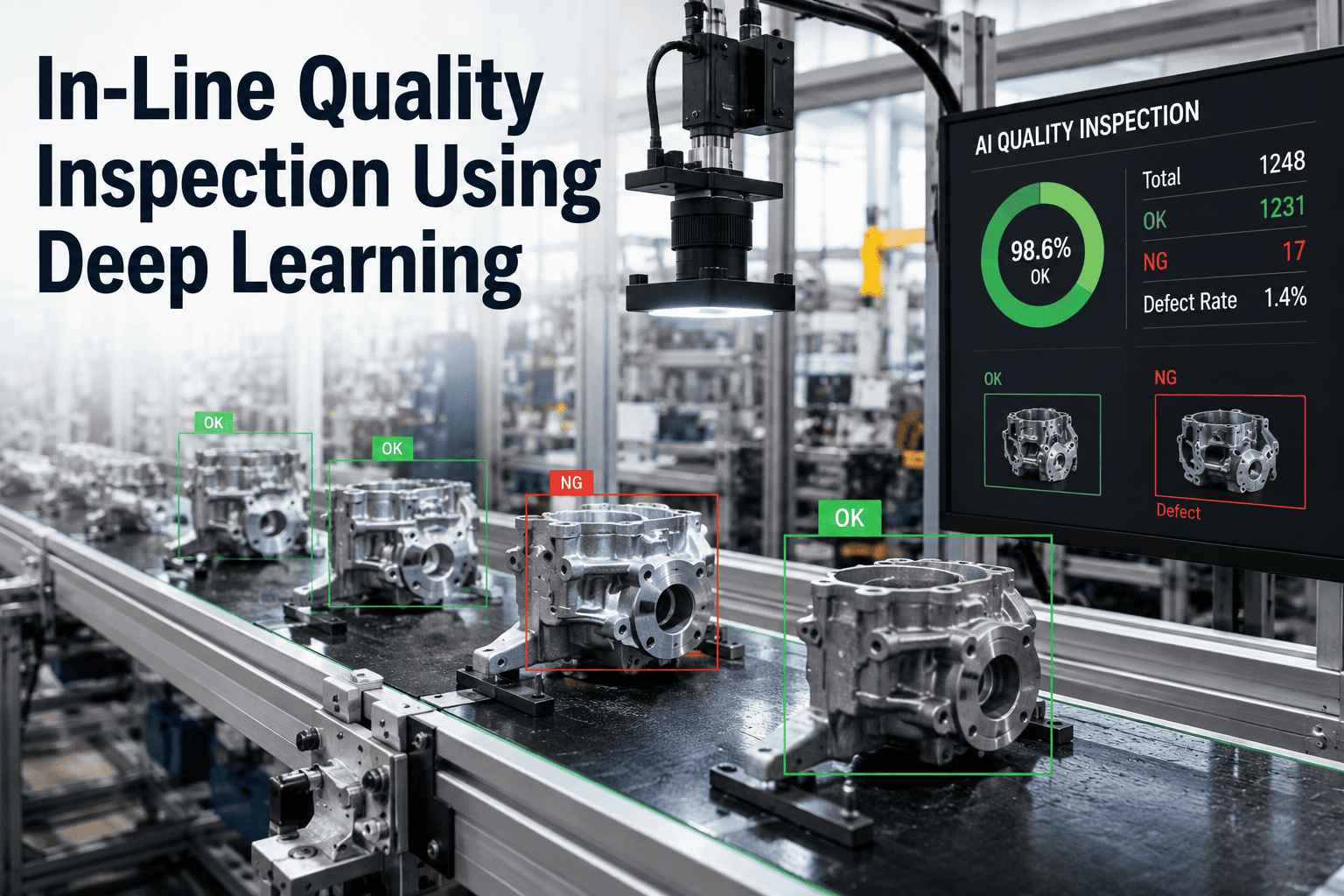
The AI vision quality platform combines deep-learning defect detection models, real-time image processing pipelines, and automated quality record generation into a unified architecture that operates at float line speeds. Cameras positioned across the ribbon width capture high-resolution images at production rate, and the AI inference engine classifies each detected anomaly within milliseconds — enabling real-time quality decisions and complete audit traceability. Book a Demo to explore the full platform architecture.

The defect detection engine uses convolutional neural networks trained on over 500,000 labeled float glass defect images spanning bubble categories (seed, blister, knot), stone inclusions (refractory, batch, metallic), tin-related defects (pickup, drip, stain), ream and cord, optical distortions (anisotropy, waviness), and surface damage (scratch, dig, chip). The models operate at 99.7% classification accuracy across all defect types with a false positive rate below 0.3% — exceeding human inspector consistency by a significant margin. Each detected defect is classified by type, severity grade, size in millimeters, and position across the ribbon width, generating a structured quality data point that feeds into the digital traceability record. The inference pipeline processes images at line speed without introducing inspection delay, enabling real-time quality decisions that prevent defective product from reaching subsequent processing stages.

Every defect detection event generates a structured quality record that includes timestamp, camera position, ribbon position coordinates, defect classification, severity grade, dimensional measurements, and a reference image. These records are linked to the production batch — raw material melt number, furnace campaign, product type, thickness, pull rate, and recipe — creating a complete quality traceability chain from raw material to finished product. The traceability database supports IATF 16949 and AS9100D requirements for lot traceability and containment, enabling the quality team to instantly query all product produced within a specific time window, from a specific furnace campaign, or with specific defect characteristics. The platform generates quality reports in standard audit formats without manual data compilation.

The audit documentation module automatically compiles the quality records, inspection logs, defect trend analyses, and process capability reports required for IATF 16949, AS9100D, and ISO 9001 surveillance and recertification audits. The platform maps each quality data point to the specific clause and requirement in the applicable standard — an auditor request for evidence of defect detection capability under Clause 8.5.1 (Control of Production and Service Provision) is answered with the AI model validation records, detection accuracy metrics, and a complete inspection log for the audit period. The documentation is generated in the formats auditors expect without requiring quality engineers to spend weeks compiling evidence before each audit. The platform also tracks corrective action requests (CARs) and maintains the complete audit trail for closure verification.

Measured Outcomes

03 / Measured Impact on Audit Readiness and Quality Performance

The deployment of AI vision quality systems across float glass production lines has produced measurable improvements in both audit readiness posture and quality performance metrics. The following comparison reflects documented results from facilities transitioning from manual cold-end inspection to AI-powered vision quality platforms. Book a Demo to schedule an AI vision quality assessment for your float line.

QUALITY METRIC
MANUAL INSPECTION
AI VISION QUALITY
IMPROVEMENT
Inspection Coverage
Sample-based — 2-5% of production
100% of every square meter
Sample → Full coverage
Defect Classification Consistency
72-85% inter-inspector agreement
99.7% AI classification accuracy
85% → 99.7% consistency
Quality Record Latency
4-24 hours post-inspection
Real-time — generated at line speed
24 hrs → Real-time records
Audit Preparation Time
3-6 weeks per audit
Automated — ready on demand
6 wks → On-demand readiness
Defect Escape Rate
1.2-2.8% of shipped product
Under 0.15% escape rate
2.8% → 0.15% escape
AI VISION QUALITY · AUDIT READINESS · FLOAT GLASS · ROI ASSESSMENT
Your Next IATF 16949 or ISO 9001 Audit Can Be Fully Automated — Not a 6-Week Preparation Effort
iFactory provides a complimentary AI vision quality assessment that analyzes your float line's current inspection coverage, defect escape rate, and audit preparation burden — and projects the specific audit readiness and quality improvement achievable with AI vision deployment on your line.
Industry Voice
Expert Review
L
L. Thornton, Director of Quality Systems — Float Glass Manufacturing, 24 Years
Lead Auditor, IATF 16949 Certified, ASQ Certified Quality Auditor
"I have managed quality systems across five float glass plants over 24 years and served as the lead quality representative for 12 IATF 16949 recertification audits. The single most significant variable in audit outcome has always been the quality of inspection records — not the absence of defects, but the ability to demonstrate that every quality-critical characteristic was inspected, every defect was documented, and every corrective action was closed. Manual inspection systems, regardless of how diligent the operators, cannot provide that level of evidence because they inspect samples, not the full product stream, and the records are created hours or days after the inspection event. AI vision quality changes this fundamentally. The platform does not improve inspection — it replaces inspection with a verifiable, continuous, and fully documented quality assurance process that auditors recognize as superior to manual systems. In our most recent IATF recertification, the audit team spent 40% less time on quality records verification because the digital traceability was complete and immediately accessible. That is not a minor efficiency gain. It is a fundamentally better audit position."

L. Thornton, Director of Quality Systems Float Glass Manufacturing — 24 Years, IATF 16949 Lead Auditor, ASQ CQA
Conclusion

04 / AI Vision Quality Delivers Audit-Ready Float Glass Operations — Every Day, Not Just Before Audits

Audit readiness is not a preparation activity that happens in the weeks before a registrar visit. It is the output of a quality system that operates with complete visibility, consistent classification, and verifiable documentation every day. Manual inspection systems cannot deliver that level of readiness because they are inherently limited — by sampling rates, by inspector variability, by documentation latency, and by the fundamental constraint that human attention cannot sustain continuous defect detection at float line speeds across every square meter of production. AI vision quality systems eliminate those constraints. Every square meter inspected. Every defect classified with 99.7% accuracy. Every quality record generated at line speed. Every audit query answered in seconds instead of weeks. For plant executives accountable for quality performance and certification status, AI vision quality is not an incremental improvement to the inspection process — it is a replacement of the inspection paradigm with a continuous, verifiable, and audit-ready quality assurance system. Book a Demo to start the AI vision quality assessment for your float line and discover how quickly your operation can achieve continuous audit readiness.
100%
Inspection Coverage — Every Square Meter
99.7%
Defect Classification Accuracy
Real-Time
Quality Records at Line Speed
40%
Audit Time Reduction on Records Verification
FAQ

Frequently Asked Questions — AI Vision Quality for Float Glass
Yes. The deep-learning vision models are trained on over 500,000 labeled float glass defect images spanning the full spectrum of defect categories: gaseous inclusions (seed, blister, secondary blister, knot), solid inclusions (refractory stone, batch stone, metallic inclusion, cord), tin-related defects (tin pickup, tin drip, tin stain, tin sweat), surface defects (scratch, dig, chip, rub, crush), optical distortions (anisotropy, waviness, ripple, lens), dimensional deviations (thickness variation, width variation, bow, warp), and coating defects for coated glass products. The models achieve 99.7% classification accuracy across these categories, and the platform supports continuous model improvement through active learning — when the quality team confirms or corrects a classification, the model incorporates that feedback to improve future detection accuracy without requiring a full retraining cycle.
The AI vision quality platform integrates at the data layer with existing quality management systems (QMS), manufacturing execution systems (MES), and enterprise resource planning (ERP) platforms through REST APIs, OPC-UA, and direct database connectors. Inspection results, defect classifications, and quality records are written directly into the existing quality system without requiring manual data entry or file transfers. The platform maps each quality data point to specific IATF 16949 and ISO 9001 clauses — enabling auditors to navigate from a clause requirement directly to the relevant inspection records, defect trend analyses, and process capability reports. Integration is typically completed within 1 to 2 weeks and does not require modifications to existing QMS or MES software deployments.
When the AI vision system detects a defect exceeding the configured severity threshold, the platform executes a multi-step response within milliseconds. The defect is classified, measured, and logged in the quality record database with full traceability data. An alert is sent to the cold-end quality workstation with the defect image, classification, position coordinates, and recommended action. The platform updates the real-time quality dashboard showing the current defect rate and trend for the affected product type. For critical defects that require immediate containment, the platform creates a hold record in the QMS that prevents the affected product from being released to inventory or shipment until disposition is completed. The entire response — from detection to quality record creation — occurs at line speed without introducing any inspection delay.
The camera infrastructure is configured for the specific float line width, line speed, and defect detection requirements. A typical deployment uses 4 to 8 high-resolution line-scan cameras positioned across the ribbon width at the cold end, after the annealing lehr and before the cutting section. Cameras are mounted at a fixed distance from the glass surface with specialized LED illumination systems optimized for float glass optical inspection — bright-field illumination for surface defect detection, dark-field illumination for edge and subsurface defects, and transmitted light for optical distortion detection. The camera housings are rated for the cold-end ambient conditions and include air-purge systems for dust management. iFactory's integration team specifies the camera configuration during the facility assessment phase based on the line's product mix, defect types of concern, and quality specification requirements. Book a Demo to schedule the camera infrastructure assessment for your float line.
Full deployment of iFactory's AI Vision Quality platform is typically completed within 8 to 12 weeks from project initiation to audit-ready operation. The camera infrastructure installation and configuration requires 2 to 3 weeks, conducted during scheduled maintenance windows without production interruption. Model deployment and calibration on the specific float line's product mix requires 3 to 4 weeks — the pre-trained defect detection models are fine-tuned on sample images from the line's actual production to confirm accuracy across all product types and thicknesses. QMS and MES integration requires 1 to 2 weeks. Operator training and go-live validation requires 1 week. The platform begins generating audit-ready quality records from the first day of live operation — quality teams typically achieve full confidence in the system within the first two weeks of parallel operation with existing manual inspection.
AI VISION QUALITY · AUDIT READINESS · FLOAT GLASS · DEPLOYMENT
Continuous AI Vision Inspection. Real-Time Quality Records. On-Demand Audit Readiness. Deployed in 10 Weeks.
iFactory gives float glass plant executives AI-powered vision inspection across every square meter of production, automated defect classification at 99.7% accuracy, digital quality records generated at line speed, and IATF 16949 / ISO 9001 audit documentation on demand — with full deployment in 10 weeks and zero production interruption.
100%Every Square Meter Inspected
99.7%Defect Classification Accuracy
Real-TimeQuality Records at Line Speed
10 wkFull Platform Deployment

Share This Story, Choose Your Platform!