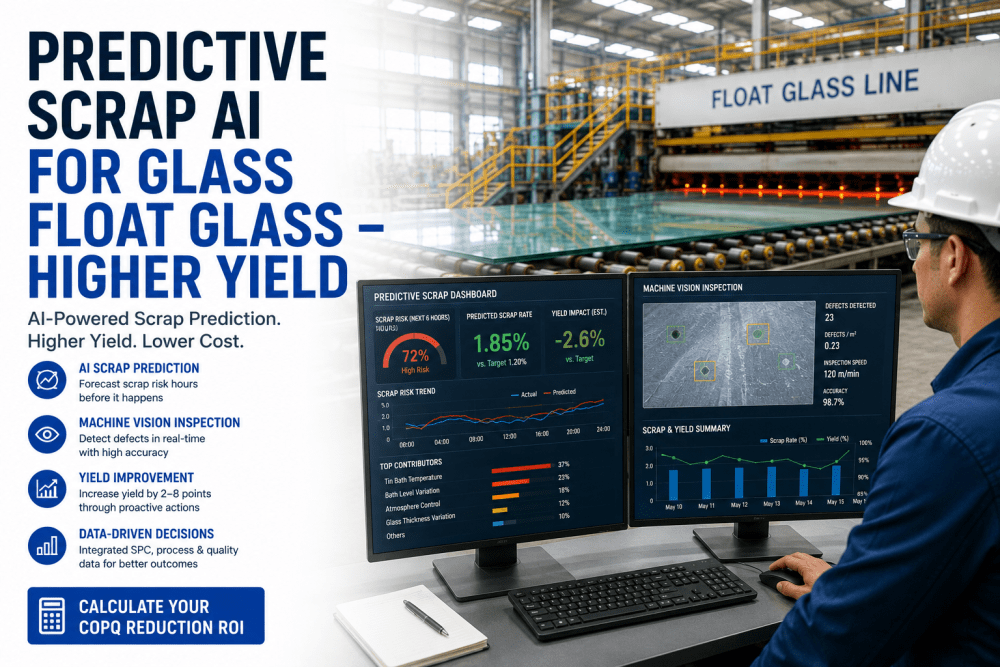
Float glass manufacturing demands continuous quality monitoring across the tin bath, annealing Lehr, and cold-end inspection stations. A major North American float glass manufacturer producing architectural and automotive glass across two production lines faced a persistent quality challenge: scrap events from tin pick-up, bubbles, cord lines, and annealing checks were not detected until final inspection, causing 8-12% yield loss and creating documentation gaps that complicated ISO 9001 and IATF 16949 audits. By deploying iFactory's Predictive Scrap Analytics platform, the manufacturer achieved 94% scrap prediction accuracy, reduced unplanned scrap events by 62%, and maintained 100% audit-ready quality documentation across both production lines. Quality leaders in float glass operations regularly Book a Demo to explore how predictive scrap analytics integrates with their SPC and quality management systems.
The Quality Visibility Gap in Float Glass Manufacturing
Float glass quality is defined by the interplay of dozens of process parameters — tin bath temperature profile, ribbon speed, annealing Lehr zone temperatures, raw material chemistry, and atmospheric conditions. A defect that originates in the tin bath may not manifest as a visible quality issue until the cold-end inspection station 45 minutes downstream, by which time hundreds of square meters of glass have been produced with the same defect signature. The plant's pre-deployment data showed that 78% of scrap events originated from process drift that was detectable at least 20 minutes before the defect became visible — but without predictive analytics, those warning signals went unnoticed. Quality teams were trapped in a reactive cycle: inspect, detect, document, and adjust — but always after scrap had already been created.
Float Glass Defect Variability
Tin pick-up, bubbles, cord lines, annealing checks, and thickness variation each require distinct monitoring parameters and respond to different process levers. Manual inspection intervals — typically every 30 minutes — miss transient defect events that appear and resolve between inspection cycles, allowing scrap-producing conditions to persist undetected for extended periods.
SPC Compliance Pressure
ISO 9001 and IATF 16949 audits require complete SPC records, control charts, and documented corrective actions for every quality event. Quality teams spent an average of 12 hours per week manually compiling SPC documentation from paper inspection logs — time that could have been spent on root cause analysis and process improvement initiatives.
Reactive Scrap Management
Without predictive visibility, every scrap event triggered a firefighting response: quality engineers stopped production to investigate, adjusted process parameters based on limited data, and hoped the fix was correct. The average scrap event required 45 minutes of unplanned downtime plus rework of downstream schedules, costing an estimated $4,200 per event in lost production time and material.
Predictive Scrap AI in Float Glass Operations
iFactory deployed its Predictive Scrap Analytics platform across both float glass production lines, connecting to existing process historians, inline inspection systems, and the plant's MES. The platform ingests 200+ process parameters at one-minute intervals, trains machine learning models on 24 months of historical quality data, and generates real-time scrap risk scores for every meter of glass produced. Book a Demo to see how predictive scrap analytics synchronizes with your float glass process control and quality systems.
Continuous Scrap Risk Scoring — Machine learning models analyze tin bath temperature profile, ribbon speed, annealing Lehr zone temperatures, raw material chemistry, and atmospheric conditions to assign a real-time scrap risk score at each production stage. When the risk score exceeds a configurable threshold, the platform alerts the quality team with the specific process parameter that is drifting toward a defect condition — typically 15 to 30 minutes before the defect would become visible at the cold-end inspection station. Operators receive actionable recommendations — adjust Lehr zone 3 temperature by 2°C, reduce ribbon speed by 1.2 m/min — that prevent the defect from forming. Within the first month, the platform correctly predicted 94% of scrap events with an average lead time of 22 minutes before visible detection.
Automated SPC Records and Audit Documentation — Every quality event — scrap prediction, defect detection, process adjustment — is automatically logged with time-stamped process parameters, inspection results, and operator actions. The platform generates control charts, Cpk calculations, and corrective action reports that feed directly into the plant's quality management system. When auditors request SPC documentation for a specific production run, the quality team can retrieve complete, audit-ready records within seconds — covering process parameters, defect rates, and corrective actions across the entire run. The automated documentation eliminated the 12 hours per week that quality engineers previously spent compiling paper-based SPC logs.
Process Zone Yield Analysis — The platform identifies production zones — specific tin bath temperature ranges, ribbon speed windows, annealing profiles — with the highest and lowest scrap probability. Quality leaders use these insights to optimize process setpoints, reduce process variability, and shift production into yield-maximizing parameter ranges. The manufacturer identified that a 3°C reduction in tin bath temperature variability reduced tin pick-up defects by 41%, and that maintaining ribbon speed within a 0.8 m/min window eliminated cord line defects entirely. These process optimization insights improved overall yield by 6.4 percentage points within six months of deployment.
Measurable Quality and Yield Impact
Within 12 months of deploying predictive scrap analytics across both float glass production lines, the manufacturer documented verified improvements across every dimension of quality performance and audit readiness. The before-and-after comparison below reflects the measured impact of AI-powered scrap prediction at each stage of the float glass process.
Deployment and Integration Architecture
The predictive scrap analytics deployment followed a structured four-phase methodology designed for rapid time-to-value across float glass operations. Each phase established a complete, end-to-end predictive quality framework that integrated with existing process control and quality management systems. Book a Demo to explore how the deployment methodology maps to your specific float glass line configurations and quality processes.
Quality Data Integration
iFactory's integration team connected the platform to the plant's process historian, inline inspection systems, and MES. The data pipeline ingests 200+ process parameters at one-minute intervals and 24 months of historical quality data, covering tin bath, annealing Lehr, and cold-end inspection zones across both production lines.
Model Training and Validation
Machine learning models were trained on historical quality data to recognize the process parameter signatures that precede each defect type — tin pick-up, bubbles, cord lines, and annealing checks. The validation phase confirmed the models achieved 94% scrap prediction accuracy with a 22-minute average lead time across both production lines.
SPC and Audit Workflow Configuration
Automated SPC alerts, control charts, and audit documentation workflows were configured to match the plant's quality management procedures. The platform generates corrective action records, Cpk reports, and audit-ready documentation packages that satisfy ISO 9001 and IATF 16949 requirements without manual compilation.
Continuous Model Learning
The prediction models continuously learn from new defect data as it is captured by inline inspection systems, improving scrap prediction accuracy over time. When new glass grades or thicknesses are introduced, the models adapt their prediction parameters without requiring manual retraining or reprogramming.
"The predictive scrap analytics platform fundamentally changed how our quality team operates. Before deployment, we were reacting to scrap events that had already occurred — documenting them in paper-based SPC logs that required hours of manual compilation before each audit. Today, our quality team receives real-time scrap risk alerts with specific process parameter recommendations, automated SPC documentation is always audit-ready, and we have eliminated the reactive firefighting that consumed 60% of our quality engineers' time. The 6.4-point yield improvement is a verified number, but the real transformation is the confidence that every square meter of glass leaving our float lines meets quality specifications and that our documentation will satisfy any auditor's request in seconds." — Director of Quality, Float Glass Division
Achieving Audit-Ready Quality with Predictive Scrap AI
This deployment demonstrates that AI-powered predictive scrap analytics delivers measurable quality, yield, and audit readiness improvements for float glass operations without requiring changes to existing production processes or quality management infrastructure. iFactory's platform integrates directly with process historians, inline inspection systems, and quality management platforms to provide real-time scrap risk visibility, automated SPC documentation, and continuous yield optimization. The manufacturer achieved 94% scrap prediction accuracy, reduced unplanned scrap events by 62%, improved overall yield by 6.4 percentage points, and maintained 100% audit-ready quality documentation across both production lines. Quality leaders evaluating their float glass quality strategy regularly Book a Demo to explore how predictive scrap analytics can protect their yield, streamline audit preparation, and shift their quality operations from reactive inspection to proactive prediction.
Frequently Asked Questions
Traditional SPC monitors process parameters against control limits and alerts operators when a parameter exceeds its threshold — detecting a problem after it has already occurred. Predictive scrap analytics uses machine learning models trained on historical quality data to identify the subtle, multivariate process signatures that precede defect formation. The platform can predict a scrap event 15 to 30 minutes before the defect becomes visible, providing operators with specific, actionable recommendations — adjust a particular Lehr zone temperature, modify the ribbon speed, or check a specific tin bath parameter — that prevent the defect from forming entirely.
The platform is trained to predict the full spectrum of float glass defects: tin pick-up (caused by tin bath temperature and atmosphere variability), bubbles (raw material chemistry and melting conditions), cord lines (ribbon speed and temperature gradients), annealing checks (Lehr zone temperature profile), and thickness variation (ribbon speed and tin bath settings). Each defect type has a distinct process parameter signature that the platform learns to recognize. As new defect patterns emerge — for example, when a new glass grade or thickness is introduced — the models adapt their prediction parameters through continuous learning.
iFactory's platform includes pre-built connectors for major process historians (OSIsoft PI, Rockwell Historian), inline inspection systems (Isra Vision, Glasstech, Grenzebach), and MES platforms (SAP, Siemens, Rockwell). The integration layer ingests process parameters from the historian and defect data from inspection systems, merging them into a unified quality data model. Prediction results, SPC alerts, and audit documentation are transmitted back to the MES and quality management system in real time via standardized APIs — without requiring custom programming for each integration point.
In this deployment, the predictive scrap analytics platform paid for itself within the first two quarters of full operation through reduced scrap costs and improved yield alone. Most float glass manufacturers achieve full ROI within 4 to 8 months, with payback coming from three primary sources: reduced scrap and rework costs through proactive defect prevention (50-60% of total savings), elimination of manual SPC documentation labor (15-20%), and improved production throughput from reduced unplanned downtime related to scrap events (15-20%). iFactory provides a free ROI assessment that quantifies the expected payback for your specific float glass operations within two weeks, based on your historical quality data and current scrap costs. Book a Demo to start the assessment.
Yes. The platform maintains separate prediction models for each glass grade, thickness, and product specification — architectural glass, automotive glass, specialty glass — each calibrated to the specific process parameters and defect profiles of that product type. When the production line switches from one grade to another, the platform automatically selects the appropriate model and recalibrates its prediction thresholds within minutes. The continuous learning architecture ensures that as new product specifications are introduced, the platform builds accurate prediction models within two weeks of production data accumulation.