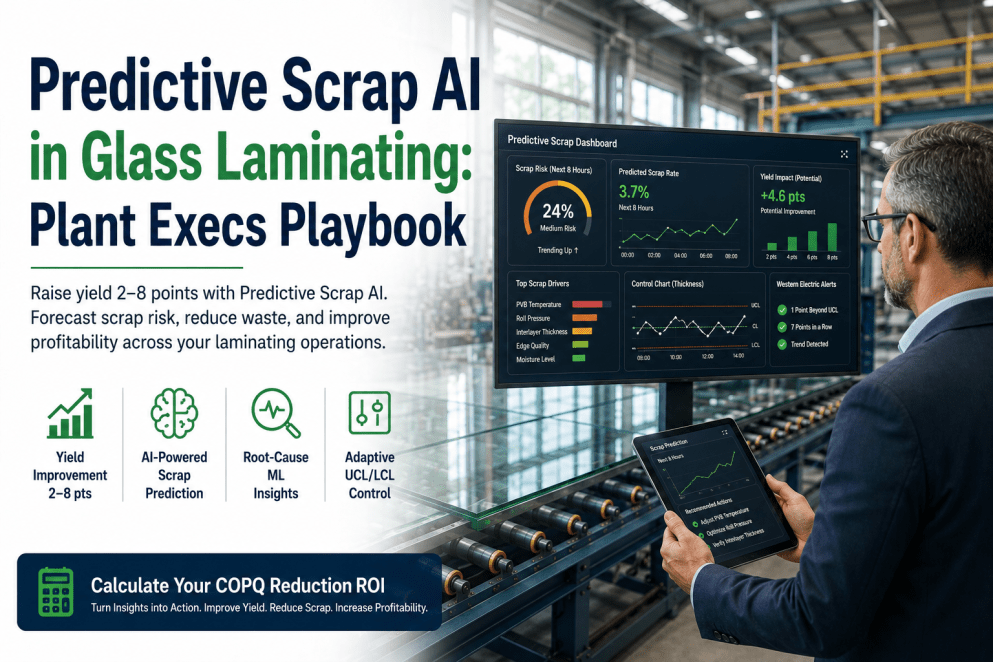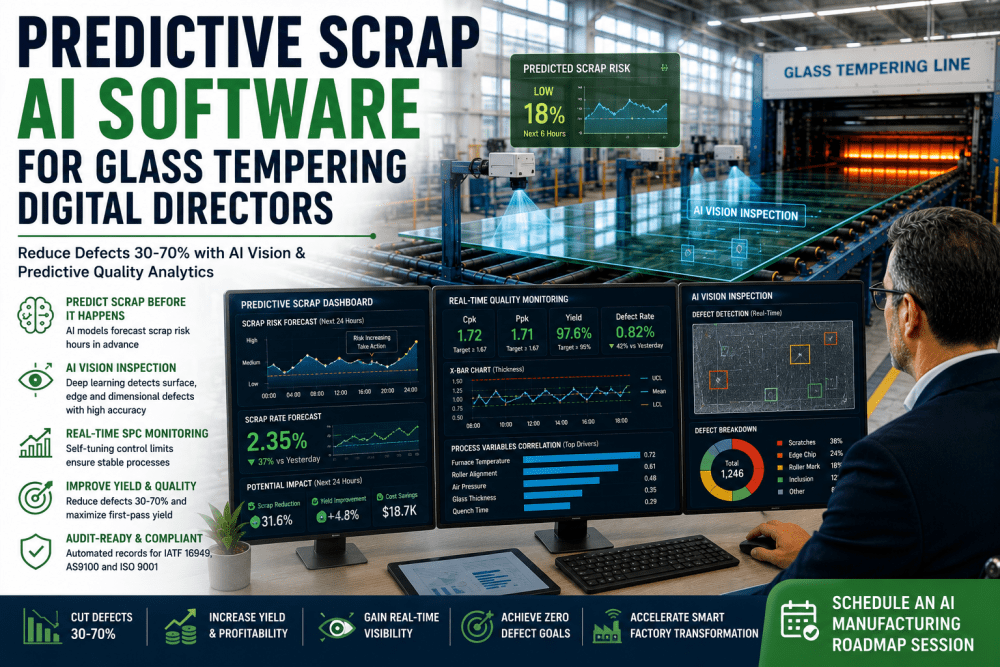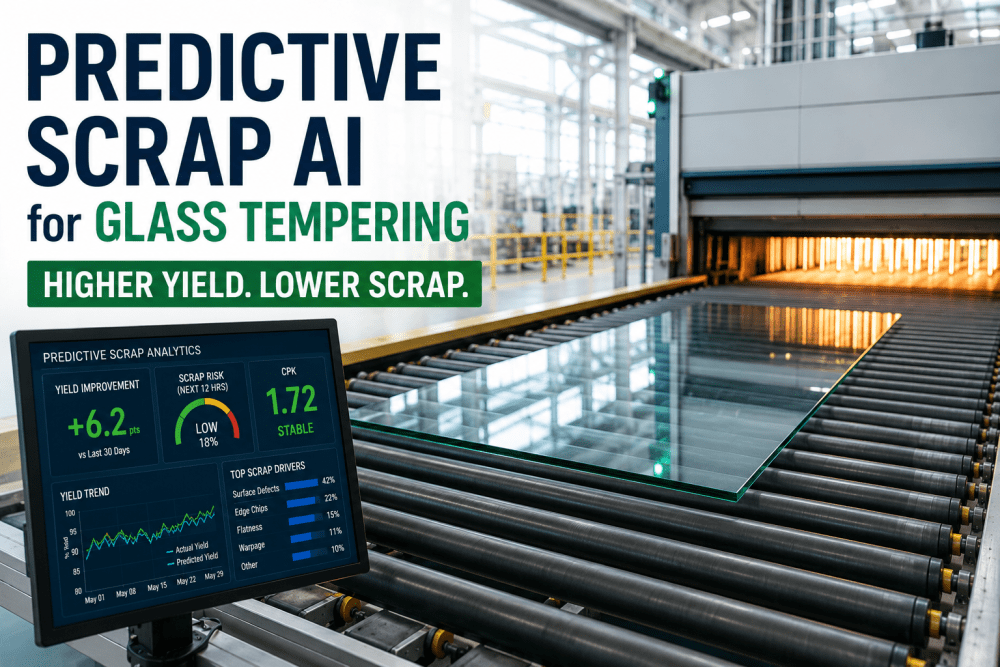
Float glass manufacturing yield — the percentage of production that meets first-quality specifications — is the single most direct lever for plant profitability. A one-percentage-point yield improvement on a 500-tonne-per-day float line operating at industry-average margins translates to approximately $800,000 in annual profit gain. Yet most float lines manage yield reactively: defects are detected at cold-end inspection, scrap is calculated after the fact, and root cause analysis begins hours or days after the scrap event occurred — when the process conditions that caused the defect have already changed. Predictive scrap AI changes this paradigm by using machine learning models that analyze real-time process parameters, machine vision outputs, SPC trends, and production history to forecast defect risk and scrap events hours before they occur — enabling proactive corrective actions that prevent scrap rather than counting it. Book a Demo to see how iFactory's Predictive Scrap Analytics platform projects yield improvement for your specific float line configuration.
01 / The Yield Challenge — Why Reactive Scrap Management Leaves Profit on the Table
Float glass scrap is not a random occurrence. Every bubble, stone, tin pickup, ream streak, and optical distortion is the result of process conditions — furnace temperature gradients, tin bath atmosphere composition, lehr cooling profiles, or raw material chemistry variations — that develop over time before they produce a visible defect at the cold end. In reactive scrap management, those defects are detected only after they appear on the inspection line, meaning the process conditions that caused them have already passed and the scrap is already counted. Book a Demo to discuss how predictive scrap analytics closes this gap for your float line.
02 / Predictive Scrap AI Platform Architecture
The predictive scrap analytics platform combines machine learning models, real-time process data ingestion, machine vision integration, and automated workflow execution into a unified architecture that continuously monitors every float line production zone and forecasts defect risk before scrap occurs. Book a Demo to explore the full platform architecture for your float line.
The risk detection engine ingests over 200 data points per minute per float line — furnace crown temperatures, oxygen trim levels, tin bath gradient sensors, lehr zone controllers, ribbon thickness gauges, and cold-end inspection defect data. Machine learning models trained on historical scrap events identify the precursor patterns that precede each defect type. For bubble defects, the model detects the characteristic furnace temperature gradient shift and oxygen trim excursion that precedes seed and blister formation by 45 to 90 minutes. For tin pickup defects, the model identifies the tin bath atmosphere composition drift and temperature gradient change that precedes pickup formation by 60 to 120 minutes. When the model detects a precursor pattern exceeding the configured risk threshold, it generates a predictive alert with the estimated defect type, probability, time to occurrence, and recommended corrective action — giving operators a 30-minute to 4-hour intervention window before the defect reaches the cold end.
The platform integrates directly with inline machine vision inspection systems at the cold end — ingesting every defect detection event with classification, severity grade, size, and ribbon position coordinates. The vision data serves dual functions. First, it provides the ground truth labels for the predictive model training pipeline — every defect detected at the cold end is correlated backward to the process conditions that preceded it, enabling the model to learn which precursor patterns produce which defect types. Second, it provides real-time validation of the predictive model's accuracy — when the model forecasts a bubble defect within a specific time window and the vision system detects the predicted defect at the expected location and severity, the model's confidence weighting for that precursor pattern is reinforced. The vision integration operates at line speed without introducing inspection delay, enabling continuous model improvement through active learning cycles.
When the predictive model generates a risk alert, the platform initiates a closed-loop prevention workflow that executes across multiple enterprise systems. The alert is displayed on the shift-floor dashboard with the predicted defect type, probability, estimated time to occurrence, and recommended corrective action — such as reducing furnace crown temperature by 5°C or adjusting tin bath atmosphere hydrogen concentration. If the operator confirms the corrective action within the configured response window, the platform tracks the process parameter change and validates that the defect risk score decreases below threshold. If no corrective action is taken within the window, the alert escalates to the shift supervisor and plant manager dashboards. When the defect does not occur within the predicted window, the model logs a successful prevention event that reinforces the predictive pattern. When a defect still occurs despite the alert, the platform captures the full event lifecycle for model refinement and root cause analysis.
03 / Measured Yield Impact — Documented Results Across Float Glass Production
Float glass facilities deploying predictive scrap analytics have documented consistent yield improvements across every production zone. The results below reflect a 14-week deployment across two float lines producing architectural and automotive glass products with combined annual production of 320,000 tonnes. Book a Demo to review the full case study and yield improvement projection for your float line.
Expert Review — A Quality Director's Perspective on Predictive Scrap Analytics
Conclusion — Predictive Scrap Analytics Transforms Yield from a Lagging Metric into a Leading Indicator
Yield has always been a lagging metric in float glass manufacturing — measured after the scrap is counted, analyzed after the defects are classified, and improved through after-the-fact corrective actions that address symptoms rather than root causes. Predictive scrap analytics changes this fundamental paradigm by forecasting defect risk before scrap occurs, enabling process adjustments that prevent defects rather than count them. The 2.8 to 3.2 percentage point yield improvements documented across architectural and automotive float glass lines, combined with 71% prediction rates and 4.1 hours of advance warning, demonstrate that the technology delivers measurable, repeatable, and sustainable yield gains. The platform operates on the same sensor networks, machine vision systems, and process control infrastructure already installed on your float line — no additional instrumentation required. Book a Demo to start the predictive scrap assessment for your float line and discover how much yield AI-driven scrap prevention can deliver for your operation.