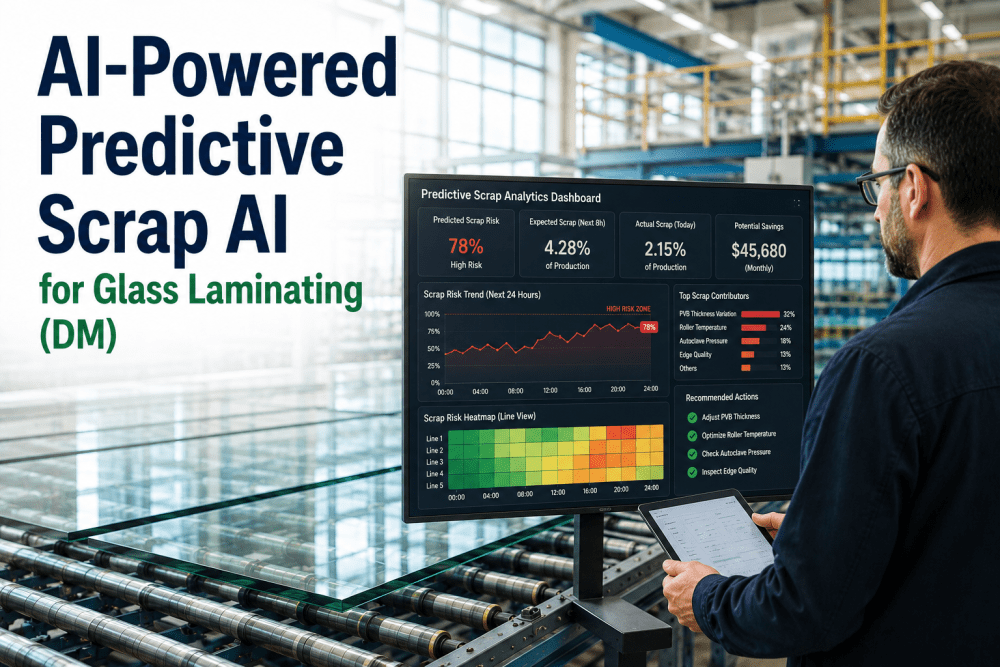
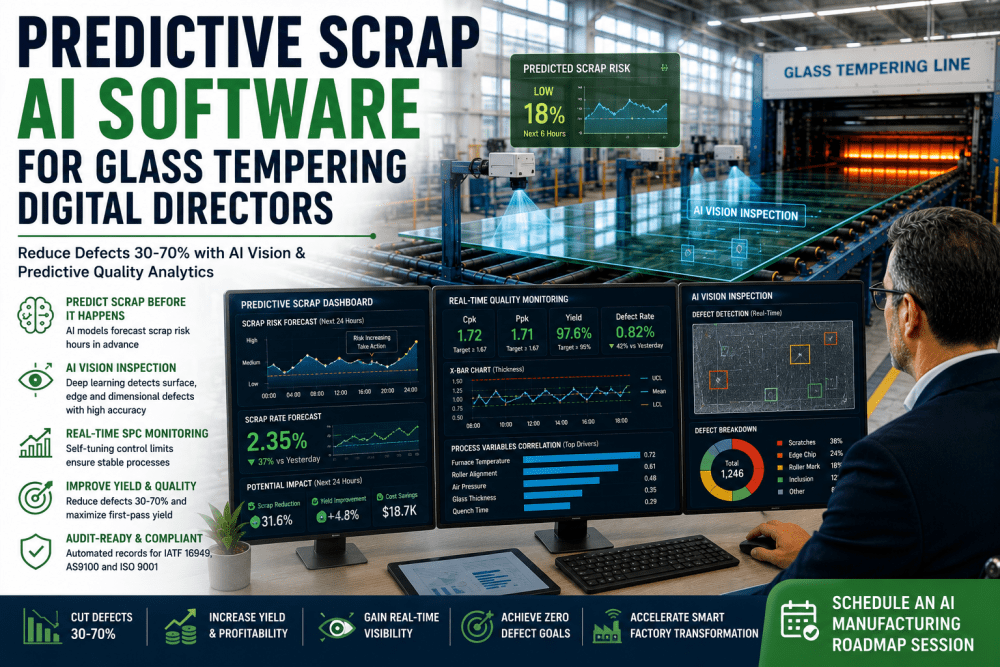
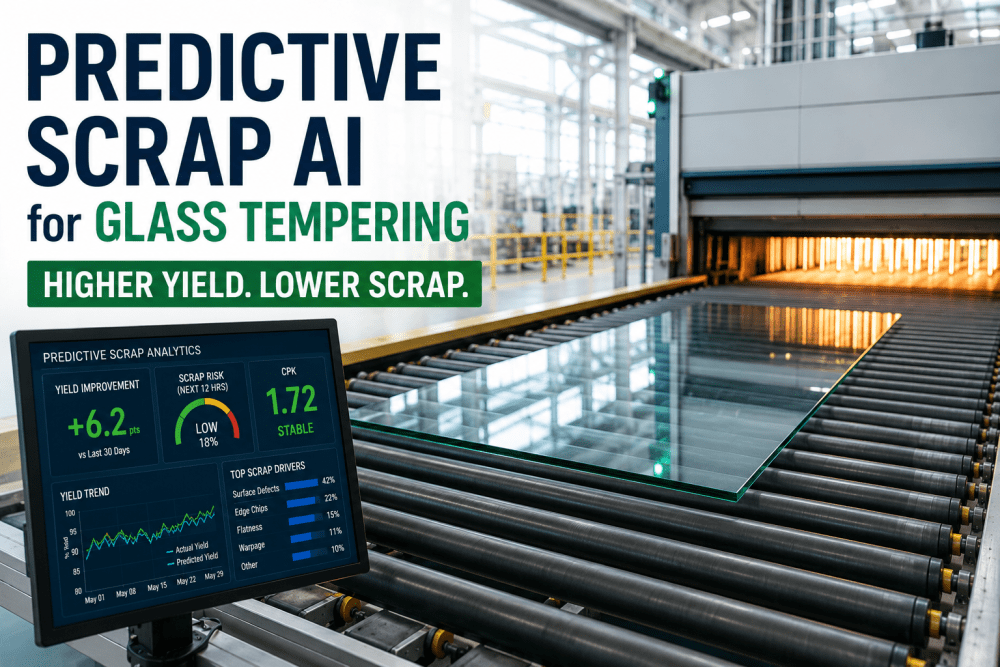
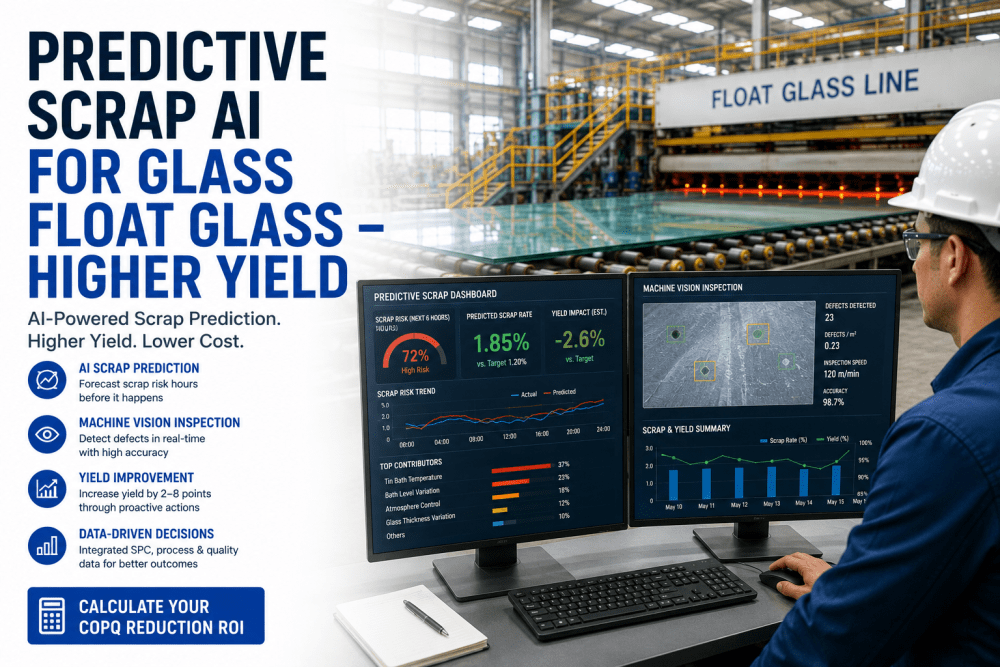
Float glass manufacturing has long operated on a detect-and-react quality paradigm — defects are identified after they occur, scrap is quantified after production, and root cause analysis happens days or weeks after the event. For digital manufacturing directors responsible for throughput, yield, and production efficiency, this reactive approach represents a significant competitive disadvantage. Predictive scrap analytics changes this equation entirely, shifting from post-production defect detection to pre-production scrap risk forecasting. By analyzing real-time process parameters — furnace temperature profiles, tin bath atmosphere conditions, annealing lehr temperature gradients, and raw material composition variations — machine learning models can forecast scrap risk hours before any defect appears in the finished glass. This predictive capability enables production teams to intervene proactively, adjusting process parameters to prevent defects rather than sorting good glass from bad after production. iFactory's predictive quality platform delivers this capability through integration with existing float glass line sensors, MES systems, and quality control databases, providing digital manufacturing directors with a unified view of scrap risk across the entire production line. Book a Demo to evaluate how predictive scrap analytics can improve throughput in your float glass operation.
The Challenge of Scrap in Float Glass Manufacturing
Float glass production is inherently sensitive to process variation — a 2°C temperature deviation in the furnace, a 0.1% change in tin bath atmosphere composition, or a minor fluctuation in raw material batch chemistry can produce kilometers of off-quality glass before the defect is detected at the inspection station. For digital manufacturing directors, the financial impact is substantial: scrap rates of 8–15% are common in float glass operations, representing millions of dollars in lost throughput annually. The challenge is compounded by the time delay between cause and effect — a furnace temperature excursion at 8:00 AM may not produce visible defects until the glass reaches the cold-end inspection station at 10:30 AM, by which time hundreds of square meters of glass have already been produced to off-quality specifications. Traditional scrap management relies on statistical process control charts and periodic lab sampling that identify trends over hours or shifts, not the real-time predictive capability needed to prevent scrap before it occurs. Predictive scrap analytics addresses this gap directly, transforming the scrap management paradigm from reactive sorting to proactive prevention.
| Operational Dimension | Traditional Scrap Management | Predictive Scrap Analytics | Impact on Throughput |
|---|---|---|---|
| Detection Timing | Post-production — defects identified at cold-end inspection, 1–3 hours after occurrence | Pre-production — scrap risk forecasted 30–90 minutes before defect generation | Proactive intervention window eliminates defect generation during the response period |
| Data Sources | Limited to cold-end inspection cameras, lab samples, and manual QC data entry | Full sensor fusion — furnace thermocouples, tin bath atmosphere sensors, lehr temperature profiles, raw material batch data, hot-end imaging | Comprehensive process visibility enables early warning before any defect criteria are violated |
| Analysis Method | SPC chart review, manual trend analysis, periodic lab sample evaluation | ML models trained on historical defect-to-parameter relationships, real-time anomaly scoring against process baselines | Pattern recognition identifies subtle precursor conditions invisible to traditional SPC methods |
| Response Workflow | QC tags suspect glass, operator adjusts process based on experience, re-inspection confirms correction | System alerts operator with specific parameter recommendation, verifies correction through real-time risk score reduction | Standardized, data-driven response reduces variability and accelerates correction cycles |
| Yield Optimization | Fixed cutting patterns, post-production optimization of salable glass from acceptable inventory | Dynamic cutting optimization based on real-time quality maps, predictive grade allocation before glass reaches cold end | Maximizes salable yield from every square meter of glass produced, even during process transitions |
How Predictive Scrap Analytics Delivers Throughput Gains
The throughput improvement delivered by predictive scrap analytics follows a structured four-phase methodology that integrates with existing float glass line operations and quality management workflows. Each phase builds on the previous one, creating a cumulative improvement in scrap prevention capability and production throughput. Digital manufacturing directors planning their predictive quality roadmap Book a Demo to review the deployment model configured for their float glass line specifications and production profile.
AI-Powered Quality Monitoring Architecture
The predictive scrap analytics platform is built on a three-layer architecture that combines AI vision inspection, predictive process modeling, and real-time yield optimization into a unified quality monitoring system. Each layer addresses a specific aspect of the scrap prevention challenge, and the integration between layers creates a comprehensive quality assurance capability that spans from raw material input to finished glass output. Digital manufacturing directors evaluating the technology stack for their float glass operation Book a Demo to review the architecture configured for their line specifications and quality requirements.
AI Vision-Based Defect Detection and Classification — The vision inspection layer integrates with existing hot-end and cold-end camera systems, applying deep learning models trained on float glass defect typologies including bubbles, stones, tin drips, thickness variations, distortion, and coating defects. Unlike traditional threshold-based inspection systems that trigger on pixel-level anomalies, AI vision models classify defects by type, severity, and likely root cause, providing quality teams with actionable classification data rather than raw pixel maps. The vision models operate at line speed, processing full-width glass images in real time and generating quality maps that feed into the predictive risk scoring and yield optimization layers. Defect classification accuracy exceeds 95% for major defect types, and the models continuously improve through active learning cycles that incorporate operator feedback and lab sample correlation data.
Predictive Process Models for Scrap Risk Forecasting — The predictive modeling layer ingests real-time sensor data from across the float glass line — furnace zone temperatures, tin bath atmosphere composition and pressure, lehr zone temperature profiles, ribbon speed, and raw material batch moisture and chemistry data — and applies trained ML models to forecast scrap risk for the glass currently in production. The models identify precursor patterns in process parameters that historically preceded specific defect types, enabling 30-to-90-minute advanced warning before off-quality glass is produced. Each forecast includes the predicted defect type, severity, probability, and the specific process parameters that are contributing to the elevated risk score. This granular predictive data enables operators to make targeted, data-driven process adjustments rather than relying on trial-and-error parameter changes that often introduce additional process variability.
Real-Time Yield Optimization and Grade Allocation — The yield optimization layer combines quality maps from AI vision inspection with scrap risk forecasts from predictive models to optimize cutting patterns and grade allocation in real time. When the platform predicts elevated scrap risk for a specific production segment, the yield optimization engine adjusts cutting patterns to maximize salable glass recovery from the glass that has already been produced, allocating lower-quality sections to less demanding grade specifications and preserving high-quality sections for premium grades. This dynamic optimization capability is particularly valuable during process transitions — grade changes, ribbon width changes, and startup/shutdown sequences — when traditional fixed cutting patterns produce significantly higher scrap rates. Digital manufacturing directors implementing yield optimization report 15–25% throughput increases within the first quarter of deployment, with additional gains as the optimization models refine their algorithms through continuous learning cycles.
Expert Review: A Digital Manufacturing Director's Perspective on Predictive Scrap Analytics
I have spent 18 years in glass manufacturing operations — starting as a process engineer in a float glass plant, then moving through quality management, and for the last seven years serving as digital manufacturing director for a global glass producer operating 12 float glass lines across three continents. When our team first evaluated predictive scrap analytics, my primary concern was whether machine learning models could handle the complexity and variability of float glass production — the interactions between furnace conditions, raw material chemistry, tin bath dynamics, and atmospheric conditions that make each production day different from the last. What I found in the iFactory platform was a system designed for exactly this complexity. The models identified a developing bubble defect pattern in our furnace 75 minutes before our hot-end camera system detected any visible anomaly — that early warning gave our furnace team time to adjust combustion profiles and prevent over 800 square meters of off-quality glass. The throughput impact was immediate: our scrap rate dropped from 11% to 7% within the first month of deployment, and the continuous learning models have driven it below 5% over six months. What I tell other digital manufacturing directors is that predictive scrap analytics is not a future technology — it is available now, and the competitive advantage it provides in throughput and yield is substantial enough that delaying deployment represents a measurable opportunity cost.
— Digital Manufacturing Director, Global Glass Producer — 18 Years in Glass Manufacturing Operations and Digital TransformationConclusion
Predictive scrap analytics represents a fundamental shift in float glass quality management — from reactive defect detection after production to proactive scrap prevention before defects occur. The 15–25% throughput increase, 40% scrap reduction, 90% prediction accuracy, and 60% faster root cause analysis documented through production deployments are measurable outcomes achieved by digital manufacturing directors who have already implemented predictive quality platforms on their float glass lines. iFactory provides the AI vision inspection, predictive process modeling, real-time yield optimization, and continuous learning engine that deliver these outcomes through integration with existing float glass line infrastructure without requiring modifications to furnaces, tin baths, lehrs, cutting systems, or inspection equipment.
The next step for digital manufacturing directors evaluating this technology is a predictive quality assessment that evaluates your float glass line's current scrap profile, data infrastructure readiness, and highest-impact use cases for predictive scrap analytics. iFactory provides the assessment, the platform, the integration, and the continuous model refinement — and the assessment is conducted on your production data so the projected throughput improvements are specific to your float glass line configuration, product mix, and quality specifications. Book a Demo to start the predictive quality assessment for your float glass operation and discover how predictive scrap analytics can improve throughput, reduce scrap, and optimize yield across your production lines.
Frequently Asked Questions
Predictive scrap analytics for float glass manufacturing applies machine learning models to real-time process data — furnace zone temperatures, tin bath atmosphere conditions, lehr temperature profiles, raw material batch data, and ribbon speed — to forecast scrap risk before defects appear in the finished glass. Unlike traditional quality management systems that detect defects after production, predictive scrap analytics provides 30-to-90-minute advanced warning of scrap events, enabling operators to adjust process parameters proactively and prevent off-quality glass from being produced. The models are trained on historical production data and continuously improve through real-time learning cycles, achieving prediction accuracy of 90% or higher for major defect types including bubbles, stones, tin drips, and thickness variations.
Predictive scrap analytics improves throughput through three primary mechanisms. First, early warning of scrap risk enables operators to adjust process parameters before defects occur, preventing the production of off-quality glass and keeping production within specification continuously. Second, the yield optimization engine dynamically adjusts cutting patterns and grade allocation based on real-time quality maps and scrap risk forecasts, maximizing salable glass recovery from every square meter produced. Third, the continuous learning models improve prediction accuracy over time, driving a compounding improvement in scrap reduction as the platform accumulates operating experience on each specific float glass line. Digital manufacturing directors deploying predictive scrap analytics report 15–25% throughput increases within the first quarter of operation, with additional improvements through subsequent continuous learning cycles.
iFactory's predictive quality platform is designed to integrate with existing float glass line sensors and control systems. The primary data sources include furnace zone thermocouple arrays, tin bath atmosphere composition and pressure sensors, lehr zone temperature controllers, hot-end and cold-end inspection camera systems, and raw material batch tracking data. The platform connects to these data sources through standard industrial protocols including OPC-UA, Modbus, and MQTT, and integrates with MES and quality management databases for historical production data access. No modifications to existing sensors, control systems, or production equipment are required. The infrastructure requirements are limited to a dedicated server or cloud instance for model training and inference, network connectivity to the float glass line control network, and a data historian or streaming data pipeline for real-time sensor data ingestion. The deployment assessment includes a comprehensive data infrastructure audit to identify any gaps and recommend solutions before deployment begins.
The deployment timeline for predictive scrap analytics typically spans 8 to 14 weeks from initial site assessment to validated real-time operation. Data infrastructure integration and historical data ingestion requires 3 to 4 weeks. ML model training and validation using historical production data takes 2 to 3 weeks. Real-time scoring engine deployment, threshold configuration, and operator dashboard setup requires 2 to 3 weeks. Operator training, workflow integration, and validation testing adds 1 to 2 weeks. Continuous learning begins immediately after validation with no additional deployment time. The phased deployment approach allows digital manufacturing directors to realize measurable throughput improvements from the first day of real-time operation, with full predictive capability achieved within the first month of continuous learning. iFactory provides a free deployment assessment that projects the specific timeline and ROI milestones for your float glass line's current data infrastructure and quality management workflows.
Digital manufacturing directors deploying predictive scrap analytics on float glass lines typically report ROI within 6 to 10 months of deployment, with payback periods varying based on line configuration, current scrap rates, and product mix complexity. The primary ROI drivers include throughput increase (15–25% improvement adding $500,000 to $2 million in annual revenue per line depending on line width and product mix), scrap reduction (40% reduction saving $200,000 to $800,000 per year in material and energy costs), reduced rework and handling costs (savings of $50,000 to $150,000 per year), and improved asset utilization through reduced process transitions and grade change scrap. iFactory provides a free ROI projection as part of the deployment assessment, calculating the expected payback period and throughput improvement targets specific to your float glass line's production data and quality profile.