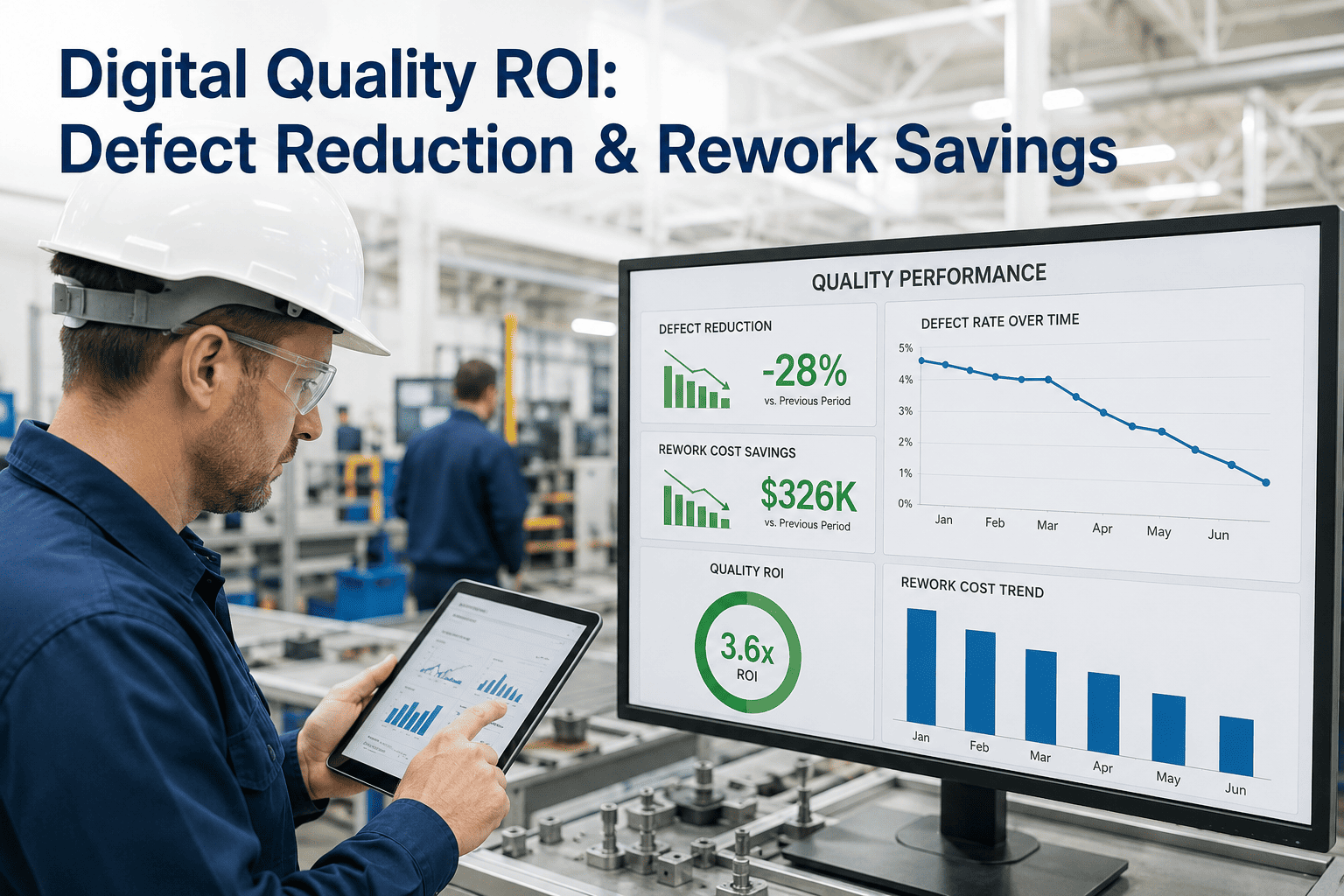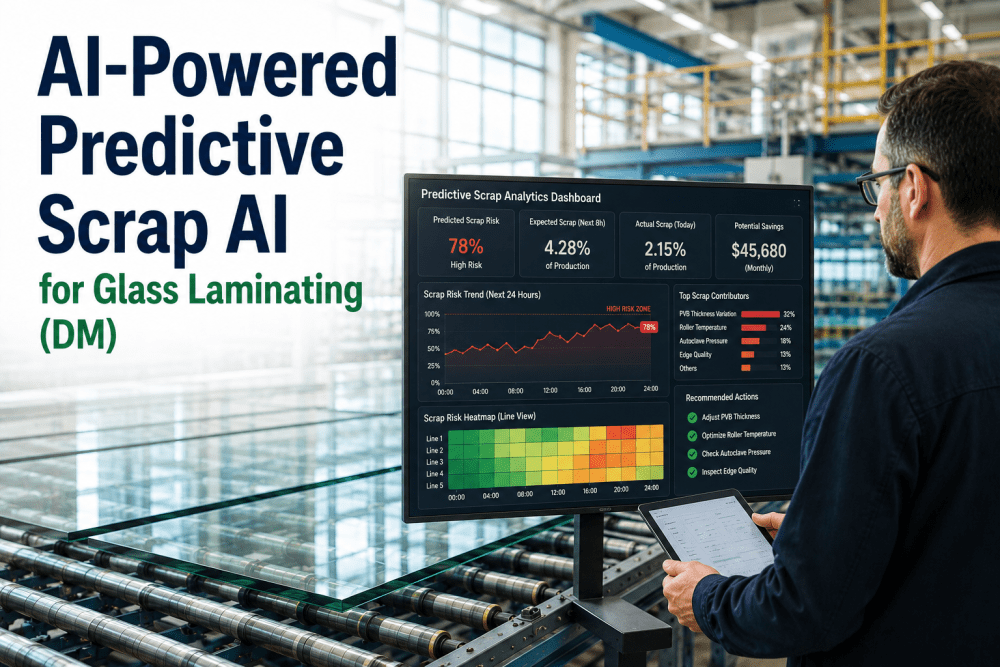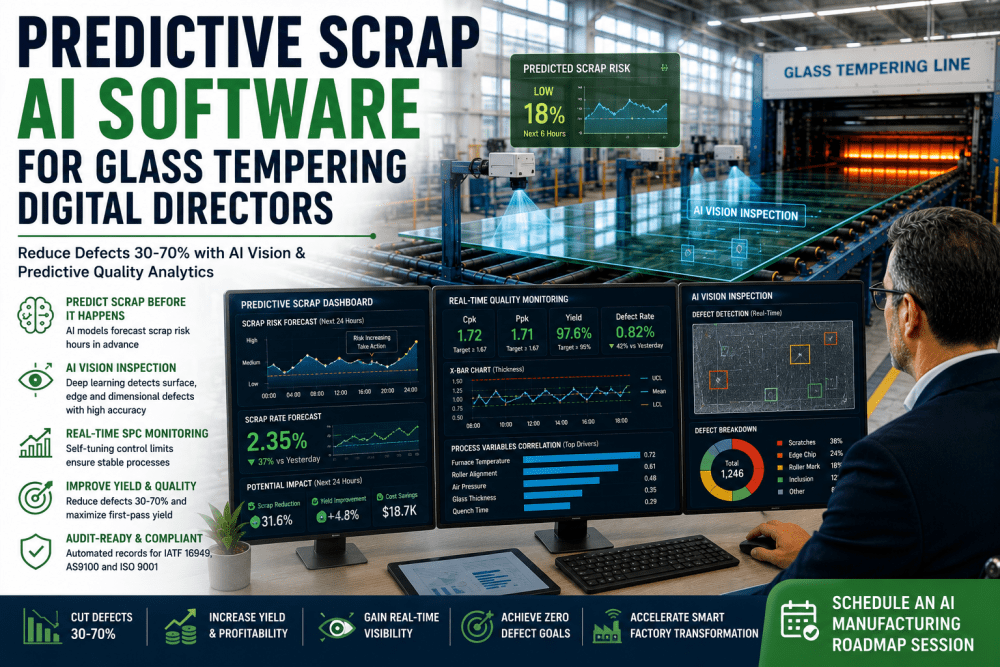
A digital manufacturing director reviews the weekly quality dashboard for five glass laminating lines. The data reveals a persistent pattern: 4.7% scrap rate across architectural laminated glass production, with defects detected only after final inspection — meaning every nonconforming panel consumed autoclave time, interlayer material, and handling labor before rejection. Manual visual inspection performed by quality technicians at the end of each line captured only major defects, missing micro-bubbles, edge delamination, and interlayer contamination that would be flagged by customers during installation. The gap between what human inspectors can see and what AI vision quality systems detect is the difference between 4.7% scrap and sub-2% scrap. Digital manufacturing directors evaluating their smart factory quality strategy Book a Demo to explore how iFactory deploys AI vision quality across glass laminating operations.
What Is AI Vision Quality in Glass Laminating?
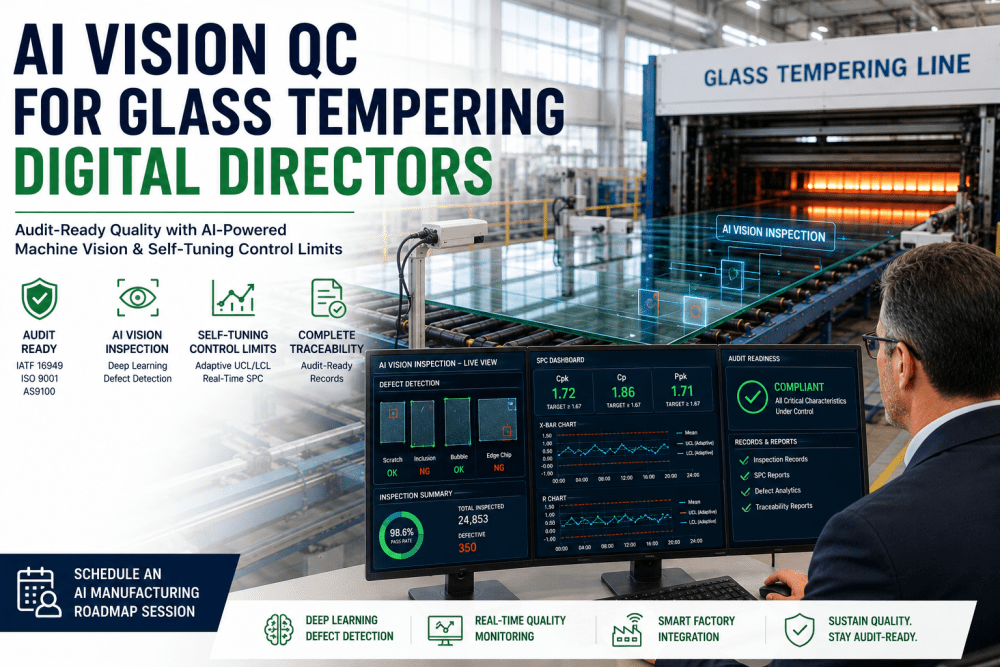
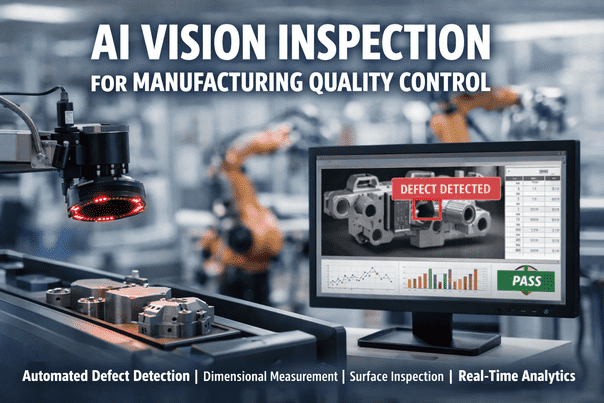
AI vision quality for glass laminating replaces or augments manual visual inspection with deep learning models trained on thousands of labeled defect images captured across the laminating process. The system ingests real-time image data from high-resolution cameras positioned after each critical process stage — autoclave exit, edge seal inspection, and final quality gate — and classifies every panel against 14 defect categories including micro-bubbles, interlayer contamination, edge delamination, optical distortion, and coating non-uniformity. Defects that would be invisible to human inspectors under standard lighting conditions are detected, classified, and escalated within milliseconds. Digital manufacturing directors building their Industry 4.0 quality infrastructure Book a Demo to review the AI vision integration architecture for laminating operations.
Human Visual Limitations
Manual inspection catches only 68% of defects under ideal conditions. Micro-bubbles smaller than 0.5mm, edge delamination in early stages, and interlayer contamination hidden within the laminate structure are routinely missed by human inspectors working at line speed.
Delayed Feedback Loops
End-of-line inspection detects defects after the full value of autoclave processing has been consumed. By the time a defect is found, 8–12 additional panels have passed through the same process conditions, compounding scrap and rework costs.
Inconsistent Quality Data
Shift-to-shift variation in inspector judgment creates inconsistent quality classification. A defect flagged on day shift may pass night shift inspection, creating compliance gaps and making trend analysis unreliable for process improvement initiatives.
Limited Traceability
Manual inspection records lack the granularity needed to correlate defect types with specific process variables. Without per-panel image data linked to autoclave temperature profiles, material lot IDs, and production timestamps, root cause analysis remains speculative.
How Machine Vision Reduces Scrap Rates
The AI vision platform deploys a three-stage inspection architecture that transforms scrap management from end-of-line disposition to in-process prevention. Each stage captures specific defect categories and feeds data back into process control. Digital manufacturing directors comparing vision system architectures Book a Demo to review the camera configuration and model training methodology.
Post-Layup Surface Inspection
High-resolution cameras capture the glass and interlayer assembly before autoclave processing. Deep learning models detect contamination, interlayer wrinkles, and alignment issues at this stage, enabling rework before the panel enters the autoclave — saving the full processing cost of scrap panels.
Post-Autoclave Defect Classification
Immediately after autoclave processing, cameras inspect each panel for bubbles, delamination, and optical distortion. The VLM classifies defects into severity levels and correlates findings with autoclave temperature, pressure, and cycle time data to identify process drift in real time.
Edge Seal & Final Quality Gate
Edge inspection cameras detect seal integrity issues and edge delamination that compromise long-term laminate durability. The final gate combines all inspection data into a panel-level quality record linked to the iFactory MES for traceability and compliance reporting.
Deep Learning for Automated Defect Detection
The core of the AI vision system is a deep learning model trained on over 50,000 labeled defect images from glass laminating operations. The model uses a convolutional neural network architecture optimized for manufacturing inspection, achieving 97.3% detection accuracy across all defect categories while maintaining false positive rates below 1.2%. The system supports three configurable inspection modes depending on production requirements and quality thresholds.
100% Panel Coverage — Every panel is inspected at all three stations with full defect classification. Recommended for high-volume architectural and automotive laminated glass production where zero-defect compliance is required. Inspection throughput matches maximum line speed of 2.4 panels per minute with no throughput reduction.
Risk-Based Sampling — Configurable sampling rate based on current defect trend data. When the AI vision system detects process drift, the sampling rate automatically increases to 100% until stability is restored. This mode reduces inspection data volume during stable operation while maintaining full protection during risky periods.
Edge-Only Defect Detection — Focuses inspection resources on the highest-impact defect category. Edge delamination and seal integrity issues account for 38% of field failures in architectural laminated glass. This mode dedicates full AI processing capacity to edge inspection while routing panels with surface defects through downstream manual verification.
Measurable Quality Improvement Across Laminating Lines
Within 10 weeks of deploying AI vision quality across five glass laminating lines, a Tier 1 architectural glass manufacturer documented measurable improvements validated through production data, quality audits, and customer return tracking.
| Metric | Manual Inspection | AI Vision Quality | Improvement |
|---|---|---|---|
| Scrap Rate | 4.7% | 2.4% | 49% reduction |
| Defect Detection Accuracy | 68% | 97.3% | +29.3 pp |
| Inspection Throughput | 32 panels/hour | 144 panels/hour | 4.5X |
| Detection Delay | End of line | In-process, real-time | Immediate |
| False Positive Rate | N/A | 1.2% | Low false alerts |
| Customer Returns (Laminate) | 2.8% | 0.6% | 79% reduction |
"Our manual inspection process was the weakest link in our quality system. We had invested in every other aspect of process control — autoclave monitoring, interlayer material certification, SPC charting — but the final quality decision came down to a technician looking at panels under fluorescent lights. The AI vision system found defects we did not know we were producing, including a recurring micro-bubble pattern that traced back to an aging vacuum pump. The scrap reduction from 4.7% to 2.4% paid for the deployment in under four months, and the defect data we now collect has fundamentally improved how we manage process quality." — Digital Manufacturing Director, Architectural Glass Manufacturer
Building a Smart Factory Quality Strategy with AI Vision
AI vision quality represents a foundational capability for digital manufacturing directors executing their Industry 4.0 roadmap in glass laminating. By replacing manual visual inspection with deep learning systems that detect defects in real time, classify them by severity, and feed quality data directly into MES and SPC systems, facilities can achieve scrap reduction targets that are structurally out of reach with human inspection alone. The platform's integration with existing quality infrastructure — including iFactory CMMS, SPC modules, and MES platforms — ensures that AI vision data flows seamlessly into broader manufacturing analytics and operational reporting. Digital manufacturing directors building their smart factory quality stack Book a Demo to discuss how iFactory's AI vision quality platform supports their digital transformation goals.
Frequently Asked Questions
The system detects and classifies 14 defect categories including micro-bubbles (down to 0.3mm), interlayer contamination, edge delamination, optical distortion, coating non-uniformity, interlayer wrinkles, glass chip defects, seal integrity failures, moisture ingress indicators, interlayer thickness variation, glass surface scratches, edge chip defects, alignment offset, and foreign material inclusion. Each defect is classified by severity level and correlated with upstream process data for root cause analysis.
iFactory's AI vision platform connects directly to existing MES, SPC, and CMMS systems via REST API and OPC-UA. Inspection results for each panel are written to the MES quality record, defect trend data feeds SPC control charts, and recurring defect patterns trigger CMMS work orders for process investigation. The platform also exports inspection data to common formats for regulatory compliance and customer quality reporting.
The system uses industrial-grade 12MP area-scan cameras with customized LED lighting arrays optimized for glass surface inspection. Camera enclosures are rated for manufacturing environments and mount directly to existing inspection frame structures. iFactory provides complete integration including camera positioning, lighting calibration, model training, and edge computing hardware. No modifications to existing production equipment are required.
Pre-trained models achieve approximately 89% detection accuracy at deployment, drawing from a training set of 50,000+ labeled defect images from similar glass laminating operations. After 4 weeks of site-specific calibration with facility images, accuracy reaches 95%. Continuous active learning from each inspection improves accuracy to 97%+ within 10 weeks. The platform requires approximately 500 labeled defect images per category to achieve stable production-level accuracy.
Facilities with 3+ laminating lines and current scrap rates above 4% typically recover platform investment within 4 to 6 months. Primary ROI drivers include reduced material waste from earlier defect detection, eliminated rework labor for panels that pass end-of-line inspection but fail in the field, improved yield from process corrections triggered by real-time defect data, and reduced customer return processing costs. A personalized ROI analysis is provided during the Book a Demo consultation.