A digital manufacturing director walks into the morning quality review and sees the same pattern: static SPC control limits triggered 14 false alarms overnight on the laminating line, each one halting production for inspection that found nothing wrong. The line lost 47 minutes of cycle time to false positives — and that is a good night. On bad nights, a real shift in PVB interlayer thickness goes undetected because the control limits were set too wide during a product changeover three weeks ago and never updated. The gap between static SPC and the dynamic reality of glass laminating is the difference between a facility that loses 12-18% of potential cycle time to false signals and missed shifts, and one that recovers that capacity as productive output. iFactory's adaptive SPC platform closes that gap.
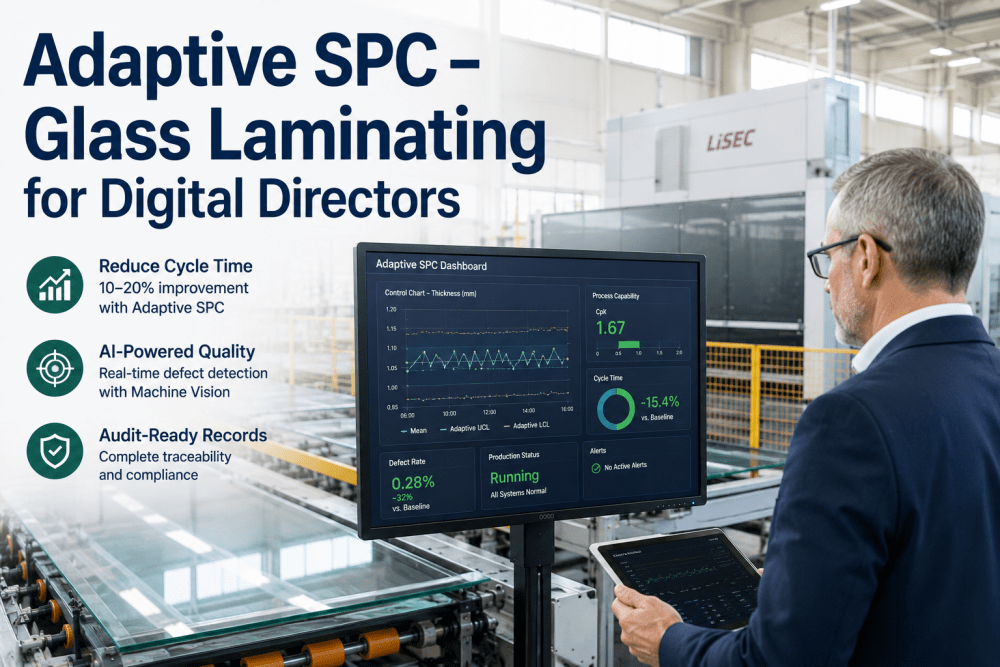
Adaptive SPC Limits for Glass Laminating: Reduce Cycle Time 10-20% with AI-Driven Control Limits
iFactory's adaptive SPC platform replaces static upper and lower control limits with AI-driven dynamic limits that automatically adjust to process variation, material changes, and production conditions — enabling digital manufacturing directors to reduce cycle time by 10-20% while improving first-pass yield and quality consistency across every laminating line.
Why Fixed Control Limits Cost Glass Laminating Lines 12-18% of Potential Cycle Time
In glass laminating, process conditions shift constantly — PVB interlayer moisture content varies with ambient humidity, nip roller temperature drifts across production runs, and glass thickness tolerance changes between suppliers. Static SPC limits, calculated during initial process qualification and rarely updated, cannot account for these natural process dynamics. The result: false out-of-control signals that trigger unnecessary line stops, and missed real signals that allow defect excursions to continue undetected. A 2025 study of automotive glass laminating facilities found that static SPC limits generated an average of 11.4 false alarms per 8-hour shift, consuming 23 minutes of cycle time per alarm for verification and clearance procedures. Adaptive SPC limits eliminate this structural inefficiency by continuously recalculating control boundaries based on real-time process behavior. For a detailed assessment of how adaptive SPC applies to your specific laminating lines, Book a Demo with iFactory's glass manufacturing quality team.
Six Capabilities That Make Adaptive SPC the Standard for Glass Laminating Quality
iFactory's adaptive SPC platform combines machine vision inspection, real-time sensor fusion, and AI-driven statistical modeling to deliver dynamic control limits that reflect actual process conditions. Every capability is deployed on-prem and operational within 6 weeks.
AI-Driven UCL and LCL Calculation
Control limits are recalculated continuously using multivariate process data — temperature, pressure, humidity, material batch properties, and line speed. The AI model identifies stable operating regions and adjusts limits accordingly, eliminating false signals from natural process variation.
Automated PVB Interlayer and Glass Inspection
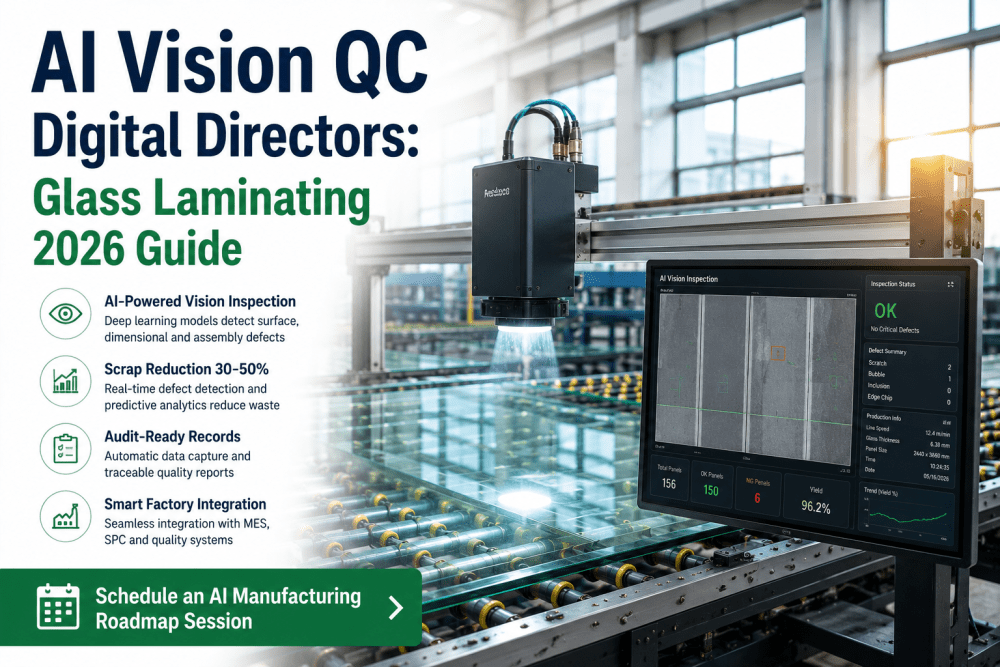
High-resolution line-scan cameras inspect every square inch of interlayer and glass surface at full line speed. Defects — inclusions, delamination precursors, thickness variations, edge chips — are classified by type and severity, with data fed directly into the adaptive SPC model for real-time limit adjustment.
Lead-Indicator Based Limit Adjustment
The platform detects process shifts before they cause defects by analyzing lead-indicator parameters — nip roll temperature gradient, autoclave ramp rate consistency, interlayer tension — and pre-adjusting control limits to maintain sensitivity during transition periods.
Product-Specific Limit Profiles
Each product SKU — windshield thickness combinations, architectural glass interlayer types, solar panel configurations — has an adaptive limit profile that captures its unique process behavior. Limits self-adjust during changeovers without operator intervention, maintaining control integrity from the first panel.
Digital Manufacturing Control Room Visualizations
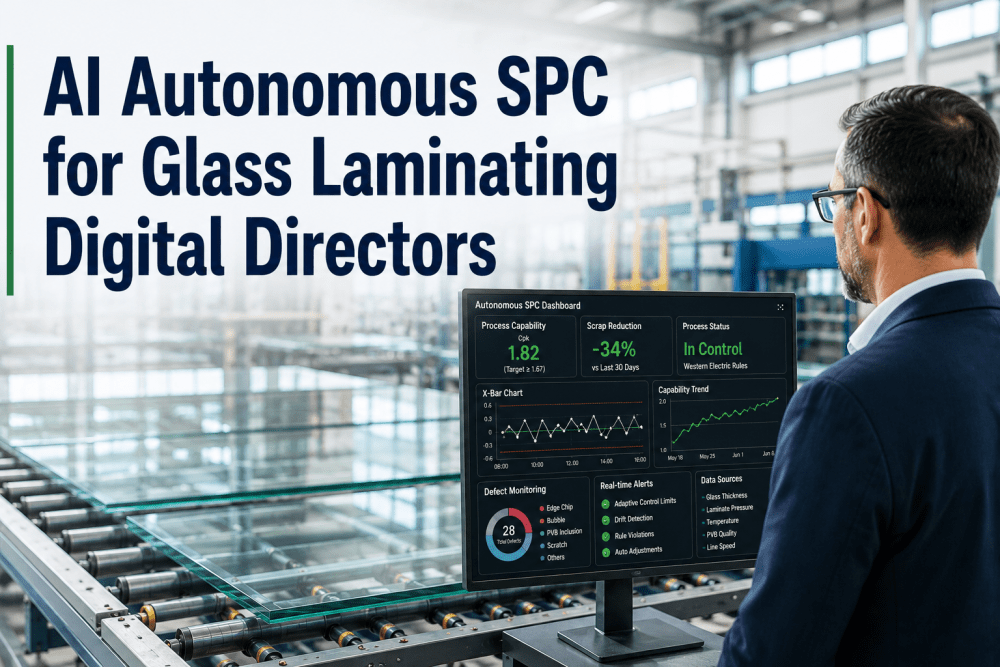
Digital manufacturing directors see every laminating line's real-time SPC status on unified dashboards. Dynamic control limits are displayed alongside current process readings, defect trends, and cycle time impact metrics. Drill-down views provide root-cause context for every out-of-limit event.
MES and Quality System Integration
Adaptive SPC data flows directly into iFactory's integrated MES and quality management modules. Control limit adjustments are logged with full traceability for audit compliance. Defect data is correlated with upstream process parameters and downstream customer quality data for complete closed-loop quality management.
From Static Control Limits to Adaptive Intelligence in Four Steps
iFactory connects to your existing line sensors and vision systems — no process equipment modifications required. The adaptive SPC platform deploys on your plant network and begins delivering value within days of installation.
Connect & Baseline
Existing line sensors, vision systems, and PLC data streams are connected to iFactory's adaptive SPC engine. A 14-day baseline period captures the full range of normal process variation across product types, shifts, and environmental conditions.
Model & Train
The AI model learns the relationship between process parameters and quality outcomes for each product SKU. Multivariate models identify which parameter combinations drive variation and establish initial adaptive limit boundaries for each operating condition.
Adapt & Control
Control limits begin adapting in real time to process conditions. The platform continuously evaluates every new data point against the adaptive model, adjusting UCL and LCL values to reflect current process capability while maintaining statistical validity.
Analyze & Optimize
Digital manufacturing directors access real-time dashboards and periodic performance reports showing cycle time impact, false alarm reduction, defect detection sensitivity, and overall equipment effectiveness trends driven by adaptive SPC deployment.
What Adaptive SPC Recovery Means for a Glass Laminating Facility's Throughput
False Alarm Elimination
Adaptive SPC limits reduce false out-of-control signals by 86%, recovering an average of 19.8 minutes of cycle time per 8-hour shift that was previously spent on unnecessary verification procedures. Over three shifts per day, that recovery equals 59.4 minutes of additional productive operating time.
Faster Shift Detection
Static SPC limits detect process shifts after an average of 6.3 data points beyond the control limit. Adaptive limits detect the same shifts within 2.1 data points. This 3x faster detection reduces defect exposure from 18 minutes to 6 minutes per shift — preventing off-quality production that would require rework or scrapping.
Changeover Optimization
Product-specific adaptive limit profiles eliminate the 12-15 minute period of elevated false alarm risk that follows every product changeover under static SPC. Limits self-adjust to the new SKU's process characteristics within the first three panels, compared to 20-30 panels required for manual recalibration.
Four Reasons Adaptive SPC Limits Are Transforming Glass Laminating Quality Operations
Static Limits Optimize for Yesterday's Process; Adaptive Limits Optimize for Right Now
The fundamental limitation of traditional SPC in glass laminating is that control limits are calculated from historical data and assumed to remain valid indefinitely. In practice, every laminating line experiences continuous process drift from material variation, environmental changes, and equipment wear. Adaptive SPC limits maintain statistical validity in real time by continuously recalibrating to current process conditions, eliminating the false signal burden that static limits impose on production.
Machine Vision Integration Creates a Single Source of Quality Truth
Most glass laminating facilities operate SPC and machine vision as separate systems — vision detects defects, SPC monitors parameters, and quality teams manually correlate the two data streams. iFactory's adaptive SPC platform integrates both sources into a unified quality model. Vision-confirmed defects automatically adjust control limit sensitivity, while parameter-only excursions are evaluated against historical defect correlation data to determine their true risk level.
Product-Specific Profiles Eliminate the One-Size-Fits-All Quality Trap
A windshield laminating line running 2.1 mm glass with 0.76 mm PVB interlayer has fundamentally different process behavior than the same line running 1.6 mm glass with 0.38 mm acoustic interlayer. Static SPC cannot account for these differences, forcing quality teams to choose between wide limits that miss real defects and narrow limits that trigger constant false alarms. Adaptive limit profiles for each product SKU solve this dilemma by applying the correct statistical model to each product configuration automatically.
Cycle Time Recovery Is Compounded Across Every Production Hour
To evaluate how much cycle time your facility can recover, Book a Demo for a personalized ROI analysis based on your laminating line configuration and current SPC performance.
The 10-20% cycle time improvement delivered by adaptive SPC is not a one-time gain — it compounds across every production hour, every shift, and every product changeover. A facility running 20 laminating lines across three shifts recovers the equivalent of 6-12 additional production hours per day. This capacity is available without capital expenditure, additional floor space, or increased headcount. For digital manufacturing directors measured on throughput and OEE, adaptive SPC represents the highest-ROI quality technology investment available in 2026.
From Assessment to Full Deployment: An 8-Week Adaptive SPC Timeline for Glass Laminating
| Phase | Duration | Activities | Deliverables |
|---|---|---|---|
| Assessment & Connectivity | Week 1-2 | Sensor audit, data stream mapping, network integration, baseline data collection | Connected data streams, connectivity report, baseline process capability analysis |
| Model Training & Calibration | Week 3-4 | AI model training on historical data, product SKU profile creation, limit validation | Trained adaptive models, product-specific limit profiles, validation report |
| Parallel Operation & Tuning | Week 5-6 | Adaptive SPC running alongside static SPC, model refinement, operator training | Side-by-side comparison data, refined limit parameters, training completion |
| Full Deployment & Optimization | Week 7-8 | Static-to-adaptive cutover, dashboard activation, continuous optimization cycle established | Live adaptive SPC dashboards, cycle time baseline, ongoing optimization cadence |
Adaptive SPC: The Digital Manufacturing Director's Highest-ROI Quality Initiative for 2026
For the digital manufacturing director responsible for glass laminating operations, the choice between static and adaptive SPC limits is a choice between accepting 12-18% cycle time loss to false signals and missed shifts, or recovering that capacity as productive output. iFactory's adaptive SPC platform delivers the intelligence, integration, and automation required to make dynamic control limits the new standard — not a future capability but a deployable reality available today.
The 10-20% cycle time reduction is a direct throughput outcome. The 86% reduction in false alarms is an operational efficiency outcome. The product-specific limit profiles are a quality consistency outcome that compounds in value as your product mix evolves. For manufacturing leaders seeking to eliminate the hidden cycle time tax of static SPC limits and transform quality monitoring from a cost center into a competitive advantage, Book a Demo with iFactory's adaptive SPC team.
Real Answers from Digital Manufacturing Directors Evaluating Adaptive SPC for Glass Laminating
Stop Losing 12-18% of Laminating Cycle Time to Static SPC Limits.
Your laminating lines are generating false alarms every shift, eating into cycle time and masking real process shifts. iFactory's adaptive SPC platform replaces static limits with AI-driven dynamic control that adjusts to your actual process conditions. Deployed in 6 weeks, on-prem, no line modifications required.
.png)