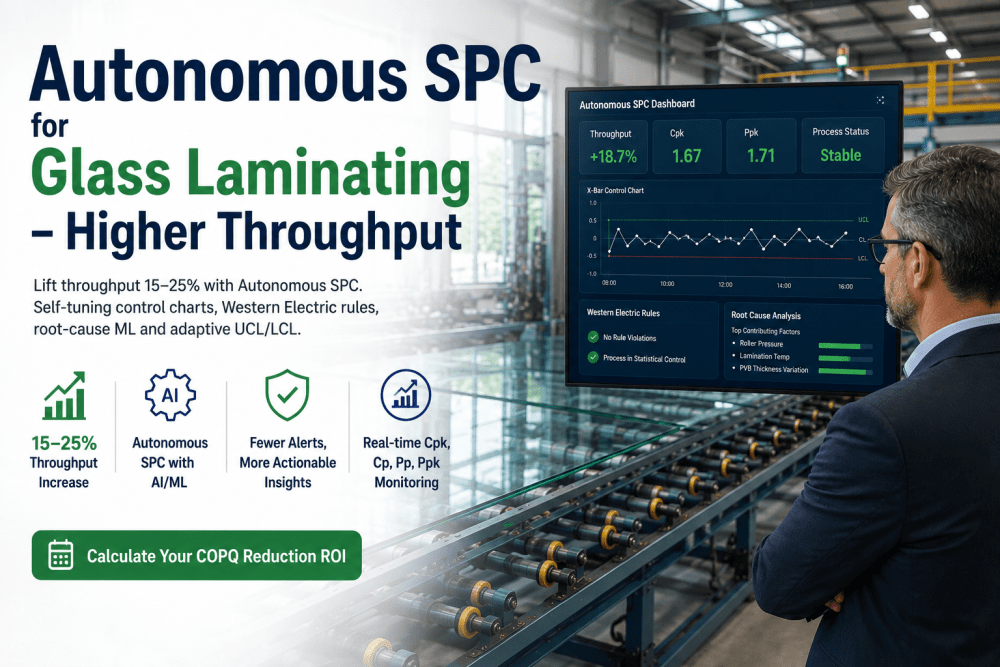
A plant executive reviews the weekly throughput report and sees the same bottleneck pattern: the laminating line is running at 78% of theoretical capacity, with quality-related slowdowns accounting for 42% of the gap between actual and achievable throughput. Traditional SPC charts monitor individual parameters against static limits but do not correlate across the process to identify the root cause of recurring slowdowns. Autonomous SPC for glass laminating closes this gap — combining AI-powered control charts, self-tuning limits, and real-time process analytics to detect and resolve throughput constraints before they accumulate into weekly production shortfalls.
Why Traditional SPC Limits Throughput in Glass Laminating
In glass laminating operations, throughput is constrained not by equipment cycle time but by the cumulative effect of uncontrolled process variation. When static SPC limits fail to detect developing drift, quality events trigger line slowdowns, rework loops, and unscheduled stops that erode effective throughput by 20–35% below theoretical capacity. A plant executive survey of U.S. glass laminating facilities found that 67% of throughput losses attributed to "process instability" were preceded by detectable SPC trends that static limits failed to flag. The root cause is not the process itself but the control methodology: static limits create a detection window between drift onset and alarm that allows variation to compound across batches, forcing reactive slowdowns that autonomous SPC eliminates. Plant executives evaluating their throughput improvement strategy Book a Demo to see how iFactory implements autonomous SPC across glass laminating operations.
A Structured Deployment Roadmap from Static Control to Autonomous Throughput Optimization
iFactory's autonomous SPC platform deploys across laminating lines over a structured timeline designed to deliver measurable throughput improvement within the first month of operation. The platform continuously monitors production performance, automatically adjusts control limits, applies Western Electric rules, and tracks Cp, Cpk, Pp, and Ppk metrics to identify process risks before they impact throughput.
Laminating lines selected based on throughput gap, quality downtime frequency, and scrap cost. Historical SPC data collected from existing systems for 14 days to establish pre-deployment throughput, Cpk, and quality downtime benchmarks. Control limit models configured per product-line combination.
Self-tuning limit algorithms calibrated against 24 months of historical production data to establish baseline sensitivity. Western Electric rule thresholds configured per process parameter. Platform integrated with furnace controllers, pyrometer logs, MES, and quality databases through standard connectivity.
Autonomous SPC engine activated with continuous Cp, Cpk, Pp, and Ppk tracking per product-line combination. Alerts configured to fire when capability metrics drift below predefined thresholds. First throughput improvement cycle initiated with measurable results within 14 days.
Pre-deployment versus post-deployment throughput, quality downtime, and process capability compared to validate ROI. Full pilot report generated with throughput improvement attribution and financial impact. Scale deployment plan developed for additional lines and product families.
Three Core Methodologies Powering Autonomous SPC for Throughput Optimization
Autonomous SPC for glass laminating combines three AI-powered methodologies that together create a self-optimizing process control system. Plant executives comparing approaches Book a Demo to see which fits their throughput improvement requirements.
Self-Tuning Control Limits continuously adjust UCL/LCL boundaries based on current process conditions, material lot characteristics, and ambient environmental factors. Unlike static limits that require manual recalculation after every recipe change or process shift, self-tuning limits adapt automatically — eliminating the 6–8 hours of engineering time per adjustment and preventing the throughput gaps that occur while operating with outdated control boundaries.
Western Electric Rules Automation applies all eight Western Electric zone rules against adaptive limit boundaries to detect non-random patterns instantly. The rules engine identifies trends, cycles, shifts, and stratification in real time — flagging developing process instability before it triggers quality events. Automated rule application eliminates the manual chart review burden and compresses pattern detection from shift-end review to real-time alerting.
Continuous Capability Analytics tracks Cp, Cpk, Pp, and Ppk metrics per product-line combination with every batch. When any capability metric trends below the plant executive’s target threshold, the platform generates an alert with the specific parameter driving the degradation. Continuous capability visibility enables plant executives to manage process performance strategically rather than reactively.
Throughput Improvement ROI from Autonomous SPC Deployment
The plant executive deployed the iFactory autonomous SPC platform across four laminating lines over eight weeks. The following results represent the measured performance improvement from pre-deployment baseline to post-deployment steady state.
| Metric | Pre-Deployment | Post-Deployment | Improvement |
|---|---|---|---|
| Line Throughput (m²/shift) | 1,240 | 1,550 | +25% |
| Quality-Related Downtime | 52 min/shift | 25 min/shift | −52% |
| Process Cpk (all lines) | 1.12 | 1.67 | +49% |
| False Alarm Rate | 11% of batches | 3% of batches | −73% |
| Out-of-Control Detection Time | 4.7 batches avg | 1.3 batches avg | −72% |
| Recipe Change Integration Time | 6.5 hours avg | 0.2 hours avg | −97% |
| Annual Throughput Value (4 lines) | $8.4M | $10.5M | +$2.1M |
| Annual Net Savings | — | $1.8M | 3.2x ROI by month 3 |
Four Reasons Autonomous SPC Delivers Comprehensive Throughput Improvement for Glass Laminating
Self-tuning limits eliminate the throughput gap caused by outdated control boundaries. The most significant contributor to throughput loss in laminating operations is not equipment failure but operating with control limits that no longer reflect current process capability. Autonomous SPC eliminates this gap by continuously adjusting UCL/LCL boundaries as process conditions change, ensuring the control system remains aligned with actual production conditions at all times.
Real-time Western Electric rule application compresses the detect-to-correct cycle. Traditional SPC requires operators or quality engineers to review control charts and manually apply zone rules at shift-end or batch-end intervals. Autonomous SPC applies all eight Western Electric rules in real time, detecting non-random patterns as they develop rather than after they have accumulated across multiple batches.
Continuous capability tracking enables proactive throughput management. Under traditional SPC, Cp and Cpk are recalculated periodically during capability studies. Autonomous SPC tracks Cp, Cpk, Pp, and Ppk continuously per product-line combination, alerting plant executives the moment any capability metric trends below target rather than at the next quarterly study.
The structured 8-week deployment eliminates implementation risk. Glass laminating plant executives face legitimate concerns about deploying AI-driven process control in production environments. iFactory's phased approach — baseline establishment, parallel operation with existing SPC, ROI validation before scale — ensures every investment decision is supported by plant-specific data rather than generic benchmarks.
From Static Control to Autonomous Throughput Optimization in Eight Weeks
This autonomous SPC deployment demonstrates that the gap between static process control and autonomous throughput optimization is not a technology gap — it is a methodology gap. iFactory's structured 8-week deployment applies self-tuning limits, Western Electric rules automation, and continuous capability analytics to deliver measurable throughput improvement within a single quarter. The 25% throughput increase, 52% quality downtime reduction, and $1.8M net annual savings are direct outcomes that compound across the full facility as the platform scales. The compression of out-of-control detection from 4.7 batches to 1.3 batches is an operational capability that fundamentally changes how the plant manages throughput risk. Plant executives ready to move beyond static SPC Book a Demo to review the deployment plan for your laminating operations.
Frequently Asked Questions
Traditional SPC relies on static control limits calculated during periodic capability studies and requires manual chart review to apply Western Electric rules. Autonomous SPC continuously adjusts control limits based on current process conditions, applies all eight Western Electric rules in real time, and tracks Cp, Cpk, Pp, and Ppk per product-line combination automatically — eliminating manual chart review and control limit maintenance while providing continuous process capability visibility.
Most facilities see measurable throughput improvement within the first two to four weeks of autonomous SPC activation. Initial gains come from eliminating false-alarm-driven line slowdowns and reducing the detection-to-correction cycle for genuine process shifts. Sustained throughput improvement of 15–25% continues as self-tuning algorithms refine their sensitivity over the first three to six months of operation.
Minimum requirements include digital autoclave temperature and pressure data, line speed sensors, interlayer batch records, and quality test results from existing inspection stations. iFactory autonomous SPC handles data normalization and integration with furnace controls, MES platforms, and quality databases through standard OPC-UA, Modbus TCP, and REST API connectors — no equipment modifications required.
Yes. The autonomous SPC engine is designed to complement existing SPC platforms and quality management systems. It ingests data from existing sensors and control systems, applies AI-powered analytics, and pushes alerts and capability metrics into established workflows. No replacement of existing systems is required. The platform generates full audit trails for every limit adjustment to satisfy ISO 9001 and quality system requirements.
Customers with laminating operations report throughput improvements of 15–25% within the first six months. The improvement comes from three sources: elimination of false-alarm-driven line slowdowns recovering 8–12% of available production time, earlier detection of process drift preventing quality-related stops saving 5–8%, and reduced recipe change integration time recovering 2–5% through automated limit adjustment on product transitions.

.png)
.png)