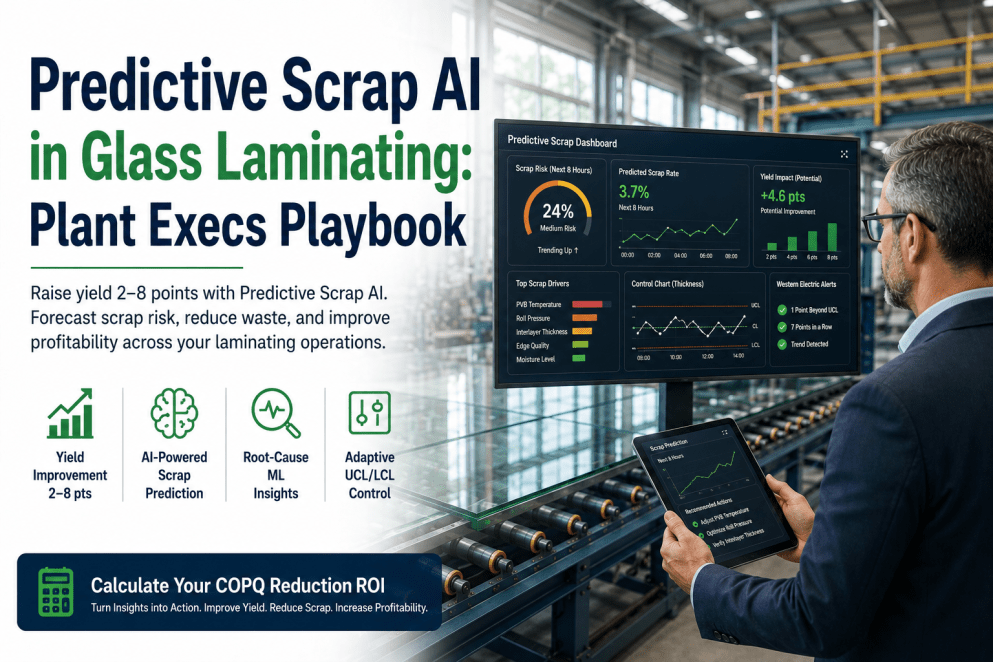
Plant executives in glass laminating face a persistent challenge: scrap events that silently erode yield by 3–8% and cost millions annually. Traditional quality systems detect defects after material is already in the rework or scrap bin. Predictive scrap analytics for glass laminating changes this paradigm—using machine learning, SPC data, process parameters, and production history to forecast scrap risk before defects materialize. This playbook explains how AI-powered predictive analytics enables plant executives to increase yield by 2–8 percentage points, reduce scrap-related losses, optimize resource utilization, and build a data-driven operational excellence strategy. Plant executives assessing their yield improvement roadmap Book a Demo to review the predictive scrap analytics architecture for your laminating lines.
What Is Predictive Scrap Analytics for Glass Laminating?
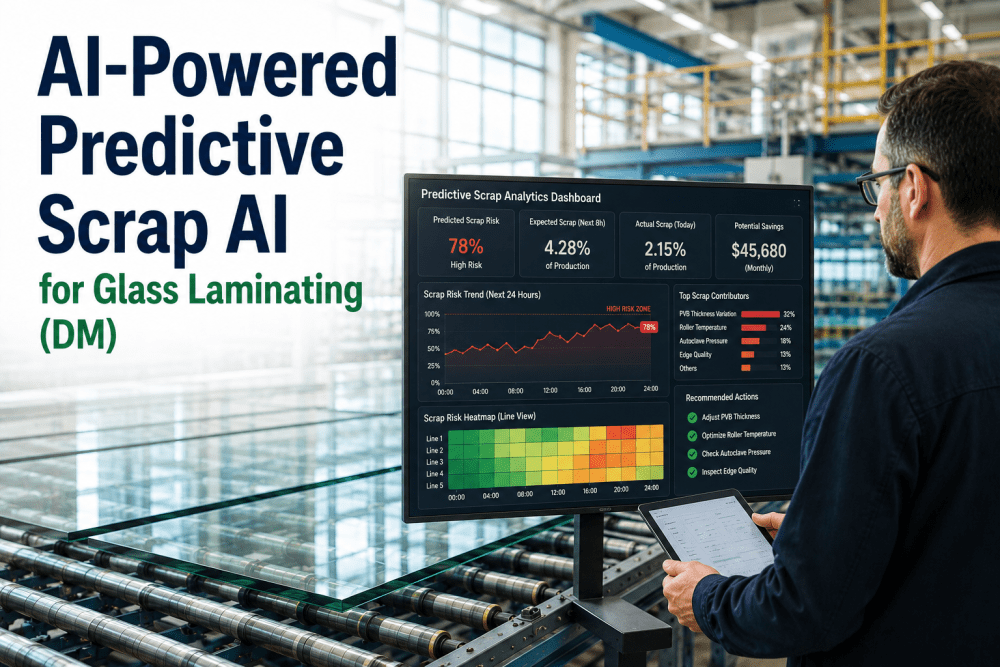
Predictive scrap analytics for glass laminating uses machine learning algorithms trained on historical production data, SPC control chart signals, autoclave temperature and pressure profiles, interlayer batch characteristics, ambient environmental conditions, and final inspection results to forecast the probability and severity of scrap events before the first nonconforming unit is produced. Unlike traditional quality systems that react to defects after detection, predictive scrap analytics generates real-time risk scores for every batch in progress, enabling plant executives to intervene, adjust process parameters, or halt production before scrap accumulates. The system continuously learns from every production outcome, improving its prediction accuracy over time and building a facility-specific scrap risk model that captures the unique causal signatures of each laminating line. Plant executives evaluating predictive quality capabilities Book a Demo to see how iFactory integrates predictive scrap analytics with existing SPC and quality infrastructure.
Three AI Methodologies That Forecast Scrap Before Defects Occur
Predictive scrap analytics combines three AI-powered methodologies that together create a comprehensive scrap forecasting system. Each methodology addresses a different prediction horizon and data requirement. Plant executives comparing prediction approaches Book a Demo to see which methodology fits their process complexity and data maturity.
ML Classification Models are trained on labeled historical data—batches that passed versus batches that scrapped—to learn the multivariate decision boundary between good and nonconforming production. Features include autoclave zone temperatures, ramp rates, soak times, pressure differentials, interlayer material lot properties, ambient humidity, and line speed. The model assigns a scrap probability score to each batch in real time, alerting plant executives when the predicted scrap risk exceeds a configurable threshold. Classification models achieve 83–91% accuracy after three to six months of production data accumulation and continuous retraining.
Time Series Forecasting models analyze sequential process data to predict scrap rate trends over hourly, daily, and weekly horizons. These models capture temporal patterns—such as gradual autoclave seal degradation, seasonal humidity cycles, and line-speed drift across shifts—that classification models may miss when analyzing individual batches in isolation. Time series outputs feed directly into production planning systems, enabling plant executives to adjust capacity allocation and material planning based on predicted scrap volume for upcoming production windows.
Anomaly Detection Engines establish a baseline of normal process behavior across all laminating lines and flag deviations that historically preceded scrap events. Unlike classification models that require labeled scrap data for training, anomaly detection identifies novel process patterns that may indicate emerging scrap risk even when no historical precedent exists. This makes anomaly detection particularly valuable for new product introductions, recipe changes, and material lot transitions where historical scrap data is limited or unavailable.
Improving Yield with Machine Learning Models
The gap between traditional scrap management and AI-powered yield optimization is measured in both prediction accuracy and intervention speed. The table below compares both approaches across capabilities that matter most to plant executives in glass laminating.
| Capability | Traditional Scrap Management | Predictive Scrap Analytics |
|---|---|---|
| Detection Timing | After defect is produced and inspected | Before scrap occurs—real-time risk scoring per batch |
| Prediction Accuracy | Reactive—no prediction capability | 83–91% accuracy with ML classification models |
| Data Sources | Final inspection results only | SPC charts, process sensors, material lots, environmental data |
| Intervention Window | Zero—scrap is already produced | Minutes to hours before scrap threshold is crossed |
| Yield Impact | 3–8% yield loss to undetected scrap events | 2–8 percentage point yield improvement |
| Learning Mechanism | Manual RCA after each scrap event | Continuous ML model retraining from every batch outcome |
Six-Week Implementation Roadmap
Deploying predictive scrap analytics across glass laminating lines follows a structured six-week sequence designed to deliver measurable yield improvement within the first month of operation.
Expert Analysis—Why Predictive Scrap Analytics Is Transforming Glass Laminating Yield
Before deploying predictive scrap analytics, we were managing yield using historical averages and manual investigation after every scrap event. The AI model predicted a scrap event on our highest-volume architectural line 90 minutes before the first nonconforming panel was produced. We adjusted the autoclave temperature profile based on the model's recommended corrective action and avoided 120 square meters of scrap. That single prediction validated the entire investment. For plant executives evaluating this technology, predictive scrap analytics transforms yield management from a backward-looking reporting exercise into a forward-looking strategic capability.
— Vice President of Operations, Mid-Volume Glass Laminating Facility, ISO 9001 and AS9100 AccreditedConclusion
Predictive scrap analytics for glass laminating delivers a fundamental improvement in how plant executives manage yield, scrap, and operational performance. ML classification models forecast scrap risk with 83–91% accuracy, time series analysis identifies yield trends across production horizons, and anomaly detection captures emerging risk for new products and process configurations. The result is 2–8 percentage point yield improvement, over 60% reduction in scrap-related production losses, and a measurable path to operational excellence built on data-driven decision making rather than reactive firefighting. Plant executives ready to transform their yield management approach Book a Demo to review the predictive scrap analytics deployment plan for your laminating facility.
Frequently Asked Questions
The system ingests data from SPC control charts, autoclave temperature and pressure sensors, humidity monitors, line-speed encoders, interlayer batch records, and final inspection results. iFactory handles data normalization and integration with existing infrastructure through standard OPC-UA, Modbus TCP, and REST API connectors.
ML classification models achieve 83–91% prediction accuracy within three to six months of deployment, depending on data quality and production volume. Accuracy improves continuously through active learning as the model incorporates every new batch outcome. Facilities with 24+ months of historical production data typically achieve higher accuracy faster.
Customers report yield improvements of 2–8 percentage points within the first six to twelve months. Initial gains come from preventing high-probability scrap events identified by ML models. Sustained improvement continues as models accumulate training data and refine sensitivity, enabling detection of subtle scrap risk patterns that manual analysis would miss.
Yes. The platform is designed to complement existing SPC platforms and quality management systems. It ingests SPC control-chart signals as model inputs and pushes scrap risk alerts into established quality workflows. No replacement of existing systems is required. Integration is completed during weeks 3–4 of the deployment timeline.
Most facilities recover platform investment within 4–8 months. Primary ROI drivers include scrap cost reduction from prevented defects, yield improvement recovering 2–8% of production output, reduced rework and inspection labor, and decreased material waste disposal costs. A personalized ROI analysis is provided during the Book a Demo consultation.


.png)