
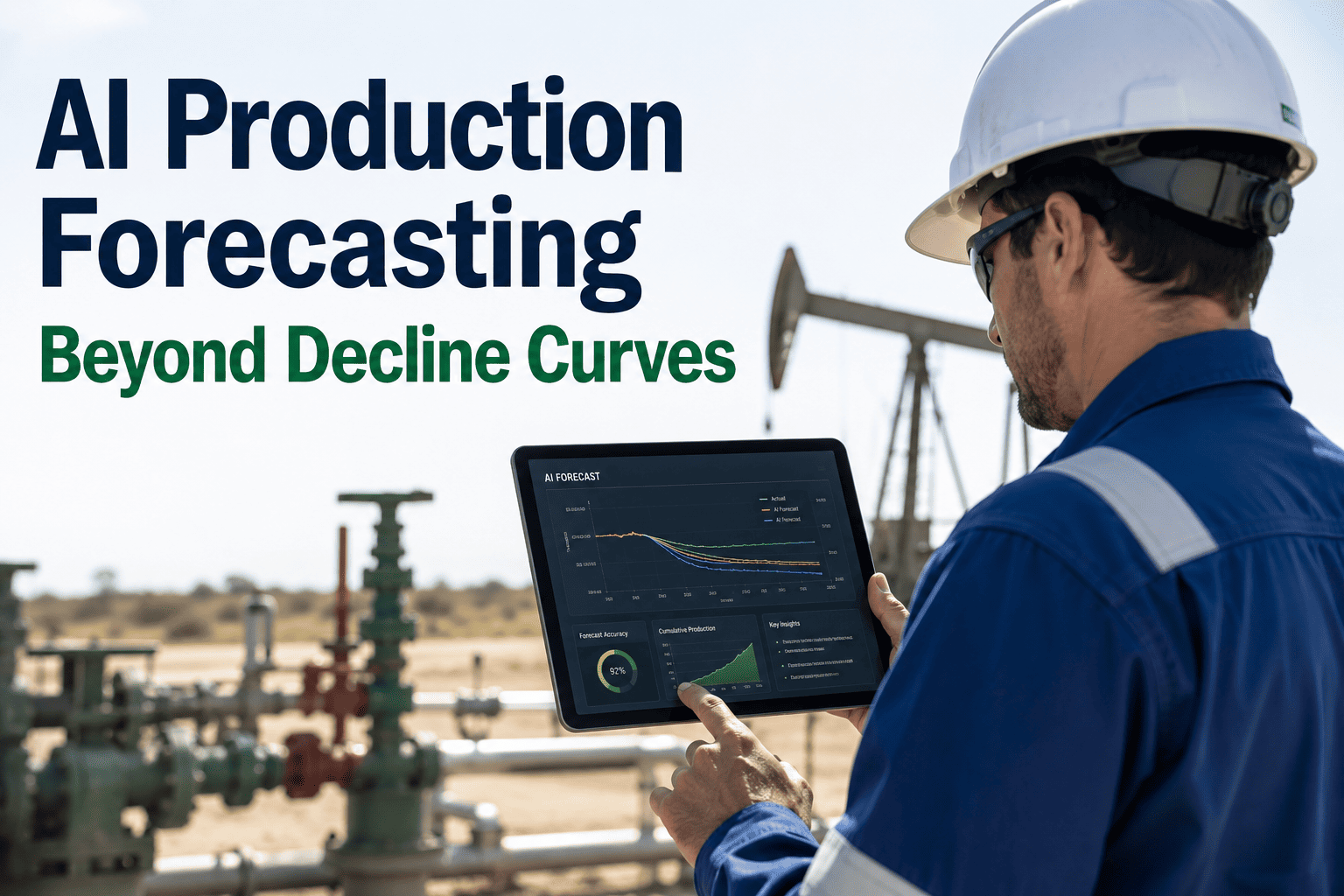
Shale gas basins — from the Permian to the Marcellus — have transformed U.S. energy production over the past two decades, yet accurate production forecasting remains one of the most computationally demanding challenges in reservoir management. Conventional decline curve analysis and physics-based simulators struggle to capture the nonlinear, multi-variable behavior of unconventional reservoirs: fracture complexity, pressure-dependent permeability, multi-phase flow, and the operational variability across thousands of horizontal laterals. Deep learning shale gas production forecast models are changing this calculus, delivering well-level predictions that outperform traditional methods by integrating heterogeneous data sources — seismic attributes, completion parameters, production histories, and real-time surface measurements — into a single predictive framework. Operators who Book a Demo with iFactory AI are discovering how purpose-built deep learning infrastructure closes the gap between reservoir complexity and operational decision speed.
CTA Block 1
Deep Learning Production Forecasting — Built for Unconventional Reservoirs
iFactory AI integrates LSTM networks, transformer-based sequence models, and physics-informed neural networks into a unified shale gas forecasting platform — delivering well-level production predictions your reservoir team can act on.
Why Conventional Methods Fall Short in Unconventional Reservoirs
Shale gas wells exhibit production behavior that defies the assumptions underlying traditional Arps decline curve analysis. Hyperbolic decline exponents (b-values) in shale often exceed 1.0 during early transient flow, creating terminal rate overestimates when analysts apply standard DCA without a boundary-dominated flow correction. Physics-based numerical simulators offer more rigor but require detailed fracture network characterization — data that is expensive, time-consuming, and rarely available at the scale of a multi-thousand-well development program.
Deep learning models sidestep both limitations. By training on large, heterogeneous well datasets, recurrent neural networks and transformer architectures learn the statistical signatures of shale production decline without requiring explicit fracture parameterization. When production anomalies deviate from learned patterns — indicating fracture communication, artificial lift failure, or offset well interference — the model flags the divergence in real time rather than at the next quarterly review cycle. Operators who want to understand this workflow in practice can Book a Demo with iFactory AI to see it applied to their basin data.
| Forecasting Method | Data Requirement | Forecast Horizon | Handles Interference | Scalability |
|---|---|---|---|---|
| Arps Decline Curve (DCA) | Production history only | Medium (1–5 yr) | No | High — manual |
| Rate Transient Analysis (RTA) | Pressure + production | Long (EUR) | Limited | Low — specialist-intensive |
| Numerical Reservoir Simulation | Full fracture + reservoir model | Long (EUR) | Yes | Very low — months per model |
| Machine Learning (XGBoost / RF) | Completion + production features | Short–Medium | Partial | High — batch inference |
| Deep Learning (LSTM / Transformer) | Multi-source time-series | Short to EUR | Yes — learned | Very high — well-scale inference |
Deep Learning Architectures Driving Shale Gas Forecast Accuracy
Not all deep learning architectures perform equally on shale production data. The optimal model selection depends on data availability, forecast horizon, and operational use case — from short-cycle well optimization to long-horizon EUR estimation for reserves reporting.
Long Short-Term Memory Networks
Designed for sequential time-series data, LSTMs capture long-range dependencies in production decline — making them the baseline architecture for shale gas rate forecasting. Best suited for single-well and pad-level prediction with 6–24 month horizons.
Temporal Convolutional Networks
TCNs process long production histories faster than LSTMs through parallel convolution, with dilated receptive fields that capture multi-scale decline patterns. Increasingly preferred for basin-wide forecasting where training speed matters at 10,000+ well scale.
Physics-Informed Neural Networks
PINNs embed reservoir physics — Darcy flow, material balance — as soft constraints in the loss function, preventing physically impossible forecasts in sparse-data wells. Critical for early-life wells with fewer than 6 months of production history.
Temporal Fusion Transformers
TFTs combine multi-horizon attention with static covariate encoding — integrating completion parameters, geological attributes, and operational variables into a single probabilistic forecast. Delivers P10/P50/P90 uncertainty quantification required for reserve reporting.
From Raw Well Data to Actionable Production Forecast: The iFactory AI Workflow
Implementing deep learning for shale gas forecasting is not a single-model deployment — it is a data pipeline and model governance problem. iFactory AI structures the process across five stages, each with defined data inputs, quality gates, and output validation criteria.
What Drives Deep Learning Forecast Accuracy in Shale Gas Wells
The predictive power of a deep learning shale gas production forecast is directly proportional to the breadth and quality of input variables. iFactory AI's feature importance analysis — run across Marcellus, Haynesville, and Permian Basin training datasets — identifies the variables with the highest contribution to forecast accuracy.
| Input Variable Category | Specific Parameters | Forecast Impact | Data Source |
|---|---|---|---|
| Completion Design | Proppant intensity (lb/ft), fluid volume, stage spacing, lateral length | Very High | AFE / Frac Reports |
| Early Production Signal | IP30, IP90, GOR trend, flowing wellhead pressure | Very High | SCADA / Production Database |
| Petrophysical Attributes | Porosity, Vclay, water saturation, TOC, brittleness index | High | Petrophysical Interpretation |
| Geomechanical Parameters | Minimum horizontal stress, Young's modulus, Poisson's ratio | High | Geomechanical Model / Logs |
| Operational Variables | Choke size history, artificial lift type, production downtime | Medium–High | SCADA / Operator Records |
| Offset Well Context | Parent–child distance, offset completion timing, frac hit history | Medium | Spacing Analysis / GIS |
Operators running iFactory AI's platform can Book a Demo to review feature importance rankings calibrated to their specific basin and formation — ensuring the model is trained on the variables that actually drive production variability in their acreage position.
Replace DCA Spreadsheets with a Real-Time Deep Learning Forecast Engine
iFactory AI delivers well-level shale gas production forecasts, EUR estimates, and anomaly detection — updated daily from your SCADA data, integrated with your reserves reporting workflow.
iFactory AI: Unified Deep Learning Infrastructure for Reservoir Management
Most upstream operators attempting to deploy deep learning for shale gas forecasting encounter the same structural barriers: fragmented data across production databases, geotechnical systems, and SCADA historians; model governance gaps that prevent reserves-grade validation; and the absence of real-time feedback loops between forecast deviation and field response. iFactory AI addresses each of these barriers as a platform-level capability, not a custom consulting engagement.
iFactory AI connects to PI Historian, SCADA systems, WellView, Enverus, IHS Markit, and operator-specific production databases via standard APIs and OPC-UA connectors. Production, pressure, and operational data are normalized to a common time-series schema and continuously quality-checked for completeness before model inference.
- Native connectors to PI Historian, SCADA, and WellView production databases
- Automated data quality scoring with missing-data imputation using basin physics priors
- Completion parameter ingestion from AFE and frac reports via structured document parsing
- Petrophysical log integration from LAS files with automated depth-to-time alignment
- Offset well spacing and parent–child relationship mapping from GIS well plat data
Reserves auditors and SEC reporting requirements demand model transparency that generic ML platforms cannot provide. iFactory AI maintains a full model provenance record — training dataset composition, architecture version, validation MAPE by basin and formation, and calibration history — queryable at the well level and exportable for third-party reserves review.
- Versioned model registry with full training dataset and architecture documentation
- Holdout validation MAPE by basin, formation, and vintage — exportable to PDF audit report
- Automatic model recalibration triggers when live well performance diverges from forecast
- P10/P50/P90 uncertainty quantification with confidence interval propagation to EUR
- SEC Regulation S-X Article 4-10 compliant EUR methodology documentation
Daily SCADA data triggers rolling forecast updates across the entire well portfolio. When any well's production deviates from its predicted decline trajectory by more than a user-defined threshold, the system generates an anomaly alert with automated root-cause hypotheses ranked by posterior probability — dramatically compressing the time between performance deviation and engineering response.
- Daily automated forecast vs. actual comparison across full well portfolio
- Anomaly alerts with ranked root-cause hypotheses: frac hit, liquid loading, equipment, pressure
- Frac hit detection via offset completion timing correlation and rate signature matching
- Artificial lift performance monitoring with pump-off detection and optimization recommendations
- Customizable alert thresholds by asset team, basin, and well type
iFactory AI generates EUR estimates and production type curves in formats compatible with major reserves management platforms including Aries, PHDWin, and ERCE. Each EUR export includes the complete forecast methodology documentation required by SEC and SPE-PRMS standards, eliminating the manual reconciliation step between the reservoir engineering team and reserves auditors.
- EUR export to Aries, PHDWin, and CSV with SPE-PRMS compliant methodology notes
- Type curve generation by reservoir quality tier, completion vintage, and geographic zone
- Proved, probable, and possible category assignment with supporting uncertainty documentation
- Year-over-year EUR revision tracking with variance attribution to model updates vs. performance
- Automated reserves deck generation for mid-year and year-end reporting cycles
Deep Learning for Shale Gas Forecasting Is a Reservoir Management Imperative, Not an Experiment
Shale gas production forecasting has historically been constrained by the limitations of the tools available, not the limitations of the data being generated. U.S. unconventional operators are capturing more subsurface, completion, and production data per well than at any point in the industry's history — yet most of that data is still being processed through decline curve analysis frameworks designed in the 1940s. The structural mismatch between data richness and analytical capability is where production value is being left on the table.
Deep learning architectures — LSTM, TCN, PINN, and TFT — close this gap by learning directly from the multi-variable complexity of shale production behavior at basin scale. The result is forecast accuracy that supports reserves reporting, production optimization decisions, and real-time anomaly response within a single integrated platform. For operators developing Haynesville dry gas, Marcellus mixed-phase, or Permian Basin associated gas assets, the competitive question is not whether deep learning will replace DCA — it is how quickly the transition can be executed before the gap in forecast quality becomes a gap in capital allocation discipline. Operators ready to accelerate that transition can Book a Demo with iFactory AI today.
Deep Learning Shale Gas Production Forecast — Frequently Asked Questions
Deploy Deep Learning Shale Gas Production Forecasting with iFactory AI
iFactory AI connects your well, completion, and SCADA data into a unified deep learning forecasting platform — delivering well-level production predictions, probabilistic EUR estimates, and real-time anomaly alerts for your entire shale gas portfolio.



.png)
