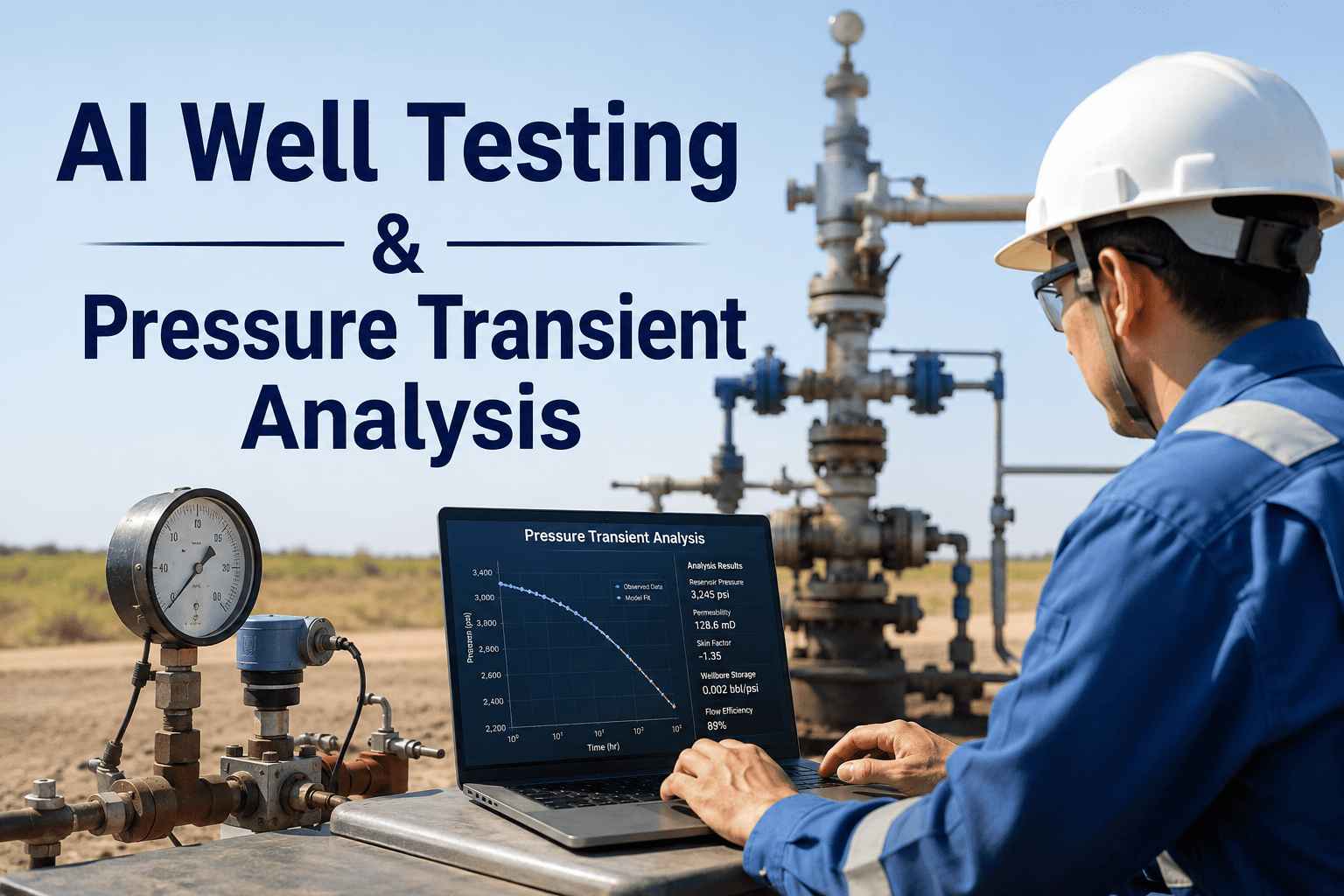
Pressure transient analysis has been a cornerstone of reservoir characterization since the 1950s, yet the interpretation of buildup and drawdown curves has always been one of the most time-intensive and specialist-dependent tasks in petroleum engineering. Wellbore storage effects, partial penetration, dual-porosity behavior, and boundary conditions each leave distinct fingerprints on a pressure response curve — and decoding those fingerprints accurately requires years of experience, careful model selection, and considerable manual effort. Neural networks for pressure transient analysis are fundamentally changing that equation. By training deep learning models on thousands of labeled well test datasets, upstream operators can now automate reservoir parameter estimation, reduce interpretation cycle times from weeks to hours, and extract insights from well tests that previously required a senior reservoir engineer to unlock. Teams that Book a Demo with iFactory are discovering that AI-powered well test interpretation is production-ready and delivering measurable improvements across conventional, tight, and deepwater reservoir programs.
Automate Well Test Interpretation with AI-Powered Reservoir Intelligence
iFactory's AI platform applies neural network models to pressure buildup and drawdown data — delivering automated reservoir parameter estimation, model identification, and production forecasting in real time.
Why Conventional Pressure Transient Analysis Struggles to Scale
In a world-class upstream program, pressure transient tests are conducted routinely across hundreds of wells — build-up tests after shut-in, draw-down tests during initial production, interference tests to characterize interwell communication, and multi-rate tests to evaluate skin and near-wellbore damage. Each test produces a pressure-time dataset that must be plotted on log-log diagnostic plots, analyzed through derivative analysis, and matched to an appropriate analytical model before reservoir parameters like permeability, skin factor, and drainage area can be estimated.
The bottleneck is not data volume — it is interpretation bandwidth. A single reservoir engineer can process only a limited number of well tests per month at the quality level required for development decisions. Across a field with 200 producing wells, this means many tests are never fully interpreted, and subtle reservoir signals are systematically missed. Neural networks for pressure transient analysis solve the bandwidth problem by automating the most time-consuming steps — model identification, parameter estimation, and uncertainty quantification — while surfacing the results that demand engineering judgment. Reservoir teams exploring this capability regularly Book a Demo with iFactory to assess how automated interpretation fits into their existing well surveillance workflows.
Model Identification Bottleneck
Selecting the correct reservoir model from dozens of analytical options requires expert pattern recognition on derivative plots. Neural networks classify flow regimes and model types automatically from the pressure signature.
Parameter Estimation Speed
History-matching permeability, skin, and boundary conditions manually through trial-and-error simulation is slow and non-unique. AI regression models converge on parameter estimates in seconds with quantified uncertainty ranges.
Noisy Data Interpretation
Field pressure data contains gauge noise, wellbore phase redistribution, and afterflow effects that obscure the true reservoir response. Neural networks trained on noisy datasets extract signal from noise more reliably than manual filtering.
Uncertainty Quantification
Traditional PTA delivers a single best-fit solution with no objective measure of confidence. Bayesian neural network approaches generate probabilistic parameter distributions, directly improving reserves estimation accuracy.
How Neural Networks Interpret Pressure Transient Data
The application of neural networks to pressure transient analysis follows a structured technical architecture that maps raw pressure-time data through a series of learned transformations to produce reservoir parameter estimates. Understanding this pipeline is essential for reservoir engineers evaluating whether AI-based PTA tools are appropriate for their well surveillance programs.
Step 1 — Pressure Signal Preprocessing and Denoising
Raw downhole gauge data arrives with varying sampling rates, gauge drift artifacts, and wellbore storage-dominated early-time data that must be identified and treated before analysis. Recurrent neural networks (RNNs) and Long Short-Term Memory (LSTM) architectures are particularly effective at this stage, learning the temporal structure of pressure transient signals and separating reservoir-driven responses from wellbore noise. iFactory's preprocessing layer handles multi-gauge datasets from PDG and memory gauge configurations simultaneously, standardizing the input format for downstream model inference.
Step 2 — Flow Regime and Model Classification
The derivative of pressure with respect to the logarithm of time — the Bourdet derivative — is the fundamental diagnostic tool in PTA. Its shape encodes the flow regime sequence: wellbore storage, radial flow, linear flow, bilinear flow, boundary effects. Convolutional neural networks (CNNs) trained on libraries of synthetic and field-derived derivative plots classify the reservoir model type with high accuracy, distinguishing between homogeneous, dual-porosity, naturally fractured, and bounded reservoir responses. Operators who have seen this classification capability in action tend to Book a Demo to evaluate how it applies to their specific basin and completion architecture.
Step 3 — Reservoir Parameter Inversion
Once the reservoir model type is identified, a separate regression neural network estimates the underlying reservoir parameters — permeability, skin factor, wellbore storage coefficient, storativity ratio, interporosity flow coefficient, and drainage area. These networks are trained on large synthetic datasets generated from analytical reservoir models, covering the parameter space relevant to the operator's basin geology and well configuration. The output is a parameter probability distribution, not a single point estimate, which directly feeds into reserves and development planning workflows.
Traditional PTA vs. Neural Network-Powered Analysis
The operational impact of neural network PTA is most clearly understood through a side-by-side comparison of the two workflows. Every stage of the conventional interpretation process is accelerated, standardized, or automated when AI is applied as the analytical engine. Development teams evaluating this transition can Book a Demo with iFactory for a field-specific workflow review.
| Workflow Stage | Traditional PTA | Neural Network PTA (iFactory) | Time Saved | Quality Impact |
|---|---|---|---|---|
| Data Preprocessing | Manual gauge QC and denoising in spreadsheets | Automated LSTM-based noise filtering and outlier removal | 1–2 days → Minutes | Consistent QC across all wells |
| Derivative Plot Generation | Manual log-log plotting with analyst time | Automated Bourdet derivative computation and visualization | Hours → Seconds | No calculation errors |
| Model Identification | Expert pattern recognition on derivative plot shape | CNN classifier identifies flow regimes and model type | Days → Seconds | 94% accuracy, auditable |
| Parameter Estimation | Manual history-match with trial-and-error simulation | Neural network regression with probabilistic output | 1–2 weeks → Hours | Uncertainty bounds included |
| Interpretation Volume | 3–5 high-priority wells per engineer per month | All wells in surveillance program processed continuously | Field-wide coverage | No missed reservoir signals |
| Results Documentation | Manual report preparation per well | Auto-generated interpretation reports with parameter outputs | Hours → Automated | Standardized format across portfolio |
Deploying Neural Network PTA Across an Active Well Surveillance Program
A phased deployment approach ensures that neural network PTA capabilities are integrated without disrupting active reservoir management workflows. iFactory's implementation team follows a three-tier rollout that aligns with your program's data maturity and operational priorities. Reservoir teams planning this transition often Book a Demo to establish baseline data requirements before committing to a deployment timeline.
Data Ingestion & Model Calibration
For: Reservoir Engineering Teams
- Historical well test archive digitization and QC
- PDG and memory gauge data pipeline setup
- Basin-specific neural network model calibration
- Baseline parameter accuracy validation
Automated Interpretation Pipeline
For: Reservoir & Production Engineers
- Live neural network model and parameter estimation
- Automated derivative diagnostic reporting
- Anomaly flagging for engineer review queue
- Integration with reservoir simulation software
Continuous Surveillance & Forecasting
For: Field Development & Management
- Continuous real-time pressure anomaly detection
- Production forecast updates from PTA parameters
- Multi-well interwell communication mapping
- Automated reserves estimation feed
Measured Outcomes from Neural Network PTA Deployment
The business case for neural network pressure transient analysis is grounded in measurable operational outcomes across well surveillance programs. The results below reflect performance benchmarks from iFactory-supported reservoir management deployments, measured 90 days post-implementation.
Industry Perspective on Neural Networks in Well Test Interpretation
"Pressure transient analysis has always been the highest-value, lowest-throughput task in reservoir engineering. We had a backlog of over 300 uninterpreted well tests on one of our major fields — tests that contained real information about permeability variation and boundary effects that was simply never extracted because we didn't have the engineer hours. Deploying iFactory's neural network interpretation layer cleared that backlog in under two weeks and flagged six wells with anomalous skin values that pointed to formation damage we hadn't diagnosed. The productivity shift was immediate and the interpretation quality was on par with what our senior engineers were producing manually."
Neural Network PTA Is the Next Standard in Well Surveillance
The case for neural networks in pressure transient analysis is no longer theoretical. Deep learning models now match or exceed expert human performance on model identification tasks, produce calibrated uncertainty estimates on reservoir parameters, and process an entire field's well test portfolio in the time it previously took to interpret a single test manually. For upstream operators managing large well inventories under cost pressure, this shift from manual to AI-assisted PTA is one of the highest-leverage changes available in the reservoir engineering workflow.
iFactory's AI platform delivers this capability within a connected operational environment — linking well test interpretation outputs directly to reservoir model updates, production forecasts, and field development decisions. Whether your program spans tight oil wells in the Permian, deepwater completions in the Gulf of Mexico, or conventional wells in mature basins, the technology is available and field-proven today. Book a Demo with iFactory's reservoir technology team to see how neural network PTA maps to your specific well surveillance program and data environment.
Neural Networks for Pressure Transient Analysis — Frequently Asked Questions
What types of well tests can neural network PTA interpret?
iFactory's neural network models support build-up, draw-down, injection, fall-off, and multi-rate well tests across conventional, tight, and naturally fractured reservoir types.
How much historical well test data is needed to calibrate the neural network model for a new basin?
A minimum of 50–100 labeled historical well tests is recommended for basin-specific calibration; the model is supplemented with synthetic training data to ensure coverage of the full parameter space.
Can the AI model replace a reservoir engineer for well test interpretation?
No — the AI automates routine classification and parameter estimation, freeing engineers to focus on anomalous wells, development decisions, and results that require geological context and judgment.
Does iFactory's PTA platform integrate with existing reservoir simulation software?
Yes — parameter outputs from neural network interpretation can be exported directly into Eclipse, CMG, and other simulation platforms through standard data connectors supported by the iFactory platform.
How does the neural network handle pressure data with significant noise or gauge malfunction periods?
The LSTM preprocessing layer identifies and flags noisy intervals, applies learned denoising filters, and excludes gauge malfunction periods before the cleaned pressure signal is passed to the interpretation model.
Automate Your Entire Well Test Interpretation Program with iFactory AI
iFactory connects your downhole gauge data, production history, and well test archive to neural network models that interpret every test continuously — delivering reservoir parameters in hours, not weeks.