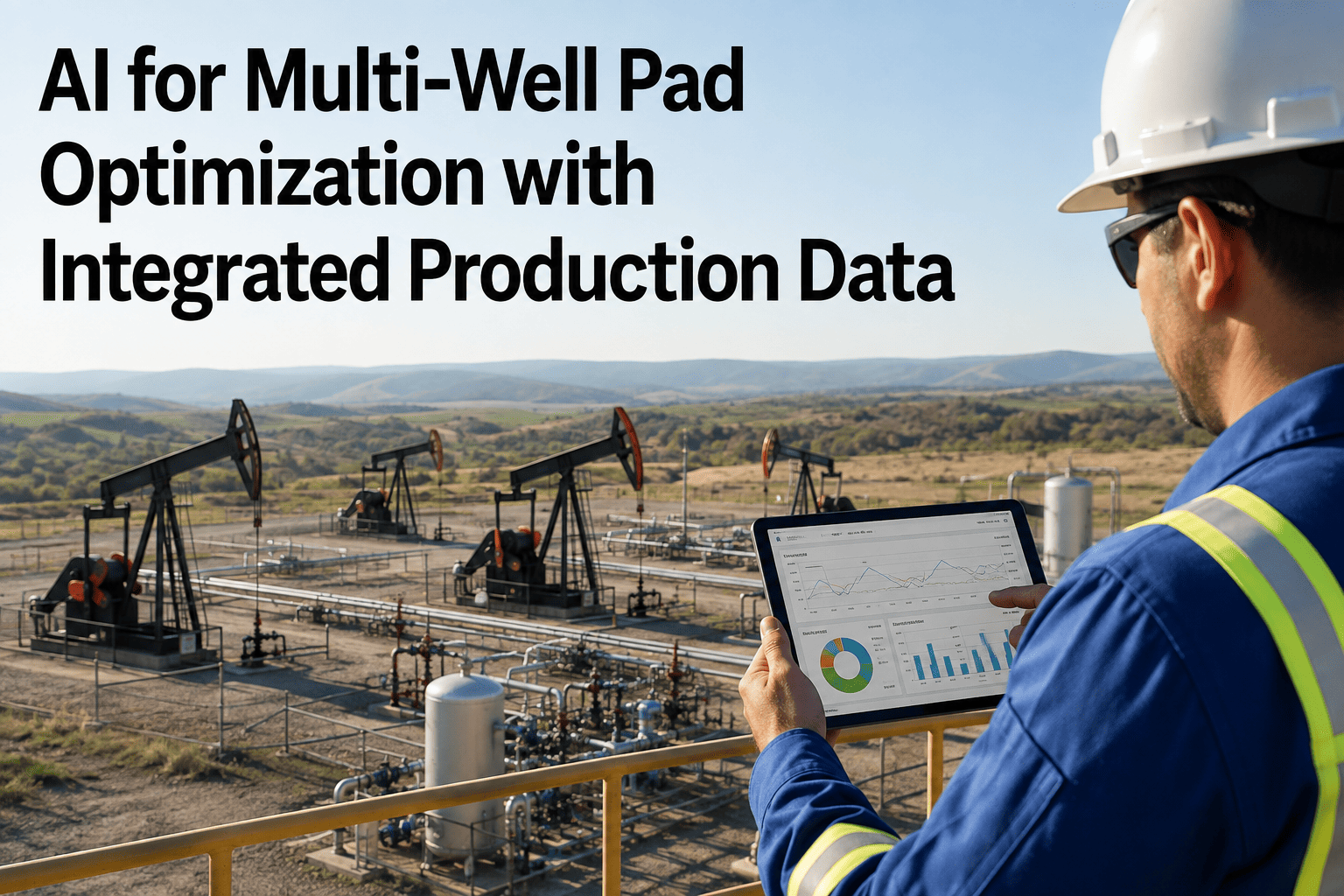
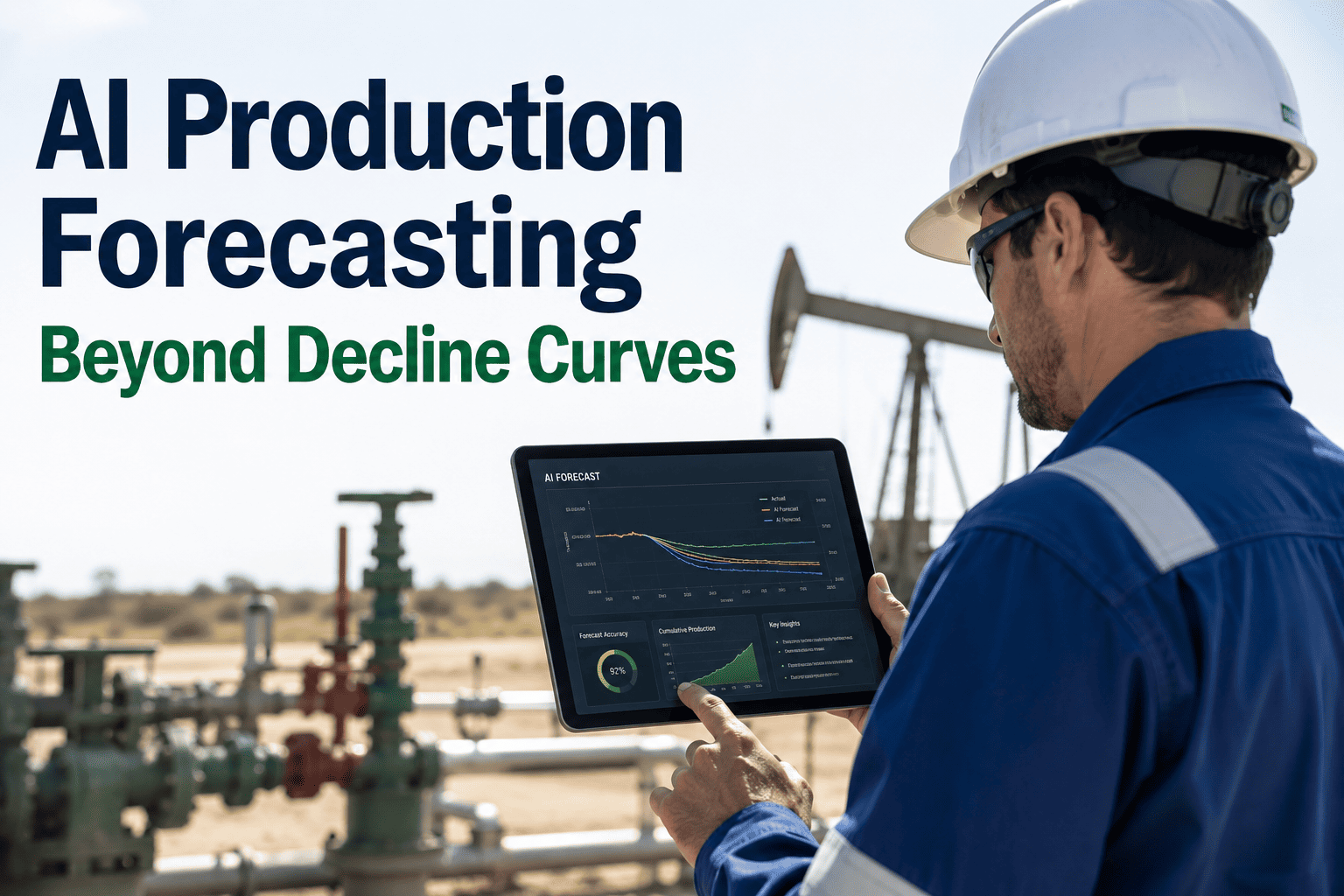
Production allocation across multiple oil wells has always been one of the most data-intensive, error-prone, and consequentially expensive challenges in upstream operations. When a shared separator receives commingled flow from eight, twelve, or forty wells simultaneously, attributing the correct oil, gas, and water volumes to each individual well is not a measurement problem — it is a modeling and inference problem. And in fields where test separator capacity accommodates only one well at a time, well tests happen infrequently enough that the allocation factors being applied today may reflect reservoir conditions from three months ago. The gap between what operators believe each well is producing and what it is actually producing drives misallocation of artificial lift resources, misinformed workover decisions, incorrect royalty calculations, and reservoir management strategies built on fundamentally inaccurate data. AI-enabled production allocation is the methodology that closes this gap — replacing periodic, low-frequency well test snapshots with continuous, high-fidelity per-well production attribution that updates in real time as reservoir and surface conditions evolve. This article explains how iFactory AI's platform delivers that capability across multi-well fields of any configuration, and what production allocation accuracy means for every downstream decision that depends on it.
Why Traditional Production Allocation Fails Multi-Well Fields
The conventional approach to production allocation — routing each well through a dedicated test separator on a rotating schedule, applying the resulting test ratios as fixed allocation factors until the next test — was designed for a simpler operational environment. In a 10-well field with monthly well tests and relatively stable reservoir conditions, allocation errors might be tolerable. In a 50-well shale pad operation where water cuts shift weekly, artificial lift settings change daily, and any single well can experience a rate change that propagates misallocation errors across the entire commingled stream, monthly well tests produce allocation accuracy that is structurally insufficient for the decisions that depend on it.
The consequences of poor allocation accuracy are not abstract. An ESP well that is being credited with 480 BOPD when it is actually producing 310 BOPD will not receive a workover recommendation until the next well test confirms the discrepancy — by which point the production loss has compounded for weeks. A waterflood injector pattern where producer allocation is inaccurate cannot be optimized because the injection-to-production correlation required for conformance modeling is built on wrong producer-level data. Royalty and fiscal allocation errors in commingled production systems create regulatory exposure that is far more expensive than the technology investment required to eliminate them. Operators who Book a Demo with iFactory consistently identify allocation accuracy as the foundation on which every other production optimization initiative depends.
- Well test allocation factors applied for 30–90 days between tests — no real-time update
- Single-well test separator accommodates one well at a time — high opportunity cost per test
- Rate changes from ESP adjustments, workover, or natural decline invisible between tests
- Commingled zone attribution in multilateral completions based on static models only
- Regulatory and fiscal allocation reconciliations require manual correction cycles
- Artificial lift optimization decisions built on allocation data that may be weeks out of date
- Virtual flow metering updates per-well allocation continuously from wellhead sensor data
- ML allocation model recalibrates automatically against well test data when tests are run
- ESP and choke adjustment events trigger immediate allocation factor recalculation
- Commingled zone attribution updated from downhole pressure gradient and temperature data
- Immutable allocation records generated automatically for regulatory and fiscal reporting
- Artificial lift optimization decisions driven by current, validated per-well production data
How AI Virtual Flow Metering Enables Continuous Production Allocation
The technical foundation of AI-enabled production allocation is the virtual flow meter — a machine learning model that estimates per-well oil, gas, and water production rates continuously from available wellhead and downhole sensor data, without requiring the well to be routed through a physical test separator. Virtual flow meters have been validated across onshore and offshore fields, multilateral completions, high-GOR reservoirs, and high water-cut production environments. The ensemble machine learning approach — combining gradient-boosted models, recurrent neural networks, and physics-informed correction layers — has demonstrated the ability to estimate multiphase flow rates with accuracy comparable to physical multiphase flow meters, at a fraction of the infrastructure cost.
iFactory's virtual flow metering engine ingests the sensor streams that most production wells already have: wellhead temperature and pressure, choke position, tubing and casing pressure differentials, and where available, downhole gauge readings. From these inputs, the ML model estimates the instantaneous oil, gas, and water rates for each well in the commingled system. The allocation of field-level separator measurements to individual wells is then performed by normalizing each well's virtual flow meter output against the measured total — producing well-level allocation volumes that are consistent with the measured total at the separator while reflecting each well's actual contribution. Operators looking to validate this approach for their specific field configuration are encouraged to Book a Demo with iFactory's reservoir technology team.
Production Allocation Across Commingled and Multilateral Completions
The allocation challenge is most acute in two well configurations that are now standard across U.S. unconventional and mature conventional operations: commingled multi-zone completions, where multiple reservoir intervals produce into a single wellbore without individual zone isolation; and pad drilling configurations, where multiple lateral wellbores share surface gathering infrastructure and a common production measurement point. In both cases, the fundamental problem is the same — production is measured at a point that is downstream of where the allocation decision needs to be made — but the data available to support AI allocation modeling differs significantly between these well types.
For commingled multi-zone completions, iFactory's AI allocation model incorporates downhole pressure gradient data from permanent downhole gauges or periodic PLT surveys to attribute production to individual zones. The model correlates surface production rate changes with downhole pressure responses to infer zone-level contribution factors that are updated continuously rather than locked at the last PLT interval. For pad drilling configurations, iFactory's multi-well allocation engine uses the multi-task learning architecture — a neural network architecture that learns shared production behavior patterns across all wells on a pad simultaneously — which has been validated to achieve 25–50% lower allocation error rates versus single-well models on assets where individual well data is insufficient to train accurate standalone models. Upstream engineers planning to apply this methodology to their specific completion architecture are encouraged to Book a Demo with iFactory to see how the model configuration maps to their field.
From Allocation Accuracy to Production Optimization: The Downstream Value Chain
Accurate per-well production allocation is not the end objective — it is the prerequisite for every production optimization decision that depends on knowing what each well is actually contributing. The operational value of AI allocation accuracy compounds across artificial lift management, waterflood pattern balancing, workover prioritization, and reservoir model history matching simultaneously.
| Downstream Application | How Allocation Accuracy Enables It | Impact Without AI Allocation | iFactory AI Capability |
|---|---|---|---|
| ESP & Gas Lift Optimization | Lift efficiency calculated per well requires accurate per-well liquid rate attribution | Lift setpoints optimized against allocated rates that may be 20–40% inaccurate — resulting in over- or under-lifted wells | Real-time lift efficiency scoring per well with automated setpoint recommendation based on current allocated production |
| Waterflood Pattern Balancing | Injection-to-production ratio per pattern requires accurate producer allocation by pattern zone | Pattern voidage replacement calculations built on inaccurate producer data — leading to pressure maintenance strategy errors | AI waterflood conformance model uses allocation-validated producer rates to optimize injection distribution per pattern |
| Workover Prioritization | Underperforming well identification requires deviation of actual vs expected production per well | Workovers scheduled based on operator observation or deferred to next well test — weeks of production loss before action | Anomaly detection flags allocation-validated rate deviations in real time — workover priority list updated daily, not monthly |
| Reservoir Model History Match | Dynamic model calibration requires per-well production history at fine temporal resolution | History matching performed with well test snapshots — model accuracy limited by test frequency, not reservoir complexity | Continuous allocation data feeds reservoir simulator history-match workflow — model accuracy improves as allocation data accumulates |
| Regulatory & Fiscal Reporting | State and federal production reports require well-level volume attribution at monthly resolution | Manual reconciliation of test-separator allocation factors against separator totals — high error rate and audit exposure | Automated production reports generated from immutable allocation records — regulatory format export with audit trail |
The compounding value of allocation accuracy across these five application areas is what drives the ROI case for AI production allocation in multi-well fields. A 15% improvement in ESP lift efficiency across a 40-well field, enabled by accurate per-well liquid rate data, delivers more economic value than the allocation system costs in its first year of operation. Upstream production engineers ready to quantify that value for their specific field are encouraged to Book a Demo with iFactory for a field-specific ROI assessment.
Expert Perspective: What AI Allocation Accuracy Changes in Multi-Well Field Operations
We had been running production allocation on a 60-day well test rotation across 34 wells on three pads. The allocated rates were the foundation of everything — lift optimization, waterflood pattern balancing, our reservoir model history match. What we discovered when we deployed continuous AI virtual flow metering was that eleven of our thirty-four wells had allocation factors that were off by more than 18% from their actual current rates. Two of them were off by more than 35%. The wells that looked like they needed workovers based on allocated rates did not need workovers — they needed their allocation factors corrected. And three wells that had been showing "normal" allocated production were actually underperforming significantly. Once we had accurate per-well data, our workover crew's first six months of prioritization decisions were completely different from what they would have been. The lift optimization recommendations also changed materially — we had been over-lifting seven wells and under-lifting four others based on inaccurate liquid rate attribution. Correcting that generated about 340 incremental BOPD in the first quarter without a single workover or equipment change.
Conclusion: Allocation Accuracy Is the Foundation, Not a Feature
The upstream oil and gas industry has accepted inaccurate production allocation as an operational reality for decades — because the alternative, running a test separator on every well continuously, was not economically feasible. AI virtual flow metering and machine learning allocation modeling have changed that equation entirely. Continuous per-well production attribution is now achievable using the sensor infrastructure that most multi-well fields already have installed, at a cost that is a fraction of the production value recovered through better lift management, workover prioritization, and waterflood optimization decisions. The fields where AI allocation has been deployed are not discovering marginal improvements in reporting accuracy — they are discovering that their entire production optimization strategy was built on a data foundation that was significantly less accurate than anyone realized. Correcting that foundation, in field after field, generates production recovery and operating cost savings that dwarf the platform investment within the first operating year. Upstream operators ready to assess their allocation accuracy and quantify what it is costing them should Book a Demo with iFactory and receive a field-specific allocation accuracy assessment before any platform commitment.