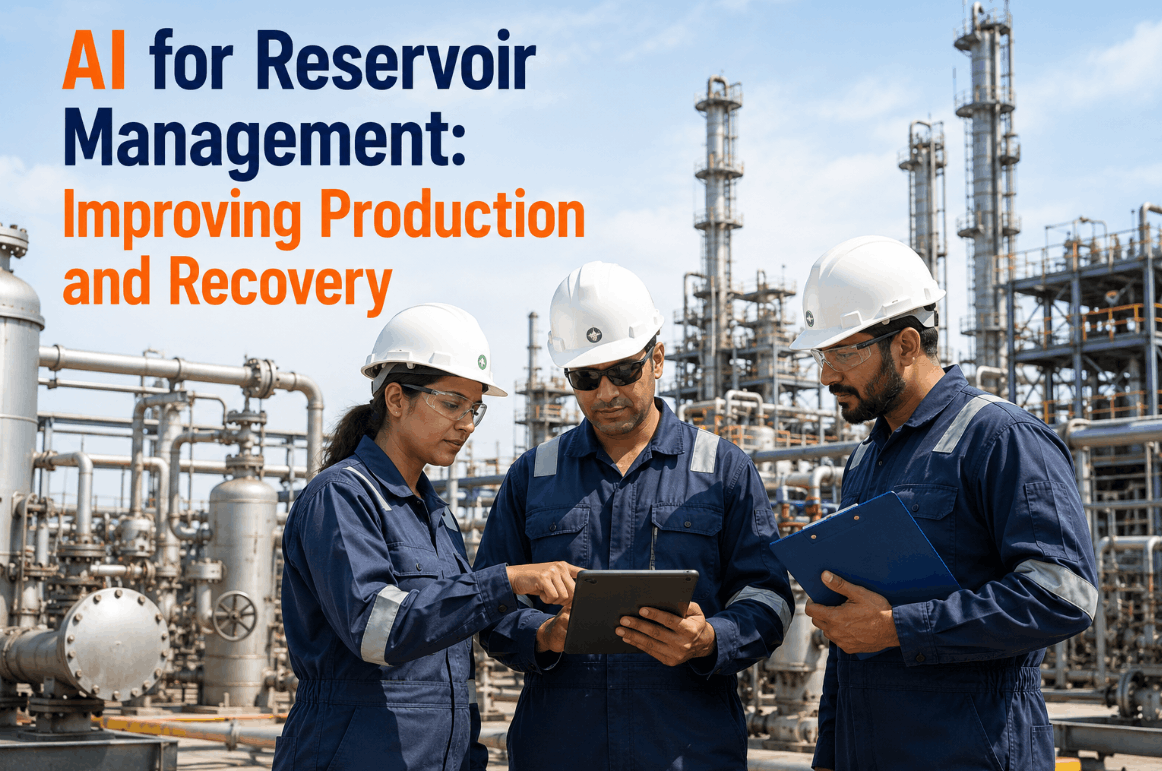
Reservoir management has always demanded the sharpest intersection of subsurface science, production engineering, and real-time decision-making — but the data volumes, heterogeneous geology, and economic pressures facing today's upstream operators have fundamentally outpaced what conventional simulation tools and manual workflows can process. From deepwater assets with thousands of sensor channels to unconventional shale plays with dense lateral spacing and complex fracture networks, the gap between available data and actionable insight has never been wider. AI reservoir management production recovery platforms close that gap by aggregating production histories, seismic attributes, well logs, and real-time downhole telemetry into a unified intelligence layer that continuously optimizes recovery decisions — shifting upstream operations from reactive production management to proactive, evidence-based reservoir stewardship.
Is Your Reservoir Data Driving Maximum Recovery Decisions?
Unify subsurface analytics, well performance monitoring, EOR optimization, and production forecasting into one intelligent platform purpose-built for upstream oil and gas reservoir management.
Why AI Is Redefining Reservoir Management and Production Recovery
Conventional reservoir management workflows — decline curve analysis, material balance calculations, and manually-run eclipse simulations — were built for a data environment that no longer exists. Modern upstream assets generate terabytes of structured and unstructured data per month across SCADA systems, downhole gauges, production historians, and completion records. The challenge is not data availability; it is the absence of an analytics layer capable of correlating signals across those systems, identifying the production-limiting conditions that are invisible to any single model, and generating recovery optimization recommendations that reach the reservoir engineer before the opportunity is lost. AI reservoir management production recovery platforms like iFactory AI address this directly — applying machine learning models trained on subsurface and surface data to deliver continuous production optimization across the full reservoir lifecycle. Upstream teams that Book a Demo consistently discover that their existing data infrastructure already contains the signals needed to meaningfully improve recovery factors — what was missing was the analytical framework to connect and act on them.
The transition from reactive to predictive reservoir management begins with a unified data layer. Pressure transient signals, water cut trends, gas-oil ratio anomalies, and injection conformance deviations are all detectable in real time — but only when AI models are applied across the full production dataset simultaneously. This capability transforms a reservoir engineer's ability to intervene early in decline events, optimize injection strategies, and protect long-term asset value across diverse geology and completion designs.
Production Decline Prediction
Apply neural network models to production histories and downhole sensor streams to forecast decline trajectories and identify intervention windows before rate loss becomes permanent recovery impairment.
EOR Strategy Optimization
Optimize water flood patterns, gas injection volumes, and chemical EOR timing using AI models that continuously update sweep efficiency predictions based on production response data from offset wells.
Well Interference Detection
Identify subsurface connectivity and inter-well communication patterns that cause production interference in tight spacing scenarios — protecting individual well EUR and preventing premature depletion.
Injection Conformance Monitoring
Monitor water and gas injection profiles in real time against reservoir simulation targets — automatically flagging conformance deviations that indicate channeling, thief zones, or wellbore integrity issues before sweep efficiency is compromised.
Building a Unified AI Architecture for Full-Cycle Reservoir Intelligence
A purpose-built AI reservoir management platform must address five foundational requirements unique to upstream production operations: real-time well performance monitoring, subsurface uncertainty quantification, EOR optimization across injection patterns, production forecasting for capital planning, and regulatory compliance documentation. Engineers who have already Book a Demo consistently report that connecting their fragmented production databases, simulation outputs, and real-time sensor streams into a unified AI analytics layer is the single highest-impact step in their reservoir management modernization program.
| Analytics Module | Primary Function | Reservoir Application | Production Benefit | Priority Level |
|---|---|---|---|---|
| Well Performance Monitoring | Rate decline & anomaly detection | Producers & Injectors | Early decline intervention | Critical |
| Injection Optimization | Sweep efficiency modeling | Water & Gas Flood Patterns | Improved recovery factor | Critical |
| Production Forecasting | EUR & decline curve AI | Asset-Level Planning | Defensible reserves estimates | High |
| Subsurface Connectivity | Inter-well communication mapping | Tight & Unconventional Assets | Reduced interference loss | High |
| Compliance Reporting | Regulatory documentation | State & Federal Audits | Zero documentation gaps | Standard |
How AI Reservoir Management Platforms Are Deployed Across Upstream Assets
Deploying an AI reservoir management platform is a structured process that connects existing production infrastructure — SCADA historians, completion databases, injection records, and downhole gauges — without requiring replacement of current reservoir simulation tools. The workflow below reflects how iFactory AI integrates with upstream data environments to deliver production optimization from day one of live monitoring. Reservoir engineers who Book a Demo early in their planning cycle consistently achieve faster time-to-value and stronger production response outcomes across their asset portfolios.
Production Data Unification & Asset Register Build
Aggregate production histories, completion data, injection records, and downhole sensor streams from SCADA, historian, and CMMS systems into a unified reservoir analytics layer. Establish well-level and pattern-level asset registers with quality classification and production priority mapping.
AI Model Training on Asset-Specific Production Signatures
Train machine learning models on field-specific production baselines — not generic type curves. Neural network models calibrated to local geology, completion design, and fluid properties deliver prediction accuracy that industry-standard decline curve tools cannot match across heterogeneous reservoir intervals.
Real-Time Production Monitoring & Anomaly Detection Activation
Connect all production sensor streams to the live AI monitoring layer. Configure well-level and pattern-level anomaly detection thresholds with consequence-weighted alert routing — separating production-critical signals from noise and delivering actionable intelligence to the reservoir engineer in real time.
EOR and Injection Optimization Deployment
Enable AI-driven injection optimization that continuously updates water flood allocation, gas injection scheduling, and chemical EOR timing based on production response signals from the active well pattern — improving sweep efficiency and recovery factor without requiring additional simulation runs.
Closed-Loop Production Optimization & Reserves Reporting
Implement a closed-loop optimization cycle where production outcomes feed back into model recalibration — continuously improving forecast accuracy and EUR estimates. Generate SEC-compliant production forecasts and regulatory reporting packages automatically from the same analytics layer driving operational decisions.
"Before deploying iFactory's AI reservoir management platform, our water flood patterns were operating at 54% sweep efficiency — with no systematic way to identify which injectors were channeling into thief zones versus contributing to productive sweep. Within 90 days of live monitoring, we identified three pattern rebalancing opportunities that increased field-level recovery factor by 6.2% and reduced water handling costs by $1.4M annually."
Top Challenges AI Reservoir Management Solves for Upstream Operators
Most upstream operators pursuing AI-driven improvements to their reservoir management programs encounter a consistent set of data, workflow, and organizational challenges. Understanding these gaps before a platform deployment dramatically improves implementation success and helps reservoir engineering teams allocate finite budgets more strategically across complex multi-asset portfolios.
Production histories, injection records, downhole gauges, and completion data sit in disconnected systems — making cross-pattern and cross-well analytics impossible without manual data extraction that introduces lag and error.
Arps decline curves cannot adapt to changing reservoir drive mechanisms, artificial lift transitions, or infill drilling effects — generating EUR estimates that systematically diverge from actual recovery performance over time.
Water and gas injection programs managed on fixed monthly allocation schedules cannot respond to real-time production signals indicating channeling, pressure imbalance, or sweep deterioration — leaving significant recovery on the table.
Without AI-driven inter-well communication analysis, unconventional operators lack the subsurface connectivity intelligence needed to optimize infill spacing, prevent frac hits, and protect parent well EUR in tight lateral environments.
Production reporting, reserves documentation, and regulatory filings built on manual data assembly create compliance risks, consume engineering bandwidth, and delay the operational decisions that drive recovery performance.
Reservoir simulation models built during development planning become progressively less representative as production data accumulates — without an AI history-matching layer, the gap between model predictions and actual performance widens continuously.
Closing these gaps requires more than off-the-shelf production analytics software — it demands a purpose-built platform engineered for the subsurface complexity and data heterogeneity of modern upstream operations. Reservoir engineers regularly Book a Demo to benchmark their current program against a proven AI reservoir management architecture.
Key AI Capabilities Driving Production and Recovery Improvement
The highest-impact AI capabilities in reservoir management production recovery are not replacements for reservoir engineering expertise — they are force multipliers that allow a reservoir team to apply that expertise across more wells, more patterns, and more decisions simultaneously than any manual workflow allows. iFactory AI delivers four core technical capabilities that address the specific production and recovery challenges of upstream oil and gas asset management.
Core AI Capabilities for Reservoir Management and Production Recovery
Combine reservoir physics constraints with neural network flexibility to generate EUR forecasts that honor subsurface geology while adapting to production anomalies that purely empirical models cannot explain.
Apply AI-assisted pressure transient interpretation to continuous downhole gauge data — delivering reservoir characterization insights at a frequency and scale that traditional manual PTA workflows cannot match across large well counts.
Simultaneously optimize injection allocation, production choke settings, and artificial lift parameters across interconnected well patterns — capturing pattern-level recovery improvements invisible to single-well optimization approaches.
Continuously recalibrate reservoir simulation models against production performance data using AI-driven history matching — maintaining a representative subsurface model that supports reliable long-range recovery forecasting and infill drilling decisions.
Expert Review: Why AI Is Now a Competitive Requirement in Reservoir Management
In more than two decades of reservoir engineering across Permian Basin unconventional assets and deepwater Gulf of Mexico fields, the pattern I encounter most consistently is this: the production data to improve recovery decisions existed. Water cut trends that signaled injection channeling three months before a pattern producer went on pump. Pressure transient signals in the downhole gauges that indicated a fracture communication event nobody interpreted until the parent well declined 35% ahead of forecast. The failure was not instrumentation or engineering competence. It was the absence of an analytics layer that could connect those signals across the full well count and deliver an actionable recommendation to the reservoir engineer before the recovery window closed. What AI reservoir management changes is the fundamental throughput of the reservoir engineering function — instead of analyzing 12 wells per month in detail, a team with the right AI platform can maintain real-time intelligence across 400 wells simultaneously, with automated anomaly escalation that surfaces the wells requiring intervention before the engineer would have identified them manually. The operators I see deploying AI-driven production optimization are not just improving their near-term recovery rates. They are changing the quality of their reserves estimates, their infill drilling decisions, and their conversations with capital allocators — because they can demonstrate, with continuous production data, that their reservoir management program is evidence-based rather than schedule-based. That distinction is worth hundreds of millions of dollars over the life of a major asset.
Modernize Your Reservoir Management Program with AI
Deploy a unified AI platform that integrates production monitoring, EOR optimization, subsurface connectivity analytics, and compliance documentation — built specifically for upstream oil and gas reservoir management.
The AI Advantage in Reservoir Management: From Data Overload to Recovery Intelligence
The production and recovery signals needed to improve upstream asset performance are already present in the data that modern oil and gas operations generate every hour. Pressure transients, water cut trends, injection conformance deviations, and inter-well communication patterns are all detectable — but only by an analytics layer capable of processing the full production dataset simultaneously and delivering consequence-weighted recommendations before the recovery window closes. Calendar-based reservoir management programs and static decline curve tools cannot deliver this capability at the well counts and data volumes that characterize modern upstream portfolios.
iFactory AI delivers exactly what modern reservoir management requires: real-time well performance monitoring, AI-driven injection and EOR optimization, subsurface connectivity intelligence for unconventional assets, automated history matching for reservoir model accuracy, and full compliance documentation — all from a single platform that connects to existing production infrastructure without replacing the simulation tools already in use. The economic case is unambiguous: a 6% improvement in recovery factor on a mid-size oil field represents hundreds of millions of dollars in incremental asset value. To see how AI reservoir management maps to your specific asset portfolio and production data environment, Book a Demo with the iFactory AI team today.
AI Reservoir Management — Common Questions Answered
AI identifies injection conformance deviations, channeling events, and sweep inefficiencies in real time — enabling pattern rebalancing and EOR timing adjustments that recover incremental reserves invisible to conventional decline analysis.
Yes — iFactory AI sits above existing simulation tools as an intelligence layer, ingesting simulation outputs and production data via API to deliver real-time optimization recommendations without replacing current engineering workflows.
iFactory AI generates production forecasts from production histories, downhole pressure and temperature data, injection records, and completion parameters — integrating from SCADA, historian, and CMMS systems already present in most upstream operations.
Physics-informed neural network models quantify forecast uncertainty through probabilistic output ranges — providing P10/P50/P90 production scenarios that update continuously as new production data is ingested, reducing uncertainty over the asset life cycle.
Most iFactory AI deployments deliver measurable production optimization actions within 60–90 days of live monitoring, with pattern-level recovery improvements and injection rebalancing opportunities identified in the first full production cycle following platform activation.