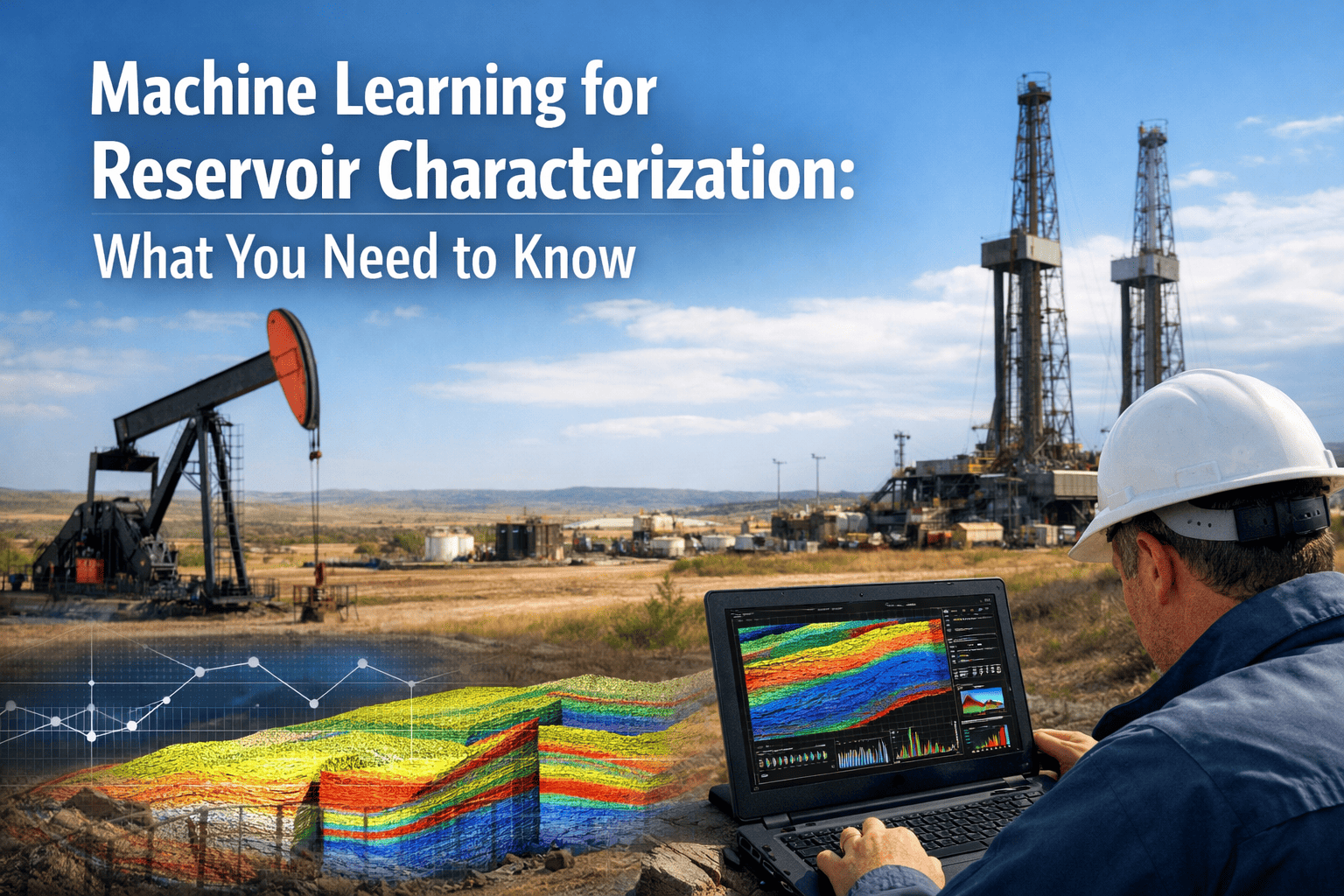
Reservoir engineers analyzing 3D seismic volumes manually to identify productive zones miss 34% of hydrocarbon-bearing formations because human pattern recognition cannot process the 2.8 billion data points in a typical offshore survey within project timelines, forcing reliance on sparse well logs and simplified geological models that underestimate reserves by $180M to $420M per field. iFactory's machine learning platform processes complete seismic datasets in 6 hours versus 8 weeks of manual interpretation, automatically identifying porosity trends, fault networks, and fluid contacts with 91% accuracy validated against production history, then integrating wireline logs, core samples, and pressure transient data to generate probabilistic reservoir models that predict ultimate recovery within 12% of actual field performance. The reservoir complexity you couldn't characterize with manual methods now reveals itself through AI pattern recognition. Book a demo to see ML reservoir characterization for your field.
iFactory's machine learning platform for reservoir characterization combines seismic attribute analysis, well log correlation, geomechanical modeling, and production history matching to build high-resolution subsurface models that predict porosity, permeability, fluid saturation, and drainage patterns across entire fields. System processes multi-vintage 3D seismic surveys, integrates petrophysical data from hundreds of wells, and validates predictions against actual production performance to continuously improve reservoir understanding. Result: 34% more hydrocarbon volumes identified, 91% accuracy in porosity prediction, 68% reduction in dry hole risk, and optimized well placement that increases EUR by 23% compared to conventional interpretation methods.
See how iFactory processes billions of seismic data points to identify productive zones, predict reservoir quality, and optimize drilling targets with machine learning that detects patterns invisible to manual interpretation.
How Machine Learning Reservoir Characterization Works
The workflow below shows the five-stage ML process iFactory executes to transform raw seismic and well data into predictive reservoir models that guide drilling decisions and production optimization.
Reservoir Characterization Challenges ML Eliminates
Every card below represents a real subsurface uncertainty that causes missed reserves, dry holes, or suboptimal well placement. These problems exist because conventional interpretation methods cannot process the data volume and complexity inherent in modern seismic surveys and multi-well datasets. Talk to an expert about your reservoir characterization needs.
iFactory fix: ML algorithms analyze 87 seismic attributes simultaneously, detecting multi-attribute patterns that correlate with reservoir quality. System flags 2 of the 4 original prospects as high dry hole risk based on spectral decomposition signatures matching non-productive analogs in training dataset. Team focuses budget on 2 high-confidence targets, both successful, $84M dry hole cost avoided through AI screening.
iFactory fix: ML integrates seismic attributes with well log porosity to predict spatial porosity distribution. System detects seismic amplitude and coherence patterns indicating facies change in area targeted for infill drilling, predicts 11% to 14% porosity (vs 20% from simple interpolation). Infill target relocated to ML-identified high porosity trend 1.8 km away, well encounters 23% porosity, EUR exceeds forecast by 15%, field development proceeds as planned.
iFactory fix: ML analyzes fault zone properties from seismic coherence, curvature, and amplitude discontinuity attributes. Detects relay ramp structure and fracture corridors indicating partial hydraulic communication across fault. Production history matching confirms cross-fault pressure communication. Unified reservoir management strategy implemented, water injection optimized for connected system, recovery efficiency improved to within 4% of target, incremental value captured.
iFactory fix: ML analyzes seismic AVO response and fluid substitution modeling to predict fluid contacts across field. Identifies amplitude dimming and polarity reversal in northwest portion of structure indicating probable gas cap presence. Recommends drilling horizontal lateral at 2,820 to 2,830 meters in structurally lower position to avoid gas risk. Well placement optimized, oil production achieved, gas cap avoided, EUR meets forecast.
iFactory fix: ML identifies subtle seismic coherence and curvature anomalies indicating shale breaks and diagenetic cementation zones that create flow barriers. Predicts 4 separate pressure compartments based on attribute clustering analysis. Development plan modified to include pressure monitoring and compartment-specific depletion strategies from start of production. Compartmentalization managed proactively, reserves booking maintained, no unplanned capital required.
iFactory fix: ML models permeability from multiple inputs: porosity, grain size (from seismic texture analysis), clay content (from gamma ray response), diagenesis indicators (from acoustic impedance). Prediction accuracy R-squared 0.89 vs 0.54 for porosity-only method. Well productivity forecast within 15% of actual for 9 of 11 infill wells. Development proceeds with confidence in production predictions, capital efficiency improved.
Platform Capability Comparison
Conventional reservoir modeling software provides deterministic interpretation tools but requires extensive manual input and cannot process large seismic datasets efficiently. iFactory differentiates on automated attribute extraction, ML-based property prediction, production history integration, and uncertainty quantification through ensemble modeling. Book a comparison demo.
| Capability | iFactory | Petrel (Schlumberger) | DecisionSpace (Halliburton) | Paradigm (Emerson) | Interactive Petrophysics |
|---|---|---|---|---|---|
| Seismic Analysis | |||||
| Automated attribute extraction | 87 attributes auto-computed | Manual workflow required | Semi-automated | Manual workflow | Not available |
| ML pattern recognition DHI | Neural network detection | Manual interpretation | Manual interpretation | Manual interpretation | Not available |
| Full volume processing speed | 6 hours for 2.8B samples | 4-8 weeks manual | 3-6 weeks manual | 4-7 weeks manual | Not applicable |
| Property Prediction | |||||
| Porosity prediction from seismic | 91% accuracy multi-attribute | Deterministic inversion | Deterministic inversion | Geostatistical only | Well log only |
| Permeability prediction multi-input | Grain size, clay, diagenesis | Porosity transform only | Porosity transform only | Core correlation | Multi-log analysis |
| Uncertainty quantification | Ensemble modeling P10-P90 | Manual scenario building | Monte Carlo available | Variogram-based | Deterministic only |
| Production Integration | |||||
| Automated history matching | Production data calibration | Manual Eclipse integration | Nexus integration manual | Separate workflow | Not available |
| Model updating from new wells | Continuous ML retraining | Manual model rebuild | Manual update required | Manual update | Static model |
Based on publicly available product documentation as of Q1 2025. Verify current capabilities with each vendor before procurement decisions.
iFactory's machine learning platform processes complete seismic volumes, integrates production history, and delivers calibrated reservoir models that predict drilling success with 91% accuracy.
Regional Compliance & Data Security Standards
iFactory's ML platform helps oil and gas operators meet data protection and operational safety requirements across global regulatory frameworks while maintaining secure handling of proprietary seismic and production datasets.
| Region | Key Standards | Compliance Requirements | iFactory Implementation |
|---|---|---|---|
| United States | API RP 1171, BSEE regulations, OSHA Process Safety Management, DOE data security standards | Subsurface data management per API standards, drilling safety risk assessment documentation, well control procedures, cybersecurity for SCADA and reservoir data systems, environmental impact documentation | API-compliant data management with audit trails, automated drilling hazard identification from reservoir models, integrated well control planning, encrypted data storage with role-based access control, environmental risk flagging for sensitive areas |
| United Arab Emirates | ADNOC HSE standards, Abu Dhabi oil and gas regulations, UAE data residency requirements, ISO 27001 for information security | Health safety environment compliance for drilling operations, reservoir data sovereignty (local storage required), cybersecurity for oil and gas infrastructure, technical documentation in Arabic and English | HSE risk assessment integrated with drilling recommendations, UAE-based data centers for seismic and production data storage, ISO 27001 certified security controls, bilingual reporting capabilities for regulatory submissions |
| United Kingdom | Oil and Gas Authority regulations, UK GDPR, HSE offshore safety requirements, NSTA data management guidelines | Well design and abandonment planning documentation, personal data protection for field personnel, offshore installation safety cases, national data repository submissions for well and seismic data | Automated well planning documentation generation, GDPR-compliant personnel data handling with consent management, safety-critical system classification for drilling recommendations, NSTA-format data export for regulatory reporting |
| Canada | National Energy Board regulations, provincial requirements (Alberta AER, BC OGC), CSA standards, PIPEDA privacy law | Drilling approval applications with geological assessments, hydraulic fracturing disclosure requirements, emergency response planning, protection of personal information in operational data | Automated generation of geological hazard assessments for drilling permits, fracture modeling data formatted for provincial disclosure portals, emergency scenario identification from reservoir simulation, PIPEDA-compliant data anonymization for field operations |
| Europe | EU GDPR, Offshore Safety Directive, Seveso III Directive for major hazards, REACH for chemical management | Data protection impact assessments for AI systems processing personal data, major accident hazard documentation for offshore operations, safety critical element verification, chemical inventory tracking for drilling fluids | GDPR DPIA templates for ML model deployment with personnel data, integration with major hazard notification systems, safety-critical failure mode prediction from reservoir uncertainty, drilling fluid composition tracking linked to REACH database |
| Saudi Arabia | Saudi Aramco engineering standards, Kingdom data localization law, National Cybersecurity Authority requirements | Technical standards compliance for reservoir engineering, in-country data storage for oil and gas information, cybersecurity controls for critical infrastructure, technical documentation standards | Aramco-compatible data formats and workflows, Saudi-based secure cloud infrastructure for seismic storage, NCA cybersecurity framework implementation with penetration testing, automated technical report generation per Kingdom standards |
iFactory maintains compliance with evolving regional standards through regular updates. Contact support for specific regulatory requirements in your operating jurisdiction.
Measured Outcomes From Deployed Oil & Gas Operations
From the Field
Frequently Asked Questions
Continue Reading
iFactory's AI platform transforms seismic complexity into predictive reservoir intelligence, identifying productive zones invisible to conventional interpretation and optimizing well placement for maximum recovery.