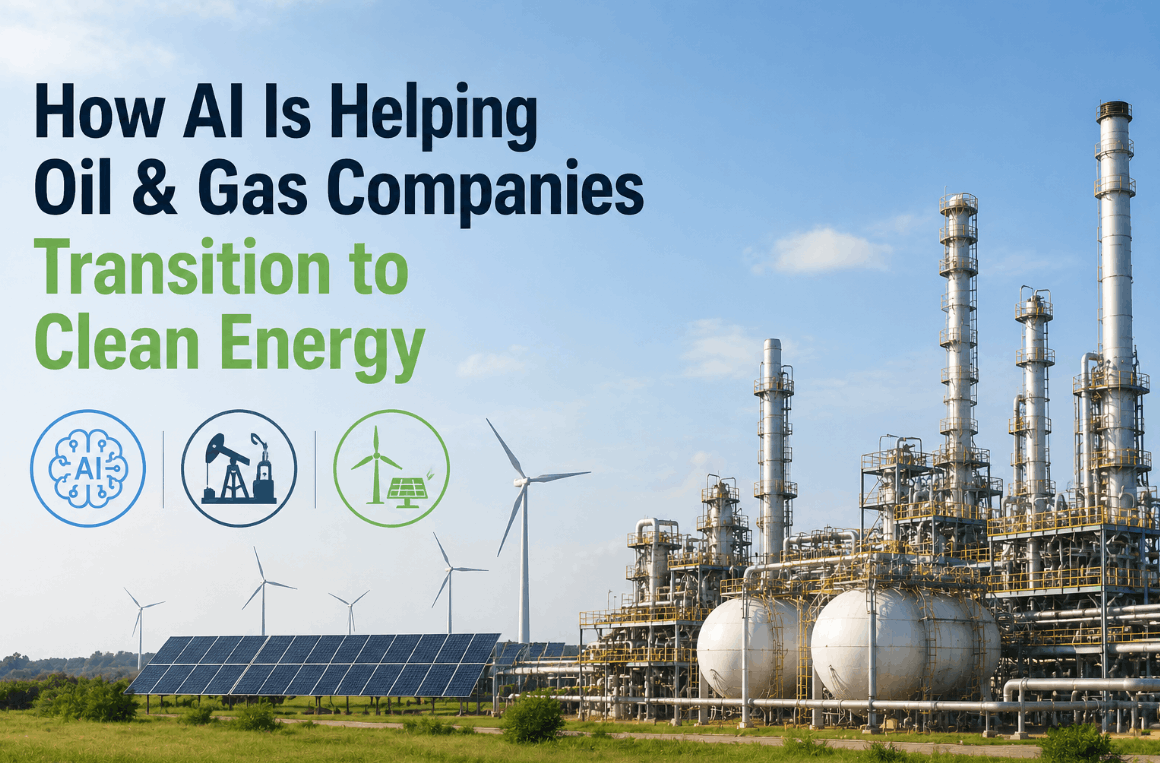
The oil and gas industry is under mounting pressure to reduce its carbon footprint while continuing to meet global energy demand. Across upstream, midstream, and downstream operations, producers are navigating tightening emissions regulations, shareholder net-zero commitments, and an accelerating shift toward cleaner energy sources. AI is emerging as the most practical technology bridge — enabling oil and gas companies to simultaneously optimize current operations, reduce methane and CO2 emissions, accelerate carbon capture programs, and integrate renewable energy into their existing infrastructure. Book a Demo to see how iFactory AI supports the oil and gas clean energy transition across your operations.
How AI Is Accelerating the Oil & Gas Clean Energy Transition
iFactory AI connects emissions monitoring, CCUS optimization, hydrogen production planning, and renewable integration into one intelligent platform — built for oil and gas operators committed to decarbonization without sacrificing production performance.
Why AI Has Become Central to the Oil & Gas Clean Energy Transition
For decades, oil and gas companies managed emissions as a compliance exercise — periodic surveys, annual reporting, and reactive mitigation. That model no longer meets the pace of regulatory change or investor expectations. The U.S. Inflation Reduction Act, SEC climate disclosure rules, and global net-zero frameworks are demanding continuous, verifiable emissions reduction across the full asset lifecycle. At the same time, cleantech investments are projected to reach $670 billion in 2025, surpassing upstream oil and gas spending for the first time — a clear signal of where capital is flowing.
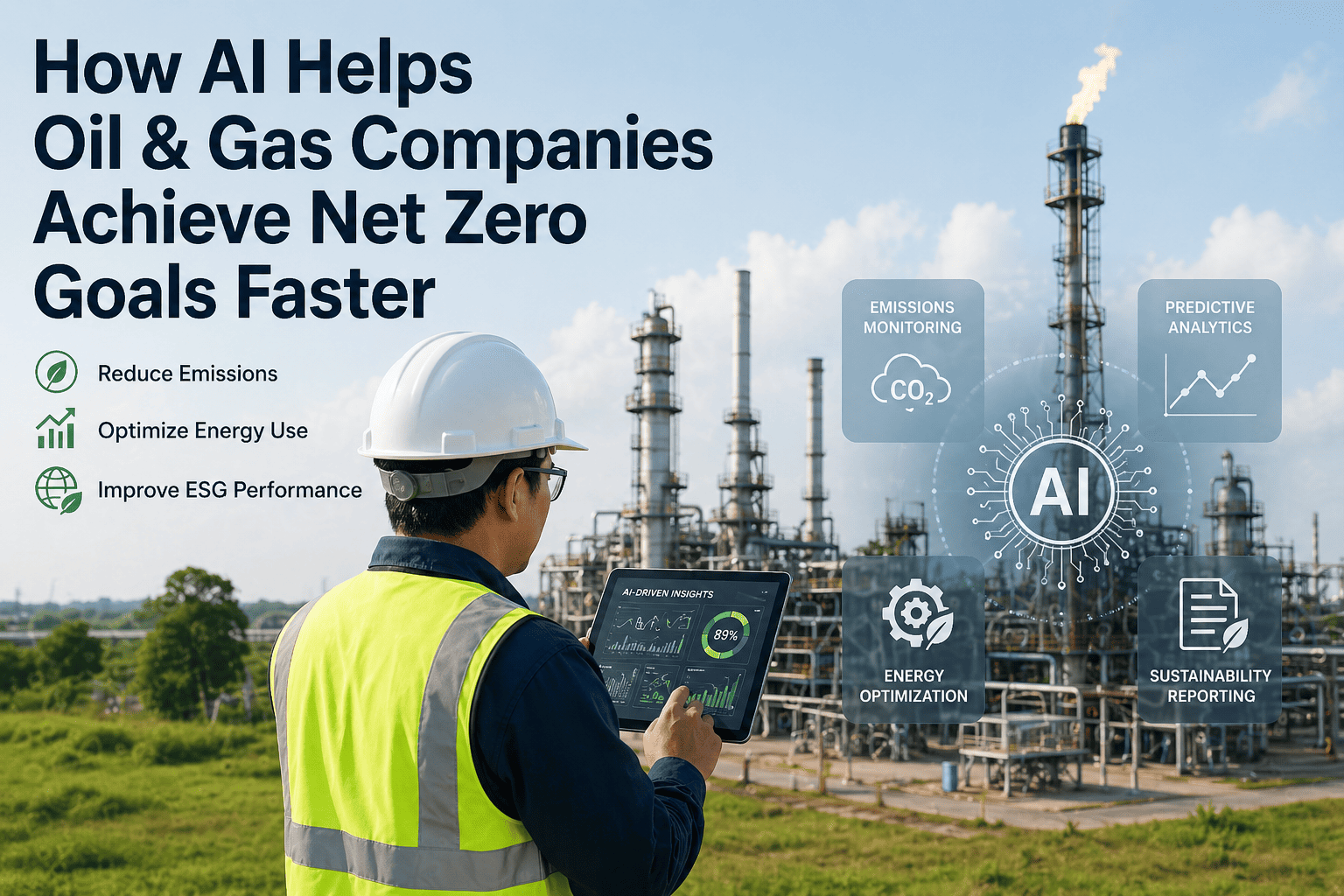
The challenge for oil and gas operators is that decarbonization cannot come at the cost of production continuity. AI resolves this tension directly. By applying machine learning across operational data streams — SCADA signals, IoT sensor feeds, satellite imagery, and ERP records — AI platforms like iFactory AI identify where emissions originate, predict where equipment is trending toward inefficiency, and optimize process conditions to reduce carbon intensity per barrel without interrupting output. Book a Demo to see how iFactory AI maps AI capabilities to your specific transition roadmap.
AI-Driven Methane Detection and Emissions Reduction Across Oil & Gas Assets
Methane traps heat roughly 80 times more effectively than CO2 over a 20-year period, making leak detection the single highest-leverage emissions reduction opportunity available to oil and gas operators today. Traditional survey methods — periodic on-site inspections conducted a few times per year — consistently miss short-duration releases and cannot prioritize repair by volume impact. AI transforms this entirely.
Machine learning models fuse satellite imagery, fixed IoT sensors, mobile monitoring units, and SCADA data to scan asset networks continuously — flagging anomalies that signal methane releases within hours rather than months. AI-driven systems like iFactory AI integrate this detection layer with maintenance workflows, automatically generating repair work orders prioritized by emissions volume and regulatory risk. The result is a closed-loop emissions management system where every detected leak triggers a documented, trackable response.
Continuous Satellite and IoT Methane Monitoring
AI models trained on multispectral satellite imagery and ground-level sensor data can detect methane plumes at facility level with two-day revisit cycles — enabling attribution to specific equipment and triggering notifications before emissions accumulate. iFactory AI ingests these signals and contextualizes them against production state, wind conditions, and historical baseline data for accurate source attribution.
Flaring Optimization and Combustion Efficiency
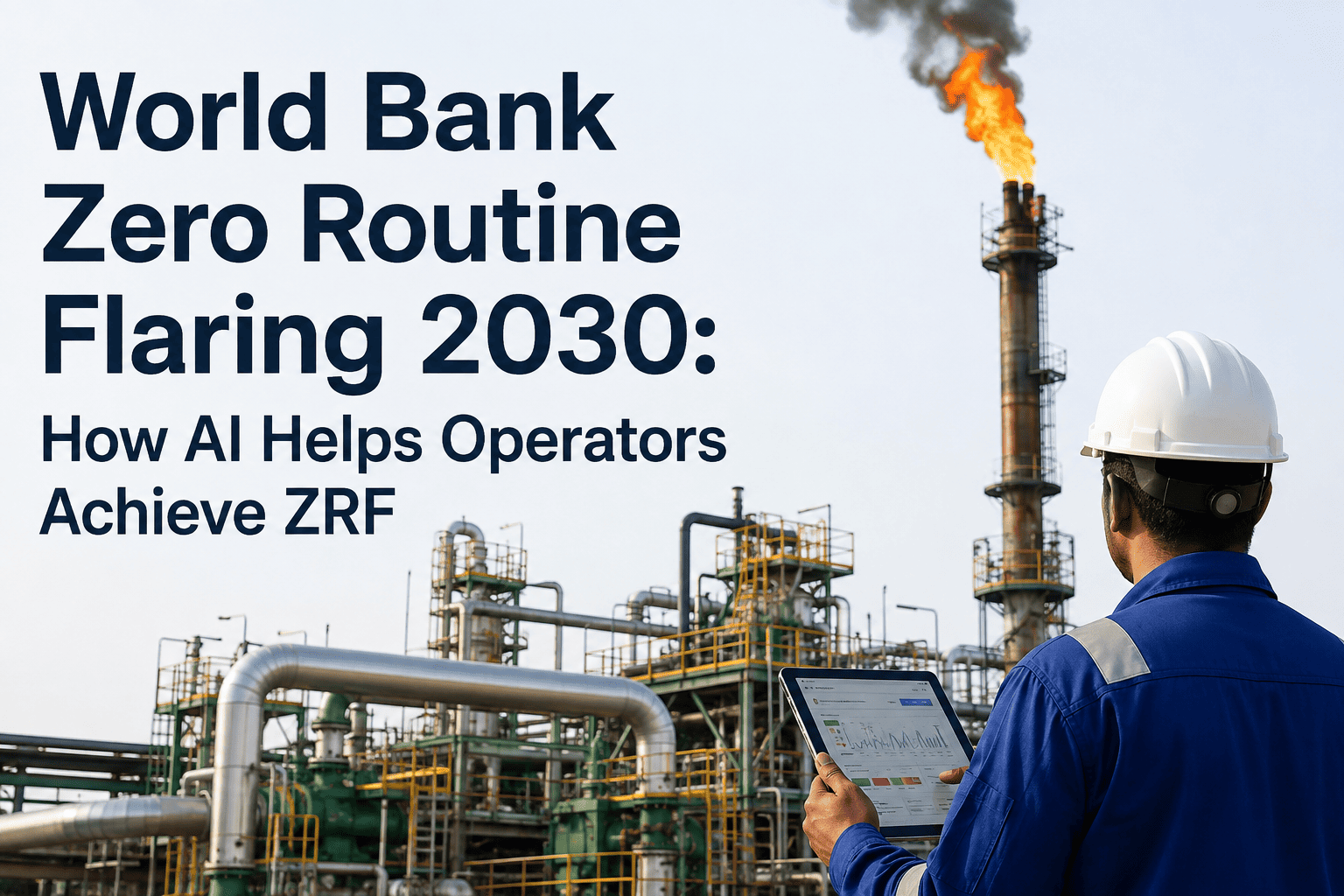
Flaring accounts for a significant share of upstream CO2 emissions. AI models analyze flare system operating conditions — composition, pressure, combustion efficiency, and regulatory thresholds — to minimize flare volume, improve combustion completeness, and identify opportunities for gas recovery. iFactory AI continuously monitors combustion parameters and adjusts operational setpoints to keep carbon intensity per barrel on target.
Carbon Intensity Benchmarking and Regulatory Reporting
AI-driven platforms consolidate emissions data from across the asset portfolio — wellheads, compressor stations, processing facilities, and transport infrastructure — into audit-ready carbon intensity dashboards. iFactory AI automates the calculation of Scope 1 and Scope 2 emissions, maps results against OGCI intensity targets, and generates regulatory reporting outputs aligned with SEC disclosure and EPA reporting requirements.
AI in Carbon Capture, Utilization, and Storage: Accelerating CCUS Deployment
Carbon Capture, Utilization, and Storage is one of the most critical pathways for oil and gas decarbonization — particularly for assets where operational emissions cannot be eliminated through efficiency alone. The IEA projects that CCUS must capture 840 million metric tons of CO2 annually by 2030 to stay on track for net-zero targets. Achieving that scale requires AI-driven optimization at every stage: site selection, capture process efficiency, storage integrity monitoring, and utilization pathway management.
iFactory AI supports CCUS programs by integrating subsurface sensor data, process control signals, and reservoir simulation outputs into a unified intelligence layer. AI models continuously optimize capture solvent conditions, compressor efficiency, and injection pressure profiles — reducing the energy penalty of carbon capture and improving the economics of CCUS projects over their operational lifetime. Book a Demo to explore how iFactory AI supports CCUS operations management.
Capture Process Optimization
AI models monitor solvent degradation, absorber column temperatures, and regeneration energy consumption in real time — identifying setpoint adjustments that reduce the energy penalty of CO2 capture by 12–18% compared to static control approaches.
Compression and Transport Monitoring
Predictive maintenance models analyze compressor vibration, seal condition, and pressure differential data to prevent unplanned shutdowns in the CO2 transport network — maintaining CCUS project availability and avoiding costly reinjection interruptions.
Geological Storage Integrity
AI-driven reservoir models integrate microseismic data, wellhead pressure readings, and geochemical monitoring to verify storage formation integrity — providing continuous assurance that injected CO2 is contained and generating the verified storage records required for 45Q tax credit documentation.
Utilization Pathway Planning
For operators pursuing CO2 utilization — enhanced oil recovery, synthetic fuel production, or industrial feedstock supply — AI optimizes injection scheduling, product quality management, and revenue modeling to maximize the commercial value of captured carbon.
AI-Enabled Hydrogen Production and Renewable Energy Integration in Oil & Gas
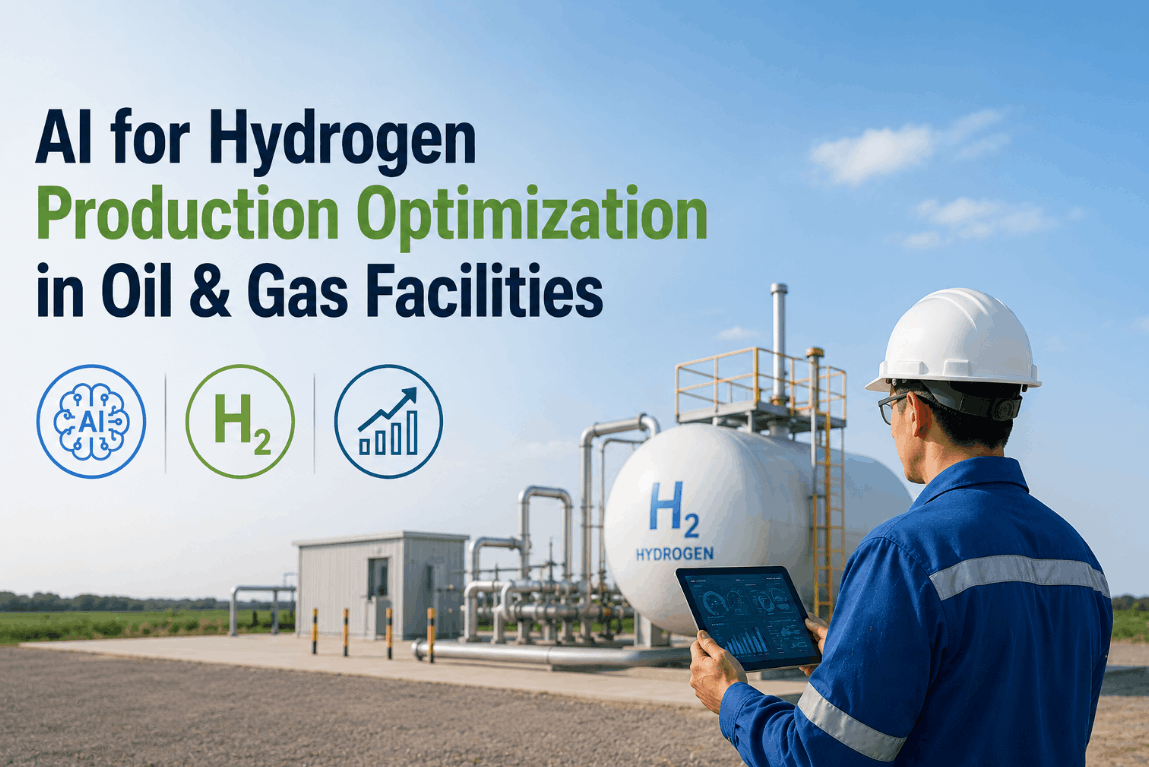
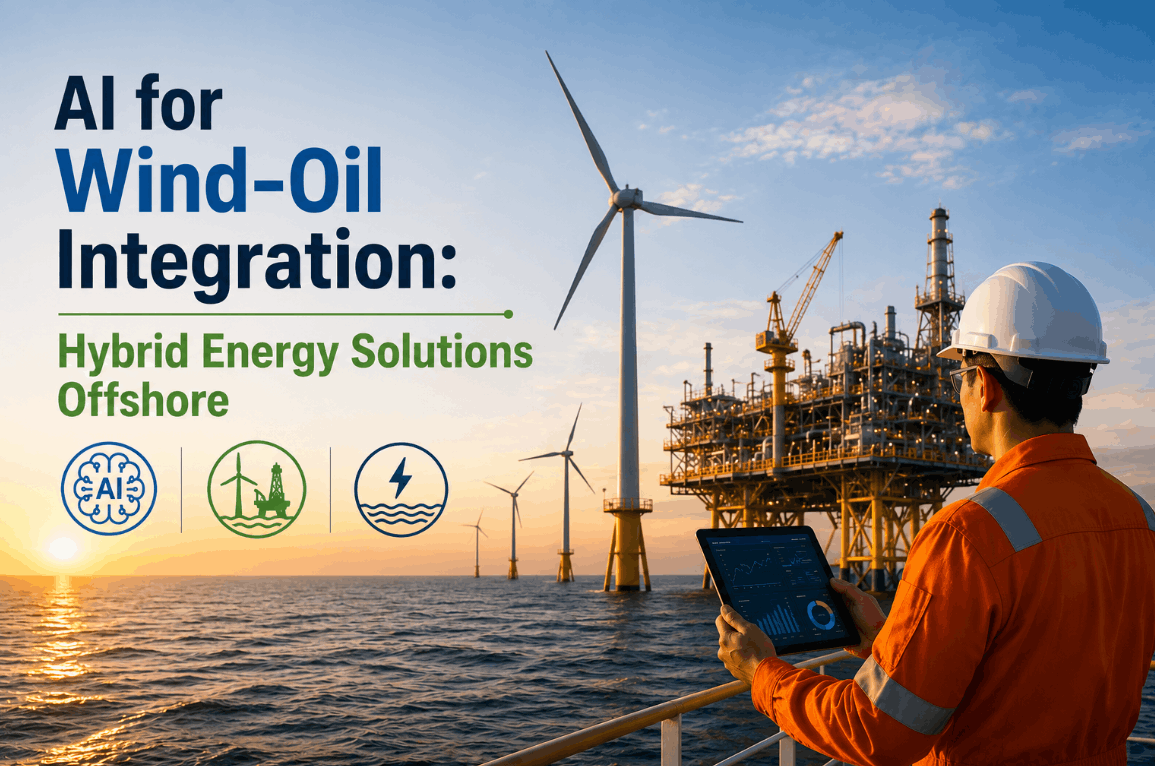
Oil and gas companies hold a structural advantage in the emerging hydrogen economy — existing pipeline infrastructure, compression assets, and subsurface storage resources that can be repurposed for hydrogen at significantly lower capital cost than greenfield development. AI accelerates this repositioning by optimizing blue hydrogen production from natural gas with CCUS, managing green hydrogen electrolyzer performance, and balancing renewable energy integration across hybrid energy systems.
| Energy Transition Pathway | AI Application | iFactory AI Capability | Typical Benefit |
|---|---|---|---|
| Blue Hydrogen (SMR + CCUS) | Reformer efficiency optimization | Process AI + CCUS integration | 8–12% energy reduction |
| Green Hydrogen (Electrolysis) | Electrolyzer stack health monitoring | Predictive maintenance + dispatch | 15% LCOH improvement |
| Renewable Energy Integration | Grid balancing & demand forecasting | AI energy dispatch optimization | Reduced gas backup demand |
| Methane Abatement | Continuous leak detection & repair | IoT + satellite AI fusion | Up to 40% reduction by 2030 |
| CCUS Storage Verification | Reservoir integrity AI monitoring | Subsurface + sensor integration | 45Q credit documentation |
| Carbon Intensity Reporting | Automated Scope 1/2 calculation | Audit-ready compliance dashboards | 85% reporting time saved |
Deploying AI for Clean Energy Transition: A Phased Roadmap for Oil & Gas Operators
Transitioning to AI-driven decarbonization does not require replacing existing operational technology. iFactory AI is designed to layer over current SCADA, ERP, and MES infrastructure — ingesting data from existing systems and adding AI intelligence without disrupting production continuity. The following phased approach reflects how leading operators structure their AI-enabled transition programs.
Emissions Baseline and Data Integration
Inventory all emissions sources across the asset portfolio — wellheads, compressors, flares, processing units. Connect iFactory AI to SCADA, IoT sensor networks, and ERP systems. Establish a verified emissions baseline against which AI-driven reductions will be measured and reported.
Methane Detection and Flare Optimization Activation
Deploy AI methane detection models across priority assets. Activate flaring optimization and combustion efficiency AI. Begin generating automated repair work orders for detected leaks. Establish carbon intensity KPI dashboards for operational and executive visibility.
CCUS and Hydrogen Program Integration
Integrate CCUS process data into the iFactory AI platform. Activate capture optimization, compression monitoring, and storage integrity AI models. For hydrogen programs, connect electrolyzer or SMR process data for performance optimization and predictive maintenance.
Regulatory Reporting and Net-Zero Program Management
Activate automated Scope 1/2 reporting aligned with SEC, EPA, and OGCI requirements. Generate verified emissions reduction records for 45Q CCUS tax credit documentation. Deploy enterprise-wide net-zero program dashboards that consolidate reduction performance across all AI modules.
Expert Review: What Oil & Gas Operators Need to Know About AI and the Clean Energy Transition in 2025
Reviewed by energy transition engineers and industrial AI architects with extensive experience deploying AI-driven decarbonization programs across upstream, midstream, and downstream oil and gas assets in the United States and internationally. The following observations reflect current best practice and reflect the operational realities of transitioning producing assets.
The most important shift operators must make is recognizing that AI-driven decarbonization is not a separate initiative from production optimization — it is the same initiative. The systems that monitor compressor health for predictive maintenance are the same systems that monitor methane emissions from compressor seals. The AI that optimizes gas processing efficiency is the same AI that reduces the carbon intensity of processed volumes. When operators treat emissions reduction and production performance as competing priorities, they miss the integrated value that a unified AI platform delivers.
Second, data quality remains the primary barrier. AI models for methane detection, CCUS optimization, and carbon intensity reporting are only as accurate as the underlying sensor and process data. Operators that invest in sensor coverage, data historian connectivity, and data quality management before deploying AI consistently outperform those that attempt to apply AI models to sparse or unreliable data. iFactory AI includes data quality scoring and gap identification as a prerequisite step in every deployment — ensuring that AI-driven decarbonization recommendations are grounded in verified operational data. Book a Demo to review iFactory AI's data readiness assessment methodology.
Third, regulatory compliance automation is no longer optional. The convergence of SEC climate disclosure requirements, EPA methane regulations, and OGCI voluntary targets creates a reporting burden that manual processes cannot sustain at scale. AI platforms that automate the collection, calculation, and formatting of emissions data — aligned to the specific requirements of each applicable framework — deliver compliance assurance while freeing engineering and environmental teams to focus on actual emissions reduction rather than data compilation.
Conclusion: AI Is the Execution Engine for Oil & Gas Clean Energy Transition
The oil and gas industry's transition to clean energy is not a future event — it is an active operational reality that is reshaping capital allocation, regulatory exposure, and competitive positioning today. The companies that will navigate this transition most effectively are those that deploy AI not as a technology experiment but as a core operational discipline: continuously monitoring emissions, optimizing CCUS and hydrogen programs, integrating renewable energy, and generating the verified reduction records that investors and regulators require.
iFactory AI delivers this capability through a unified platform that connects SCADA, IoT, ERP, and process control data into an intelligent decarbonization layer — purpose-built for the operational complexity of oil and gas assets. From methane detection to CCUS process optimization to net-zero program reporting, iFactory AI provides the AI infrastructure that turns energy transition commitments into measurable, auditable outcomes.
Frequently Asked Questions: AI Oil & Gas Clean Energy Transition
How does AI help oil and gas companies reduce methane emissions?
AI fuses satellite imagery, IoT sensor data, and SCADA signals to continuously detect methane leaks and automatically prioritize repair work orders by emissions volume — eliminating the detection gaps of periodic manual surveys.
Can AI improve the economics of CCUS projects?
Yes. AI optimizes capture process conditions, compressor performance, and injection scheduling in real time — reducing CCUS energy penalties by 12–18% and improving project economics over the full operational lifecycle.
What role does AI play in hydrogen production for oil and gas operators?
AI monitors electrolyzer stack health for green hydrogen and optimizes SMR reformer conditions for blue hydrogen — improving efficiency, reducing downtime, and lowering the levelized cost of hydrogen production.
Does iFactory AI support automated emissions reporting for SEC and EPA compliance?
iFactory AI automates Scope 1 and Scope 2 emissions calculation, OGCI intensity benchmarking, and generates audit-ready reports aligned to SEC climate disclosure and EPA methane reporting requirements.
How quickly can iFactory AI be deployed on existing oil and gas infrastructure?
iFactory AI layers over existing SCADA, IoT, and ERP systems without requiring infrastructure replacement — with emissions baseline and detection capabilities active within 6 weeks of initial deployment.
Deploy AI Across Your Oil & Gas Decarbonization Program
iFactory AI connects emissions monitoring, CCUS optimization, hydrogen program management, and automated regulatory reporting into one intelligent platform — built for the operational reality of U.S. oil and gas assets.
-ai-s-critical-role.png)