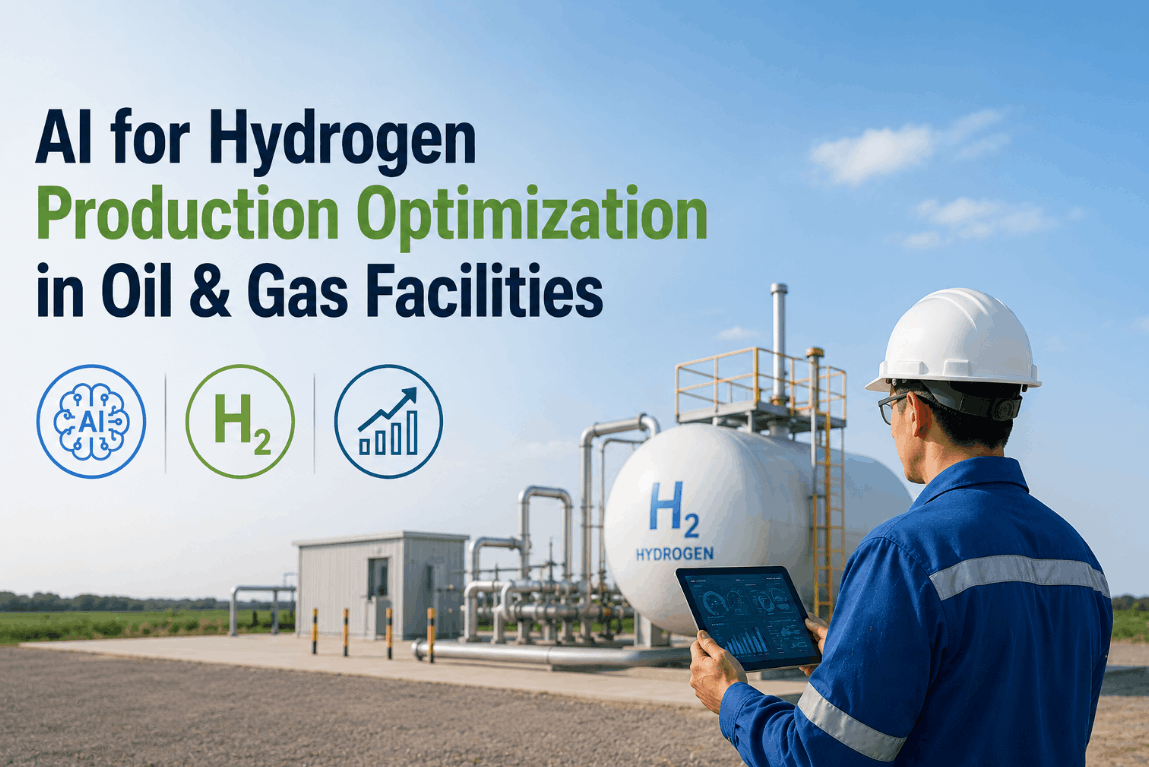
The oil and gas industry is undergoing a fundamental shift. As global energy markets respond to decarbonization pressure, hydrogen has emerged as a critical transition fuel — and artificial intelligence is rapidly becoming the operational backbone of efficient, scalable hydrogen production. Whether through steam methane reforming (SMR), electrolysis, or blue hydrogen with carbon capture, the complexity of managing hydrogen production at industrial scale demands a level of real-time analytics and predictive intelligence that only AI can deliver. For oil and gas facilities navigating this transition, AI hydrogen production optimization is not a future-state ambition — it is an immediate operational imperative.
The Industrial Case for AI-Driven Hydrogen Optimization
Hydrogen production — whether at a standalone green hydrogen facility or integrated within a conventional oil and gas refinery — involves a dense network of interdependent processes: reformers, shift reactors, pressure swing adsorption (PSA) units, compressors, and purification systems. Each of these assets operates within narrow performance windows, and small deviations compound quickly into yield loss, energy waste, and unplanned downtime. Traditional control systems respond to process deviations only after they occur. AI-driven optimization platforms, by contrast, build predictive models from continuous sensor data streams — detecting drift, forecasting failures, and autonomously adjusting process parameters to keep production running at peak efficiency.
For oil and gas facilities specifically, the stakes are elevated further by the dual pressure of production targets and decarbonization commitments. Blue hydrogen assets — those coupled with carbon capture, utilization, and storage (CCUS) infrastructure — must simultaneously maximize hydrogen yield and minimize CO₂ slip, a balance that manual control simply cannot maintain at scale. AI hydrogen production optimization enables facilities to meet both targets through continuous, data-driven process management. Book a Demo with ifactory's industrial analytics team to explore what this looks like in your facility.
What AI Hydrogen Production Optimization Actually Delivers
AI optimization in hydrogen production is not a single technology — it is a coordinated stack of machine learning, IoT sensor integration, and digital twin modeling applied across the full production workflow. The following capabilities represent the operational core of a mature AI deployment in an oil and gas hydrogen facility.
Measured Outcomes from AI-Optimized Hydrogen Facilities
Across industrial hydrogen production deployments, AI optimization platforms consistently deliver performance improvements across yield, energy efficiency, equipment reliability, and compliance. The benchmarks below reflect published industry outcomes and reported results from AI-enabled hydrogen operations.
| Performance Area | Typical Baseline (No AI) | With AI Optimization | Improvement |
|---|---|---|---|
| SMR hydrogen yield efficiency | ~82–85% of theoretical yield | 88–92% of theoretical yield | +4–7 percentage points |
| Reformer energy consumption (GJ/t H₂) | ~11.5–12.5 GJ/t H₂ | ~10.0–10.8 GJ/t H₂ | ~12–15% reduction |
| Unplanned compressor downtime | 8–14 events/year | 1–3 events/year | ~75–85% reduction |
| CCUS capture efficiency (blue H₂) | ~85–88% CO₂ capture rate | ~93–96% CO₂ capture rate | +5–8 percentage points |
| Electrolyzer stack degradation rate | ~2–3% per 1,000 hrs | ~0.8–1.2% per 1,000 hrs | ~50–60% slower degradation |
| PSA hydrogen purity compliance rate | ~91–94% time in spec | ~98–99.5% time in spec | Near-continuous compliance |
| Mean time to detect process anomaly | 2–6 hours (manual review) | < 90 seconds (AI alert) | Real-time detection |
How AI Accelerates Carbon Capture in Blue Hydrogen Operations
Blue hydrogen — produced from natural gas with carbon capture — represents the most immediately scalable pathway to low-carbon hydrogen for the oil and gas sector. But the economic and regulatory viability of blue hydrogen depends entirely on the capture efficiency of the associated CCUS infrastructure. AI plays a decisive role at every stage of the carbon capture process chain.
AI models analyze shift reactor temperatures and water-gas shift catalyst activity in real time, optimizing CO₂ separation before the syngas stream reaches the absorption column — maximizing the CO₂ concentration delivered to the capture unit and reducing downstream amine solvent demand.
Amine-based CO₂ absorption is highly sensitive to solvent loading ratios and regeneration steam demand. AI platforms continuously adjust lean solvent flow rates, stripper temperatures, and reboiler duty to maintain peak capture efficiency while minimizing the energy penalty of solvent regeneration — one of the largest cost drivers in CCUS operations.
AI-driven predictive maintenance on CO₂ compressor trains and injection pump systems ensures reliable delivery to geological storage formations. Anomaly detection on pipeline pressure profiles and seal integrity prevents fugitive emissions events that would directly undermine the carbon intensity credentials of the blue hydrogen product.
AI platforms automatically generate time-stamped, sensor-verified emissions records for every production cycle — providing the audit-ready documentation required for carbon credit certification, regulatory reporting, and third-party verification under frameworks such as ISO 14064 and emerging clean hydrogen certification standards.
For oil and gas operators evaluating blue hydrogen investments, the ability to certifiably demonstrate consistent capture rates above 90% is not just an environmental objective — it is a commercial prerequisite for accessing premium low-carbon hydrogen markets. Book a Demo with ifactory to see how AI CCUS monitoring integrates with your existing control architecture.
How ifactory Delivers AI Hydrogen Production Optimization for Oil & Gas
ifactory's industrial AI platform is purpose-built for high-complexity process and asset-intensive manufacturing environments — including hydrogen production facilities and oil and gas refineries undergoing energy transition upgrades. The platform integrates directly with existing SCADA and DCS systems, requiring no rip-and-replace infrastructure investment, and begins generating predictive insights within days of sensor mesh deployment.
ifactory's platform is OEM-agnostic and supports integration with leading DCS platforms including Honeywell Experion, ABB 800xA, Emerson DeltaV, and Siemens PCS 7 — ensuring compatibility with the control architecture already running your hydrogen facility. Book a Demo to see a live integration walkthrough for your facility type.
Expert Review: What Industrial AI Gets Right in Hydrogen Operations
Process variability is the silent yield killer in hydrogen production. Industry process engineers consistently identify steam-to-carbon ratio drift and reformer tube temperature non-uniformity as the two leading causes of below-nameplate hydrogen yields in SMR facilities. These deviations are typically gradual — undetectable on conventional hourly shift log reviews — and compound over days before an operator intervenes. AI platforms that continuously monitor these parameters and apply closed-loop corrections routinely recover 4–7% of theoretical yield that was previously written off as unavoidable process loss.
The integration gap between CCUS and hydrogen production is a solved problem when AI is in the loop. Many oil and gas operators treat their carbon capture unit as a downstream add-on rather than an integrated component of the hydrogen process. This silo creates inefficiencies — over-stripping of amine, excessive reboiler steam consumption, and lower-than-permitted capture rates. AI platforms that model the full process chain — from feed gas conditioning through CO₂ injection — have consistently demonstrated that integrated AI optimization reduces the combined energy penalty of blue hydrogen production by 10–15% compared to separately managed sub-systems.
Green hydrogen economics only improve at scale when AI manages electrolyzer dispatch intelligently. The levelized cost of green hydrogen from electrolysis is highly sensitive to electricity cost and utilization rate. AI platforms that integrate day-ahead renewable generation forecasts, real-time grid pricing APIs, and electrolyzer health models to schedule production windows have demonstrated reductions in effective electricity cost per kg H₂ of 18–25% compared to static continuous operation — a difference that can move a green hydrogen project from marginal to commercially viable at current electricity tariff structures.
AI Hydrogen Production Optimization: The Path to Profitable, Low-Carbon Operations
The energy transition is not an abstract future scenario for oil and gas operators — it is an active capital allocation and operational efficiency challenge playing out across every production facility today. Hydrogen, whether blue or green, represents a core pillar of the decarbonization roadmap for the sector, and the economic competitiveness of hydrogen production is directly determined by the quality of process control and asset management deployed at each facility. AI hydrogen production optimization closes the gap between theoretical and actual performance — recovering yield losses, eliminating unplanned downtime, reducing energy intensity, and providing the emissions documentation infrastructure that clean hydrogen markets increasingly require.
Platforms like ifactory provide oil and gas operators with the industrial AI infrastructure to begin capturing these advantages within a 60-day deployment window — without replacing existing control systems and without requiring a dedicated data science team. The facilities that build this AI operational foundation today will define the production cost benchmarks that new entrants will be measured against tomorrow. Book a Demo with ifactory's industrial analytics team to map an AI deployment roadmap for your hydrogen production facility.
-ai-s-critical-role.png)