Refineries operate under some of the most demanding environmental compliance requirements in U.S. industry. NOx and SOx emissions — byproducts of combustion processes in heaters, furnaces, flue gas systems, and sulfur recovery units — are subject to federal Clean Air Act standards, EPA New Source Performance Standards, and state-level permit conditions that vary significantly by region. Traditional monitoring approaches rely on manual stack sampling, periodic CEMS calibration checks, and compliance reports assembled after the fact. When a permit exceedance occurs, the discovery often comes too late to prevent a reportable event. AI-driven emissions monitoring changes that equation by turning continuous sensor data into real-time regulatory intelligence — enabling refineries to detect deviation trends before they become violations, automate compliance documentation, and demonstrate good-faith regulatory stewardship to EPA and state agencies. Book a Demo to see how iFactory connects your emissions data to audit-ready compliance records.
AI Emissions Monitoring — iFactory 2025
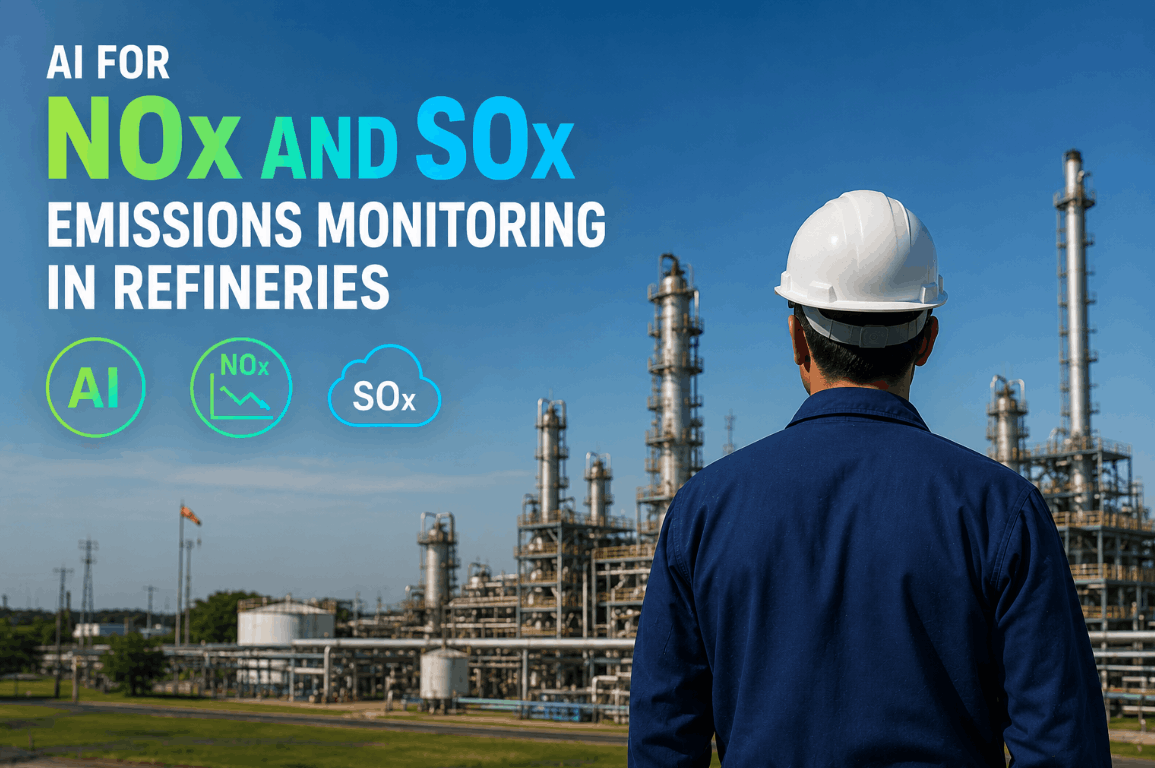
AI for NOx and SOx Emissions Monitoring in Refineries
Real-time CEMS integration · Permit exceedance prediction · EPA compliance automation · FSMA traceability · Audit-ready environmental records for oil & gas operations.
48hr+
Advance warning before permit exceedance events
90%
Reduction in manual compliance documentation time
100%
CEMS data coverage with immutable digital audit trail
1–2 Wk
Deployment with pre-built refinery compliance templates
Why NOx and SOx Monitoring Is a Critical Compliance Challenge for Refineries
NOx (nitrogen oxides) and SOx (sulfur oxides) are the two primary criteria pollutants generated during refinery combustion and sulfur processing operations. NOx forms in fired heaters, process furnaces, and fluidized catalytic cracking (FCC) units when combustion temperatures exceed nitrogen oxidation thresholds. SOx originates primarily in sulfur recovery units (SRUs), fluid cokers, and any unit processing high-sulfur crude. Both are federally regulated under the Clean Air Act, monitored under Title V permits, and tracked through Continuous Emissions Monitoring Systems (CEMS) that generate gigabytes of time-series data every operating day.
The compliance challenge is not data availability — most refineries already have CEMS infrastructure in place. The challenge is turning that data into actionable intelligence before a permit limit is breached. Manual review cycles, disconnected historian systems, and after-the-fact compliance reports create a gap between what the sensors are detecting and what the compliance team knows. AI closes that gap by continuously analyzing CEMS data streams, identifying deviation trends in their earliest stages, and triggering automated workflows that give operations and environmental teams time to respond.
NOx & SOx Emission Sources — Refinery Coverage Map
Fired Heaters
NOx Source
Combustion · Excess air · Burner condition
CEMS · PdM
▶
FCC Units
NOx / SOx
Regenerator flue gas · Catalyst burns
Deviation alerts
▶
SRU / Claus
SOx Source
Sulfur recovery · Tail gas treatment
Auto logs
▶
Flare Systems
Intermittent
Emergency flaring · Routine flaring
Event capture
▶
Boilers / CHP
NOx Source
Steam generation · Combined heat and power
Compliance data
Three Core Problems AI Solves in Refinery Emissions Compliance
01
Permit Exceedance Detection Before It Becomes a Violation
CEMS data streams are continuous, but human review is not. By the time an hourly average or rolling average limit is approaching its threshold, the window for corrective action is often narrow. iFactory's AI models continuously analyze emission rate trends across all monitored stacks and process units — flagging deviation patterns 48 hours or more before a permit limit is at risk of being breached. Operations teams receive real-time alerts with enough lead time to adjust fuel quality, burner air-to-fuel ratios, or SRU operating conditions before a reportable exceedance occurs.
48hr+ advance warning
Real-time CEMS analysis
Automated deviation alerts
02
Manual Compliance Documentation and Reporting Burden
Title V compliance requires detailed periodic compliance reports, excess emissions reports, and deviation logs that must be submitted to EPA and state agencies on defined schedules. Environmental engineers at most refineries spend significant hours each month manually extracting CEMS historian data, calculating rolling averages, and assembling regulatory submittals. iFactory automates this workflow end-to-end — ingesting CEMS data, applying permit-specific calculation methodologies, and generating pre-formatted compliance reports with immutable digital audit trails that satisfy 40 CFR Part 75 and state reporting requirements.
Book a Demo to see iFactory's compliance reporting automation in action.
Auto report generation
40 CFR Part 75 ready
Immutable digital logs
03
Correlating Emissions Data with Equipment Condition
NOx and SOx exceedances are rarely isolated events — they are symptoms of underlying equipment or process conditions. A fired heater producing elevated NOx may have a fouled burner tip, degraded air register, or incorrect fuel gas composition. An SRU generating excess SOx may have a catalyst bed issue or upstream feed composition shift. iFactory's predictive maintenance engine correlates emissions trends with equipment condition data — vibration, temperature, pressure — to identify the root equipment cause of developing emissions issues, enabling maintenance response rather than just operational adjustment.
Root cause correlation
Equipment-emissions link
Auto work orders
How AI Emissions Monitoring Works: From CEMS Data to Compliance Action
The workflow from raw CEMS sensor data to regulatory compliance action involves several stages that, in traditional refinery operations, are handled by separate teams using disconnected systems. iFactory integrates these stages into a single AI-powered platform.
1
CEMS Data Ingestion
iFactory connects directly to existing CEMS analyzers, DCS historians (OSIsoft PI, Aspen IP.21, Honeywell PHD), and SCADA systems via standard OPC-UA, Modbus, or API integrations. No hardware replacement required.
2
AI Trend Analysis
Machine learning models trained on refinery emissions patterns analyze rolling averages, rate-of-change trends, and cross-unit correlations in real time — identifying deviation trajectories before they approach permit thresholds.
3
Automated Alerting & Workflows
When a threshold deviation is predicted, iFactory triggers role-based alerts to operations, maintenance, and environmental teams — with context on which unit, which pollutant, and what the projected exceedance timeline is.
4
Compliance Record Generation
Every CEMS reading, deviation event, corrective action, and operational note is captured in immutable digital records — automatically formatted for Title V periodic compliance reports, excess emissions reports, and EPA agency submittals.
Regulatory Frameworks iFactory Supports for Refinery Emissions
U.S. refineries navigate a layered regulatory environment for NOx and SOx compliance. iFactory's platform is built to support the key frameworks that apply to petroleum refining operations, so compliance teams are not manually translating regulatory requirements into system logic.
40 CFR Part 75
CEMS data quality
Auto QA/QC · Missing data substitution
Continuous emissions data integrity and hourly averages reporting
Title V Permit
All major sources
Permit limit tracking · Periodic reports
Annual compliance certification and deviation reporting
NSPS Subpart J/Ja
Petroleum refineries
SO₂ · NOx limits tracking
New Source Performance Standards for fuel gas combustion and sulfur
EPA Refinery Sector Rule
Flare · SRU · Heater units
Flare monitoring · SRU deviation logs
Integrated compliance for refinery-wide emission points
State SIP / RACT Rules
Nonattainment areas
Configurable permit limits per unit
State-specific NOx limits in ozone nonattainment regions
OSHA PSM (29 CFR 1910.119)
Process safety overlap
MOC integration · Incident records
Process changes affecting emissions tied to PSM documentation
What iFactory Delivers for Refinery Emissions Compliance Operations
50%
Fewer reportable exceedance events on monitored units
Via 48hr+ predictive deviation detection
2 Days
Compliance audit prep (vs 3 weeks of data assembly)
Immutable records retrievable in seconds for any date range
100%
CEMS data coverage with digital compliance records
Sensor-to-report automation eliminates manual extraction
1–2 Wks
Deployment with pre-built refinery compliance templates
Not 6–12 months like legacy environmental management systems
Expert Review: AI Emissions Monitoring in U.S. Refinery Operations
The transition from periodic manual CEMS review to continuous AI-driven monitoring represents one of the most significant operational shifts in refinery environmental compliance in the past decade. Most refineries have had CEMS infrastructure in place for years — the gap has never been data collection, it has been real-time interpretation at scale.
What AI brings to NOx and SOx monitoring is the ability to analyze cross-unit correlations that human reviewers simply cannot track manually. A fired heater showing a gradual NOx increase over 72 hours may be invisible in a daily compliance review cycle but statistically significant when an AI model is watching it against rolling average permit limits in real time. The value isn't just catching violations — it's giving operations the time and context to prevent them.
Platforms like iFactory that connect CEMS data directly to predictive maintenance signals are particularly important for SRU operations, where SOx exceedances are often precursors to equipment issues that have both environmental and safety consequences. The integration of emissions monitoring with work order automation closes a loop that has historically required manual coordination between environmental and maintenance departments.
Key Takeaway
AI emissions monitoring is not a replacement for CEMS — it is the intelligence layer that makes CEMS data actionable for compliance, operations, and maintenance simultaneously.
See iFactory's Emissions Monitoring Platform in Action
Connect your CEMS data to real-time deviation detection, automated compliance reporting, and predictive maintenance workflows — purpose-built for U.S. petroleum refining operations.
Conclusion: From Reactive Reporting to Predictive Emissions Compliance
The regulatory environment for NOx and SOx emissions in U.S. refineries is not getting simpler. EPA's ongoing tightening of ozone and particulate matter standards under the Clean Air Act, combined with increasing state-level requirements in nonattainment areas, means that refineries operating with manual CEMS review cycles and disconnected compliance documentation face growing risk of permit exceedances, excess emissions events, and the enforcement actions that follow. AI-driven emissions monitoring shifts the posture from reactive reporting to predictive compliance management — giving environmental, operations, and maintenance teams a unified view of emissions trends with enough lead time to act before violations occur. Book a Demo to see how iFactory can connect your refinery's CEMS data to real-time compliance intelligence.
FAQ: AI NOx and SOx Emissions Monitoring for Refineries
Deploy iFactory for Refinery NOx and SOx Emissions Monitoring
AI-powered emissions compliance platform purpose-built for U.S. petroleum refineries — connecting CEMS data to real-time deviation detection, automated regulatory reporting, and predictive maintenance workflows. 1–2 week deployment with pre-built refinery templates and 90-day implementation support.
NOx Monitoring
SOx Compliance
CEMS Integration
Title V Automation
40 CFR Part 75
Predictive Maintenance