AI for OSHA and API Standards Compliance in US Oil & Gas

By Henry Green on May 30, 2026

ai-for-osha-and-api-standards-compliance-in-us-oil-&-gas

Regulatory compliance in U.S. oil and gas has never been more complex — or more consequential. OSHA 1910.119 Process Safety Management, API 580/581 Risk-Based Inspection, EPA 40 CFR Part 68 Risk Management Programs, and an expanding web of environmental and mechanical integrity standards create an obligation that most facilities are still managing through spreadsheets, manual inspection logs, and periodic third-party audits. The gap between compliance as documented and compliance as practiced is where violations, citations, and catastrophic incidents occur. AI-powered compliance platforms change this equation fundamentally — continuously monitoring process safety conditions, automating inspection documentation, flagging mechanical integrity deviations, and generating audit-ready records without the latency and inconsistency of manual tracking. Upstream, midstream, and downstream operators who Book a Demo with iFactory receive a facility-specific assessment of how AI compliance automation maps to their existing OSHA PSM, API RBI, and EPA RMP obligations before any deployment begins.

87%
Reduction in compliance documentation time with AI-automated record generation
$2.4M+
Average cost of a single OSHA PSM citation at a U.S. process facility
94%
Mechanical integrity anomaly detection accuracy vs. 31% for threshold-based systems
5 wks
Full AI compliance platform deployment from data audit to live monitoring
AI Is Redefining How U.S. Oil & Gas Facilities Meet OSHA and API Standards — From Reactive Documentation to Continuous Compliance
iFactory's AI compliance platform integrates with your existing CMMS, historian, and DCS infrastructure to deliver real-time PSM monitoring, automated RBI documentation, and audit-ready records across every regulatory framework your facility operates under.

Why OSHA and API Compliance Is Breaking Down at the Documentation Layer

The core regulatory frameworks governing U.S. oil and gas process safety — OSHA 1910.119 PSM, API 580 Risk-Based Inspection, API 581 Quantitative RBI, and EPA 40 CFR Part 68 — are not new. What is new is the operational complexity that modern facilities must document: more assets, more process variables, shorter inspection cycles, and increasing regulatory scrutiny on the quality of compliance records, not just their existence.

The documentation layer is where most compliance programs fail in practice. Process Hazard Analysis revalidations are delayed. Mechanical integrity inspection records are incomplete. Management of change processes are bypassed under production pressure. Permit-to-work authorizations lack the documented pre-job verification that OSHA 1910.119(f) requires. And when an OSHA inspection or incident investigation follows, the paper trail reveals years of accumulated gaps that no one was tracking in real time.

PSM Mechanical Integrity Documentation Gaps
OSHA 1910.119(j) requires documented inspection results, corrective actions, and next inspection dates for all pressure vessels, piping, and relief devices. Manual tracking across large asset fleets produces systematic gaps that accumulate undetected until audit review.
RBI Interval Misconfiguration Under API 580/581
Generic damage mechanism libraries applied without facility-specific calibration produce inspection intervals that are non-conservative on high-severity corrosion mechanisms — creating safety exposure that is invisible until a failure event triggers regulatory investigation.
Management of Change Process Bypass
OSHA PSM MOC requirements apply to every process, equipment, and procedure change that could affect process safety. Under production pressure, informal changes proceed without documented safety review — a primary finding in process incident root cause analyses and OSHA enforcement actions.
EPA RMP Update and Submission Delays
40 CFR Part 68 requires RMP updates within 3 years of the previous submission or when process changes trigger threshold conditions. Manual RMP management at multi-unit facilities consistently misses update triggers — producing regulatory exposure that compounds silently across reporting cycles.

How AI Transforms OSHA PSM Compliance Across All 14 Elements

OSHA 1910.119 Process Safety Management defines 14 elements — from Process Safety Information and Process Hazard Analysis through Mechanical Integrity, Hot Work Permits, and Emergency Planning. AI compliance platforms address each element differently, but the fundamental shift is the same: moving from periodic documentation to continuous compliance monitoring with automatic record generation. Facilities exploring this shift can Book a Demo with iFactory to see how AI maps to their current PSM element status and documentation gaps.

01
Process Safety Information (PSI) — Continuous Data Integrity
AI platforms maintain PSI records — P&IDs, equipment design specifications, material safety data — in a continuously updated, version-controlled repository. Any process change that modifies PSI triggers an automatic documentation update flag, preventing the P&ID drift that regulators consistently find during PSM inspections.
02
Mechanical Integrity — AI Anomaly Detection and Inspection Scheduling
AI models trained on historical sensor data, NDE measurement records, and CMMS maintenance history continuously monitor equipment health, predict degradation trajectories, and automatically schedule inspections before OSHA-required intervals elapse. Inspection completion is documented automatically when field data is entered, closing the record-keeping loop that manual systems leave open.
03
Management of Change — AI-Triggered MOC Workflow Initiation
When operating parameters, equipment configurations, or procedures deviate from documented baselines, AI systems automatically initiate MOC workflow triggers — ensuring that no process change proceeds without a documented safety review, regardless of production schedule pressure. MOC records are timestamped, attributed, and retained in the immutable audit trail.
04
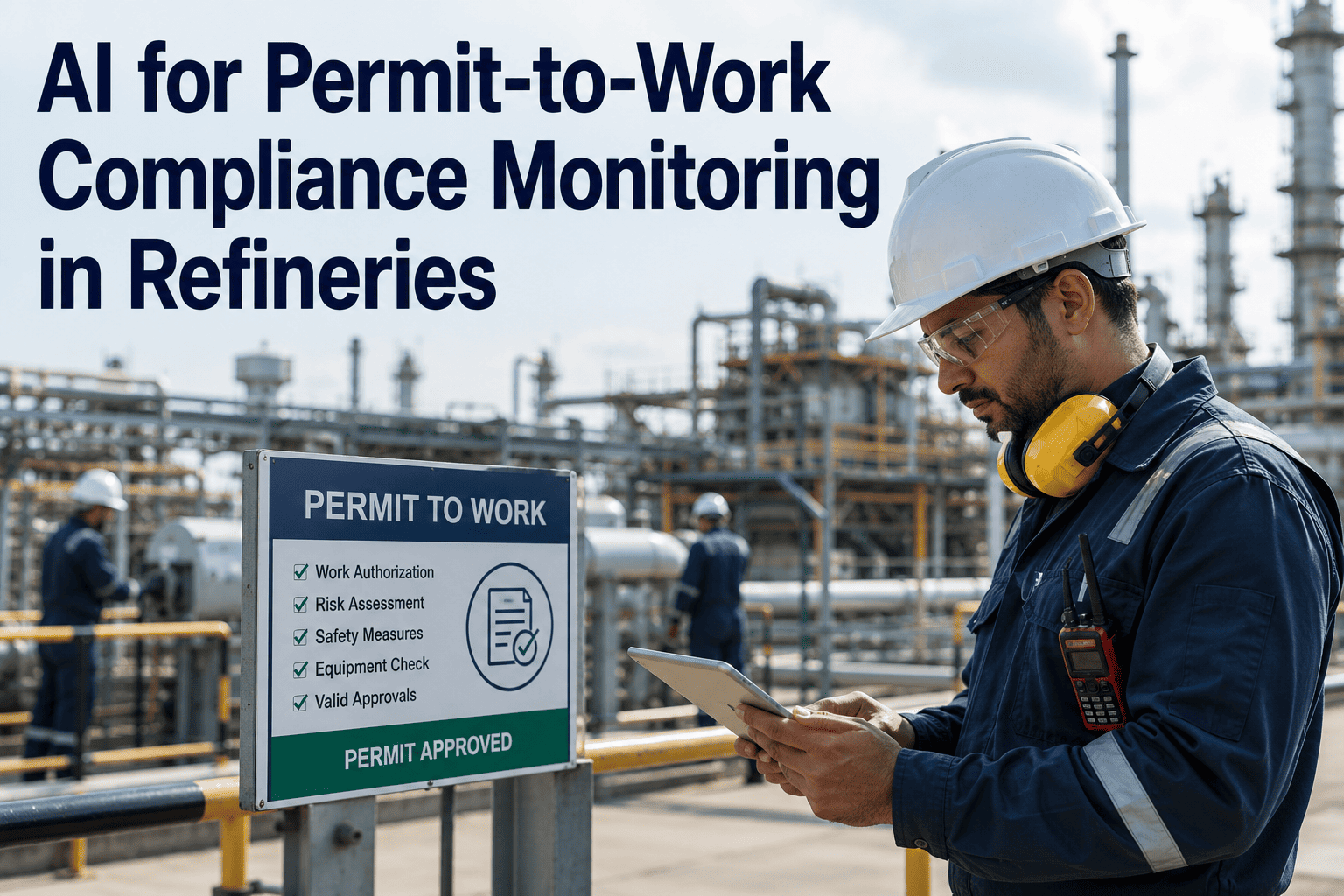
Permit-to-Work — AI-Assisted Authorization Verification
AI-assisted PTW platforms verify pre-job safety conditions — gas testing results, isolation verification, atmospheric monitoring, personnel qualification records — before permit authorization is available. Human authorization remains required, but AI ensures every verification step is documented before the approval is granted, eliminating the undocumented conditional approvals that OSHA inspectors routinely find.
05
Incident Investigation — AI Evidence Preservation and Root Cause Support
Upon incident initiation, AI systems automatically preserve all sensor logs, alert histories, process parameter records, and model outputs from the preceding 30-day window in a write-protected forensic archive. This evidence preservation prevents the data loss that hampers root cause analysis and undermines regulatory investigation defensibility under OSHA 1910.119(m) requirements.
06
Compliance Audits — Real-Time Audit Trail and Documentation Generation
AI compliance platforms maintain a continuously updated, immutable audit trail covering all inspection records, MOC approvals, PTW authorizations, corrective action closures, and model configuration changes — generating audit-ready documentation packages aligned to OSHA PSM, API 580/581, and EPA RMP format requirements on demand, without manual compilation.

AI and API 580/581 Risk-Based Inspection: From Static Schedules to Dynamic Risk Management

API 580 defines the principles of Risk-Based Inspection, and API 581 provides the quantitative methodology for probability of failure and consequence of failure assessment. Together, they represent the industry standard for inspection interval optimization at U.S. refineries, chemical plants, and upstream facilities. The challenge is that most facilities implement RBI as a periodic exercise — reassessing risk rankings every 3–5 years using point-in-time data — rather than as the continuous, dynamic risk management framework the API standards were designed to support.

API 580
RBI principles framework — facility-specific calibration required

AI platforms implementing API 580 methodology move RBI from a periodic desktop exercise to a continuously updated risk model. iFactory ingests real-time operating parameters — temperature, pressure, flow rates, fluid composition — alongside NDE inspection results and CMMS maintenance history to maintain current probability of failure assessments for every inspectable item in the asset register. When process conditions change or new inspection data arrives, risk rankings update automatically, triggering inspection schedule adjustments without waiting for the next scheduled RBI revalidation cycle.

API 581
Quantitative PoF assessment — damage mechanism library calibration

API 581 probability of failure calculations depend critically on damage mechanism library calibration — corrosion under insulation, high-temperature hydrogen attack, wet H2S cracking, sulfidation, and erosion rates must reflect actual fluid composition, operating temperature, and metallurgy at your specific facility. iFactory's AI models calibrate damage rates from your historical wall thickness measurement data, NDE records, and operating history — producing PoF assessments that reflect your plant's actual degradation environment rather than generic API 581 default values that may be non-conservative for your process streams.

CoF
Consequence modeling — flammable, toxic, and business interruption impact

Consequence of failure assessments under API 581 quantify flammable release area, toxic dispersion zones, and business interruption cost for each equipment item. AI platforms maintain CoF models that update automatically when plant layout changes, inventory volumes are modified, or regulatory classification of process streams changes. This dynamic CoF tracking ensures that high-consequence equipment is always identified with current data — not historical assessments that may have been superseded by process modifications, equipment additions, or chemical inventory changes that postdate the last RBI revalidation.

API 579
Fitness-for-Service — automated Level 1 and Level 2 assessment

API 579 Fitness-for-Service assessments determine whether equipment with known damage — wall thinning, pitting, cracking — can continue operating safely until the next planned inspection or turnaround. iFactory automates FFS Level 1 and Level 2 assessments when NDE data entries — UT wall thickness readings, pit depth surveys, crack sizing measurements — are recorded in the platform, generating remaining life projections and continued operation recommendations without requiring manual engineering calculation for every inspection data set. This automation is particularly valuable at facilities managing large fleets of fixed equipment with frequent NDE inspection cycles.

AI for Environmental Compliance: EPA RMP, LDAR, and CEMS Automation

Environmental compliance obligations in U.S. oil and gas extend well beyond process safety — EPA 40 CFR Part 68 Risk Management Programs, Leak Detection and Repair requirements under 40 CFR Part 60/63, and Continuous Emissions Monitoring System obligations under 40 CFR Part 75 each carry independent documentation, reporting, and record-keeping requirements that manual compliance management struggles to maintain consistently. AI compliance platforms address each framework with purpose-built automation that reduces reporting burden while improving the accuracy and defensibility of regulatory submissions.

EPA RMP
40 CFR Part 68 Automation
AI platforms monitor process changes, chemical inventory thresholds, and consequence modeling inputs — automatically flagging RMP update triggers and generating revised worst-case and alternative release scenario documentation within the 3-year update cycle required by 40 CFR Part 68.190.
LDAR
Leak Detection and Repair Programs
AI-assisted LDAR platforms integrate optical gas imaging, continuous fugitive emission sensors, and EPA Method 21 monitoring data — automatically flagging components exceeding 500 ppm leak concentration thresholds, generating repair work orders, and maintaining the component-level monitoring records required for LDAR compliance demonstrations.
CEMS
Continuous Emissions Monitoring
AI-enhanced CEMS platforms monitor analyzer performance, apply EPA-approved quality assurance procedures, detect exceedances in real time, and initiate automated regulatory notification workflows within the timeframes required by applicable Title V permits and consent decrees — eliminating late notification violations that regulators penalize independent of the underlying emissions event.
HSE Reporting
Integrated Compliance Analytics
AI compliance dashboards consolidate PSM element status, RBI inspection progress, environmental monitoring compliance, and PTW performance into a single leading-indicator reporting framework — giving HSE managers real-time visibility into compliance gaps before they become regulatory findings rather than after an audit surfaces them.
$37K–$156K
Per-day penalty range for knowing OSHA PSM violations at covered process facilities
3 Years
Maximum EPA RMP update cycle — AI auto-triggers updates when process changes occur sooner
100%
Audit trail coverage required — AI immutable logs meet OSHA, EPA, and API documentation standards

iFactory AI Compliance Platform: How It Maps to Your Regulatory Stack

iFactory's AI compliance platform is not a standalone compliance management tool — it is an AI layer built on top of your existing CMMS, historian, and process data infrastructure that continuously monitors compliance status, automates documentation, and generates regulatory records without replacing the systems your operations team already operates within. Facilities ready to see the platform mapped to their specific OSHA PSM, API 580/581, and EPA regulatory obligations can Book a Demo with iFactory's compliance engineering team.

Regulatory Requirement Traditional Manual Approach iFactory AI Platform
OSHA PSM Mechanical Integrity Spreadsheet-tracked inspection schedules, manually updated after field completion. Gaps accumulate when inspections slip without automatic follow-up triggers. AI-scheduled inspections with automatic CMMS work order generation, field completion tracking, and overdue inspection escalation alerts. Immutable record maintained continuously.
API 580/581 RBI Assessment Periodic desktop reassessment every 3–5 years using point-in-time data. Inspection intervals static between reassessment cycles regardless of process condition changes. Continuously updated PoF/CoF assessments from real-time operating data. Inspection intervals adjust automatically when process conditions, NDE results, or damage rates change.
OSHA PSM Management of Change Paper-based or email-driven MOC workflow dependent on individual awareness of change threshold. Informal changes frequently bypass documented review under production pressure. AI-triggered MOC initiation when process parameters, equipment configurations, or procedure deviations exceed documented baselines. No change proceeds without documented safety review record.
EPA 40 CFR Part 68 RMP Manual RMP update tracking against calendar schedule. Process changes that trigger update requirements are frequently missed between scheduled review cycles. Continuous monitoring of RMP update triggers — process changes, inventory thresholds, worst-case scenario modifications. Automated update workflow initiation when trigger conditions are detected.
LDAR Monitoring Records Manual field survey logs compiled into compliance reports quarterly or annually. Component-level tracking inconsistent across large equipment populations. Continuous sensor integration and optical gas imaging data ingestion with component-level compliance status, automatic repair work order generation, and regulatory submission-ready monitoring records.
Audit Trail and Compliance Records Records distributed across CMMS, email archives, paper files, and individual spreadsheets. Compilation for audit or inspection requires weeks of manual assembly. Immutable, timestamped, user-attributed audit trail covering all compliance activities. Regulatory documentation packages generated on demand in format accepted by OSHA, EPA, and API auditors.

Expert Perspective: What AI-Driven Compliance Looks Like in Practice at U.S. Oil & Gas Facilities

The compliance challenge we faced was not a lack of data or a lack of regulatory knowledge — it was the operational bandwidth to keep 14 PSM elements documented in real time across a 600-asset fixed equipment fleet. Every time a process condition changed, someone had to manually evaluate whether it triggered an MOC, an RBI reassessment, or an RMP update. More often than not, that evaluation happened weeks after the change occurred, which is exactly the gap OSHA inspectors look for. After deploying iFactory's AI compliance platform, those triggers happen automatically. The system monitors our operating envelope against our documented PSI baselines continuously, flags every potential trigger the moment it occurs, and generates the documentation trail that demonstrates we reviewed it. Our last OSHA PSM audit found zero documentation gaps across mechanical integrity and MOC — for the first time in eight years of PSM program operation. The ROI case is straightforward: one avoided OSHA citation pays for the platform for three years.
Process Safety Manager
Gulf Coast Refinery, Crude Distillation and Delayed Coking Units, U.S. Gulf Coast
Zero
PSM Documentation Gaps
Across mechanical integrity and MOC elements in post-deployment OSHA audit
87%
Compliance Admin Time Reduction
Manual documentation burden eliminated through AI-automated record generation
Real-time
Compliance Status Visibility
PSM element status, RBI progress, and environmental monitoring in a single dashboard
3x ROI
First Year Platform Return
Single avoided OSHA citation delivers platform payback across three-year deployment

Implementation: Deploying AI Compliance at Your Facility in 5 Weeks

iFactory's AI compliance platform follows a structured 5-week deployment that integrates with your existing CMMS, historian, and DCS infrastructure without displacing the systems your operations team depends on. Facilities receive ROI evidence — documented compliance gaps closed and audit trail coverage achieved — before the deployment is complete. Reliability and compliance teams ready to begin the process can Book a Demo and receive a facility-specific deployment timeline and compliance gap assessment before any commitment is made.

Weeks 1–2
Compliance Gap Assessment and Integration Planning
OSHA PSM element status audit across all 14 elements — documentation gaps, overdue inspections, and MOC records reviewed against RAGAGEP standards
API 580/581 RBI configuration review — damage mechanism library calibration status, PoF/CoF methodology validation, and inspection interval documentation completeness
CMMS, historian, and DCS integration mapping — data schema validation, API connectivity verification, and compliance record migration planning
Weeks 3–4
Platform Deployment and Compliance Monitoring Activation
AI compliance models deployed for mechanical integrity monitoring, MOC trigger detection, and RBI dynamic assessment — connected to live process historian and CMMS data
Immutable audit trail activated — all PSM activities, inspection records, and MOC approvals captured from day one of live operation
Compliance team training completed — PSM coordinators, inspection engineers, and HSE managers proficient in platform within 90 minutes of role-based training
Week 5
Full Regulatory Coverage and Audit Readiness
Environmental compliance monitoring activated — EPA RMP trigger tracking, LDAR monitoring integration, and CEMS exceedance notification workflows live
Compliance documentation packages generated and reviewed in OSHA PSM, API 580/581, and EPA RMP audit-ready formats
Ongoing compliance monitoring, model retraining schedule, and regulatory update tracking configured for continuous operation
COMPLIANCE COVERAGE FROM WEEK 3: AUDIT-READY DOCUMENTATION BEFORE DEPLOYMENT IS COMPLETE
Facilities deploying iFactory's AI compliance platform report full OSHA PSM mechanical integrity documentation coverage, active MOC trigger monitoring, and API 580/581 dynamic RBI assessment operational before the end of week 4 — with the first audit-ready documentation package generated and reviewed in week 5.
7 Days
CMMS and historian integration completion
Week 3
Live compliance monitoring and audit trail active
Week 5
Full regulatory documentation package delivered

Conclusion: AI Compliance Is Not Optional — It Is the New Standard of Care in U.S. Oil & Gas

The regulatory frameworks governing U.S. oil and gas process safety and environmental compliance — OSHA 1910.119, API 580/581, EPA 40 CFR Part 68, and the full suite of LDAR and CEMS obligations — were written for human-scale documentation systems. AI compliance platforms do not replace those frameworks; they execute them with a consistency, completeness, and audit trail quality that manual documentation systems cannot sustain across the asset populations and operational complexity of modern facilities.

The cost of non-compliance in U.S. oil and gas is not abstract. OSHA PSM citations carry per-day penalties exceeding $156,000 for knowing violations. EPA consent decrees routinely exceed $10 million for chronic environmental compliance failures. And neither figure accounts for the reputational, insurance, and operational costs that follow a process safety incident linked to documented compliance gaps. AI compliance platforms eliminate those gaps — not as a strategic aspiration, but as an operational reality, measurable within weeks of deployment. Compliance and process safety teams ready to close the gap between regulatory obligation and operational reality are encouraged to Book a Demo with iFactory and receive a facility-specific compliance gap assessment before any deployment decision is made.
Frequently Asked Questions

Yes — OSHA evaluates documentation quality and completeness, not the generation method; AI-generated records with immutable audit trails and professional reviewer attribution satisfy OSHA 1910.119 documentation requirements across all 14 PSM elements.
AI platforms generate interval recommendations and supporting PoF/CoF analysis automatically, but API 580/581 and RAGAGEP standards require documented professional review before any inspection interval change is implemented — iFactory enforces this human-in-the-loop approval step.
iFactory monitors operating parameters against documented baselines continuously and automatically initiates an MOC workflow when deviations exceed defined thresholds, ensuring every potential process change is reviewed and documented before proceeding — regardless of how the change originated.
iFactory connects bidirectionally to SAP PM, IBM Maximo, Infor EAM, OSIsoft PI Historian, Aspentech IP21, and GE Proficy via OPC-UA, REST APIs, and direct database connectors — integration is completed within 7 days during the Week 1–2 deployment phase.
Full mechanical integrity and MOC audit trail coverage is active by week 3 of deployment; complete OSHA PSM, API 580/581, and EPA compliance documentation packages are generated and validated in week 5 of the standard 5-week deployment program.
Close Your OSHA, API, and EPA Compliance Gaps With AI — Deployed in 5 Weeks, Audit-Ready in Week 5.
iFactory's AI compliance platform delivers continuous PSM monitoring, dynamic RBI assessment, automated MOC triggers, and immutable audit trails — fully integrated with your existing CMMS and historian infrastructure, with zero documentation gaps from the first day of live operation.
OSHA PSM All 14 Elements
API 580/581 Dynamic RBI
EPA RMP & LDAR Automation
Immutable Audit Trail
CMMS Integration in 7 Days

Share This Story, Choose Your Platform!