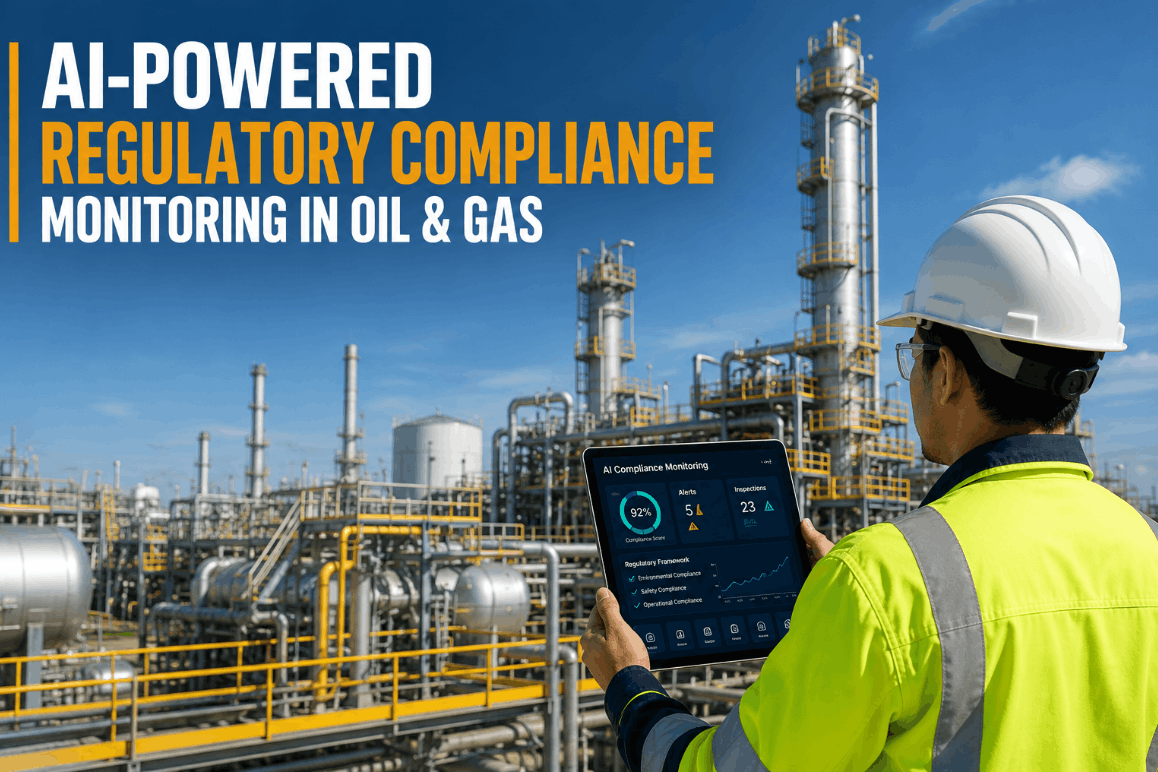
Sustainability reporting has moved from a voluntary disclosure exercise to a core compliance obligation for oil and gas companies operating in U.S. and global markets. GRI (Global Reporting Initiative) and CDP (formerly the Carbon Disclosure Project) have emerged as the two dominant frameworks through which refineries, upstream producers, midstream operators, and integrated energy companies communicate environmental performance to investors, regulators, and supply chain partners. The challenge for most oil and gas operations is not a lack of environmental data — it is the inability to collect, validate, and structure that data at the speed and accuracy these frameworks require. Manual data collection across dozens of operating units, inconsistent measurement methodologies, and reporting cycles that lag operational reality by months are the structural weaknesses that AI-driven sustainability platforms are built to address. Book a Demo to see how iFactory connects your operations data to GRI and CDP-aligned sustainability reporting.
AI Sustainability Reporting — iFactory 2025
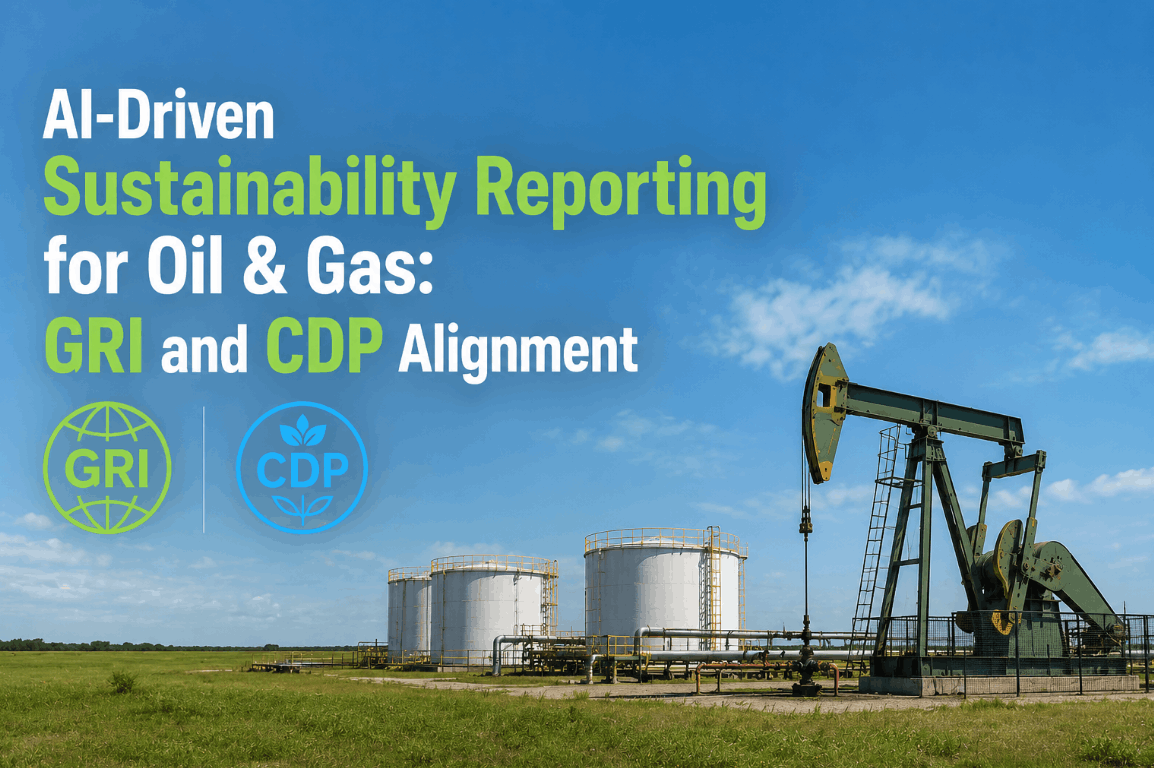
AI-Driven Sustainability Reporting for Oil & Gas: GRI and CDP Alignment
Automated GRI disclosures · CDP climate scoring · Scope 1, 2 & 3 emissions · Real-time ESG dashboards · Audit-ready sustainability records for oil & gas operations.
90%
Reduction in manual sustainability data collection time with AI automation
GRI & CDP
Pre-built disclosure templates aligned to current framework versions
48hr
From data request to audit-ready sustainability disclosure package
1–2 Wk
Deployment with pre-built oil & gas sustainability reporting templates
Why GRI and CDP Matter for U.S. Oil & Gas Operations in 2025
GRI and CDP are not interchangeable frameworks — they serve different audiences and different disclosure purposes, but they share a common dependency on accurate, verifiable operational data. GRI Standards provide a modular disclosure system that covers environmental, social, and governance topics across industry sectors. For oil and gas, the most material GRI disclosures relate to emissions (GRI 305), energy (GRI 302), water (GRI 303), and effluents and waste (GRI 306). CDP focuses specifically on climate change, water security, and forests — scoring companies on the quality and completeness of their disclosures and publishing those scores to institutional investors. A low CDP score is increasingly a direct risk factor in investor decision-making and supply chain qualification.
The business pressure to align with both frameworks simultaneously has intensified as SEC climate disclosure requirements, state-level regulations in California and New York, and European CSRD rules affecting U.S.-listed multinationals have created a regulatory reporting environment that no longer allows estimated data or annual-cycle collection processes. Book a Demo to see how iFactory automates the data foundation required for GRI and CDP alignment in oil and gas operations.
GRI vs CDP — Framework Comparison for Oil & Gas Reporting
Primary audience
Broad stakeholders — investors, regulators, communities, NGOs
Institutional investors, supply chain buyers, financial institutions
Scope of disclosure
Environmental, social, and governance — modular topic selection
Climate change, water security, forests — scored annually
Key O&G metrics
GRI 302 (Energy), GRI 305 (Emissions), GRI 303 (Water), GRI 306 (Waste)
Scope 1, 2, 3 emissions; TCFD alignment; net-zero targets; transition plans
Verification requirement
Third-party assurance recommended; required for SEC-filing companies
Self-reported with supporting evidence; assurance improves scoring
Reporting cycle
Annual; aligned with financial reporting calendar
Annual questionnaire — CDP scoring published each December
iFactory support
Pre-built GRI disclosure templates, auto-populated from operational data
CDP questionnaire mapping, Scope 1/2/3 calculation, scoring optimization
The Three Data Problems That Break Oil & Gas Sustainability Reporting
01
Emissions Data Collected Manually Across Distributed Operations
Oil and gas operations span refineries, upstream production sites, pipeline networks, and terminal facilities — often across multiple states and regulatory jurisdictions. Collecting emissions data from these distributed assets through manual processes — spreadsheets submitted by site coordinators, estimates derived from production throughput, and emission factors applied at the company level — produces data that cannot withstand the scrutiny of third-party assurance or CDP scoring review. iFactory's AI platform connects directly to CEMS, flare monitoring systems, DCS historians, and SCADA infrastructure to collect emissions data automatically at the source — eliminating the manual collection cycle entirely.
Book a Demo to see iFactory's emissions data collection architecture.
Automated CEMS integration
Distributed asset coverage
Assurance-ready data
02
Scope 3 Emissions Quantification Across the Value Chain
Scope 3 emissions — the indirect emissions that occur across an oil and gas company's value chain, from crude extraction through refining, distribution, and end-use combustion — represent 70–90% of total lifecycle emissions for most integrated operators. CDP's climate questionnaire, TCFD alignment requirements, and an increasing number of customer sustainability programs now require Scope 3 quantification that goes beyond category-level estimates. iFactory's analytics engine calculates Scope 3 emissions across the fifteen GHG Protocol categories relevant to oil and gas — integrating production data, supplier emissions factors, transportation logistics, and product use-phase calculations into a defensible, methodology-documented disclosure package.
GHG Protocol Category mapping
Supplier data integration
TCFD-aligned disclosure
03
Reporting Timelines That Lag Operational Reality
The traditional sustainability reporting process in oil and gas — data collection request to site teams, consolidation, review, verification, and report publication — typically spans four to six months after the reporting period closes. By the time the annual GRI report is published, the data is eight to eighteen months old. CDP scoring penalizes incomplete or estimated data, and institutional investors are increasingly demanding more frequent disclosure intervals. iFactory's continuous data collection model means sustainability metrics are current within 24–48 hours at all times — enabling quarterly ESG reporting, real-time dashboard access for investor relations, and CDP questionnaire responses that reflect actual operational performance rather than prior-year estimates.
Real-time ESG dashboards
Quarterly reporting capability
CDP scoring optimization
How iFactory Automates GRI and CDP Disclosure: The Data-to-Report Workflow
The path from raw operational data to a published GRI sustainability report or a submitted CDP questionnaire involves multiple transformation steps that, in traditional oil and gas operations, are handled manually across disconnected systems. iFactory integrates these steps into a single automated workflow.
1
Operational Data Ingestion
iFactory connects to CEMS analyzers, flare monitoring systems, DCS historians (OSIsoft PI, Aspen IP.21), SCADA platforms, ERP and production management systems via OPC-UA, Modbus, and REST API integrations. All relevant emission, energy, water, and waste data streams are ingested continuously.
2
Emissions Calculation & Validation
AI models apply EPA, GHG Protocol, and API Compendium emission factor methodologies to raw data — calculating Scope 1 direct emissions, Scope 2 purchased energy emissions, and Scope 3 value-chain emissions with methodology documentation. Anomalous readings are flagged for review before entering the disclosure record.
3
GRI & CDP Framework Mapping
Calculated metrics are automatically mapped to the relevant GRI disclosure numbers (302-1, 305-1 through 305-7, 303-3, 306-3) and CDP questionnaire sections — populating disclosure templates with current-period data, prior-year comparisons, and intensity metrics normalized to production output.
4
Audit-Ready Report Generation
iFactory generates pre-formatted GRI sustainability disclosures and CDP response packages with complete data lineage — from source measurement through calculation methodology to reported figure. Every data point is traceable, timestamped, and immutable, meeting the evidence standards required for third-party assurance and SEC climate disclosure review.
Key GRI Disclosures iFactory Automates for Oil & Gas
GRI Standards relevant to oil and gas operations span multiple topic areas. The following table shows the specific disclosures that iFactory automates from connected operational data — and the data sources that feed each disclosure.
GRI Disclosure
Topic
Key Metrics
iFactory Data Source
GRI 302-1
Energy consumption
Fuel combustion, purchased electricity, energy intensity
SCADA · DCS historian · Smart meters
GRI 305-1
Scope 1 direct emissions
GHG emissions from stationary combustion, process, flaring, fugitives
CEMS · Flare monitors · Leak detection
GRI 305-2
Scope 2 indirect emissions
Purchased electricity and steam emissions — location and market-based
Utility meter · ERP energy purchase data
GRI 305-3
Scope 3 value-chain emissions
15 GHG Protocol categories — upstream, downstream, product use
ERP · Supply chain data · Production records
GRI 305-4/5
Emissions intensity & reductions
GHG intensity per barrel, per MMBtu; year-over-year reduction verification
Production MES · CEMS continuous data
GRI 303-3
Water withdrawal
Water source, volume, stress area classification, intensity
IoT flow meters · Process water systems
GRI 306-3
Waste generated
Hazardous and non-hazardous waste by category and disposal route
Waste management system · ERP records
What iFactory Delivers for Oil & Gas Sustainability Reporting
90%
Reduction in manual data collection time for annual GRI disclosures
Via direct CEMS, SCADA, and ERP integration replacing spreadsheet collection
48 hrs
From data request to audit-ready GRI or CDP disclosure package
Continuous data collection eliminates the 4–6 month manual reporting cycle
CDP A–B
Score improvement potential with complete, verified emissions data
CDP scoring rewards data completeness, methodology documentation, and assurance
1–2 Wks
Deployment with pre-built oil & gas sustainability templates
Pre-mapped GRI and CDP templates — not a custom build from scratch
Expert Review: AI Sustainability Reporting in Oil & Gas Operations
The GRI and CDP reporting burden in oil and gas has grown faster than most environmental compliance teams anticipated. Five years ago, a well-resourced sustainability team could manage annual GRI disclosures through a structured spreadsheet collection process. Today, the same team is managing SEC climate disclosure requirements, CSRD obligations for European-listed entities, CDP questionnaires with increasing data granularity requirements, and customer supply chain sustainability programs that each have their own data templates.
What AI platforms like iFactory change fundamentally is the data collection architecture. When emissions data is collected automatically from CEMS and SCADA systems rather than manually reported by site coordinators, the quality of the underlying data improves dramatically — and so does the defensibility of the disclosure. CDP scoring is particularly sensitive to this: a company that can provide measured, methodology-documented Scope 1 data with third-party assurance will consistently score higher than one providing estimates, regardless of the actual emissions level.
The Scope 3 challenge is where AI analytics adds the most distinctive value. Calculating emissions across fifteen GHG Protocol categories for a multi-asset oil and gas operator — integrating upstream supplier data, transportation logistics, refinery throughput, and product use-phase calculations — is not a task that scales with manual processes. AI data integration and calculation engines are the only practical path to defensible Scope 3 disclosure at the granularity that investors and regulators now expect.
Key Takeaway
AI-driven sustainability reporting is not a reporting efficiency tool — it is the foundational data infrastructure required to meet the disclosure quality standards that GRI assurance, CDP scoring, and SEC climate rules now demand from oil and gas operators.
Connect Your Operations Data to GRI and CDP-Ready Sustainability Disclosures
iFactory's AI sustainability reporting module integrates with your existing CEMS, SCADA, and ERP systems to automate GRI disclosure population, CDP questionnaire mapping, and Scope 1, 2, and 3 emissions calculation — giving your sustainability team audit-ready data within 48 hours, not 4 months.
Conclusion: From Annual Reporting to Continuous ESG Intelligence
The oil and gas industry's sustainability reporting landscape in 2025 is defined by two converging pressures: increasing framework rigor from GRI and CDP, and a regulatory environment that is moving from voluntary disclosure to mandatory, assured reporting. The companies that are managing this transition successfully are not doing so by expanding their sustainability reporting teams — they are deploying AI platforms that automate the data collection, calculation, and framework mapping that make defensible GRI and CDP disclosure possible. iFactory's energy and sustainability tracking module provides the operational data integration, emissions calculation engine, and pre-built framework templates that oil and gas operators need to move from annual reporting cycles to continuous ESG intelligence — and to demonstrate the data quality that increasingly determines CDP scores, investor ESG ratings, and regulatory standing. Book a Demo to see how iFactory can automate your GRI and CDP reporting workflows.
FAQ: AI Sustainability Reporting for Oil & Gas — GRI and CDP Alignment
Deploy iFactory for Oil & Gas GRI and CDP Sustainability Reporting
AI-powered sustainability reporting platform purpose-built for oil & gas — automating GRI disclosure population, CDP questionnaire mapping, and Scope 1, 2 & 3 emissions calculation from your existing CEMS, SCADA, and ERP infrastructure. 1–2 week deployment with pre-built oil & gas templates and 90-day implementation support.
GRI Standards
CDP Climate Disclosure
Scope 1, 2 & 3 Emissions
SEC Climate Rules
Third-Party Assurance
TCFD Alignment