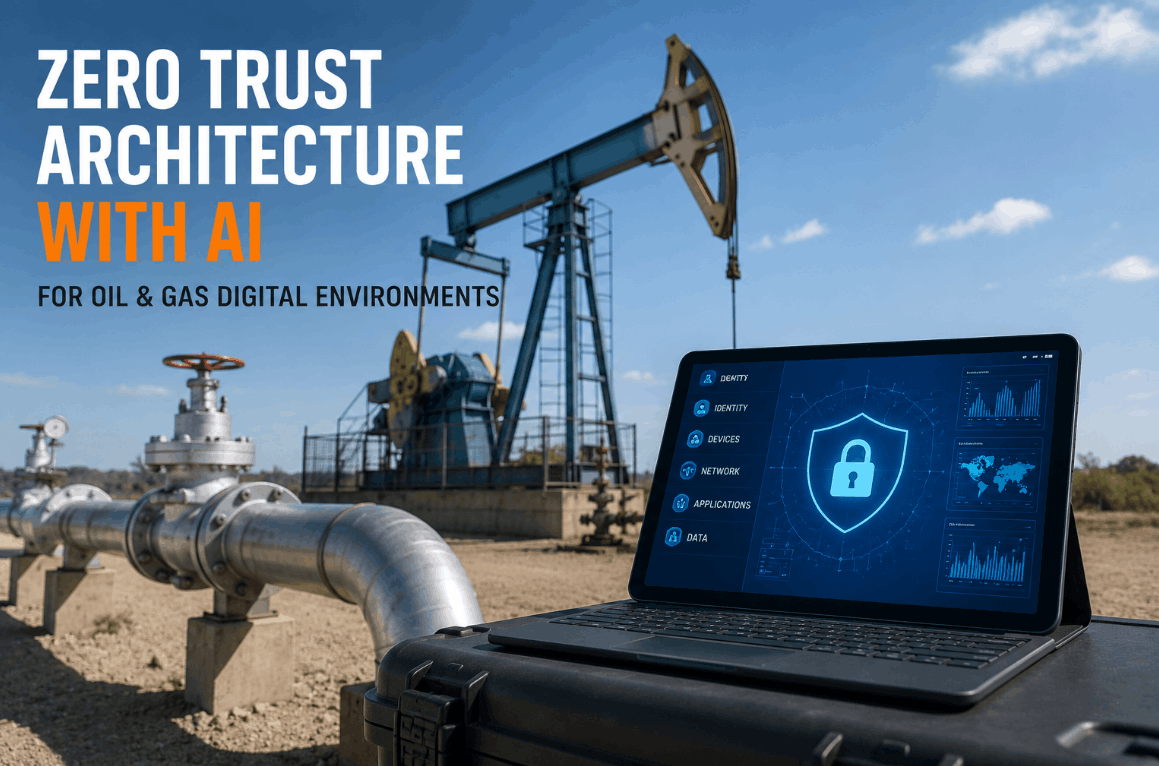
The oil and gas sector's accelerating shift to connected digital infrastructure — remote wellhead automation, cloud-integrated SCADA, and cross-facility IIoT networks — has fundamentally erased the concept of a trusted network perimeter. In 2025, a refinery's operational technology (OT) environment is no longer an isolated island; it is a dynamic, internet-adjacent ecosystem where field sensors, vendor remote access sessions, and enterprise ERP systems converge on the same logical fabric. Legacy "castle-and-moat" security models that implicitly trust any device or user inside the corporate firewall are catastrophically misaligned with this reality. Zero Trust Architecture — built on the principle of "never trust, always verify" — paired with AI-driven behavioral analytics, is now the only defensible framework for upstream, midstream, and downstream operators managing critical process environments. Operators ready to evaluate their current OT security posture can Book a Demo with iFactory and receive a facility-specific gap assessment.
Deploy Zero Trust AI Across Your Oil & Gas Digital Environment
iFactory's AI security platform delivers continuous OT identity verification, SCADA behavioral monitoring, and least-privilege access enforcement — purpose-built for oil and gas operators who cannot afford a breach.
Why the Oil & Gas OT Environment Demands Zero Trust Now
Modern oil and gas digital environments have three structural vulnerabilities that make perimeter-based security architecturally obsolete. First, OT/IT convergence has created direct — often unintended — communication paths between process control networks and enterprise IT systems. Second, vendor remote access has proliferated: turbine OEMs, pipeline SCADA integrators, and instrument calibration firms all require periodic direct access to live process equipment. Third, legacy PLCs and DCS controllers were engineered for reliability, not security — they cannot authenticate users, encrypt sessions, or detect anomalous commands. Together, these three realities mean that a single compromised vendor credential or a single unpatched HMI can cascade into a facility-wide process disruption. AI-powered Zero Trust is not a vendor product — it is the architectural response to these structural realities.
OT/IT Convergence Exposure
Historians, MES systems, and cloud dashboards create bidirectional data paths that attackers exploit to pivot from enterprise networks into process control zones — bypassing air gaps that no longer exist in practice.
Third-Party Vendor Sessions
Unmonitored vendor VPN sessions — averaging 89 simultaneous active connections at a mid-size refinery — represent the single largest uncontrolled access vector in oil and gas OT environments today.
Legacy Device Trust Assumptions
PLCs and RTUs with 15–25 year operational lifespans cannot participate in modern identity frameworks. Zero Trust compensates by applying controls at the network and session layer, not the device layer.
Ransomware Lateral Movement
Colonial Pipeline demonstrated that ransomware does not need to directly attack OT to shut down operations — IT compromise alone can force operational shutdowns. Microsegmentation stops lateral spread before it reaches critical process zones.
The Six Pillars of Zero Trust AI for Oil & Gas
iFactory's Zero Trust implementation framework maps directly to six core pillars adapted from NIST SP 800-207, engineered for OT environments where real-time process continuity is non-negotiable alongside security enforcement. Teams looking to begin pillar-by-pillar deployment can Book a Demo to receive a phased rollout plan mapped to their existing infrastructure.
Identity & Access Verification
Every user, device, and service requesting access to OT resources is verified per session — not per login. AI analyzes behavioral biometrics, session context, and access history to detect anomalous access patterns in real time, flagging deviations that rule-based MFA cannot catch.
Device Health & Posture Validation
Before any device — engineer laptop, vendor tablet, or IIoT gateway — communicates with process control systems, AI validates its security posture: patch level, endpoint protection status, and behavioral baseline. Non-compliant devices are quarantined automatically.
Network Microsegmentation
OT networks are segmented into granular zones — by process unit, equipment class, and criticality level — with AI-enforced conduit controls between each zone. Lateral movement between a compromised historian and an ESD system becomes architecturally impossible, not just policy-prohibited.
Least-Privilege Access Enforcement
Access rights are scoped to the minimum required for each role, session, and time window. AI continuously evaluates whether active access rights match current job function — automatically revoking stale permissions and flagging privilege escalation attempts that exceed defined operational context.
Continuous Monitoring & Analytics
Every packet, command, and user action within OT environments is logged and analyzed against behavioral baselines. AI correlates micro-signals — an unusual Modbus function code, a historian query at 2 AM, a vendor session accessing systems outside their scope — into composite threat scores before any individual signal would trigger a rule-based alert.
Automated Incident Response & Containment
When AI identifies a confirmed threat — an anomalous command sequence, an out-of-scope vendor session, or a credential used from an unexpected geographic location — it executes pre-approved containment actions autonomously: isolating the session, quarantining the device, and alerting the OT security team with a full forensic context packet, all within seconds of detection.
Zero Trust Implementation Roadmap: Four Phases for OT Environments
Successful Zero Trust deployments in oil and gas follow a phased sequence that never requires a "rip and replace" of existing OT infrastructure. iFactory's implementation model is additive — each phase layers security controls onto the existing environment without disrupting live process operations. Reliability and security leads frequently choose to Book a Demo to map this roadmap against their specific facility architecture before any deployment begins.
OT Asset Discovery & Identity Inventory
Passive network discovery enumerates every OT asset, active session, and communication path. AI builds the foundational asset inventory — the prerequisite for all identity and access decisions that follow. No active scanning; no process disruption.
Identity Framework & MFA Deployment
Role-based identity policies are defined for all human users and service accounts. MFA is enforced for all remote access and cross-zone sessions. AI behavioral baselines are established during this phase to calibrate what "normal" access looks like for each role and system.
Network Microsegmentation & Zone Enforcement
OT networks are divided into security zones aligned to ISA/IEC 62443 — by process unit, criticality, and function. AI-enforced conduit controls govern all inter-zone traffic. High-consequence zones (ESD, SIS) receive the most restrictive conduit policies.
Continuous AI Monitoring & Adaptive Policy
AI operates continuously — correlating identity signals, device posture data, network traffic patterns, and OT protocol behavior — refining threat models as the environment evolves. Policy adjustments are AI-recommended and human-approved, creating a self-improving security posture without manual policy maintenance.
Zero Trust AI vs. Traditional OT Security: Performance Comparison
Quantifying what changes when AI-enforced Zero Trust replaces perimeter-based OT security across the dimensions that matter most to oil and gas operations teams.
| Security Dimension | Perimeter-Based Model | Zero Trust AI Model |
|---|---|---|
| Threat Detection Time | 197 days average dwell time | Minutes to hours (behavioral AI) |
| Vendor Access Control | Persistent VPN — always-on trust | Session-scoped, time-limited, recorded |
| Lateral Movement Risk | Flat OT network — unrestricted | Microsegmented — zone-to-zone AI enforcement |
| Legacy Device Coverage | Blind — no agent supportable | Network-layer controls, no device agent required |
| Compliance Documentation | Manual — periodic audit snapshots | Continuous, automated — real-time audit trail |
| Incident Response Speed | Manual triage — hours to days | AI-automated containment — minutes |
| OT Protocol Visibility | IP/TCP only — OT layer blind | Modbus, DNP3, OPC-UA — full OT protocol parsing |
"Before iFactory, our Zero Trust strategy was a PowerPoint deck. After deployment, it became a live enforcement layer. The most revelatory moment was when the AI flagged a vendor session accessing a safety instrumented system controller that had zero relationship to the vendor's stated maintenance scope. That access had been happening for eleven months. Rule-based tools never caught it because the credentials were valid. The AI caught it because the behavior was impossible. That single detection justified the entire platform investment for our board."
Conclusion: Zero Trust AI Is the OT Security Standard for the Digital Oil & Gas Era
The digitization of oil and gas operations is irreversible — and so is the threat landscape it creates. Zero Trust Architecture powered by AI is not an optional upgrade for forward-thinking security teams; it is the baseline architecture required to operate a connected OT environment without accepting catastrophic breach risk. The five pillars — identity verification, device posture, microsegmentation, least-privilege access, and continuous AI monitoring — work as a system, each reinforcing the others in a way that no individual point solution can replicate. The four-phase implementation roadmap ensures that even facilities with complex legacy OT environments can adopt Zero Trust without disrupting live operations. Oil and gas security and operations teams ready to move from perimeter defense to genuine Zero Trust enforcement are encouraged to Book a Demo with iFactory and receive a facility-specific Zero Trust readiness assessment before any deployment commitment is made.
Zero Trust AI for Oil & Gas — Frequently Asked Questions
Q: Can Zero Trust be deployed without replacing existing OT equipment?
Yes — iFactory's Zero Trust model applies controls at the network and session layer, requiring no agents on legacy PLCs or DCS controllers that cannot support modern endpoint software.
Q: How does AI improve on rule-based Zero Trust enforcement?
AI detects anomalous behavior that follows valid rules — a legitimate credential used at an unusual time, accessing an out-of-scope system — which static rule engines structurally cannot identify.
Q: Which compliance frameworks does Zero Trust AI satisfy in oil and gas?
iFactory's Zero Trust architecture generates continuous audit evidence aligned to NERC CIP, ISA/IEC 62443, NIST CSF, and TSA Pipeline Security Directive requirements.
Q: Does Zero Trust AI disrupt real-time process control communication?
No — iFactory's passive monitoring and policy enforcement architecture is designed specifically to never introduce latency or packet loss into live OT communication paths.
Q: How long does a full Zero Trust AI deployment take in an oil and gas facility?
The four-phase deployment typically spans 18–24 weeks from passive asset discovery through full AI continuous monitoring activation, with security value delivered incrementally at each phase.
Ready to Deploy Zero Trust AI Across Your Oil & Gas Digital Environment?
iFactory's OT security team maps your existing network architecture, identity infrastructure, and compliance requirements to a phased Zero Trust deployment roadmap — before any platform commitment.