Oil and gas operations run on operational technology (OT) infrastructure — SCADA systems, distributed control systems (DCS), programmable logic controllers (PLCs), and safety instrumented systems (SIS) — that was designed for reliability and process control, not for defense against modern cyber threats. The convergence of OT and IT networks that digital transformation demands has fundamentally changed the threat surface that oil and gas operators must defend. Pipelines, refineries, upstream production facilities, and LNG terminals that were once isolated from internet-connected systems are now networked for remote monitoring, production optimization, and enterprise data integration — and every connectivity decision that improves operational visibility also expands the attack surface available to threat actors whose capabilities, ambition, and targeting of energy infrastructure have all increased substantially since 2020. The Oldsmar water treatment attack, the Colonial Pipeline ransomware event, and the TRITON/TRISIS attack targeting safety instrumented systems in a Middle East petrochemical facility are not isolated incidents — they are documented proof of concept for attack vectors that remain broadly applicable across the global oil and gas OT estate. AI-driven cybersecurity for oil and gas OT/IT networks addresses the core detection and response gap that legacy security approaches cannot close: the ability to identify anomalous behavior in OT network traffic, SCADA communications, and control system data flows in real time — before a threat actor moves from initial access to operational impact. Book a Demo to see how iFactory's AI-driven industrial platform integrates operational technology monitoring with anomaly detection for oil and gas environments.
OT Security · SCADA · ICS · AI-Driven · Oil & Gas
AI for Cybersecurity in Oil & Gas OT/IT Networks: Protecting SCADA, ICS, and Critical Infrastructure in 2025
AI-driven anomaly detection, OT/IT network monitoring, and behavioral analysis are closing the detection gap that conventional security tools leave open in oil and gas industrial control environments — where a successful attack can stop production, damage equipment, or trigger a safety event.
74%Of oil and gas operators report OT cybersecurity incidents in the past 12 months — up from 61% in 2022
$11M+Average cost of an OT cybersecurity incident in energy sector — including production loss, recovery, and regulatory impact
200 daysAverage dwell time for attackers in OT networks before detection — compared to 21 days in IT environments with mature security
60%Of OT security incidents originate from IT network lateral movement — the OT/IT convergence gap that AI closes
Why Oil & Gas OT Networks Are a High-Value Target — and Why Conventional Security Fails
The oil and gas sector holds a unique position in the cybersecurity threat landscape: it is simultaneously one of the highest-value targets for nation-state threat actors, ransomware operators, and hacktivist groups, and one of the most structurally difficult environments to defend using conventional IT security approaches. Understanding why requires understanding the technology stack that runs most oil and gas operations.
Legacy OT Systems Without Security Architecture
Most oil and gas OT infrastructure — PLCs, RTUs, DCS controllers — was designed 15 to 30 years ago with no authentication, no encryption, and no logging capability. Protocols like Modbus, DNP3, and PROFIBUS transmit commands in cleartext with no ability to verify sender identity. These systems cannot be patched or replaced on IT security timelines without production disruption.
85% of OT devices in oil and gas cannot run endpoint security agents
OT/IT Convergence Attack Surface
Digital transformation initiatives connect OT networks to enterprise IT systems for data integration, remote operations, and predictive analytics. Every connection between the OT and IT network — historian servers, remote access VPNs, engineering workstations — is a potential lateral movement path for a threat actor who gains initial access through the IT side.
60% of OT incidents originate from IT network lateral movement
Conventional Tools Have No OT Context
Standard IT security tools — SIEM platforms, endpoint detection, firewall rule sets — have no understanding of OT protocols, control system logic, or what constitutes normal versus anomalous behavior in a SCADA environment. An engineer downloading a PLC ladder logic update looks identical to an attacker modifying control logic to a security tool with no OT awareness.
200 day average attacker dwell time in unmonitored OT networks
Safety System Targeting
The TRITON/TRISIS malware — discovered in a Middle East petrochemical facility in 2017 and attributed to a Russian state-sponsored group — specifically targeted Schneider Electric safety instrumented systems (SIS). An SIS compromise can disable the last automated layer of protection against a catastrophic process safety event, turning a cyber attack into a physical consequence.
SIS targeting represents the highest-consequence OT attack category
The OT Security Detection Gap
Oil and gas OT networks generate continuous data — SCADA telemetry, PLC status, network traffic, historian writes — that contains the behavioral signatures of intrusion, lateral movement, and pre-attack reconnaissance. The problem is that no human analyst team can process that volume in real time, and conventional security tools have no baseline for what normal OT behavior looks like. AI closes that gap: it learns normal OT network behavior, identifies deviations that match known attack patterns or represent statistical anomalies, and alerts security teams before the attack progresses to operational impact.
How AI Detects Threats in Oil & Gas OT/IT Networks
AI-driven cybersecurity for OT environments operates fundamentally differently from signature-based or rule-based security tools. Rather than matching known attack signatures — an approach that misses novel threats and generates high false positive rates in OT environments — AI builds a behavioral model of normal operations and identifies deviations that represent potential threats. For oil and gas SCADA and ICS environments, this distinction is critical because both attack methods and operational behavior are highly environment-specific.
OT Network Baseline and Asset Discovery
AI-driven OT security begins with passive network monitoring — analyzing all communications on the OT network to build a complete asset inventory and behavioral baseline without sending any active traffic that could disrupt control system operation. Every device, every communication path, every protocol exchange, and every normal interaction pattern is mapped. This baseline is the foundation against which all subsequent anomaly detection operates — distinguishing authorized engineer activity from unauthorized access attempts.
OT Protocol Deep Packet Inspection
AI models trained on OT-specific protocols — Modbus, DNP3, EtherNet/IP, OPC-UA, PROFINET — can analyze traffic at the application layer, distinguishing between read operations (normal monitoring) and write operations (potential unauthorized control commands). An unauthorized write to a PLC register that controls a compressor speed setpoint looks identical to a legitimate engineering change at the network level — but stands out clearly in OT-aware deep packet inspection against an established baseline of who writes to what, when.
Lateral Movement Detection Across OT/IT Boundary
The OT/IT boundary — historian servers, engineering workstations with dual network connections, remote access infrastructure — is the highest-risk zone in converged oil and gas network architecture. AI behavioral analysis monitors all communication crossing this boundary, flagging unusual connection patterns, new device communications, and authentication anomalies that indicate a threat actor moving from the IT network toward OT systems. The Colonial Pipeline attack demonstrated exactly this vector: IT ransomware prompted a precautionary OT shutdown rather than an OT compromise — but more capable attackers use the same IT entry point to reach OT.
Process Anomaly Correlation with Cyber Events
The most sophisticated AI-driven OT security capability correlates cyber events — network anomalies, authentication failures, unusual PLC communications — with process behavior changes in SCADA data. An attacker who modifies control logic to slowly adjust a setpoint may not trigger network anomaly detection alone — but the correlation of an unusual PLC write event with a subsequent slow drift in process parameters that is inconsistent with normal operational changes flags the combined pattern as a high-priority security event requiring immediate investigation.
AI OT Security Detection Capabilities
90%
Threat Detection RateAI behavioral detection vs. 45% for signature-only tools in OT environments
70%
Reduction in False PositivesOT-context-aware AI vs. IT security tools applied to OT data
<1 hr
Mean Time to Detect (MTTD)AI real-time monitoring vs. 200-day average dwell in unmonitored OT
80%
Asset CoverageOT devices visible via passive monitoring — no agent installation required
Want to understand how AI-driven OT monitoring integrates with your existing SCADA and ICS infrastructure? Book a Demo with iFactory's industrial security team.
The OT/IT Threat Landscape in Oil & Gas: What AI Must Detect in 2025
The threat actor categories targeting oil and gas OT/IT networks in 2025 are more diverse and more capable than at any previous point. Understanding the threat landscape is a prerequisite to configuring AI detection models that prioritize the right behavioral signatures.
Nation-State
APT Groups Targeting Energy Infrastructure
Groups including Sandworm (Russia), Volt Typhoon (China), and Charming Kitten (Iran) have documented histories of targeting oil and gas OT infrastructure — with objectives ranging from persistent access for geopolitical leverage to pre-positioning for destructive attacks. Their dwell times in OT networks can exceed 12 months before any action is taken.
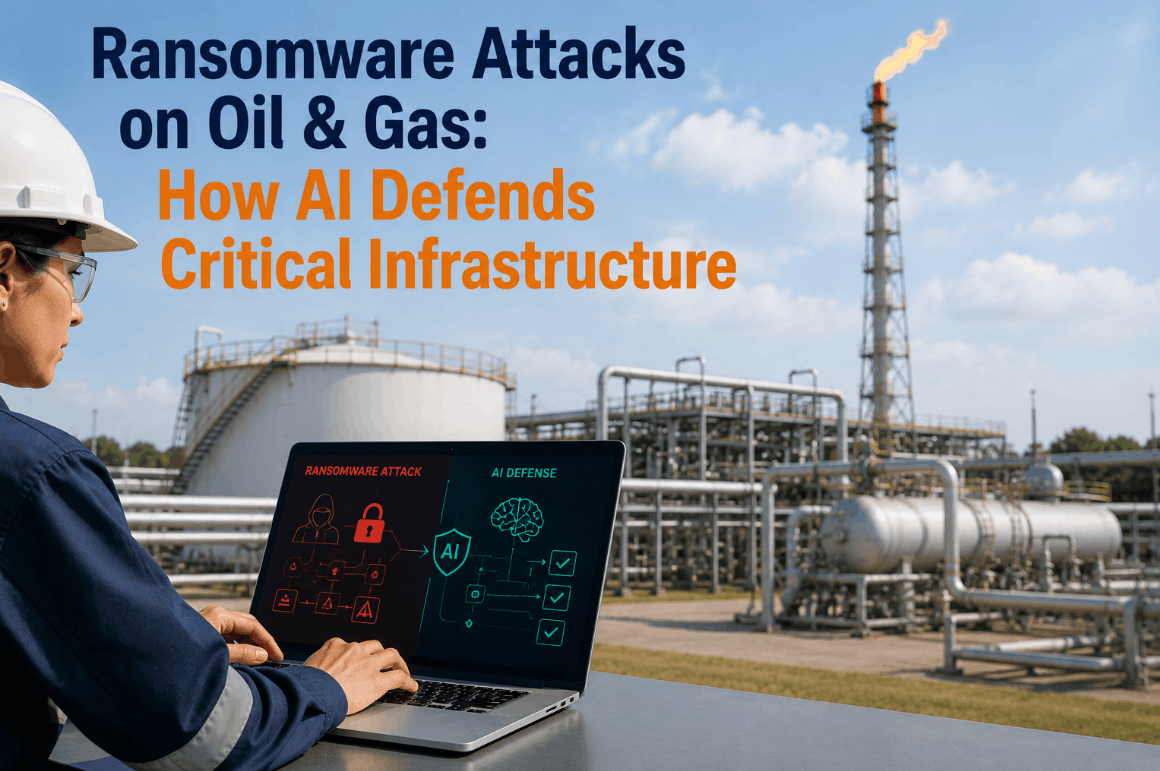
Post-Colonial Pipeline, ransomware groups explicitly target oil and gas IT infrastructure knowing operators will pay to avoid OT impact or regulatory scrutiny. Groups including BlackCat/ALPHV, LockBit 3.0, and Cl0p have all claimed energy sector victims since 2022. OT-aware variants that can directly impact industrial control systems represent the next escalation.
AI Detection Priority: Rapid lateral movement, mass file encryption indicators, C2 beacon traffic, credential harvesting tools
Insider Threat
Privileged User and Contractor Risk
Oil and gas OT environments have large populations of third-party contractors, OEM service engineers, and system integrators with legitimate remote access to critical control systems. Insider threat — whether malicious or accidental — accounts for a significant share of OT security incidents, and is particularly difficult to detect with conventional rule-based tools that treat all credentialed access as authorized.
AI Detection Priority: Access outside maintenance windows, unusual data volume transfers, configuration changes by unexpected users
Scroll to compare
Security Capability
Conventional IT Security
AI-Driven OT Security
OT Protocol Visibility
No native support for Modbus, DNP3, PROFINET, EtherNet/IP — OT traffic is opaque
Deep packet inspection for all major OT protocols — command-level visibility including read vs. write operations
Anomaly Detection Baseline
IT behavioral baselines — no understanding of normal OT communication patterns
OT-specific behavioral baseline per device, per protocol, per time window — identifies deviations from normal OT behavior
Endpoint Agent Requirement
Agent installation required — incompatible with most OT devices and vendor warranties
Passive network monitoring — no agent, no active traffic, no disruption to OT systems
Asset Inventory
IT asset discovery only — OT devices invisible to standard network scanners
Automatic OT asset discovery from passive traffic analysis — firmware versions, communication paths, vulnerabilities
Zero-Day and Novel Threat Detection
Signature-dependent — misses threats without known signatures, common in targeted OT attacks
Behavioral detection independent of signatures — identifies novel techniques through anomalous behavior patterns
Process Safety Correlation
No process data context — cannot correlate cyber events with physical process changes
Cyber-physical correlation — links network anomalies to SCADA process deviations for higher-confidence threat scoring
AI Cybersecurity Architecture for Oil & Gas OT/IT Environments
Deploying AI-driven cybersecurity in oil and gas OT environments requires an architecture that is fundamentally different from IT security deployments. The constraints are real: OT systems cannot tolerate active scanning, network disruption, or performance impact; many facilities operate in air-gapped or limited-connectivity environments; and security monitoring must integrate with OT operational data without creating new attack vectors through the monitoring infrastructure itself.
Passive Network Tap Architecture
OT security sensors connect to network switches via SPAN ports or network TAPs — receiving a copy of all traffic without injecting any packets into the OT network. This passive architecture guarantees zero impact on control system communications or process operations, while providing complete visibility into all OT network activity for AI analysis.
Zero Disruption
On-Premise AI Processing
For facilities with air-gapped OT networks or strict data sovereignty requirements — common in government-affiliated oil and gas operations — all AI analysis runs on on-premise hardware within the operator's own data center. No operational data leaves the facility network, and the AI models are updated via secure offline processes rather than cloud connectivity.
Air-Gap Compatible
SIEM and SOC Integration
AI-generated OT security alerts integrate with enterprise SIEM platforms — Splunk, IBM QRadar, Microsoft Sentinel — through standard CEF or LEEF syslog formats, enriched with OT context that makes alert triage faster and more accurate. Security operations center analysts receive OT alerts with protocol context, asset criticality, and MITRE ATT&CK for ICS mapping.
SOC Integration
Zero Trust OT/IT Boundary Enforcement
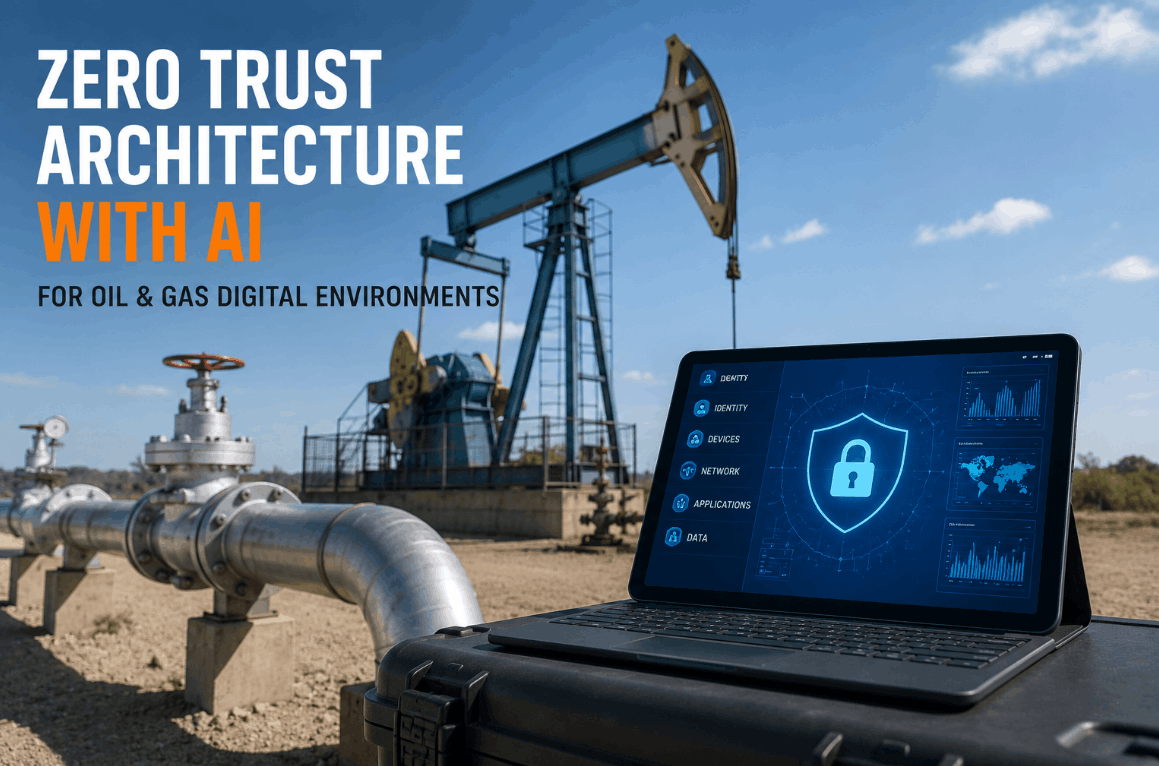
AI-driven zero trust architecture for OT/IT boundaries continuously validates all communication crossing from IT to OT networks — flagging connections that deviate from established communication policies even when they use valid credentials. This approach detects credential theft-based attacks and supply chain compromises that rule-based firewall policies miss.
Zero Trust
ICS Vulnerability Management
AI-driven asset inventory combined with ICS-specific CVE databases provides continuous vulnerability exposure assessment across all OT devices — identifying known vulnerabilities in PLCs, RTUs, and SCADA servers without active scanning. Vulnerability prioritization is context-aware: exploitability in the specific OT network topology and potential operational impact determine remediation priority.
Risk Prioritization
Regulatory Compliance Documentation
Continuous OT network monitoring records — traffic logs, anomaly events, asset inventory, vulnerability assessments — maintained and exportable for NERC CIP compliance, TSA Security Directives for pipeline operators, IEC 62443 certification, and NIST CSF assessment documentation. Compliance reporting assembled automatically from continuous monitoring data.
NERC CIP · IEC 62443
Protect Your Oil & Gas OT Network With AI-Driven Anomaly Detection That Understands Industrial Control Systems
iFactory's industrial AI platform integrates operational technology monitoring with anomaly detection for oil and gas SCADA and ICS environments — passive deployment, no OT disruption, and security alerts enriched with process context that makes response faster and more accurate.
The fundamental challenge in oil and gas OT security is that the tools and methodologies that work in IT environments fail in OT environments for structural reasons — not because OT security professionals are behind the curve, but because the technology stack is genuinely different. A PLC running firmware from 2009 on a proprietary operating system with no authentication cannot run an endpoint agent. A safety instrumented system cannot be rebooted for a patch without a full process shutdown. A Modbus RTU connection between a wellhead RTU and a SCADA server cannot be replaced with an encrypted protocol without replacing both endpoints. These constraints are real and they are not going away. What AI changes in this environment is the detection layer — rather than trying to harden endpoints that cannot be hardened or encrypt protocols that cannot be encrypted, AI-driven network monitoring builds a behavioral model of what normal looks like in that specific OT environment and flags deviations that indicate something has changed. A PLC that has communicated with exactly three other devices for five years and suddenly initiates a new connection to an engineering workstation at 2am is immediately visible to a behavioral AI model — even though every conventional security control in the environment would have passed that traffic as legitimate because the credentials were valid. That is the gap that AI is closing in oil and gas OT security, and it is the most important security capability investment an operator can make in this environment right now.
— Senior OT/ICS Security Architect, Energy Sector · 19 Years Industrial Cybersecurity · Former Lead ICS Security Advisor, Major U.S. Pipeline Operator · ISA/IEC 62443 Certified Professional · NERC CIP Compliance Advisory Panel
Conclusion: AI Is the Only Scalable Answer to Oil & Gas OT Cybersecurity
The oil and gas OT cybersecurity challenge is not going to be solved by conventional security tools applied harder. The scale of OT assets, the structural inability to patch or harden legacy control systems, the expanding OT/IT attack surface created by digital transformation, and the sophistication of threat actors who specifically target energy infrastructure all point to the same conclusion: behavioral AI monitoring is the only detection approach that scales to the size of the threat without disrupting the operations it is protecting.
The organizations that are closing the OT security detection gap — reducing attacker dwell time from months to hours, correlating cyber events with process behavior, and delivering OT-context-enriched alerts to security operations teams — are doing it with AI-driven network monitoring that passively observes, learns, and identifies the behavioral deviations that precede operational impact. The cost of a major OT security incident in oil and gas — production loss, equipment damage, regulatory consequence, and reputational impact — is measured in tens of millions of dollars. The investment in AI-driven OT monitoring that prevents it is a fraction of that exposure. Book a Demo to see how iFactory's AI-driven industrial platform integrates security monitoring with operational technology for oil and gas environments.
Frequently Asked Questions
Can AI OT security monitoring be deployed without disrupting SCADA or control system operations?
Yes — passive network monitoring via SPAN ports or TAPs requires no active traffic injection and has zero impact on OT network communications or control system performance. No agents are installed on OT devices.
Which OT protocols does AI-driven security monitoring support in oil and gas environments?
AI OT security tools support all major industrial protocols used in oil and gas — Modbus TCP/RTU, DNP3, EtherNet/IP, OPC-UA, PROFINET, PROFIBUS, IEC 60870-5-101/104, and Emerson DeltaV proprietary protocols — with command-level deep packet inspection.
How does AI OT security help with NERC CIP and TSA Security Directive compliance?
AI-driven monitoring provides continuous asset inventory, network traffic logs, and anomaly event records that directly support NERC CIP-007 (systems security management) and CIP-010 (configuration change management) requirements, as well as TSA Security Directive pipeline cybersecurity obligations.
What is the difference between OT security and IT security in oil and gas?
OT security prioritizes availability and process safety over confidentiality — meaning security tools cannot disrupt operations, cannot require device patching on IT timelines, and must understand industrial protocols and processes that IT security tools have no visibility into.
How long does it take for AI OT security to establish a behavioral baseline in an oil and gas facility?
A statistically valid behavioral baseline for a typical oil and gas OT environment is established within 4 to 8 weeks of passive monitoring deployment, after which AI anomaly detection alerts reflect meaningful deviations from that facility's specific normal operation.
iFactory for Oil & Gas OT/IT Security — AI-Driven Monitoring That Understands Industrial Control Systems, Not Just IT Networks
Passive OT network monitoring. AI behavioral anomaly detection for SCADA and ICS. Zero disruption to control system operations. NERC CIP and IEC 62443 compliance documentation. iFactory's industrial AI platform delivers the OT security visibility that oil and gas operators need — integrated with the operational monitoring that protects production availability simultaneously.