OT Security in Oil & Gas: AI Strategies for ICS Protection

By Henry Green on May 27, 2026

ot-security-in-oil-&-gas-ai-strategies-for-ics-protection

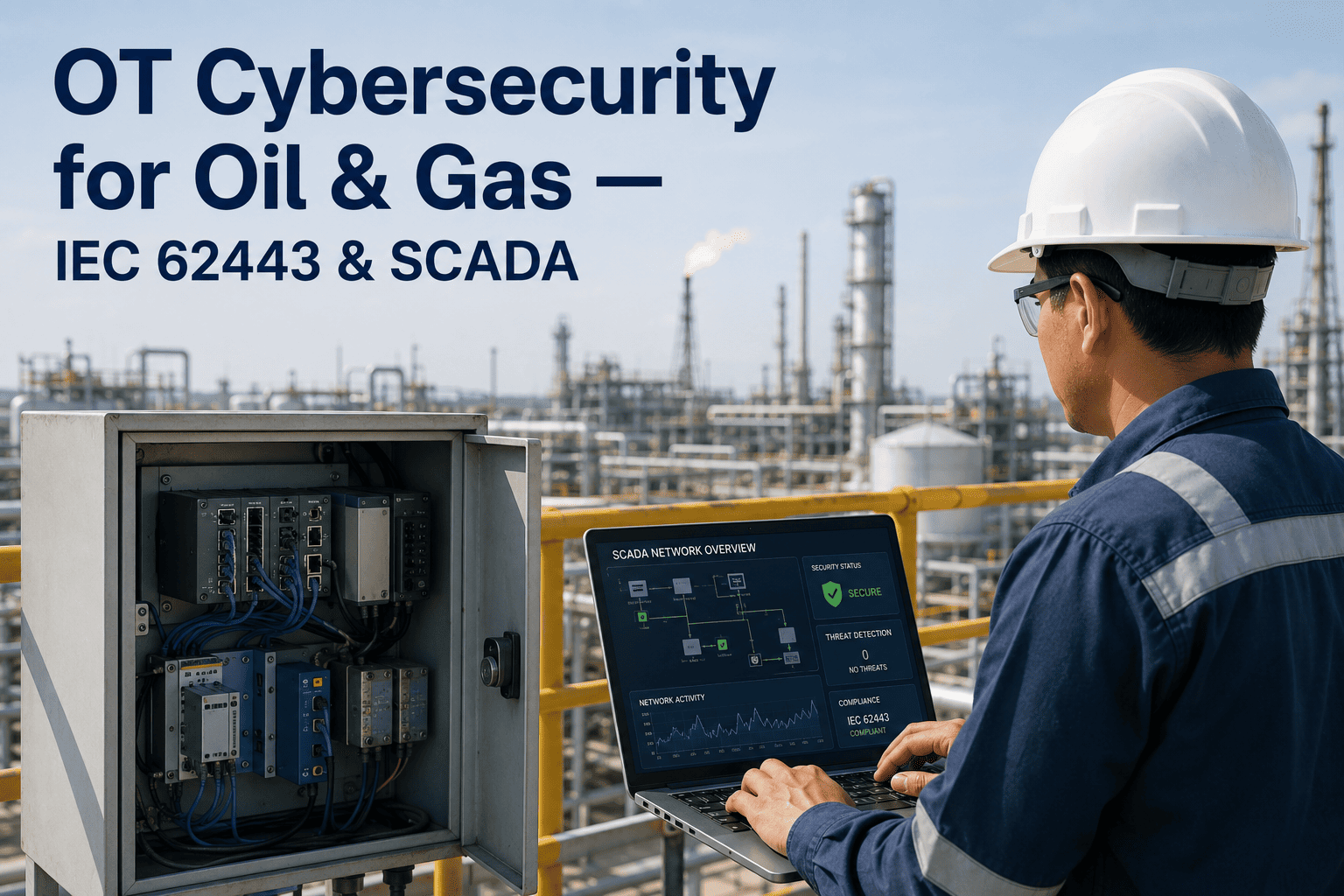
Operational technology networks in oil and gas have become the most actively targeted segment of critical infrastructure globally — and the attack surface is expanding faster than traditional ICS protection frameworks can keep pace. Pipeline control systems, refinery distributed control networks, offshore platform SCADA environments, and compressor station RTU networks were engineered for operational continuity in isolated environments, not for the connected, IT-converged topologies that now define the modern upstream, midstream, and downstream operational reality. OT security AI ICS oil gas has moved from a specialist discussion among CISO teams to a board-level operational risk priority, driven by documented incidents that have caused physical consequences, regulatory penalties, and multi-million dollar recovery costs. What has changed in 2025 is not just the volume of attacks — it is the precision. Adversaries are targeting specific ICS components, exploiting OT protocol weaknesses with automated tools, and operating inside OT networks for weeks before triggering any visible event. Defending against this threat level requires AI-driven detection that understands OT behavior at the protocol and process level — not IT security tools retrofitted to an industrial context. Book a Demo with iFactory's industrial cybersecurity team to see how AI-powered OT security deploys across oil and gas ICS environments.

Protect Your Oil & Gas ICS with AI-Driven OT Security
iFactory's industrial cybersecurity platform delivers behavioral anomaly detection, ICS protocol-level visibility, and zero trust architecture support — deployable on-premise without impacting your control system operations.
74%
Of oil & gas OT security incidents involve ICS components unreachable by IT security tools
$4.7M
Average cost of a successful OT cyberattack on oil & gas critical infrastructure (2024)
200+
Days average dwell time for advanced threats inside OT networks before detection
3x
Increase in ICS-targeted attacks on oil & gas infrastructure since 2021

The ICS Threat Landscape Specific to Oil & Gas Operations

Industrial control systems in oil and gas occupy a fundamentally different threat environment than enterprise IT networks. The consequences of a successful ICS intrusion are not measured in data loss or system downtime — they are measured in pipeline ruptures, refinery fires, compressor station shutdowns, and environmental releases. Nation-state actors, ransomware groups with OT-specific capabilities, and hacktivist organizations have all demonstrated both intent and technical capability to compromise ICS environments at oil and gas facilities in North America, Europe, and the Middle East.

The attack vectors most relevant to oil and gas ICS protection are distinct from IT-layer threats. Engineering workstations with direct PLC access, remote terminal units on pipeline networks with minimal authentication, historian servers bridging OT and IT segments, and vendor remote access channels for DCS maintenance all represent OT-specific entry points that AI-driven detection must address at the protocol and process behavior level.

PLC and RTU Firmware Attacks
Adversaries targeting programmable logic controllers and remote terminal units with malicious firmware modifications — altering control logic while reporting normal status to operator HMI screens.
HIGH RISK
DCS Engineering Workstation Compromise
Engineering workstations with direct download access to DCS controller configurations are high-value targets — compromise provides adversaries with direct control logic modification capability.
HIGH RISK
OT-Targeting Ransomware
Ransomware variants specifically designed for OT environments — encrypting historian databases, HMI configurations, and engineering files while preserving enough control to apply shutdown leverage.
HIGH RISK
Safety System Manipulation
Nation-state actors specifically targeting Safety Instrumented Systems to disable emergency shutdown logic — documented in the Triton/TRISIS attack designed to cause physical destruction at a petrochemical facility.
HIGH RISK
Pipeline Remote Access Exploitation
Exploitation of poorly secured SCADA remote access channels to pipeline RTUs — enabling adversaries to issue unauthorized valve commands, falsify flow data, or disable alarm reporting across distributed pipeline infrastructure.
MEDIUM RISK
IT/OT Boundary Traversal
Lateral movement from corporate IT networks through inadequate DMZ controls into OT historian and control system segments — the documented attack pattern in the Colonial Pipeline ransomware incident.
MEDIUM RISK
68%
Of ICS incidents originate from IT-to-OT lateral movement through connected software
43%
Of oil & gas OT devices are running unpatched firmware with known CVEs
$1M+
Per-day operational revenue exposure during a forced pipeline or refinery shutdown

AI Strategies for ICS Protection: How Machine Learning Defends OT Networks

Effective ICS protection in oil and gas requires AI detection architectures that operate at four distinct levels simultaneously: OT network traffic behavior, ICS protocol semantics, physical process integrity, and cross-layer IT/OT correlation. No single detection mechanism is sufficient. The adversary techniques documented in real-world ICS attacks — legitimate credential use, valid protocol commands, slow-moving reconnaissance — are specifically designed to evade each layer individually. AI-driven strategies that correlate anomalies across all four layers provide detection capability that no point solution delivers.

iFactory's industrial AI platform integrates OT behavioral monitoring with process physics-based anomaly detection — designed for oil and gas ICS environments with native support for Modbus, DNP3, OPC-UA, and IEC 61850 protocols. Book a Demo to see how iFactory's ICS protection capabilities deploy across your facility's control network topology.

01
OT Network Behavioral Baseline Establishment
AI models passively monitor all OT network traffic — capturing the communication patterns, polling frequencies, command sequences, and data payload structures that define normal behavior for every device pair in the ICS network. This behavioral baseline, established over 2–4 weeks of passive observation, becomes the reference against which all future activity is scored for anomaly.
02
ICS Protocol-Level Deep Packet Inspection
Protocol-aware inspection engines parse Modbus function codes, DNP3 object groups, OPC-UA node operations, and IEC 61850 GOOSE messages at the semantic level — identifying commands that are syntactically valid but operationally anomalous. A Modbus write from a device that has never previously issued write commands, or a DNP3 time sync from an unexpected source, generates an anomaly score regardless of credential validity.
03
Process Physics Integrity Monitoring
AI models trained on process physics relationships — pressure-flow dynamics, temperature-throughput correlations, compressor surge margins, separator efficiency curves — continuously validate that sensor readings are consistent with physical reality. Sensor spoofing attacks that report false readings to conceal physical manipulation generate inconsistencies that physics-based models detect even when network traffic appears normal.
04
IT/OT Cross-Layer Lateral Movement Detection
Correlating OT anomalies with IT-layer events — VPN authentication, Active Directory activity, jump server sessions, engineering workstation logins — enables detection of IT-to-OT lateral movement in progress. Composite risk scoring across both layers identifies attack chains that neither IT SIEM nor OT monitoring detects independently.
05
Automated Containment and Incident Response
Confirmed threat patterns trigger automated response playbooks — network segment isolation, session termination, and alert escalation — within seconds of detection. Security teams receive pre-triaged, high-confidence alerts with complete attack chain context rather than thousands of raw log events requiring manual correlation under operational pressure.

AI vs. Traditional ICS Security: Capability Comparison for Oil & Gas

The performance gap between AI-driven OT security and legacy ICS protection tools is most critical in the detection categories that matter most in oil and gas: novel malware with no signatures, low-and-slow reconnaissance, sensor spoofing, and legitimate-credential misuse. The comparison below maps where traditional tools fail and where AI-driven detection closes the gap.

Protection Capability Traditional ICS Security Tools AI-Driven OT Security (iFactory) Oil & Gas Relevance
Novel Malware Detection Signature-only — Triton, Industroyer, and custom nation-state malware are invisible without prior signatures Behavioral anomaly detection identifies novel malware through deviation from established OT network baselines Nation-state ICS malware targeting oil & gas uses custom tooling with no existing signature library
ICS Protocol Visibility Most tools lack semantic parsing of Modbus, DNP3, IEC 61850 — function code anomalies go undetected Protocol-aware deep packet inspection with semantic analysis of all major ICS and SCADA protocols 75% of ICS attacks exploit legitimate protocol commands — invisible to non-OT-aware security tools
Sensor Spoofing Detection No capability — cannot distinguish genuine from falsified sensor values at network or process level Physics-based process integrity models validate sensor readings against operational relationships in real time Triton/TRISIS specifically falsified SIS sensor data — a detection gap that directly enabled physical threat
Dwell Time Average 200+ day detection window — adversaries operate undetected through slow reconnaissance Behavioral baseline deviation scoring identifies low-and-slow reconnaissance within days of initial network entry Extended dwell time in oil & gas OT gives adversaries full facility mapping before triggering events
IT/OT Lateral Movement No cross-layer correlation — IT SIEM and OT tools operate in isolation with manual analysis required Automated cross-layer correlation detects IT-to-OT movement in progress before ICS systems are reached Colonial Pipeline attack traversed IT-to-OT — cross-layer AI correlation would have identified it mid-chain
False Positive Rate High — rule-based systems generate alert storms; maintenance activities trigger continuous false alarms AI models distinguish planned maintenance, seasonal process shifts, and turnaround activities from genuine threats Alert fatigue in OT security teams causes genuine threat indicators to be deprioritized or missed entirely

Zero Trust Architecture for Oil & Gas ICS: Implementation Framework

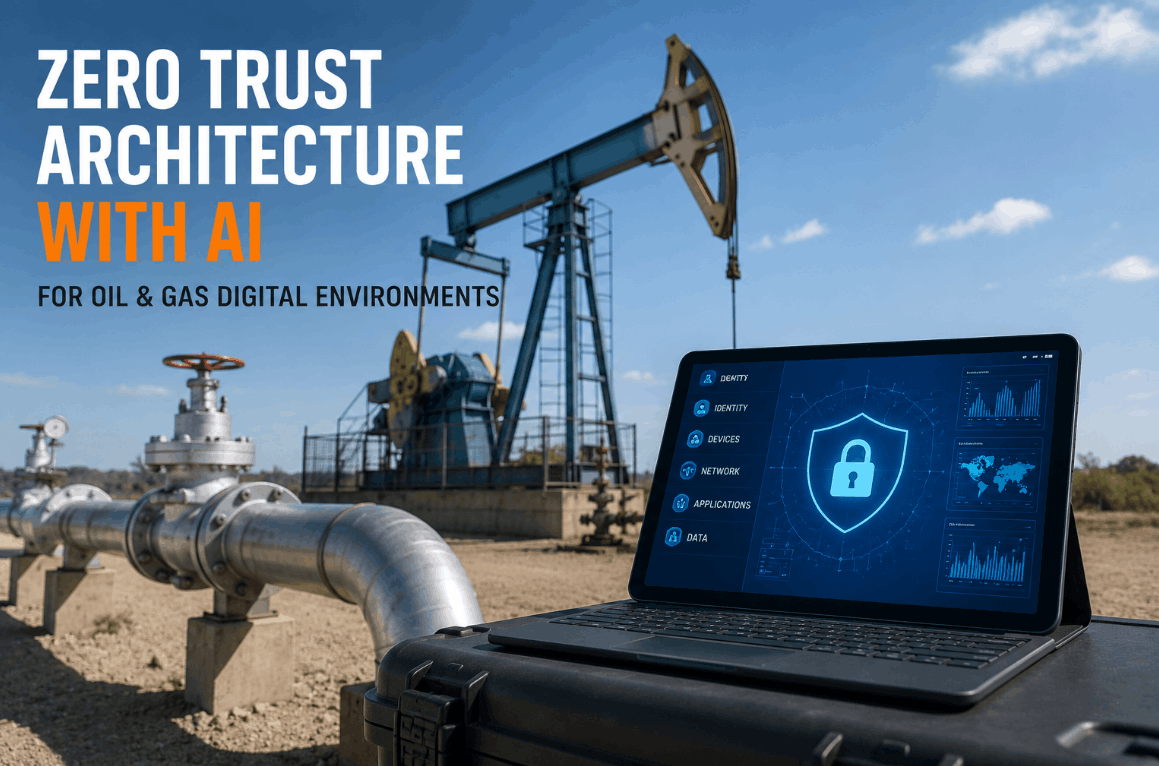
Zero trust principles — continuous verification, least-privilege access, microsegmentation — are increasingly being applied to oil and gas OT network architecture as perimeter-only defenses have proven insufficient against modern ICS threats. AI is the operational enabler of zero trust in OT environments: providing the continuous behavioral monitoring that makes dynamic access decisions possible and the anomaly detection that validates trust assertions in real time.

Zero Trust OT Implementation Checklist for Oil & Gas ICS Environments
OT Network Microsegmentation: ICS zones divided by function — pipeline SCADA, compressor control, SIS, DCS — with AI-monitored conduits and automated blocking of unauthorized inter-zone communication attempts.
Just-in-Time Vendor Access: Third-party DCS and SCADA vendor access provisioned on-demand, session-recorded, and AI-monitored — no persistent remote access channels that represent continuous attack surface for supply chain intrusion.
Engineering Workstation Isolation: EWS with PLC/DCS download access isolated to dedicated network segments with AI behavioral monitoring of all controller programming and configuration activities.
OT Device Trust Scoring: Dynamic trust scores assigned to every ICS device based on firmware patch status, communication behavior deviation, and configuration baseline compliance — flagging devices that deviate from their established operational profile.
SIS Isolation and Monitoring: Safety Instrumented Systems maintained in isolated network segments with AI monitoring of all SIS communication — detecting unauthorized attempts to query, modify, or disable safety function logic.
Historian DMZ Enforcement: Historian servers connecting OT and IT segments deployed in dedicated DMZ with unidirectional data flow enforcement — eliminating the bidirectional network path that enables IT-to-OT lateral movement through historian connections.

Implementing zero trust architecture for an oil and gas ICS environment requires deployment expertise that combines OT network architecture knowledge with AI security platform integration. Book a Demo with iFactory's OT security team to review a zero trust implementation framework tailored to your facility's ICS topology.

Regulatory Compliance: TSA, NERC CIP, and IEC 62443 for Oil & Gas OT Security

U.S. oil and gas operators face an accelerating regulatory environment specifically targeting OT cybersecurity. TSA Security Directives for pipeline operators, CISA Cross-Sector Cybersecurity Performance Goals, and the IEC 62443 international standard for industrial automation security all define specific OT protection requirements that AI-driven security platforms are architecturally positioned to satisfy. Understanding the compliance implications of AI OT security deployment is as operationally important as understanding the technical detection capabilities.

TSA SD-02D
Pipeline Cybersecurity Directive
Requires pipeline owner-operators to implement network segmentation, access controls, continuous OT monitoring, and vulnerability management — all directly addressed by AI-driven ICS security architectures.
IEC 62443
Industrial Automation Security Standard
The zone-and-conduit architecture model, security level assignments, and continuous monitoring requirements of IEC 62443 are operationalized through AI behavioral monitoring and automated anomaly detection.
NERC CIP
Critical Infrastructure Protection
For O&G operators with bulk electric system interconnections, NERC CIP Electronic Security Perimeter and interactive remote access requirements govern OT security platform deployment architecture.
CISA CPG
Cross-Sector Performance Goals
CISA's OT-specific performance goals covering log collection, network monitoring, MFA for OT access, and incident response capabilities align directly with AI-driven OT security platform core capabilities.
On-Prem
Default Deployment
No OT data leaves the facility perimeter in standard iFactory ICS security deployment
Zero
Operational Impact
Passive network monitoring via SPAN ports — no latency or reliability impact on ICS operations
2–4 Wks
Baseline Establishment
AI behavioral baseline fully established and anomaly detection active within 4 weeks of deployment
SOC 2
Vendor Certification
Type II audit report available under NDA for supply chain risk management documentation
Deploy AI-Driven ICS Protection for Your Oil & Gas OT Network
iFactory's OT security platform delivers behavioral anomaly detection, ICS protocol-level visibility, physics-based process integrity monitoring, and zero trust architecture support — deployable on-premise without operational impact to your ICS environment, with compliance documentation for TSA, IEC 62443, and NERC CIP included.

Expert Review: What Oil & Gas ICS Security Teams Consistently Underestimate

The most dangerous assumption I encounter at oil and gas facilities is that network segmentation alone constitutes an adequate OT security posture. Segmentation is a necessary control — it is not a sufficient one. Every documented ICS intrusion at an oil and gas facility in the past five years has involved an adversary who either had legitimate access to the segmented OT network, traversed through an inadequately controlled historian or DMZ connection, or exploited a vendor remote access channel that bypassed the segmentation architecture entirely. Segmentation without behavioral monitoring inside the OT segment gives operators false confidence. You need to know what is happening on the OT network, not just who is theoretically permitted to reach it. AI-driven monitoring that understands what normal ICS behavior looks like is the control that changes the detection equation.
ICS/OT Cybersecurity Principal Architect
Oil & Gas Critical Infrastructure Security, 21 Years — GICSP, CISSP
The Triton/TRISIS attack fundamentally changed how serious oil and gas operators think about safety system security. Before that incident, most facilities assumed their SIS was adequately protected by its physical and network isolation. Triton showed that a sufficiently motivated adversary could reach the SIS through a DCS engineering workstation connection that the facility's own IT team considered low-risk. The lesson for every O&G operator is that AI behavioral monitoring needs to cover the SIS communication bus specifically — not just the DCS and SCADA layers. Any unusual communication toward a SIS, from any source, at any time outside a defined maintenance window, should be treated as a high-confidence attack indicator and escalated immediately.
OT Security Integration Lead
Refinery and Upstream Oil & Gas ICS Security, 16 Years — CISM, IEC 62443 Practitioner

Conclusion: AI-Driven OT Security Is the Current Minimum Viable ICS Defense

The oil and gas ICS threat environment in 2025 has outpaced the detection capabilities of every traditional OT security approach: perimeter firewalls that don't see protocol-level anomalies inside the OT segment, signature-based detection that misses nation-state custom malware, threshold alert engines that generate fatigue without identifying genuine threats, and IT SIEM platforms that are structurally blind to OT network behavior. The incidents that have defined the ICS security conversation — Colonial Pipeline, Triton/TRISIS, Ukraine power grid — are not theoretical scenarios. They are the documented attack playbook against high-value industrial infrastructure, and they are actively evolving.

AI-driven OT security addresses the detection gaps that traditional tools cannot close — by understanding what normal ICS behavior looks like at the protocol and process level, correlating anomalies across IT and OT layers, and detecting low-and-slow intrusions that operate below every threshold-based alert. For oil and gas operators with pipeline, refinery, or production ICS environments, deploying AI-driven detection is not a future roadmap consideration. It is the current minimum viable defense against threats that are already targeting your infrastructure. Book a Demo to begin your OT security assessment with iFactory's industrial cybersecurity team.


Frequently Asked Questions

No — AI-driven OT security operates passively via SPAN port traffic copies, with zero latency impact on ICS communication or control system determinism.
iFactory supports Modbus TCP/RTU, DNP3, OPC-UA, OPC-DA, IEC 61850, EtherNet/IP, and PROFINET — covering all major ICS protocols used in oil and gas SCADA, DCS, and pipeline control environments.
AI-driven OT platforms directly satisfy TSA SD-02D continuous monitoring, network segmentation validation, and anomalous activity detection requirements, with audit-ready compliance documentation generated automatically.
Yes — behavioral baseline anomaly detection identifies unauthorized activity even with valid credentials, because the timing, sequence, and operational context of commands deviate from the established ICS communication baseline.
A meaningful OT behavioral baseline is established within 2–4 weeks of passive monitoring, capturing normal shift patterns, scheduled maintenance windows, and seasonal process variations across the ICS network.
AI-Powered ICS Protection for Oil & Gas OT Networks — Full Visibility, Zero Operational Disruption
iFactory's OT security platform delivers behavioral anomaly detection, ICS protocol-level inspection, physics-based process integrity monitoring, and zero trust architecture support — on-premise, compliance-ready, and deployable without modifying existing ICS infrastructure or impacting control system reliability.
On-Premise Deployment
ICS Protocol Visibility
Zero Operational Impact
TSA & IEC 62443 Ready
Physics-Based Detection

Share This Story, Choose Your Platform!