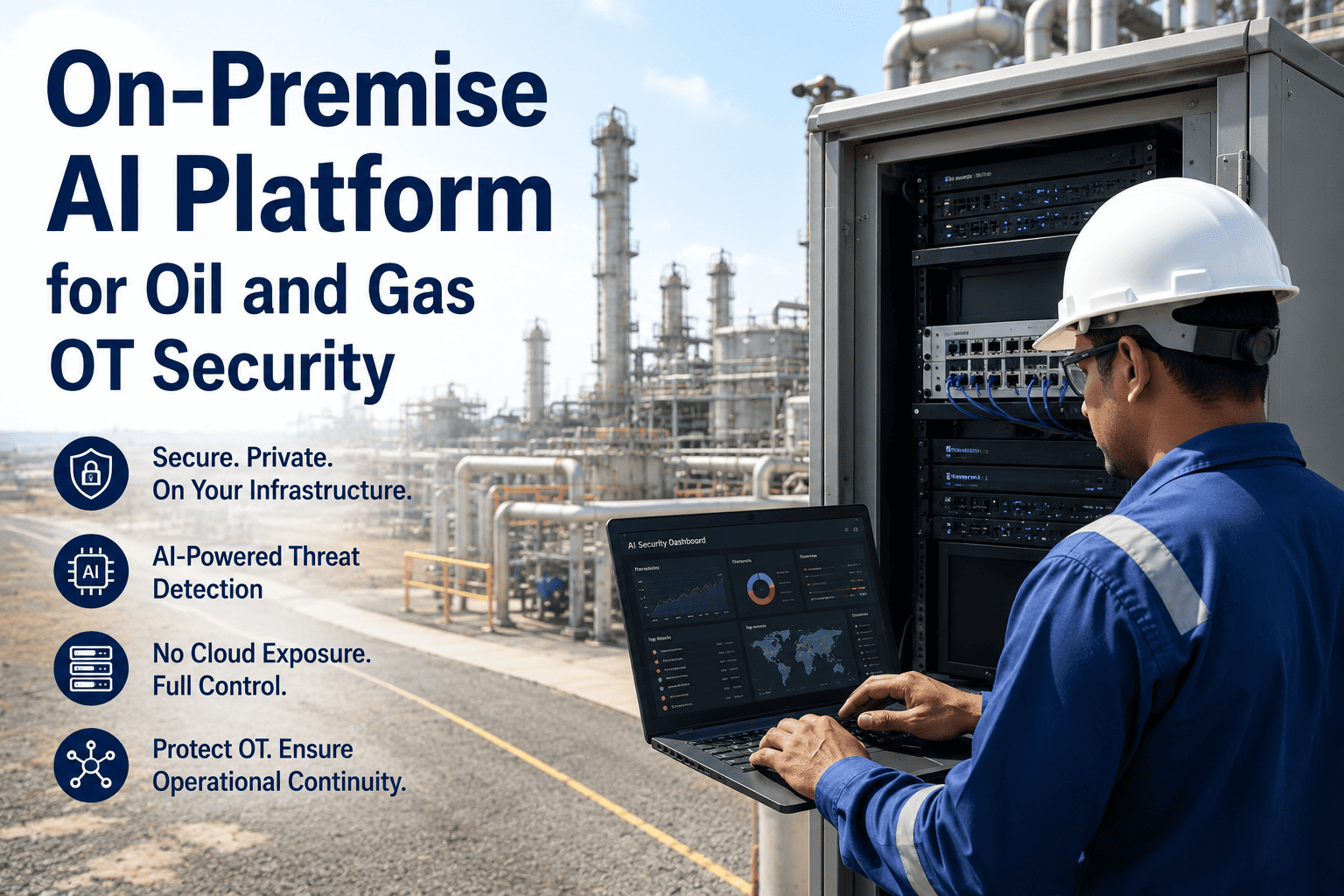
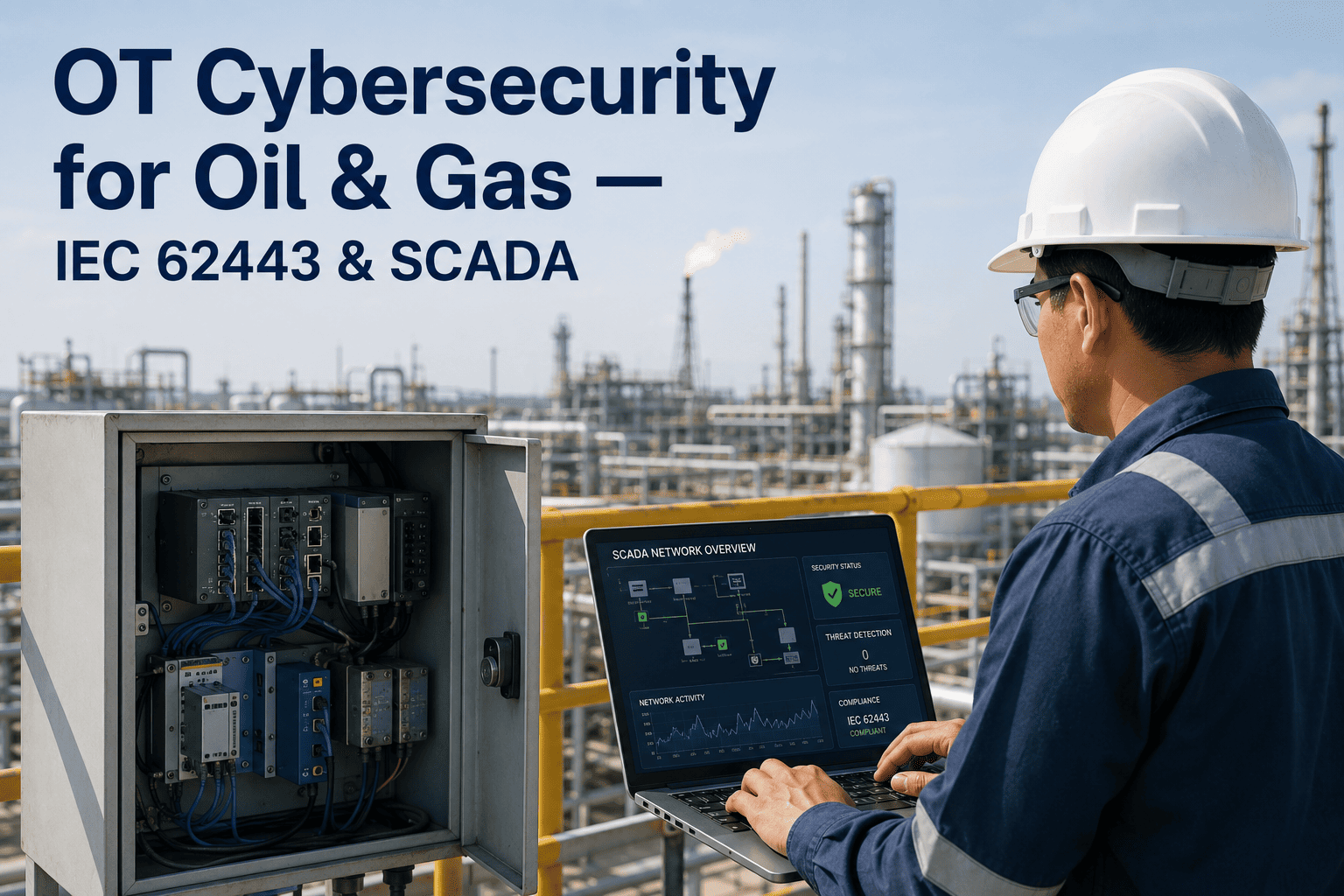
Every oil and gas facility eventually asks the same uncomfortable question: does adding AI to our control network mean opening a new door into it? For years the honest answer was yes, because most AI platforms were built cloud-first, assuming data could stream out to a server somewhere else. Refineries, pipelines, and offshore platforms don't get that luxury — segmentation and air-gap policies exist for good reason, and every documented intrusion into an OT network in recent years has traced back to some connection that bypassed that segmentation. On-premise AI closes that door instead of adding one — request a secure AI deployment demo to see how it runs entirely inside your network.
OT Security · On-Premise AI
On-Premise AI Platform for Oil and Gas OT Security
Deploy AI analytics inside your refinery or oilfield network without sending a single tag to the cloud, keeping segmentation and air-gap policy intact.
Cloud AI Asks for an Exception. On-Premise Doesn't.
Cloud-Dependent AI
Requires a new outbound connection from the OT network
Adds a lateral movement path attackers can exploit
Depends on internet uptime for inference to run at all
Raises hard questions during every IEC 62443 or TSA audit
On-Premise AI
Runs entirely on local GPU servers inside your network
Keeps the existing zone-and-conduit segmentation intact
Continues inference even during a connectivity outage
Documented and audit-ready for the frameworks you already follow
Built to Respect the Zones You Already Defined
Most OT networks are already organized around zones and conduits, separating safety-critical control systems from the level of the network that can safely talk to the outside world. On-premise AI is deployed to fit inside that structure rather than cut across it.
Enterprise / IT Network
DMZ & Monitoring Layer — On-Premise AI Runs Here
Safety-Critical Control Systems (SCADA, PLC, DCS)
Deployed With Compliance Already in Mind
IEC 62443
Zone-and-conduit architecture and security level assignments are honored by design, not retrofitted after deployment.
TSA Security Directives
Continuous OT monitoring and access control requirements for pipeline operators are addressed without a new external connection.
NERC CIP
Critical infrastructure protection requirements are supported through behavioral anomaly detection running fully on-site.
Segmentation alone isn't a complete OT security posture. Every real ICS intrusion in recent years traced back to a connection that bypassed segmentation — on-premise AI is built specifically so it never becomes that connection.
What Runs Locally, Without Sending Data Out
01
Behavioral Anomaly Detection
Local models learn the normal behavior of your control systems and flag deviations without any traffic ever leaving the site.
02
ICS Protocol Visibility
Modbus, DNP3, and similar OT protocols are inspected locally, giving visibility into asset and traffic behavior across the plant floor.
03
Process Integrity Monitoring
Physics-based checks confirm that process behavior matches expected physical reality, catching manipulation that a network-only view would miss.
04
Edge Inference at Remote Sites
Offshore platforms and remote pump stations run inference locally, so limited or intermittent connectivity never interrupts detection.
Expert Insight
The most dangerous assumption I encounter is that network segmentation alone is an adequate OT security posture. It is a necessary control, not a sufficient one. Every serious ICS intrusion I've reviewed involved an adversary who either had legitimate access to the segmented network already, or found a historian, DMZ, or vendor remote-access connection that quietly bypassed the segmentation entirely. On-premise AI matters because it closes exactly that gap instead of opening a new version of it.
Dmitri Volkov — ICS Security Architect, 15+ years hardening refinery and pipeline control networks
Cloud AI vs. On-Premise AI for OT Environments
| Consideration |
Cloud-Dependent AI |
On-Premise AI |
Why It Matters |
| Network exposure |
New outbound path required from OT network |
No new external connection needed |
Segmentation and air-gap policy stay fully intact |
| Uptime dependency |
Requires stable internet for inference |
Runs fully on local GPU hardware |
Detection continues through connectivity outages |
| Audit readiness |
Raises questions under IEC 62443 and TSA review |
Designed around zones, conduits, and existing controls |
Compliance conversations get shorter, not longer |
| Remote site fit |
Struggles with limited offshore or field bandwidth |
Edge inference works independent of bandwidth |
Offshore platforms get the same protection as the main plant |
| Data control |
Process data leaves the facility |
Data never leaves your network |
Removes an entire category of third-party risk |
Frequently Asked Questions
Does on-premise deployment mean we need to buy and manage our own servers?
Yes, on-premise AI runs on GPU hardware installed inside your network, and part of a proper deployment plan includes right-sizing that hardware to your site's tag volume and model workload. This is a one-time infrastructure decision rather than an ongoing dependency on external compute.
Request a secure deployment demo to review hardware sizing for your facility.
Will this interfere with our existing IEC 62443 zone and conduit architecture?
No, the platform is specifically designed to be deployed within your existing zone-and-conduit model rather than cutting new paths across it, typically sitting at the DMZ or monitoring layer where visibility is needed without touching safety-critical zones directly.
Contact support for guidance on where it fits in your specific architecture.
Can this run at remote or offshore sites with limited connectivity?
Yes, edge inference is built to run locally at remote pump stations and offshore platforms, so detection continues even when satellite or cellular connectivity is intermittent. This matters because many OT security failures trace back to gaps that only opened up while connectivity was down.
Request a secure deployment demo to discuss your remote site footprint.
How does this help with TSA and NERC CIP compliance documentation?
Continuous OT monitoring, access control visibility, and behavioral anomaly detection map directly onto the requirements found in TSA Security Directives and NERC CIP, and the platform is built to generate the documentation auditors ask for as a byproduct of normal operation rather than a separate reporting exercise.
Contact support to map this against your current compliance checklist.
Does keeping everything on-premise limit what the AI can actually detect?
No. Behavioral anomaly detection, ICS protocol-level visibility, and physics-based process integrity monitoring all run locally with full capability — the difference from a cloud model is where the computation happens, not what it's capable of finding.
Request a secure deployment demo to see full detection capability running on-site.
Protect the Network Without Opening a New Door Into It
Get AI-driven OT security that runs entirely inside your facility, respects your existing segmentation, and never depends on a connection to the outside world.