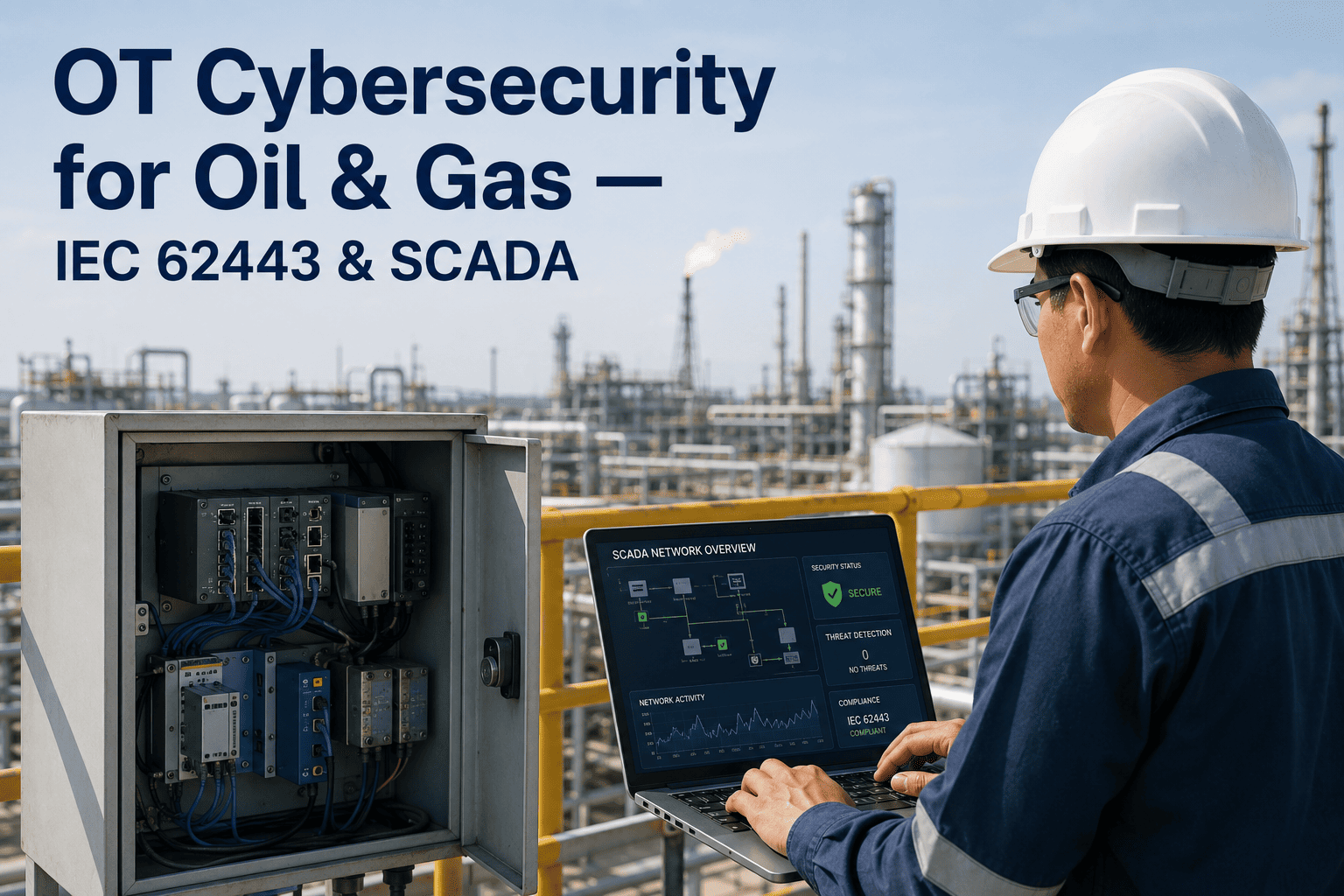
Oil and gas operational technology networks were designed decades ago for reliability and availability, not for resistance against sophisticated cyber adversaries. SCADA systems controlling wellheads, compressors, and pipeline valves often run on legacy operating systems that cannot be patched without shutting down production. Meanwhile, the threat landscape has shifted dramatically, with nation-state actors, ransomware groups, and hacktivists specifically targeting energy infrastructure. The TSA pipeline security directive, NERC CIP requirements, and increasing regulatory pressure have made OT cybersecurity a board-level issue for every midstream and upstream operator in North America. Implementing IEC 62443 as the foundational security standard provides a structured, internationally recognized framework for hardening these critical systems. To understand how IEC 62443 applies to your specific OT environment, Book a Demo with iFactory AI's industrial security team.
Your SCADA Systems Were Built to Run, Not to Defend. Fix That Now.
iFactory AI delivers OT cybersecurity assessments, IEC 62443 compliance mapping, and SCADA hardening services purpose-built for oil and gas operational environments — from wellsite RTUs to pipeline control centers.
The Five Most Dangerous Cyber Threat Vectors Targeting Oil and Gas OT Networks
Understanding the specific attack paths that adversaries use against oil and gas operational technology is the first step toward building effective defenses. Each threat vector below represents a documented attack methodology that has been used against energy sector OT environments in recent years, with severity ratings based on potential operational impact if successfully executed.
Ransomware Targeting SCADA and HMI Systems
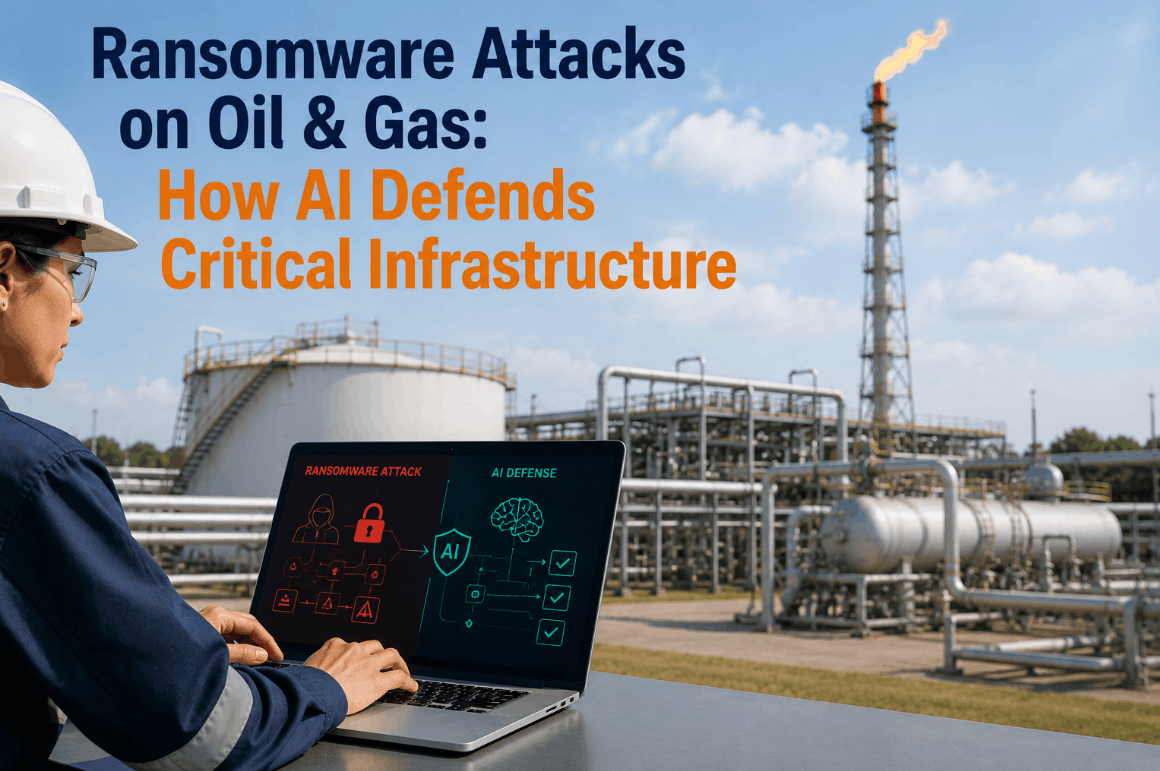
Ransomware groups have shifted focus from IT networks to OT environments, specifically targeting SCADA servers and HMI workstations that operators depend on for process visibility. When these systems are encrypted, operators lose the ability to monitor and control pipeline operations, forcing emergency shutdowns that create safety hazards and supply disruptions.
Impact: Complete loss of process visibility and controlSupply Chain Compromise of OT Software and Firmware
Adversaries infiltrate OT software vendors to insert malicious code into legitimate updates for PLC programming software, SCADA platforms, or engineering workstations. When operators deploy these compromised updates, attackers gain persistent access to the OT network with trusted credentials, bypassing network segmentation entirely.
Impact: Persistent unauthorized access to control systemsIT-to-OT Lateral Movement Through Converged Networks
Many oil and gas operators have partially converged IT and OT networks for business intelligence and remote access purposes. Attackers who compromise corporate IT systems through phishing or VPN exploitation can pivot into OT networks through inadequate network segmentation, reaching PLCs and RTUs that were never designed to resist targeted intrusion.
Impact: Direct access to field control devices from IT-originated attacksRemote Access Exploitation of Maintenance Connections
Vendor remote access connections established for PLC programming, SCADA maintenance, or equipment troubleshooting frequently use weak authentication, lack multi-factor verification, and remain active long after the maintenance window closes. These dormant connections are prime targets for attackers seeking direct entry to OT control systems without traversing network defenses.
Impact: Bypass of all network perimeter defensesCompromised Removable Media at Field Sites
Field technicians frequently use USB drives to transfer configuration files, firmware updates, and diagnostic tools between office environments and remote field devices. Malware introduced through removable media can spread across air-gapped OT segments, infecting PLCs and engineering workstations that have no direct network connection to any external system.
Impact: Malware introduction into air-gapped OT segmentsMapping IEC 62443 Security Levels to Oil and Gas OT Zones
IEC 62443 provides a zone-and-conduit model that allows oil and gas operators to categorize their OT environments into logical security zones with defined security levels, then apply appropriate protections to the conduits that connect them. This structured approach prevents the common mistake of applying uniform security measures across vastly different risk environments, from corporate IT to field-level PLCs.
Corporate business systems, email, ERP platforms. Standard IT security controls apply with no special OT hardening requirements beyond basic access controls to prevent unauthorized lateral movement toward OT networks.
Buffer zone between IT and OT containing jump servers, patch management systems, and data historians. All traffic crossing this boundary requires authentication, protocol inspection, and session logging for forensic analysis.
SCADA servers, HMI workstations, and engineering stations that provide process visibility and control. Requires hardened operating systems, application whitelisting, multi-factor authentication, and continuous monitoring for anomalous behavior.
PLCs, RTUs, and edge controllers that directly operate physical pipeline equipment. Requires firmware integrity verification, communication authentication, and strict change management to prevent unauthorized logic modifications.
Six Layers of Defense-in-Depth for Oil and Gas SCADA Environments
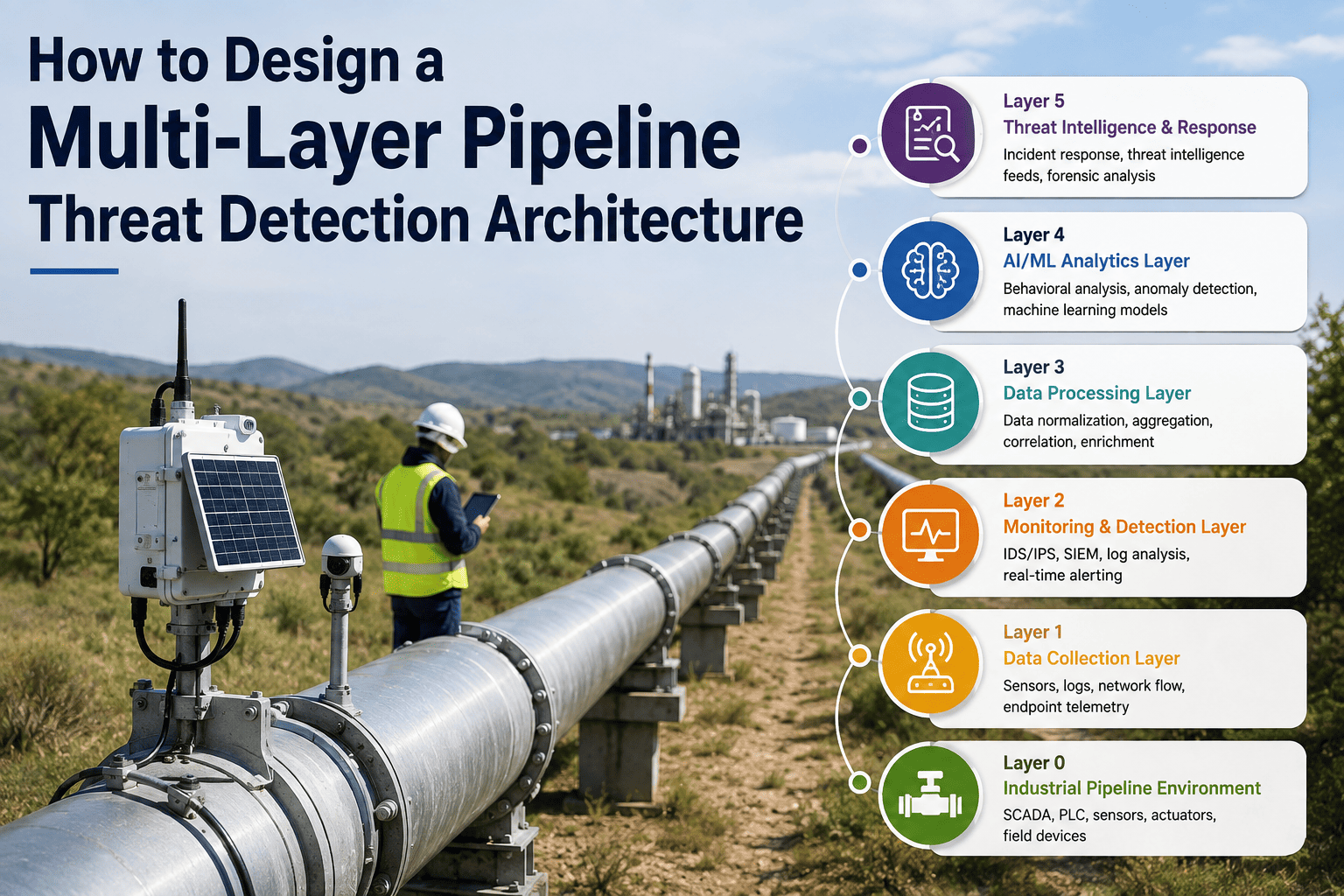
Effective OT cybersecurity does not rely on any single control. Defense-in-depth applies multiple overlapping protective layers so that if any single control fails, the remaining layers continue to provide protection. For oil and gas operators, these six layers form the minimum viable security architecture for SCADA environments controlling critical pipeline and production infrastructure.
Physical Security and Access Control
Secured enclosures for SCADA servers and PLC cabinets, badge-controlled access to control rooms, surveillance monitoring of all physical entry points to OT spaces, and strict visitor management policies that prevent unauthorized physical access to control system hardware.
Network Segmentation and Architecture
Industrial firewalls enforcing zone-to-zone traffic policies, VLAN segmentation isolating SCADA traffic from all other network traffic, protocol-aware deep packet inspection blocking unauthorized commands, and complete isolation of safety instrumented systems from standard control networks.
Endpoint Hardening and Application Control
Application whitelisting on all HMI and engineering workstations, disabled unnecessary services and ports on SCADA servers, removal of default accounts and hardcoded credentials, and operating system hardening following CIS benchmarks adapted for industrial control systems.
Identity and Remote Access Management
Multi-factor authentication for all remote access connections, role-based access controls limiting each user to minimum necessary system functions, session recording for all vendor maintenance access, and automated deactivation of temporary accounts after maintenance windows close.
Continuous Monitoring and Anomaly Detection
Passive network monitoring sensors analyzing all OT traffic for anomalous patterns, baseline behavioral profiling of normal SCADA communications, alerting on unauthorized protocol commands or unexpected device-to-device communications, and integration with SOC workflows for 24/7 visibility.
Incident Response and Recovery Preparedness
Documented OT-specific incident response playbooks, regular tabletop exercises simulating SCADA compromise scenarios, offline backups of PLC logic and SCADA configurations, and tested recovery procedures that can restore control system operations without introducing infected media.
SCADA Hardening Checklist for Oil and Gas Control Systems
SCADA hardening is the process of systematically reducing the attack surface of control system components by applying configuration changes, removing unnecessary functionality, and enforcing strict access controls. The checklist below covers the highest-priority hardening actions that every oil and gas operator should implement on SCADA servers, HMI workstations, and engineering terminals within their OT environment.
Remove All Default and Hardcoded Credentials
Scan every SCADA server, HMI workstation, PLC, and RTU for factory-default usernames and passwords. Replace with unique, strong credentials managed through a secure industrial credential vault. Document all account changes for compliance audit trails.
Priority: ImmediateDisable Unused Network Services and Ports
Identify and disable all network services not required for SCADA operations on each system, including file sharing, remote registry, and unused RPC endpoints. Close all network ports except those specifically required for SCADA protocol communication and approved management interfaces.
Priority: ImmediateImplement Application Whitelisting
Deploy application whitelisting on all HMI workstations and engineering stations to prevent execution of unauthorized software. Configure whitelist policies to allow only known-good SCADA applications, engineering tools, and approved system utilities while blocking all other executables.
Priority: HighEstablish Secure Backup and Recovery Procedures
Create offline backups of all PLC programs, SCADA configurations, HMI display files, and historian databases. Store backups on air-gapped media with documented restoration procedures. Test backup restoration quarterly to verify recoverability after a cyber incident.
Priority: HighRestrict and Monitor All Remote Access Paths
Eliminate all unmonitored remote access connections. Route all vendor and remote operator access through a secure jump server in the industrial DMZ with multi-factor authentication, session recording, and automatic session timeout. Review and revoke unused remote access accounts monthly.
Priority: ImmediatePatch Management Without Production Disruption
Establish a risk-based patching process that evaluates SCADA system patches for operational compatibility before deployment, uses maintenance windows or redundant system failover for patch installation, and documents all patch decisions including accepted risks for deferred updates.
Priority: OngoingHow OT Cybersecurity Requirements Map Across Oil and Gas Regulations
Oil and gas operators face overlapping cybersecurity requirements from multiple regulatory bodies. Understanding how these requirements intersect allows operators to build a single security program that satisfies multiple compliance obligations rather than maintaining separate, duplicative compliance efforts for each regulator.
| Security Domain | TSA Pipeline Directive | NERC CIP | IEC 62443 |
|---|---|---|---|
| Network segmentation | Required network separation between IT and OT | CIP-005: Electronic Security Perimeter | Zone and conduit architecture with defined security levels |
| Access control | Multi-factor authentication for remote access | CIP-004: Personnel and Training | Role-based access per security level requirements |
| Monitoring and detection | Continuous monitoring of cyber posture | CIP-007: Systems Security Management | Continuous monitoring and anomaly detection in conduits |
| Incident response | Documented incident response plan required | CIP-008: Incident Reporting | Security event management and incident response procedures |
| Change management | Unauthorized changes detection capability | CIP-010: Configuration Change Management | Patch management and configuration baseline controls |
| Risk assessment | Annual cybersecurity assessment required | CIP-010: Configuration Change Management | Risk assessment defining target security levels per zone |
Oil and Gas OT Incident Response Framework: From Detection to Recovery
An OT incident response plan for oil and gas operations must account for the unique constraints of industrial control systems: you cannot simply take a SCADA server offline for forensic imaging when that server is actively controlling pipeline pressure and flow. The framework below addresses these operational realities with a phased approach that balances investigation needs against the imperative to maintain safe and continuous pipeline operations.
Detection and Triage
Network monitoring sensors or operator reports trigger an initial alert. The OT security team triages the alert to determine whether it represents a genuine security incident, a configuration error, or a false positive. If a confirmed incident is identified, the severity is assessed based on which OT zone is affected and whether safety instrumented systems are potentially impacted.
Target: 15-60 MinutesContainment Without Shutdown
Containment actions in OT environments prioritize maintaining safe process operations. This may include isolating affected network segments behind firewalls, disabling compromised user accounts, blocking specific protocol commands, or switching to manual control at affected field locations while keeping SCADA systems operational in reduced-functionality mode.
Target: 1-4 HoursInvestigation and Analysis
Forensic analysis proceeds on replicated systems or through passive monitoring of live traffic to avoid disrupting operations. The investigation identifies the attack vector, affected systems, data accessed or modified, and the full scope of compromise. All findings are documented in real time to support regulatory reporting requirements under TSA and NERC CIP obligations.
Target: 4-48 HoursEradication and Recovery
Compromised systems are restored from verified clean backups, PLC logic is compared against known-good baselines, and all credentials potentially exposed during the incident are rotated. Recovery is performed systematically by zone, starting with safety instrumented systems and progressing to SCADA and field devices, with validation testing at each stage before returning to normal operations.
Target: 24-72 HoursOT Cybersecurity for Oil and Gas — Answers for Operations and Security Leaders
Why is OT cybersecurity different from IT cybersecurity in oil and gas?
OT cybersecurity differs fundamentally because the systems being protected directly control physical processes that affect human safety and environmental protection. You cannot install antivirus scans on a PLC that is controlling pipeline pressure, you cannot reboot a SCADA server during active pipeline operations for patch installation, and a false positive security alert that triggers an automatic isolation could cause a dangerous uncontrolled shutdown. OT security controls must be designed to protect without disrupting the availability and deterministic behavior that industrial control systems require to operate safely. For a detailed assessment of your OT environment, Book a Demo with iFactory AI.
What is IEC 62443 and why should oil and gas operators adopt it?
IEC 62443 is the international standard for industrial automation and control system security, providing a comprehensive framework that defines security levels, zone-and-conduit architecture, and specific technical requirements for protecting industrial networks. Oil and gas operators should adopt it because it provides a structured, internationally recognized approach to OT security that aligns with TSA pipeline security directives, NERC CIP requirements, and other regulatory obligations. Rather than building separate compliance programs for each regulator, IEC 62443 serves as a single framework that satisfies multiple overlapping requirements while providing genuine security improvement. If you need help mapping IEC 62443 to your compliance requirements, contact our support team.
How do we secure legacy SCADA systems that cannot be patched?
Legacy SCADA systems that cannot be patched due to operational constraints require compensating controls that reduce risk without modifying the unpatchable system itself. These controls include network segmentation that isolates legacy systems behind industrial firewalls with strict protocol allow-lists, application whitelisting that prevents unauthorized code execution, passive network monitoring that detects anomalous communications without requiring agent installation, and air-gapped backup systems that enable rapid recovery if the legacy system is compromised. The goal is to make the legacy system effectively unreachable and unexploitable even though its inherent vulnerabilities remain unpatched.
What is the TSA pipeline security directive and how does it affect our operations?
TSA Pipeline Security Directive 2022-02 requires critical pipeline operators to implement specific cybersecurity measures including network segmentation between IT and OT, multi-factor authentication for all remote access, continuous monitoring of cyber posture, incident response planning, and annual cybersecurity assessments. The directive applies to pipeline operators designated as critical by TSA and carries enforcement actions including potential pipeline shutdown orders for non-compliance. For most operators, meeting TSA requirements requires both technical control implementations and documented policy and procedure updates that together form a defensible compliance posture.
How does iFactory AI help with OT cybersecurity for oil and gas operations?
iFactory AI provides OT cybersecurity services that span the full lifecycle from assessment through implementation and continuous monitoring. This includes IEC 62443 zone-and-conduit architecture design, SCADA hardening against documented attack vectors, network segmentation implementation with industrial firewalls, continuous OT network monitoring with anomaly detection, incident response planning tailored to oil and gas control environments, and compliance mapping for TSA, NERC CIP, and other regulatory requirements. The platform integrates OT security monitoring with existing remote asset monitoring capabilities, providing a unified view of both operational performance and cybersecurity posture across pipeline and production infrastructure. To explore how this works for your environment, Book a Demo with our team.
Your SCADA Systems Are Exposed. Every Day You Wait Is a Day Unprotected.
Connect with iFactory AI's OT security team to assess your current SCADA attack surface, map your IEC 62443 compliance gaps, and receive a prioritized hardening roadmap built for your specific oil and gas control environment.