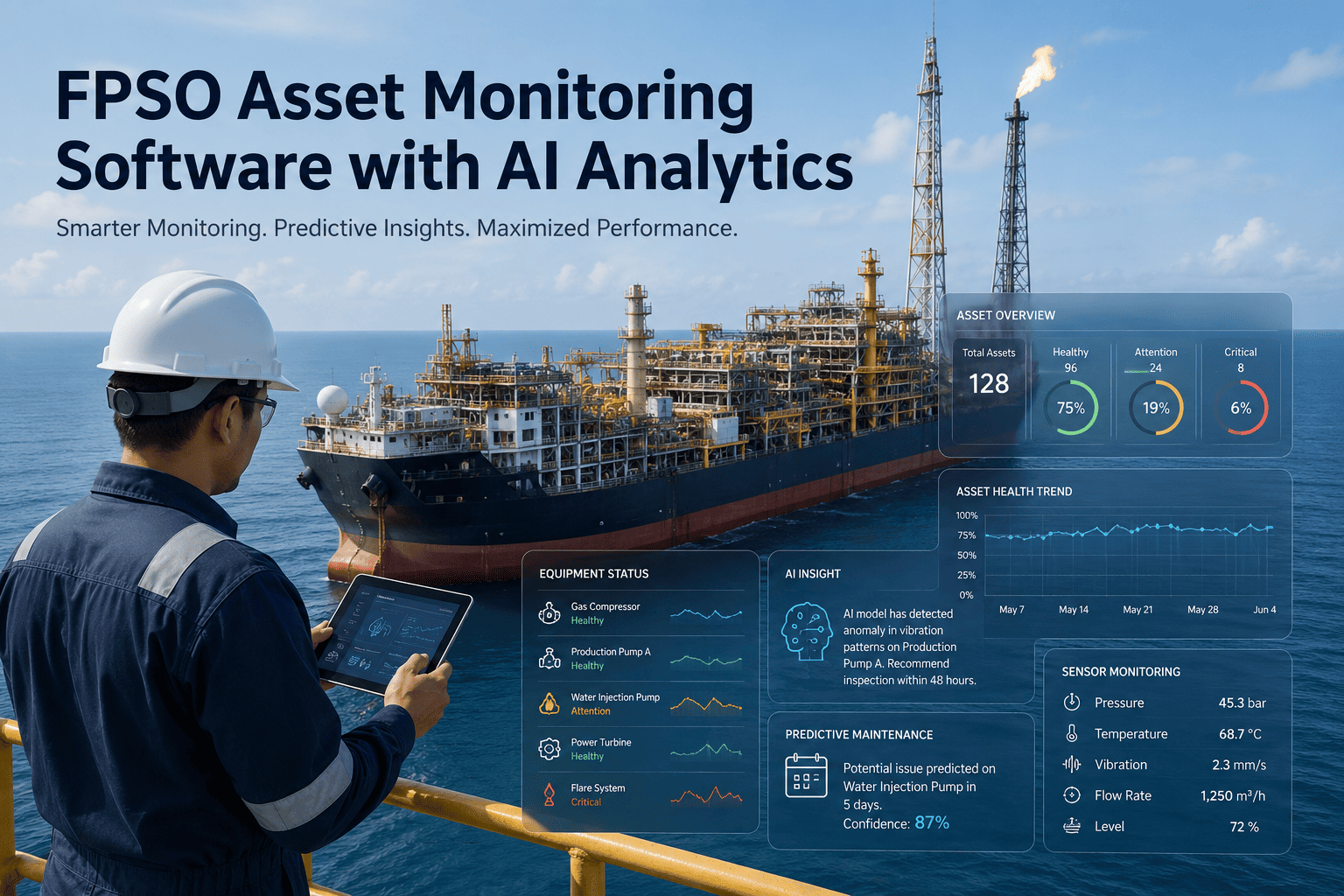
Oil and gas maintenance teams are sitting on a paradox. Facilities are generating more sensor data than ever — pressure transmitters, vibration monitors, SCADA historians, DCS alarms — yet most operations still run on calendar-based maintenance schedules that were designed when data collection was a manual process. The result is a persistent gap between what the data knows and what the maintenance team acts on. Equipment degradation signals build for weeks inside historian logs while technicians follow fixed inspection routes, unaware that a compressor bearing is trending toward failure or a pipeline segment is corroding below its integrity threshold. iFactory's IoT platform is built specifically to close that gap — connecting existing SCADA, PLC, and DCS infrastructure to AI-driven predictive models that surface failure intelligence weeks before a breakdown occurs. Reliability engineers and asset managers who want to understand exactly how this works for their facility often start by choosing to Book a Demo with the iFactory engineering team to review their current sensor architecture and asset criticality map.
The Maintenance Intelligence Gap in Oil & Gas Operations
Why Sensor Data Alone Does Not Prevent Failures
Most oil and gas facilities already have extensive sensor networks — the problem is not a lack of data, it is a lack of intelligence applied to that data in real time. Traditional SCADA systems were designed for process control, not predictive analytics. They generate alarms when thresholds are crossed, meaning by the time an alert fires, the equipment has often already lost 40 to 60 percent of its efficiency and repair costs have escalated three to five times compared to a planned intervention. The 6 to 12 week detection-to-intervention lag that characterizes reactive maintenance is not caused by bad engineers — it is caused by platforms that were never designed to identify failure patterns building across weeks of operational data. iFactory's IoT platform addresses this at the architectural level, not the dashboard level. By integrating IoT telemetry directly with machine learning models trained on your historical failure data, the platform converts raw sensor streams into actionable failure intelligence with 90 to 95 percent accuracy — identifying degradation patterns weeks before any SCADA alarm would fire. Maintenance managers who want to map this capability against their own asset failure history regularly Book a Demo to walk through a site-specific failure mode analysis with iFactory's engineers.
How iFactory's IoT Platform Works Across the Oil & Gas Value Chain
One Platform, Every Segment — From Upstream Wells to Downstream Refining
The fundamental design principle behind iFactory is that upstream, midstream, and downstream operations should not require separate specialized monitoring tools. Each segment faces distinct asset types and failure modes, but the underlying need is identical — continuous, intelligent monitoring that predicts failures before they become production events. iFactory delivers this through eight AI-powered modules running on a single IoT data layer, covering rotating equipment health, pipeline integrity, digital twin simulation, AI vision inspection, OEE analytics, energy monitoring, CMMS work order management, and ESG compliance reporting. Oil and gas teams evaluating this approach often Book a Demo to see exactly how each module applies to their specific asset portfolio.
The 5 Ways iFactory's IoT Platform Transforms Maintenance Execution
From Sensor Data to Closed-Loop Predictive Maintenance
Measured Outcomes Across Oil & Gas IoT Deployments
What iFactory's IoT Platform Delivers in Practice
The performance improvements reported across iFactory-supported oil and gas deployments are consistent because they address the same root cause — eliminating the detection-to-intervention lag that makes reactive maintenance so expensive. A major North American midstream operator deployed iFactory across a 2,500-mile pipeline network and achieved a 28 percent reduction in leak response time, a 35 percent decrease in false alarm rates, and a 42 percent improvement in maintenance planning accuracy. Offshore operators report production uptime improvements from 87 percent to 96 percent following digital twin deployment, with emergency interventions reduced by 47 percent. The table below summarizes key performance outcomes across deployment segments.
| Segment | Primary IoT Capability | Before iFactory | After iFactory | Key Metric |
|---|---|---|---|---|
| Upstream / Onshore | Rotating equipment health AI | Monthly inspection cycles | Continuous ML-driven monitoring | 58% downtime reduction |
| Midstream Pipeline | Digital twin integrity modeling | 6–12 week detection lag | 14-day advance leak detection | 28% faster leak response |
| Offshore Platform | Subsea digital twin + IoT | 87% production uptime | 96% production uptime | 47% fewer emergency calls |
| Downstream Refinery | Multi-sensor IoT correlation | Reactive alarm-triggered repair | 15–45 day predictive window | 40% unnecessary PM eliminated |
| All Segments | CMMS auto work order + mobile | Manual work order creation | AI-triggered closed-loop orders | 3–5× repair cost reduction |
What Makes iFactory's IoT Architecture Different
Edge Processing, Protocol Flexibility, and Compliance-Ready Reporting
Many industrial IoT platforms require cloud-only architectures that create latency and data security concerns for oil and gas operators working within strict OT network boundaries. iFactory deploys on-premise digital twin and ML processing locally within existing OT networks, preventing sensitive pipeline control information from leaving the facility perimeter while still delivering real-time predictive intelligence. Edge computing nodes at remote locations enable local AI processing without cloud dependency — a critical requirement for offshore platforms and pipeline compression stations that operate in low-connectivity environments. On the integration side, iFactory connects to SAP PM and EAM systems for closed-loop work order management, and auto-generates compliance-ready documentation meeting API, OSHA, and EPA regulatory requirements governing asset integrity management programs. Maintenance directors building out these compliance programs often Book a Demo to review how iFactory's reporting architecture maps to their specific regulatory obligations.
Conclusion: IoT-Driven Maintenance Is the Standard, Not the Advantage
The oil and gas facilities that have deployed iFactory's IoT platform are not gaining a temporary competitive edge — they are establishing the operational baseline that the rest of the industry will eventually have to match. Predicting failures 15 to 45 days before occurrence, eliminating 40 percent of unnecessary preventive maintenance tasks, and reducing emergency repair costs by three to five times over planned interventions are outcomes that make the ROI case self-evident. For any facility still running on calendar-based maintenance and reactive SCADA alarms, the cost of delay is measurable and compounding. The most effective next step is to Book a Demo and work through a site-specific assessment of your current asset failure costs and IoT integration readiness with the iFactory engineering team.
Frequently Asked Questions
Does iFactory's IoT platform require replacing existing SCADA or DCS systems?
No — iFactory integrates with your existing SCADA, DCS, PLC, and historian infrastructure via OPC-UA, Modbus, and 4-20mA protocols, going live on existing data without any hardware replacement.
How far in advance can iFactory predict equipment failures in oil and gas assets?
iFactory's ML models predict failures 15 to 45 days before occurrence in refinery assets and 3 to 4 weeks ahead for rotating equipment, with 87 to 92 percent accuracy across pumps, compressors, and heat exchangers.
Can iFactory monitor offshore and subsea assets on the same platform as onshore operations?
Yes — iFactory's One Platform, Every Segment architecture covers upstream onshore wells, offshore platforms, subsea assets, midstream pipelines, and downstream refineries under a single unified IoT data layer and dashboard.
How does iFactory handle data security for OT networks in oil and gas environments?
iFactory deploys on-premise within existing OT networks, processing SCADA data and IoT telemetry locally so sensitive pipeline control information never leaves the facility perimeter — no cloud exposure required.
What is the typical ROI timeline for an oil and gas IoT maintenance deployment with iFactory?
Most facilities see measurable cost savings within 60 days of go-live, with full ROI typically achieved within 8 to 12 months driven by prevented emergency repairs and eliminated unnecessary preventive maintenance tasks.