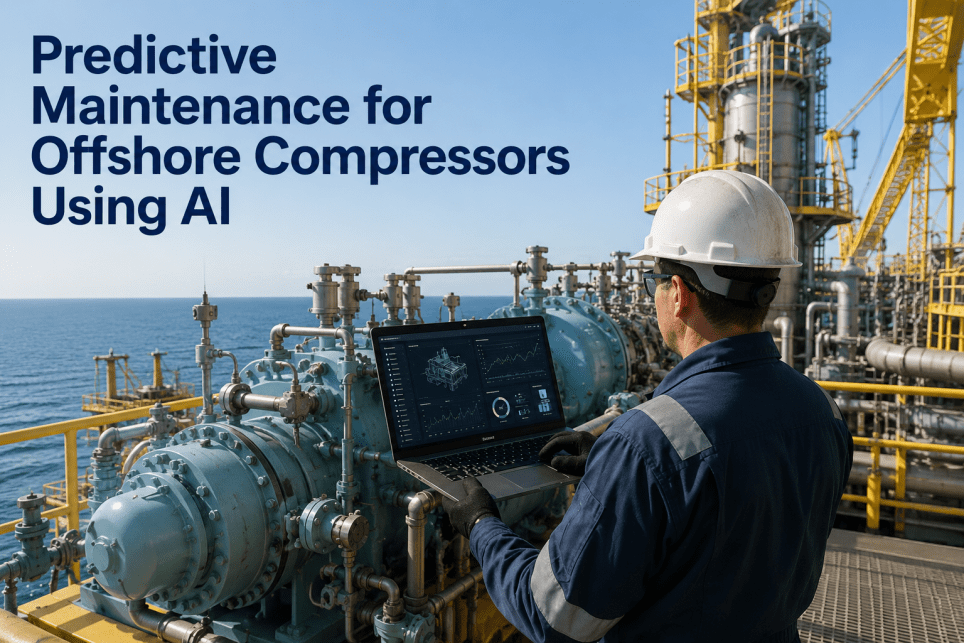
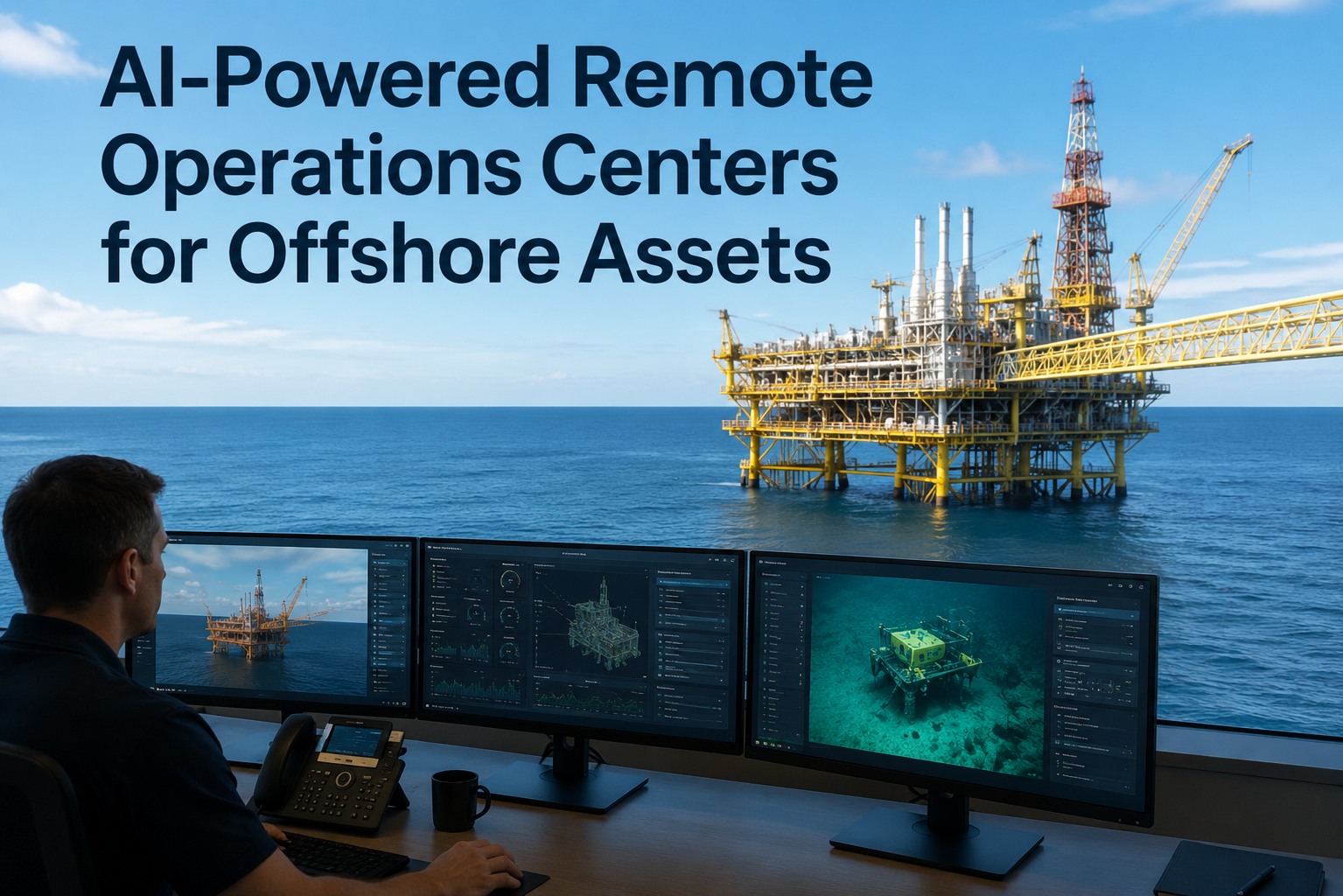
An FPSO doesn't get the luxury of a scheduled shutdown when a compressor starts drifting toward failure. It sits hundreds of miles offshore, exposed to constant vibration, corrosive salt air, and mechanical stress, with every piece of rotating equipment, safety system, and marine component expected to keep running for months between planned interventions. Reactive maintenance on a floating production facility doesn't just cost downtime — it can mean flying a crew and parts out by helicopter to fix something that AI-driven monitoring would have flagged weeks earlier. Book an FPSO AI demo to see how much earlier that warning can arrive.
FPSO Operations · Predictive Analytics
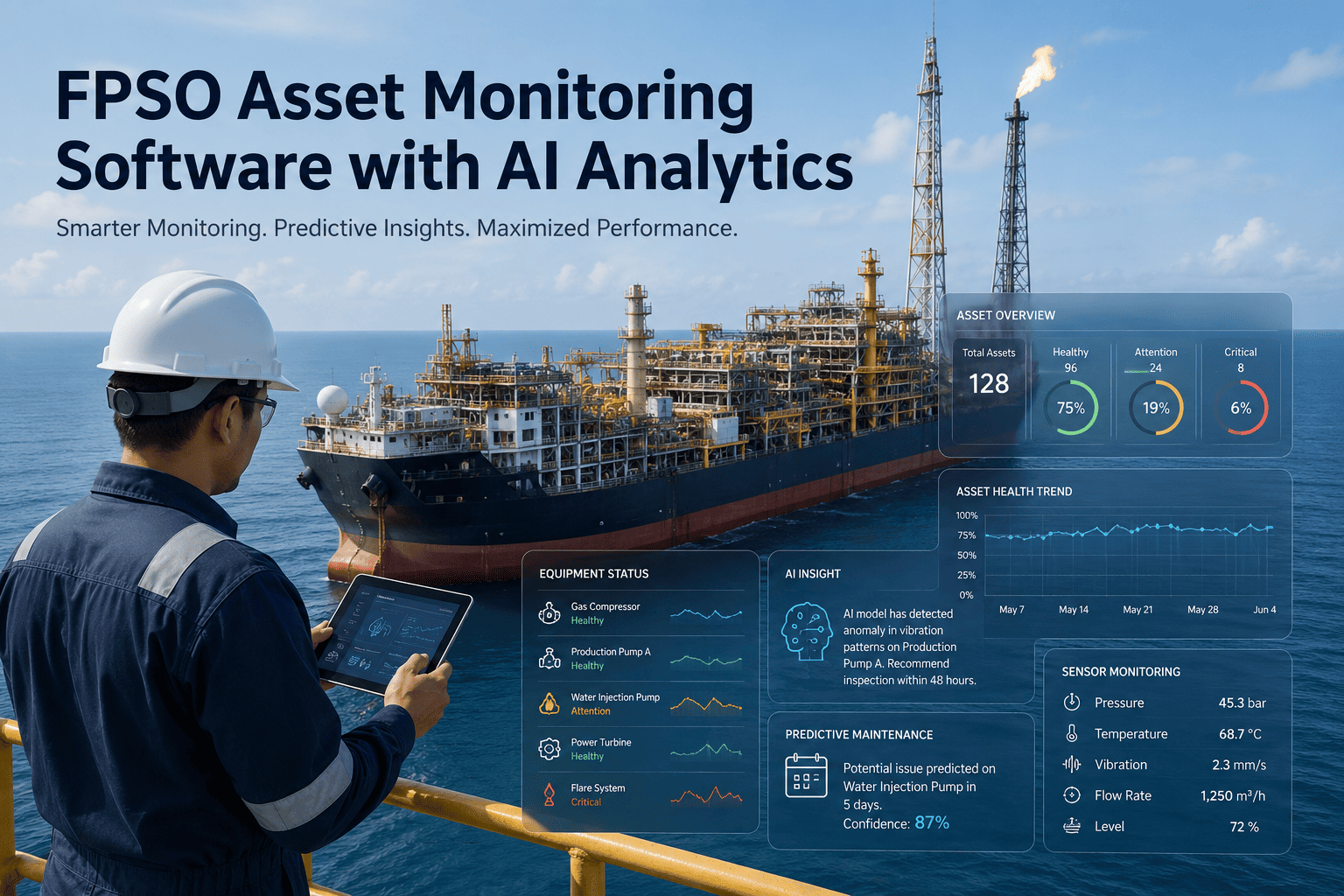
FPSO Asset Monitoring Software with AI Analytics
Monitor rotating equipment, safety systems, marine operations, and process units on your FPSO with AI analytics built for the realities of floating production.
Offshore Conditions Make Every Failure More Expensive
High-pressure environments, corrosive seawater exposure, and constant mechanical stress push offshore equipment toward degradation faster than most onshore assets ever experience, while the cost and risk of reaching a failed component only grows the further it sits from shore.
Reactive Repairs
Scheduled and reactive maintenance approaches historically leave operators exposed to unplanned outages that traditional inspection intervals simply can't catch in time.
Connectivity Limits
Remote platforms often run on limited or intermittent satellite communication, making constant cloud streaming of raw sensor data impractical at scale.
Legacy Data Gaps
Many FPSOs were built before modern digital infrastructure existed, leaving years of historical maintenance records locked in static reports instead of usable data.
Catching the Warning Long Before the Failure
Every mechanical failure follows a curve — from the first microscopic sign of wear to full functional failure. The earlier AI can detect the first sign, the more runway your maintenance team has to plan a fix instead of reacting to a breakdown.
P — Potential Failure
AI detects early vibration or thermal drift
Planning Window
Parts and crew scheduled with full lead time
F — Functional Failure
Where reactive maintenance would have first noticed
Every System That Keeps an FPSO Running
Rotating Equipment
Pumps, compressors, and turbines are watched for the vibration and thermal signatures that precede bearing wear, seal failure, and mechanical imbalance.
Safety Systems
Fire and gas detection, emergency shutdown valves, and pressure relief systems are monitored for drift that could compromise response readiness.
Marine Operations
Ballast systems, mooring integrity, and hull-related monitoring points are tracked alongside process data instead of managed in a separate system.
Process Units
Separation, gas treatment, and export systems are analyzed for the subtle efficiency losses that come before a forced production curtailment.
Offshore, a warning caught weeks early is worth more than the same warning caught onshore. Every day of lead time removes a helicopter flight, an emergency parts order, or a shutdown that wasn't planned.
Built for the FPSO You Actually Have, Not a Newbuild
Most FPSOs in operation today were commissioned long before AI analytics were part of the plan, which means retrofitting has to work around whatever data infrastructure already exists rather than starting from a blank slate.
Retrofit Sensor Integration
Condition monitoring is layered onto existing rotating equipment without requiring a full re-instrumentation of the vessel.
Edge Processing Offshore
Analysis runs locally on the platform, so limited satellite bandwidth never becomes the bottleneck for detecting a developing issue.
Historical Record Digitization
Older maintenance history trapped in static reports and PDFs gets converted into structured data models can actually learn from.
Expert Insight
The biggest misconception about FPSO predictive maintenance is that older vessels can't benefit from it because they lack modern instrumentation. In practice, the data availability challenge is real but solvable — retrofitting sensors and condition monitoring onto existing rotating equipment is increasingly viable, and even partial coverage on the highest-risk assets pays for itself quickly. The vessels that wait for a full digital rebuild before starting are the ones still flying helicopters out for preventable failures.
Adaeze Okonkwo — Offshore Reliability Engineer, 13+ years in FPSO asset integrity across West Africa and the Gulf of Mexico
Reactive Maintenance vs. AI Asset Monitoring on an FPSO
| Factor |
Reactive / Scheduled Maintenance |
AI Asset Monitoring |
Why It Matters |
| Detection timing |
Found at inspection or after failure |
Flagged at the earliest measurable sign of wear |
Longer planning window before parts and crew are needed |
| Logistics impact |
Emergency helicopter and vessel mobilization |
Scheduled resupply within normal logistics runs |
Avoids the highest-cost form of offshore intervention |
| Coverage scope |
Rotating equipment tracked separately from safety and marine systems |
Rotating, safety, marine, and process data unified in one view |
A developing issue in one system gets checked against the others |
| Connectivity dependence |
Limited real-time visibility between inspections |
Edge processing works despite intermittent satellite links |
Detection doesn't stop when the connection does |
| Legacy vessel fit |
Assumes modern instrumentation already exists |
Designed to retrofit onto existing sensors and historical records |
Older FPSOs benefit without a full digital rebuild |
Frequently Asked Questions
Can this work on an FPSO that was built before modern sensors were standard?
Yes, retrofitting condition monitoring sensors onto existing rotating equipment is increasingly viable even on older vessels, and historical maintenance data trapped in static reports can be digitized to give AI models a baseline to learn from. Full re-instrumentation isn't a prerequisite for meaningful monitoring coverage.
Book an FPSO AI demo to review what your current vessel already supports.
How does this handle limited or intermittent satellite connectivity?
Analysis is designed to run locally on the platform through edge processing, so detection continues even when the satellite link is degraded or temporarily down. Only the summarized findings need to travel back to shore rather than a continuous stream of raw sensor data.
Contact support to review connectivity requirements for your specific platform.
Does this only cover rotating equipment, or other systems too?
Coverage extends across rotating equipment, safety systems such as fire and gas detection, marine operations including ballast and mooring, and process units like separation and gas treatment, all analyzed within the same platform rather than four separate tools.
Book an FPSO AI demo to see the full scope for your vessel class.
How much earlier does AI typically catch a developing failure?
Detection timing varies by failure mode and asset type, but the goal is consistently to move the warning point back toward the earliest measurable sign of degradation rather than waiting for functional failure, giving maintenance planners a real window to schedule parts and crew instead of reacting to a breakdown.
Contact support to discuss expected lead times for your critical equipment list.
What does the ROI case look like for an FPSO life extension project?
Predictive maintenance is generally justified through a combination of reduced unplanned downtime, avoided emergency logistics costs, and extended safe operating life for aging rotating equipment, with the specific case varying by vessel age, equipment criticality, and remaining field life.
Book an FPSO AI demo to build a case specific to your asset.
Give Your Offshore Team the Warning Window They Deserve
Monitor rotating equipment, safety systems, marine operations, and process units in one AI platform built for the realities of floating production.