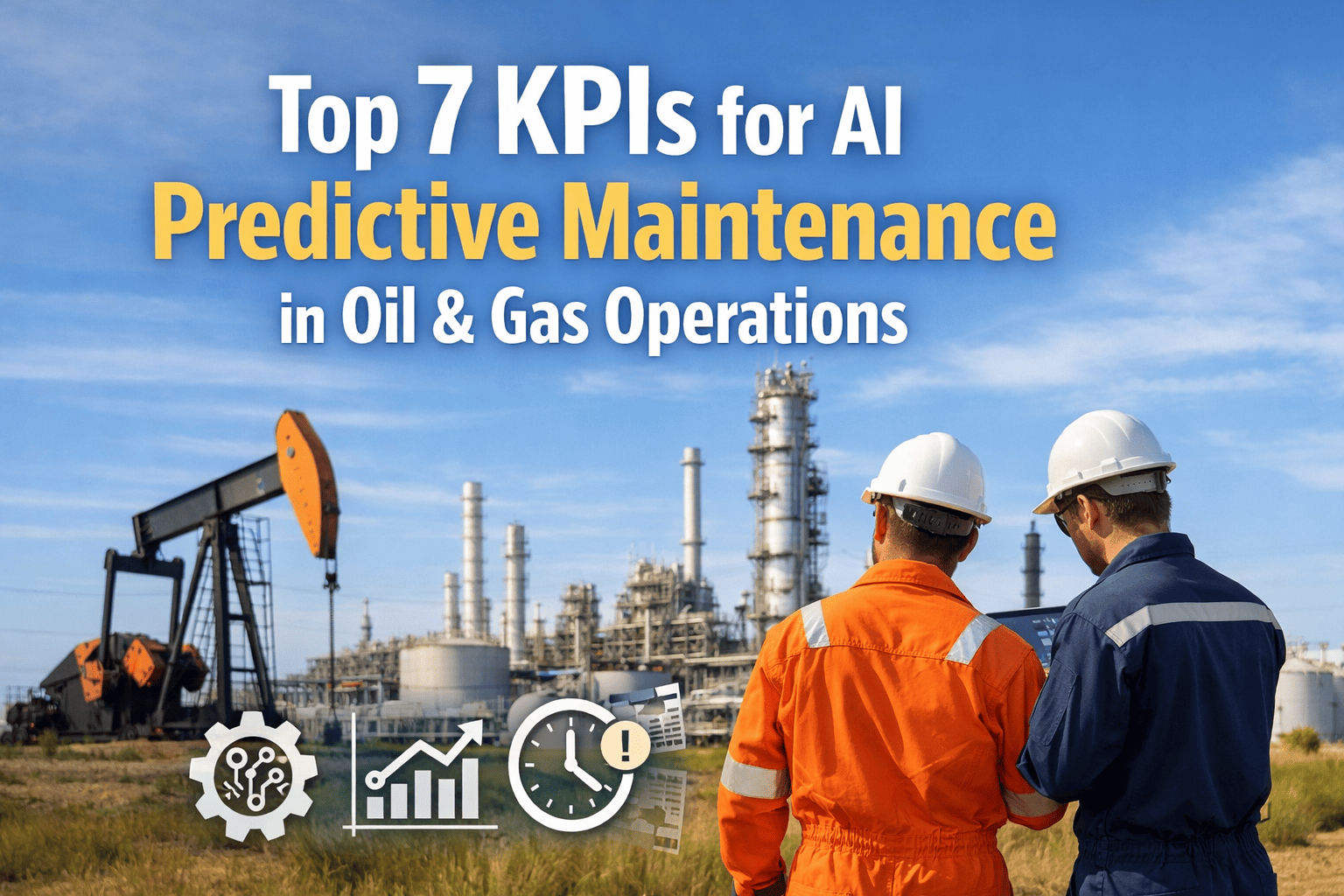
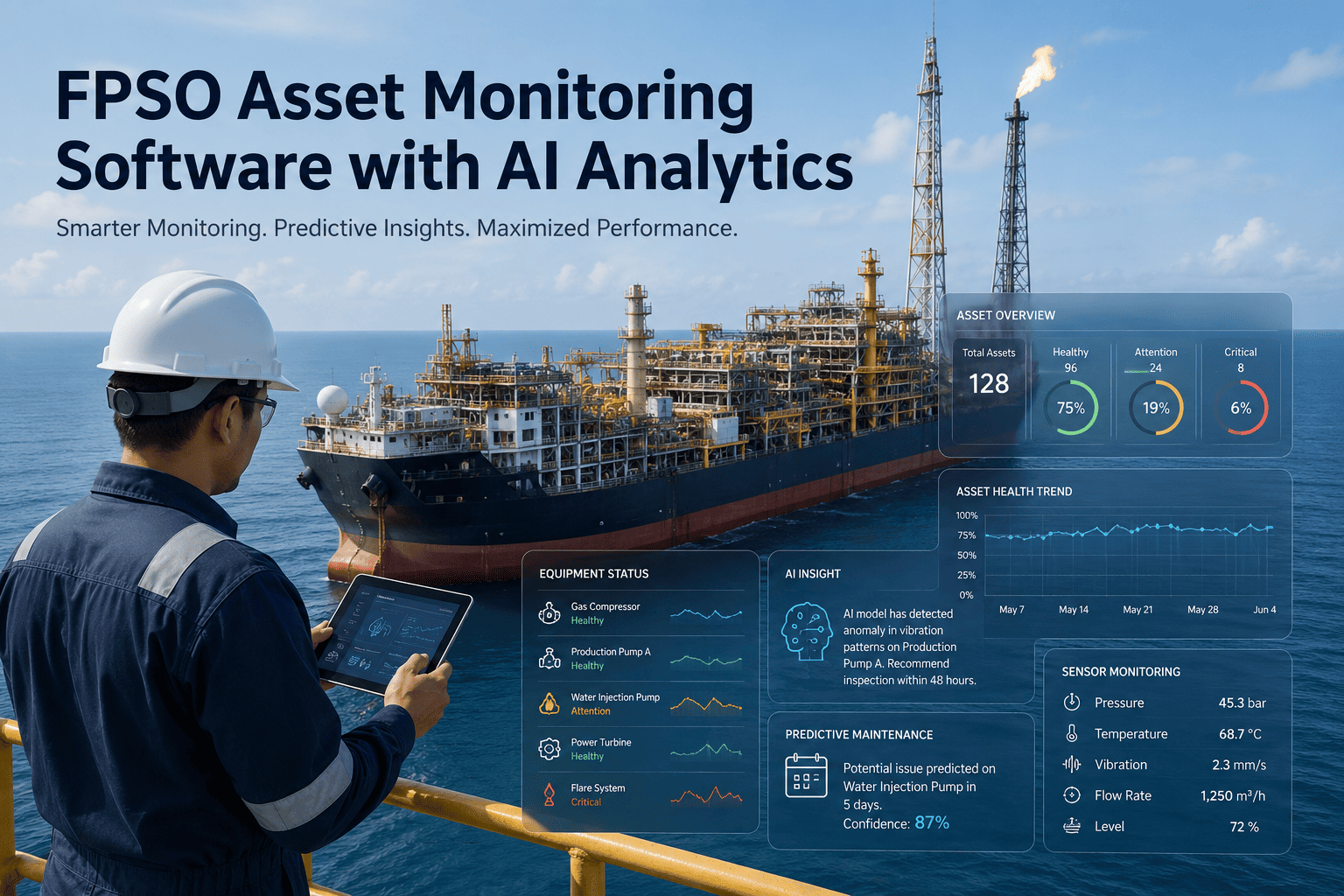
Oil and gas operations running traditional time-based maintenance spend up to 20% of operational budgets on unplanned repairs responding to equipment failures after they occur, experiencing downtime costing $1.5 trillion annually across the industry while aging infrastructure increases risk of catastrophic failures threatening safety, production schedules, and compliance. AI-powered predictive maintenance transforms this reactive approach through machine learning algorithms analyzing sensor data from pumps, compressors, turbines, and pipelines predicting failures 7 days in advance with 73% reduction in infrastructure failures, cutting maintenance costs 10-40% and reducing downtime up to 50% validated across Shell, BP, ExxonMobil, and ADNOC implementations. Tracking the right Key Performance Indicators separates reactive maintenance teams relying on guesswork from data-driven operations achieving world-class reliability through measurable improvements in Mean Time Between Failures (MTBF), Mean Time to Repair (MTTR), Overall Equipment Effectiveness (OEE), and predictive accuracy metrics. The maintenance bottleneck draining budgets and delaying production now becomes strategic advantage through AI systems providing actionable insights into equipment health, failure prediction lead time, and maintenance optimization documented through industry-validated KPIs. Book a demo to see AI predictive maintenance KPIs for your oil and gas operations.
Quick Answer
The top 7 KPIs for AI predictive maintenance in oil and gas operations are: (1) Mean Time Between Failures (MTBF) measuring equipment reliability with world-class targets exceeding 8,760 hours annually, (2) Mean Time to Repair (MTTR) tracking average repair duration with best-practice benchmarks under 4 hours, (3) Overall Equipment Effectiveness (OEE) combining availability, performance, and quality achieving 85%+ for world-class operations, (4) Predictive Accuracy Rate measuring AI model precision with industry leaders reaching 90-95% correct failure predictions, (5) Failure Prediction Lead Time quantifying advance warning periods with AI systems achieving 7+ days versus 1-2 days reactive detection, (6) Planned Maintenance Percentage (PMP) targeting 85%+ scheduled work versus emergency repairs, and (7) Maintenance Cost per Barrel tracking maintenance spend efficiency with AI implementations reducing costs 10-40% documented across PETRONAS, Shell, and ADNOC deployments achieving 20x ROI through early failure detection preventing catastrophic equipment damage.
The Complete AI Platform for Oil & Gas Operations
Track 7 Critical Maintenance KPIs with 73% Equipment Failure Reduction
AI predictive maintenance platforms analyze 2.5M+ real-time sensor data points from pumps, compressors, turbines predicting failures 7 days in advance, reducing unplanned downtime 35-45% while cutting maintenance costs 10-40% across upstream, midstream, and downstream operations.
7 Days
Prediction Lead Time
Understanding Oil & Gas Maintenance Operations
Oil and gas operations span three critical segments each with distinct equipment maintenance challenges requiring predictive intelligence. Upstream exploration and production deploy drilling rigs, pumps, compressors, and reservoir equipment requiring continuous reliability monitoring through SCADA systems collecting pressure, temperature, vibration, and flow rate data. Midstream transportation and storage operations maintain pipeline integrity across thousands of miles monitoring corrosion, leaks, pressure anomalies through IoT sensors integrated with DCS platforms controlling flow stations, storage tanks, and compression facilities. Downstream refining and processing facilities manage complex equipment portfolios including distillation columns, crackers, reformers, heat exchangers where unexpected failures halt production causing millions in daily losses.
Industrial control systems across these segments generate massive sensor data streams: Programmable Logic Controllers (PLCs) executing automation sequences, Distributed Control Systems (DCS) managing process parameters, SCADA platforms providing remote monitoring and control, and Historians archiving time-series data for trend analysis. Traditional maintenance approaches analyze this data reactively after failures occur, while AI predictive systems process real-time sensor inputs through machine learning models establishing equipment health baselines, detecting anomalies indicating developing faults, and forecasting remaining useful life (RUL) before breakdowns require emergency intervention.
The 7 Critical KPIs for AI Predictive Maintenance Success
01
Mean Time Between Failures (MTBF)
Definition: Average operating time between equipment failures for repairable assets. MTBF measures equipment reliability showing how long pumps, compressors, turbines, or drilling equipment operate before experiencing unplanned failure requiring maintenance intervention. Higher MTBF indicates more reliable equipment reducing production interruptions and emergency repair costs.
Calculation: MTBF = Total Operating Time ÷ Number of Failures. Example: Equipment running 8,760 hours annually with 2 failures = 4,380 hours MTBF. AI predictive maintenance extends MTBF 22% documented through proactive interventions preventing failures before they occur.
Benchmark: World-class oil and gas operations target MTBF exceeding 8,760 hours (full year continuous operation). Industry averages range 4,000-6,000 hours with AI implementations achieving 20-30% improvements through early fault detection preventing catastrophic failures.
AI Impact: Spectro Scientific TruVu 360 reports AI-driven oil analysis systems extend MTBF by catching failures well before catastrophic damage occurs, enabling oil changes, filter replacements, and component servicing preventing complete equipment breakdown documented across mining and energy operations.
02
Mean Time to Repair (MTTR)
Definition: Average duration required to restore failed equipment to operational status from failure detection through repair completion and return to service. MTTR measures maintenance team responsiveness, spare parts availability, technician skill levels, and repair procedure efficiency. Lower MTTR reduces production downtime minimizing revenue loss from equipment outages.
Calculation: MTTR = Total Repair Time ÷ Number of Repairs. Example: Ten repairs requiring 50 hours total = 5 hours MTTR. Best-practice oil and gas operations target MTTR under 4 hours for critical equipment. AI predictive maintenance reduces MTTR by scheduling repairs during planned downtime with parts pre-staged and technicians prepared.
Benchmark: Industry averages range 6-12 hours depending on equipment complexity and location. Offshore platforms experience higher MTTR due to logistics constraints while onshore facilities achieve faster repairs. Predictive maintenance eliminates emergency mobilization delays enabling planned interventions during scheduled outages.
Reporting Impact: MaintMaster systems track exact failure and repair timestamps automatically calculating MTTR without manual logging distortion. Accurate timestamping eliminates 6-hour errors caused by delayed reporting documented when compressor failures at 2 AM logged at 8 AM shift start creating false MTTR metrics.
03
Overall Equipment Effectiveness (OEE)
Definition: Composite metric combining availability (uptime percentage), performance (speed efficiency), and quality (first-pass yield) into single operational efficiency score. OEE measures total productive capacity revealing equipment utilization gaps from downtime, speed losses, and quality defects. World-class OEE exceeds 85% while most oil and gas operations fall 60-75% range.
Calculation: OEE = Availability × Performance × Quality. Example: 90% availability × 95% performance × 98% quality = 83.8% OEE. Requires integrated data from CMMS (downtime), SCADA (throughput), and quality systems (output specs). Manual data entry creates unreliable OEE; automated platforms unifying these streams produce trustworthy metrics.
Benchmark: World-class manufacturing achieves 85%+ OEE. Oil and gas upstream operations target 75-80% considering geological variability and well decline. Refining and processing facilities approach 85% through process optimization. AI predictive maintenance improves availability component 15-20% eliminating unplanned downtime from equipment failures.
Integration Challenge: OEE accuracy depends on reliable inputs from multiple systems. Equipment intelligence platforms unifying CMMS, SCADA, and quality data streams produce OEE operators can trust versus fragmented manual approaches generating unreliable benchmarks documented across oil and gas field operations.
04
Predictive Accuracy Rate
Definition: Percentage of AI-predicted failures confirmed through subsequent inspection or actual equipment breakdown. Measures machine learning model precision distinguishing true equipment degradation from false positives. High accuracy enables confident maintenance decisions while low accuracy creates alert fatigue and wasted inspections on healthy equipment.
Calculation: Predictive Accuracy = (Confirmed Predictions ÷ Total Predictions) × 100. Example: AI predicts 100 failures, 92 confirmed through inspection = 92% accuracy. Industry-leading systems achieve 90-95% accuracy through multi-layered validation, cross-sensor correlation, and continuous AI model refinement eliminating background noise and focusing on high-confidence alerts.
Benchmark: Effective predictive maintenance requires minimum 85% accuracy preventing false positive overload. Shell reports 40% fewer equipment failures through predictive systems, BP saves $10 million annually, ADNOC achieved 20% maintenance cost reduction with AI accuracy enabling trust in predictions driving proactive interventions rather than reactive emergency repairs.
Validation Requirement: Track predicted versus actual failures documenting false positives and false negatives. Feed validation results back into AI models improving accuracy over time through supervised learning refinement documented as systems self-learn from operational data achieving better pattern recognition than static threshold approaches.
05
Failure Prediction Lead Time
Definition: Average advance warning period from AI failure prediction alert to actual equipment breakdown. Measures how much planning time maintenance teams receive for proactive intervention. Longer lead times enable scheduling repairs during planned outages, ordering spare parts, and mobilizing technicians without production disruption versus emergency responses requiring overtime labor and expedited parts procurement.
Calculation: Lead Time = Alert Timestamp - Actual Failure Timestamp. Example: AI predicts pump failure January 15, actual failure occurs January 22 = 7 days lead time. Advanced systems warn up to 1 hour before potential breakdowns for immediate threats, 7+ days for developing degradation enabling planned maintenance during scheduled shutdowns documented across oil and gas implementations.
Benchmark: Reactive detection provides 0 lead time (failure already occurred). Basic condition monitoring offers 1-2 days warning. AI predictive systems achieve 7+ days advance notice validated through PETRONAS achieving 51 warnings including 12 high-risk alerts enabling intervention before catastrophic damage, Duke Energy saving $34 million single early-catch event through extended lead time enabling planned repair.
Operational Value: Extended lead time transforms maintenance from reactive firefighting into strategic scheduling. XByte Analytics reports AI dashboard predicting failures 7 days advance allowing proactive planning reducing downtime 35-45%, eliminating emergency repair premiums, and scheduling interventions during planned production outages minimizing revenue impact.
06
Planned Maintenance Percentage (PMP)
Definition: Ratio of scheduled maintenance work versus total maintenance hours including emergency repairs. PMP measures maintenance strategy maturity showing shift from reactive emergency responses toward proactive planned interventions. Higher PMP indicates effective predictive program minimizing unplanned breakdowns through timely preventive actions scheduled during convenient production windows.
Calculation: PMP = (Planned Maintenance Hours ÷ Total Maintenance Hours) × 100. Example: 720 planned hours out of 900 total = 80% PMP. Best-in-class operations target 85%+ PMP documented as realistic goal for mature predictive programs. Lower PMP indicates reactive firefighting mode with maintenance teams responding to failures versus preventing them.
Benchmark: Industry average oil and gas operations achieve 60-70% PMP heavily weighted toward reactive repairs. World-class predictive maintenance programs reach 85%+ PMP through AI systems converting unplanned failures into scheduled work orders triggered by degradation alerts before breakdown occurs enabling maintenance during convenient production gaps.
Strategic Indicator: PMP reveals maintenance culture transformation. Organizations increasing PMP from 65% to 85% demonstrate successful predictive program adoption reducing emergency labor overtime, expedited parts costs, and production disruption from unplanned equipment failures becoming predictable scheduled maintenance events.
07
Maintenance Cost per Barrel of Oil Equivalent (BOE)
Definition: Total maintenance expenditure divided by production volume measuring operational efficiency of maintenance spend. Tracks labor costs, spare parts, contractor services, and downtime-related production losses per unit output. Lower cost per BOE indicates efficient maintenance operations maximizing production while minimizing maintenance burden common in oil and gas financial reporting.
Calculation: Maintenance Cost per BOE = Total Maintenance Costs ÷ Total BOE Produced. Example: $2 million maintenance spending producing 200,000 BOE = $10 per BOE. AI predictive maintenance reduces this metric 10-40% documented through eliminating emergency repair premiums, reducing overtime labor, and preventing production losses from unplanned equipment failures.
Benchmark: Varies significantly by asset age, geography, and production complexity. Mature fields experience higher maintenance costs per BOE than new developments. Industry leaders achieve continuous improvement through predictive programs: Shell cut maintenance costs 15% through AI implementation, ADNOC reduced maintenance spending 20%, while extending asset longevity through condition-based interventions preventing premature failures.
ROI Metric: This KPI directly translates maintenance improvements into financial impact. McKinsey research confirms AI predictive maintenance delivers ROI within 2-6 months generating billions in annual savings industry-wide. Track quarterly trends documenting continuous improvement validating predictive program business case through measurable cost reduction per production unit.
Predictive vs Reactive Maintenance Performance Comparison
Quantifying predictive maintenance impact requires comparing KPI performance between AI-driven proactive strategies and traditional reactive approaches. Data from Shell, BP, ADNOC, PETRONAS, and Duke Energy implementations documents measurable improvements across all seven critical KPIs validating business case for AI adoption.
Scroll to see full comparison
| Performance Metric |
AI Predictive Maintenance |
Reactive Maintenance |
Improvement |
| MTBF (Hours) |
6,800-8,500 hours |
4,000-6,000 hours |
+22% increase |
| MTTR (Hours) |
2-4 hours (planned) |
8-16 hours (emergency) |
-50% to -75% reduction |
| OEE (%) |
80-85% (world-class) |
60-75% (typical) |
+15-20% improvement |
| Prediction Accuracy |
90-95% confirmed |
N/A (post-failure only) |
Proactive capability |
| Failure Lead Time |
7+ days advance warning |
0 days (reactive) |
Infinite (vs zero) |
| Planned Maintenance % |
85%+ scheduled work |
60-70% (reactive heavy) |
+20-25% increase |
| Cost Reduction |
10-40% lower costs |
Baseline (20% of OpEx) |
Validated ROI 2-6 months |
Data compiled from Shell, BP, ADNOC, PETRONAS implementations plus McKinsey, Deloitte research on AI predictive maintenance outcomes in oil and gas operations as of 2025-2026.
Platform Comparison: AI Predictive Maintenance Solutions
Oil and gas operators evaluate multiple platforms claiming predictive maintenance capabilities. Meaningful differentiation requires comparing AI sophistication, SCADA/DCS integration depth, oil and gas specialization, and deployment complexity across competing solutions. Book a comparison demo.
Scroll to see full comparison
| Capability |
iFactory |
IBM Maximo |
SAP EAM |
Fiix CMMS |
QAD Redzone |
UpKeep |
| AI Predictive Maintenance |
Advanced ML Models |
Add-on Module |
Limited AI Features |
Basic Analytics |
Not Available |
Not Available |
| SCADA/DCS Integration |
Native OPC-UA/Modbus |
Custom Integration |
PI System Only |
Limited |
Not Available |
Not Available |
| Real-time Monitoring |
2.5M+ Sensor Points |
High Capability |
Moderate |
Basic Dashboards |
OEE Focus |
Mobile-First |
| Pipeline Monitoring |
AI-Driven Integrity |
Separate Module |
Not Included |
Not Available |
Not Available |
Not Available |
| ESG Reporting |
Automated Methane/VOC |
Manual Entry |
Limited Features |
Not Available |
Not Available |
Not Available |
| Edge AI Security |
OT Data On-Premise |
Hybrid Cloud |
Cloud-Based |
Cloud SaaS |
Cloud SaaS |
Cloud SaaS |
| Deployment Timeline |
6-8 Weeks Turnkey |
6-12 Months |
9-18 Months |
3-4 Months |
2-3 Months |
1-2 Months |
| Oil & Gas Specialization |
Upstream/Mid/Downstream |
Enterprise Asset Mgmt |
General ERP |
Manufacturing Focus |
Manufacturing Focus |
Generic CMMS |
Comparison based on publicly available product documentation and vendor specifications as of Q1 2026. Verify current capabilities before procurement decisions.
Regional Compliance Requirements for Oil & Gas Operations
Predictive maintenance platforms must support regional compliance obligations varying by jurisdiction. AI systems track maintenance activities, equipment health, and safety metrics generating audit trails meeting local regulatory frameworks across US, UAE, UK, Canada, and European operations.
Scroll to see all regions
| Compliance Area |
United States |
UAE |
United Kingdom |
Canada |
Europe |
| Safety Standards |
OSHA 1910, PSM 1910.119 |
ADNOC HSE-MS Framework |
HSE UK Offshore Safety |
Provincial OH&S Acts |
ATEX Directive 2014/34/EU |
| Environmental |
EPA NSPS OOOOa Methane |
Federal Environmental Law |
UK Climate Change Act |
CEPA Federal Regulations |
EU ETS Emissions Trading |
| Industrial Standards |
API 580/581 RBI Standards |
ISO 55001 Asset Management |
PAS 55 Asset Standards |
CSA Z662 Pipeline Standard |
IEC 61511 Safety Integrity |
| Oil & Gas Compliance |
DOT PHMSA Pipeline Safety |
ADSIC Compliance Framework |
OGUK Offshore Guidelines |
NEB Safety Regulations |
Seveso III Directive 2012/18 |
One Platform, Every Segment: 8 AI-Powered Modules for Complete Oil & Gas Operations
iFactory integrates AI vision inspection, robotics monitoring, predictive maintenance, work order automation, asset lifecycle management, pipeline integrity, SCADA/DCS connectivity, edge AI security, and ESG reporting tracking 7 critical KPIs achieving 73% equipment failure reduction across upstream, midstream, and downstream operations.
MTBF +22%
MTTR -50-75%
OEE 85%+
90-95% Accuracy
7+ Days Lead Time
Frequently Asked Questions
Q
Which KPIs matter most for tracking AI predictive maintenance success in oil and gas?
The most critical KPIs are MTBF measuring equipment reliability (target 8,760+ hours), MTTR quantifying repair speed (target under 4 hours), OEE combining availability, performance, quality (target 85%+), Predictive Accuracy Rate validating AI model precision (target 90-95%), Failure Prediction Lead Time measuring advance warning (target 7+ days), Planned Maintenance Percentage tracking proactive work (target 85%+), and Maintenance Cost per BOE measuring efficiency with AI reducing costs 10-40%.
Book a demo to see KPI dashboards for your operations.
Q
How much advance warning does AI predictive maintenance provide before equipment failures?
AI predictive systems achieve 7+ days advance warning for developing degradation versus 0 days reactive detection after failures occur. Industry implementations document up to 1 hour warning for immediate threats enabling emergency shutdown, 7 days typical lead time allowing scheduled repairs during planned outages, with extended timelines for gradual wear patterns. PETRONAS achieved 51 warnings including 12 high-risk alerts preventing catastrophic damage, Duke Energy saved $34 million single early-catch event through extended lead time documented across oil and gas deployments.
Q
What accuracy rates do leading AI predictive maintenance systems achieve?
Industry-leading AI systems achieve 90-95% predictive accuracy validated through post-inspection confirmation rates. Shell reports 40% fewer equipment failures through predictive implementation, BP saves $10 million annually, ADNOC achieved 20% maintenance cost reduction with accuracy enabling confident proactive interventions. Systems below 85% accuracy create alert fatigue from false positives undermining maintenance team trust. Multi-layered validation, cross-sensor correlation, and continuous AI model refinement documented improving accuracy over time through self-learning from operational data patterns.
Q
How do you calculate Overall Equipment Effectiveness (OEE) for oil and gas equipment?
OEE = Availability × Performance × Quality. Availability measures uptime percentage (operating hours ÷ scheduled hours), Performance compares actual throughput to design capacity, Quality tracks first-pass yield excluding rework or defects. Example: 90% availability × 95% performance × 98% quality = 83.8% OEE. World-class operations achieve 85%+ OEE; oil and gas upstream targets 75-80% considering geological factors. Requires integrated CMMS, SCADA, quality data streams; manual approaches produce unreliable metrics versus automated platforms unifying these inputs documented across industry implementations.
Q
What ROI timeline can oil and gas operators expect from AI predictive maintenance implementation?
McKinsey and Deloitte research documents ROI within 2-6 months implementation through maintenance cost reduction 10-40%, downtime decrease 35-45%, and extended asset longevity. PETRONAS achieved 20x ROI from preventing catastrophic failures, Duke Energy saved $34 million single early detection event validating rapid payback. Organizations tracking seven critical KPIs measure continuous improvement documenting predictive program business case through quantifiable MTBF increases, MTTR reductions, OEE improvements, and cost per BOE decreases converting traditional 20% OpEx maintenance spending into strategic competitive advantage.
Book a demo for ROI analysis.
The Complete AI Platform for Oil & Gas Operations
Track 7 critical maintenance KPIs achieving 73% equipment failure reduction, 10-40% cost savings, and 35-45% downtime elimination through AI-powered predictive analytics processing 2.5M+ real-time sensor data points predicting failures 7 days in advance with 90-95% accuracy validated across Shell, BP, ADNOC, PETRONAS oil and gas implementations.
7 Critical KPIs
AI Predictive Models
SCADA Integration
2-6 Month ROI
73% Failure Reduction