Predictive Maintenance Software for Refinery Compressors
By Johnson on July 2, 2026
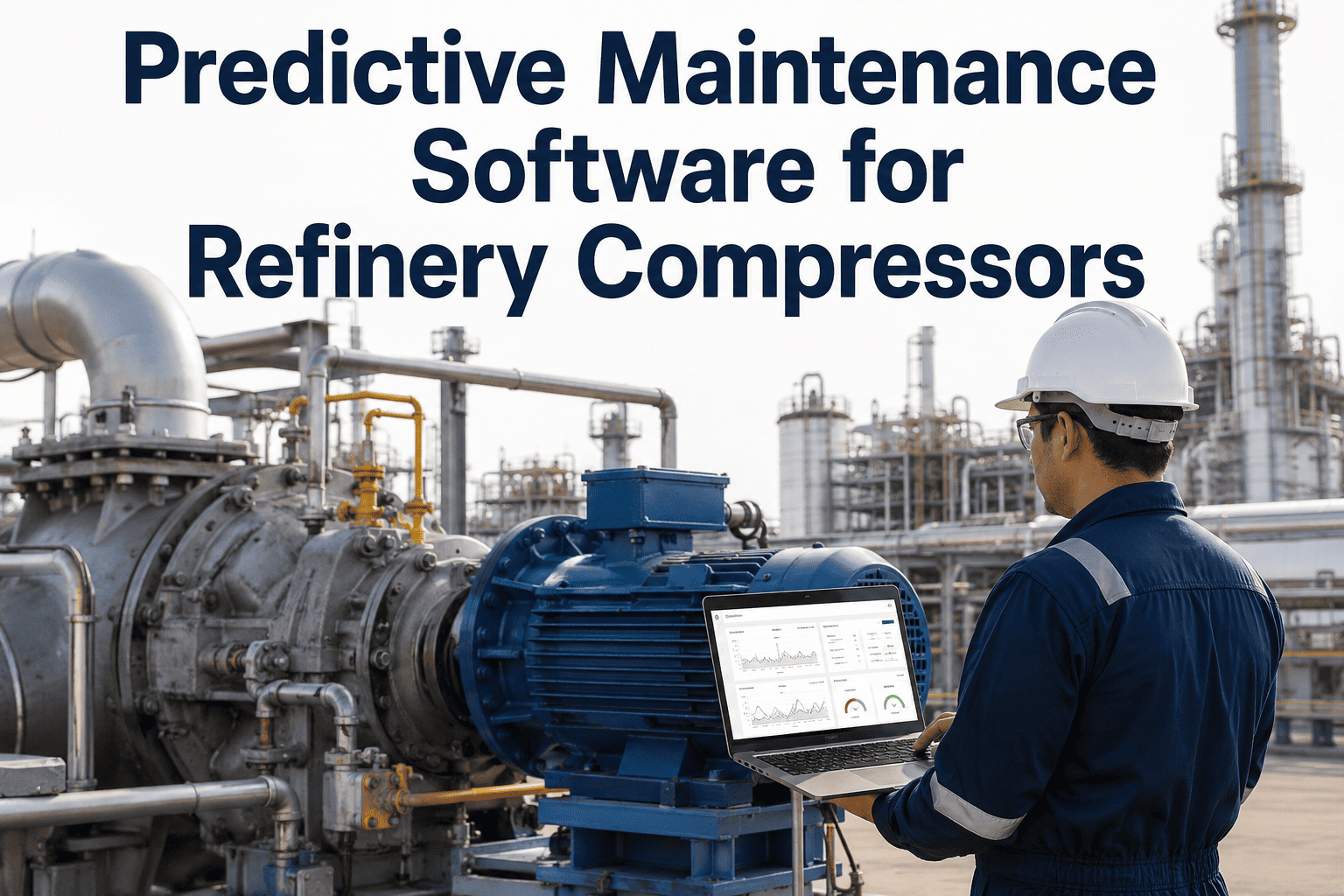
Refinery compressors — centrifugal, reciprocating, and screw — are the highest-consequence rotating assets in any downstream petroleum facility. A single unplanned compressor trip on a hydrogen recycle loop or catalytic cracker wet gas service can halt an entire processing unit, costing $500,000 or more per hour in lost throughput and triggering flaring events that compound regulatory exposure. Traditional time-based maintenance and fixed vibration alarm thresholds treat every compressor identically regardless of actual operating condition, gas composition, or load profile — missing the subtle degradation signatures that precede catastrophic failure by weeks. iFactory's AI-driven predictive maintenance platform ingests vibration spectra, process historian data, SCADA telemetry, and lube oil analytics from every compressor in your refinery fleet, detecting incipient bearing wear, valve leakage, surge margin erosion, and seal degradation 14–42 days before failure — and prescribing the exact intervention window that avoids both premature shutdown and unplanned trip. Book a Demo to see AI compressor failure prediction running on live refinery data.
Why Refinery Compressor Reliability Is a $500K/Hour Problem
U.S. refineries lose $6.6 billion annually to unplanned downtime. Compressors — sitting at the intersection of every major process unit — account for a disproportionate share of that exposure because a single compressor trip cascades across the entire refinery throughput chain.
Hourly production loss per compressor trip on a refinery hydroprocessing unit
27 Days
Average unplanned downtime per year at oil and gas facilities globally
14–42 Days
Failure prediction lead time from AI vibration and process analytics on compressor fleets
50–70%
Reduction in compressor-related safety incidents within the first year of AI deployment
Compressor Failure Modes That Shut Down Refinery Units
Every compressor class — centrifugal, reciprocating, and screw — fails differently. Effective predictive maintenance requires failure-mode-specific models trained on the distinct vibration signatures, thermodynamic indicators, and mechanical degradation patterns of each compressor type operating in refinery gas services. Generic condition monitoring platforms that apply a single alarm threshold across all rotating equipment miss the failure modes that matter most in downstream petroleum operations.
Centrifugal
Surge and Rotor Instability
Centrifugal compressors operating near the surge line experience aerodynamic flow reversal that generates extreme axial thrust loads, bearing damage, and potential casing rupture. AI surge margin monitoring tracks real-time operating point relative to the surge boundary — predicting margin erosion from fouling, gas composition shifts, and anti-surge valve degradation before the compressor trips.
Reciprocating
Valve Failure and Rod Packing Leaks
Reciprocating compressors in wet sour gas service can fail valves at 6,000 hours versus 40,000 hours on clean dry air. Valve signature analysis — tracking pressure-volume diagrams and discharge temperature differentials — detects leaking valves weeks before capacity drops. Rod packing degradation is identified through process gas leak rate trending and crosshead guide vibration patterns.
Screw
Rotor Contact and Bearing Wear
Screw compressors develop rotor-to-rotor and rotor-to-casing contact from bearing clearance degradation or thermal expansion mismatch. Gear mesh vibration analysis at characteristic frequencies detects these contact patterns months before metal-to-metal damage destroys the rotor assembly — an event that typically requires full compressor rebuild at six-figure cost.
All Types
Bearing Degradation and Seal Failure
Bearing failure is the most common root cause across all compressor classes in refinery service. AI vibration envelope analysis detects inner race, outer race, and rolling element defects at frequencies invisible to fixed-threshold alarm systems. Dry gas seal health is tracked through seal gas differential pressure and leakage rate trending — catching degradation 3–6 weeks before containment loss.
Why Fixed-Threshold Monitoring Fails in Refinery Compressor Service
Traditional condition monitoring relies on manufacturer-set vibration alarm thresholds — a single number that triggers an alert when exceeded. In refinery compressor service, where gas composition, suction pressure, load profile, and ambient temperature change continuously, a fixed threshold produces two costly outcomes simultaneously: false alarms on normal operating variation and missed detections on slow-developing faults that never breach the static limit until catastrophic failure.
Fixed-Threshold Monitoring
Same alarm threshold applied to hydrogen recycle and wet gas compressors operating at completely different baselines
No correlation between vibration data and process variables — a load change looks identical to a bearing defect
Manual vibration routes collected monthly miss fast-developing failure modes that progress from detectable to catastrophic in days
Calendar-based valve replacement treats every compressor identically regardless of actual gas quality and duty cycle
iFactory AI Predictive Analytics
ML models learn each compressor's unique normal operating envelope and flag drift from that specific baseline
Vibration spectra fused with suction pressure, discharge temperature, and lube oil data to isolate mechanical faults from process variation
Continuous online monitoring with prescriptive alerts — specific failure mode identified, confidence score provided, optimal intervention window recommended
Condition-based valve replacement scheduling driven by actual PV diagram analysis and discharge temperature trending per compressor
Stop Reacting to Compressor Trips. Start Predicting Them.
iFactory's AI platform connects to your existing SCADA, historian, and vibration monitoring infrastructure — no new field instrumentation required. See compressor failure predictions running on your own data within six weeks of deployment.
How iFactory's AI Processes Refinery Compressor Data
Effective compressor predictive maintenance requires fusing multiple data streams that traditional DCS and historian systems keep in isolated silos. iFactory ingests, normalizes, and correlates these streams in real time — building a continuously updated digital health model for every compressor in your refinery fleet without requiring manual data export or custom integration work.
01
Vibration Spectrum Ingestion
Tri-axial vibration data from permanently mounted accelerometers and proximity probes — processed at full spectral resolution. Envelope analysis, order tracking, and time-waveform diagnostics run continuously, not on monthly collection routes.
02
Process Historian and SCADA Fusion
Suction and discharge pressure, temperature, flow rate, gas composition, anti-surge valve position, and lube oil pressure — streamed from OSIsoft PI, Honeywell PHD, Yokogawa Exaquantum, or any OPC-UA/DA historian. Context separates mechanical faults from process transients.
03
Lube Oil and Wear Metal Analytics
Online oil condition sensors and lab analysis results — viscosity, total acid number, particle count, water content, and wear metal spectrometry — integrated into the compressor health model. Bearing and gear degradation trends surface months before vibration alone would detect them.
04
AI Failure Mode Classification
ML models trained on compressor-specific failure histories classify the detected anomaly — bearing inner race defect, valve leakage, surge margin erosion, seal degradation, or rotor imbalance — and assign a confidence score, remaining useful life estimate, and recommended intervention timing.
Turnkey AI Deployment: Rack It, Plug It, Predict
iFactory ships a pre-configured NVIDIA AI server — hardware and software bundled as a single turnkey appliance. Rack it in your refinery server room, connect power and Ethernet to your plant network, and the AI platform is live. No cloud dependency for real-time inference. No months of custom software development. The deployment scope covers cabling, network integration, PLC/SCADA connectivity, historian data bridging, operator training, and 24/7 remote monitoring support from day one.
Phase 1 — Weeks 1–2
Infrastructure and Data Bridge
NVIDIA AI server installed on-premise. Historian, SCADA, and vibration system data connections established. Existing sensor coverage assessed — no new field instrumentation required for initial deployment. Compressor asset hierarchy mapped and baseline operating envelopes configured.
Phase 2 — Weeks 3–8
Model Training and Validation
AI models trained on your facility's actual compressor failure history, operating profiles, and gas service conditions. Failure mode classifiers validated against known historical events. Operator dashboard configured with role-based views for reliability engineers, maintenance planners, and operations supervisors.
Phase 3 — Weeks 9–12
Live Prediction and Continuous Learning
AI-driven compressor health scores and prescriptive maintenance alerts go live in production. Models continuously retrain on new failure data and operating conditions. 24/7 remote monitoring by iFactory reliability engineers supplements your on-site team. Full handover to plant reliability staff with ongoing model performance reporting.
1,000+
Industrial Clients
99.9%
Platform Uptime
12 Wks
Full Deployment
On-Prem
No Cloud Required
What Your Operators See: AI Compressor Intelligence in Action
iFactory's operator interface delivers compressor health intelligence in natural language — no vibration analysis expertise required. When a reliability engineer or board operator queries the AI about a compressor, the platform returns actionable diagnostics tied to specific failure modes, confidence levels, and recommended next steps.
Reliability Engineer
C-2401 hydrogen recycle compressor — the board operator flagged a slight vibration increase on the outboard bearing last shift. What does the AI model show?
iFactory AI
C-2401 outboard bearing (DE) shows a developing outer race defect at BPFO frequency with 87% confidence. Current vibration amplitude is 2.1 mm/s — within your ISO 20816-1 alarm band but trending upward at 0.08 mm/s per day. At current degradation rate, estimated remaining useful life is 28–35 days. Lube oil sample from June 18 confirms elevated iron and chromium wear metals consistent with early-stage raceway spalling. Recommended action: schedule bearing replacement during your next planned turnaround window (July 14–18). No emergency intervention required — the compressor can run safely through the scheduled window with weekly vibration monitoring.
Compressor Predictive Maintenance ROI at Refinery Scale
The financial case for AI-driven compressor predictive maintenance is built on three measurable outcomes: avoided unplanned trips, extended mean time between overhauls (MTBO), and reduced emergency procurement costs. For a mid-size U.S. refinery operating 15–25 process compressors across hydroprocessing, FCC, reformer, and utilities services, the numbers compound rapidly.
ROI Driver
Before AI Predictive Maintenance
After iFactory Deployment
Annual Impact
Unplanned Compressor Trips
4–8 trips per year across fleet
0–1 trips per year
$2M–$8M in avoided production losses
Mean Time Between Overhauls
Calendar-based: every 24–36 months
Condition-based: extended to 36–60 months
$400K–$1.2M in deferred overhaul costs
Emergency Spare Parts
40% spot-buy premium on emergency orders
Planned procurement at contract pricing
$200K–$600K in procurement savings
Safety Incidents
Compressor-related PSM events 2–4 per year
50–70% reduction in first year
Regulatory and insurance cost avoidance
Maintenance Labor
60% reactive, 40% planned
15% reactive, 85% planned
30–40% reduction in overtime hours
Get a Turnkey AI Quote — 12-Week Delivery
Pre-configured NVIDIA AI server, historian and SCADA integration, operator training, and 24/7 remote monitoring — shipped racked and ready. Rack it, plug power and Ethernet, and your refinery compressor fleet has AI failure prediction live in 12 weeks.
Expert Perspective: Refinery Reliability Engineers on AI Compressor Monitoring
We had been running monthly vibration routes on 22 compressors across our hydrocracker, reformer, and FCC units — and we still averaged six unplanned trips a year because the failure modes that mattered most developed between collection intervals. iFactory's continuous monitoring caught a developing thrust bearing defect on our hydrogen recycle compressor 31 days before it would have tripped the unit. That single avoided trip paid for the entire first-year deployment cost. In the 14 months since going live, we have had zero unplanned compressor trips across the entire fleet — and we extended two major overhauls by 18 months each based on the AI condition assessment. The platform does not replace our reliability engineers. It gives them the data resolution and diagnostic clarity that monthly routes and fixed thresholds never could.
What types of refinery compressors does iFactory's predictive maintenance platform support?
iFactory supports centrifugal, reciprocating, and screw compressor types with distinct failure models for each class. Centrifugal compressor models include surge margin monitoring, rotor instability detection, and dry gas seal health tracking. Reciprocating models cover valve signature analysis using pressure-volume diagrams, rod packing leak detection, and crosshead bearing wear trending. Screw compressor models track rotor contact, gear mesh vibration, and bearing clearance degradation. Each model is trained on the specific operating conditions and gas service of your refinery — not generic industrial baselines. Book a Demo to see failure models running on your compressor fleet data.
Does the platform require new vibration sensors or field instrumentation to deploy?
No. iFactory integrates with your existing vibration monitoring infrastructure — permanently mounted accelerometers, proximity probes, and portable data collector exports. The platform also ingests process data from your historian (OSIsoft PI, Honeywell PHD, Yokogawa Exaquantum) and SCADA system via OPC-UA or OPC-DA connectivity. If your current sensor coverage has gaps on critical compressors, iFactory's deployment team will identify and recommend specific additions during the Phase 1 infrastructure assessment — but initial deployment does not require new field hardware. Contact our team for a sensor coverage assessment.
How does AI compressor monitoring differ from the predictive analytics module in our existing historian or DCS?
Historian-embedded analytics typically apply statistical process control to individual tags — flagging when a single variable exceeds a threshold. iFactory's AI models correlate multiple data streams simultaneously: vibration spectra across frequency bands, process temperatures and pressures, lube oil condition, and operating load profile. This multi-variate fusion isolates mechanical faults from process transients, identifies the specific failure mode developing, and estimates remaining useful life — capabilities that single-tag analytics cannot provide. The AI also continuously retrains on new operating data and confirmed failure events, improving prediction accuracy over time. Book a Demo to compare AI diagnostics against your current monitoring output.
Is the platform deployed on-premise or does it require cloud connectivity?
iFactory ships a pre-configured NVIDIA AI server that runs entirely on-premise inside your refinery network perimeter. Real-time inference, failure prediction, and operator dashboards all run locally with zero dependency on external cloud services. This meets the cybersecurity and data sovereignty requirements of refinery IT/OT environments without exposing process data to third-party cloud infrastructure. Remote monitoring by iFactory's reliability engineering team uses a secure, encrypted VPN tunnel — configurable to your facility's network security policies. Contact our team to review the on-premise architecture and cybersecurity documentation.
What is the typical deployment timeline and ROI payback period for a refinery compressor fleet?
Full deployment from hardware installation to live predictive alerts takes 12 weeks across three phases: infrastructure and data bridge (weeks 1–2), model training and validation (weeks 3–8), and live production with continuous learning (weeks 9–12). Most refinery deployments achieve full ROI payback within the first six months — a single avoided unplanned compressor trip on a critical hydroprocessing unit typically generates $500K–$2M in avoided production loss, which exceeds the first-year deployment cost. Book a Demo to build a compressor fleet ROI model specific to your refinery.
Your Compressors Are Talking. Start Listening.
iFactory's AI-driven predictive maintenance platform detects bearing wear, valve leakage, surge margin erosion, and seal degradation 14–42 days before failure — giving your reliability team the intervention window to avoid every unplanned compressor trip. Pre-configured NVIDIA AI server. On-premise deployment. Live in 12 weeks.
AI Vibration AnalyticsHistorian and SCADA FusionOn-Premise NVIDIA Server12-Week Deployment24/7 Remote Monitoring