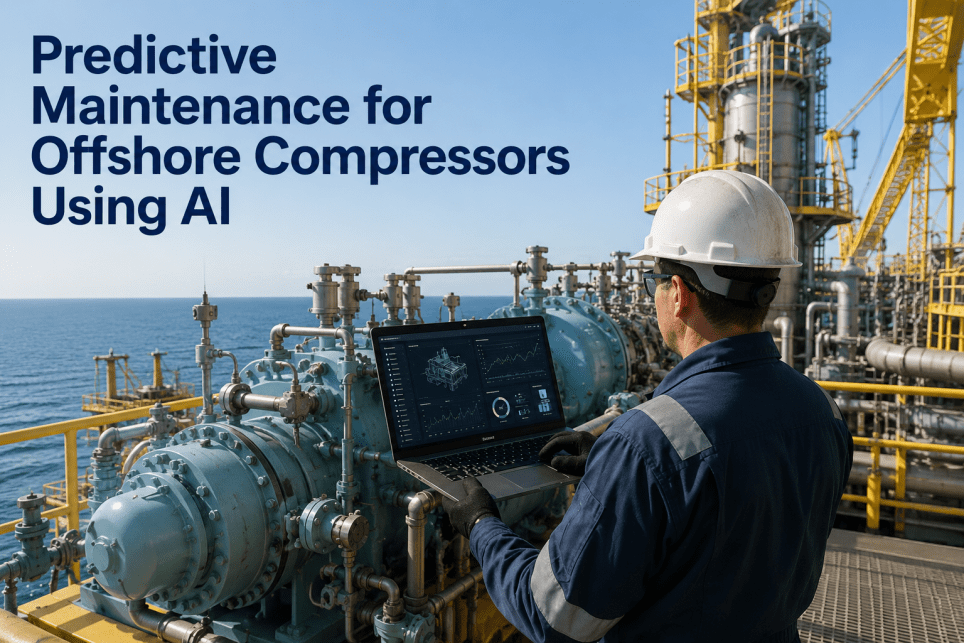
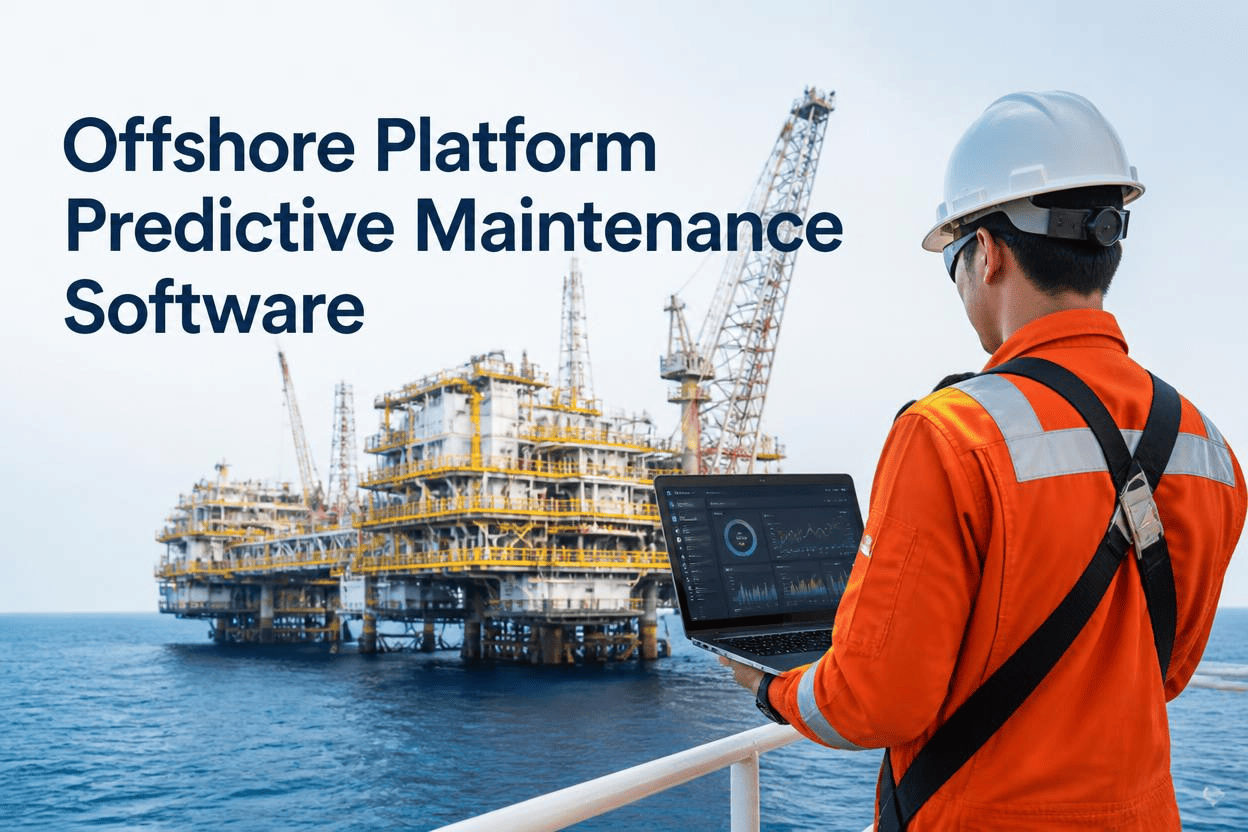
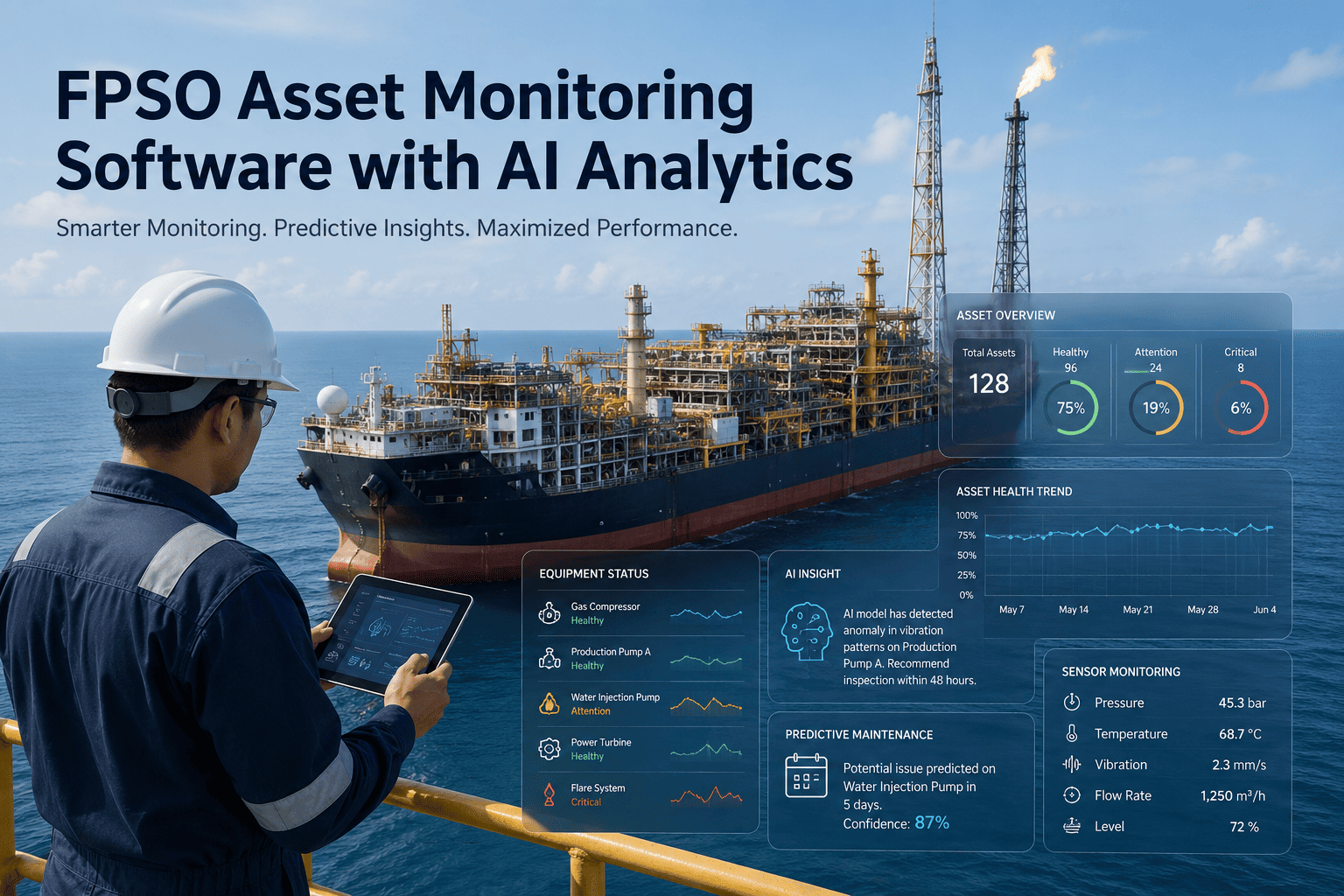
Offshore compressors are among the most demanding assets in the energy sector—operating under extreme pressure, corrosive marine environments, and 24/7 production schedules where unplanned downtime can cost operators upwards of $500,000 per day. Traditional time-based maintenance cycles were designed for a world where data was scarce. That world no longer exists. AI-powered predictive maintenance is now the defining differentiator between platforms that run lean and platforms that bleed cash on reactive repairs. This article breaks down exactly how offshore operators are deploying AI to predict compressor failures before they happen—and what your facility needs to get there. Book a demo to see iFactory's platform in action.
$500K+
Daily Downtime Cost per Offshore Incident
40–60%
Unplanned Downtime Reduction with AI
3–6×
Earlier Fault Detection vs. Time-Based PM
18–30%
Maintenance Cost Savings Reported
Why Offshore Compressors Are a High-Stakes Predictive Maintenance Target
Compressors on FPSOs, fixed platforms, and subsea tiebacks don't get the luxury of a quick shutdown, a technician visit. Every maintenance intervention requires mobilization, personnel risk, regulatory notification, and production deferral. The consequence of a compressor trip mid-operation isn't just mechanical—it cascades through separator trains, export systems, and contractual delivery obligations.
Traditional preventive maintenance schedules address this with fixed intervals: replace seals every X hours andinspect impellers every Y months. The problem is that these intervals are calibrated to worst-case conditions. In practice, 80% of assets fail before or after their scheduled window—not because the schedule is wrong, but because it ignores operating context. AI changes the equation by monitoring real-time signals and building failure signatures unique to each compressor's load profile, fluid composition, and environmental exposure. Book a demo to see how iFactory builds these signatures for your assets.
Dimension
Reactive
Preventive
AI Predictive
Failure Detection
After failure
Fixed intervals
Days–weeks in advance
Downtime Risk
Very High
Moderate
Low
Maintenance Cost
Highest (emergency)
Over-maintained
Optimized
Personnel Risk
Emergency exposure
Scheduled exposure
Planned, minimal trips
Data Utilization
None
Minimal
Continuous, ML-driven
Parts Inventory
Reactive stocking
Overcautious stocking
Just-in-time ordering
Key Failure Modes AI Detects in Offshore Compressors
Not all compressor faults announce themselves. Many begin as subtle signal deviations—a 0.3°C bearing temperature rise over 48 hours, a 2% drop in polytropic efficiency, or a marginal increase in vibration amplitude at a specific frequency band. Human operators reviewing hourly trend logs will miss these. Trained ML models won't.
Bearing Degradation
Vibration spectrum analysis identifies BPFO/BPFI frequencies indicating inner and outer race wear up to 6 weeks before functional failure.
Vibration + Thermal
Seal Gas Leakage
AI monitors dry gas seal supply and vent flow differential. Deviations trigger alerts before leakage exceeds safety thresholds or contaminates lubrication systems.
Flow Differential
Surge & Stall Events
Transient pressure oscillations and flow instability patterns are detected in real time, with AI adjusting anti-surge valve positioning before mechanical damage occurs.
Pressure + Flow
Rotor Imbalance
Mass distribution shifts caused by fouling or erosion appear as 1× running speed amplitude growth. AI baselines each rotor's healthy signature for precise comparison.
Vibration Analysis
Lube Oil System Faults
Oil pressure differentials, temperature gradients across coolers, and viscosity proxies from motor current data allow AI to flag filter clogging and cooler fouling early.
Pressure + Thermal
Efficiency Degradation
Polytropic efficiency trend monitoring detects fouled impellers and eroded internals before they cause measurable throughput loss or exceed operating envelopes.
Performance Analytics
The AI Predictive Maintenance Architecture for Offshore Compressors
Implementing AI predictive maintenance offshore is not a plug-and-play event. It requires a layered architecture that handles the unique constraints of subsea and platform environments: intermittent connectivity, high data volumes from dense sensor arrays, and the need for remote human oversight without local engineering staff on call. Book a demo to walk through iFactory's offshore-ready architecture.
AI Predictive Maintenance Stack — Offshore Compressors
01
Sensor & Data Acquisition
Vibration accelerometers (radial + axial)
RTD & thermocouple arrays
Process transmitters (P, T, F)
Motor current signature analysis
Ultrasonic flow meters
Lube oil quality sensors
02
Edge Processing
Local edge compute (platform-side)
High-freq vibration FFT processing
Alarm suppression & deduplication
Bandwidth-optimized data compression
03
AI / ML Engine
Anomaly detection (isolation forests, autoencoders)
Remaining useful life (RUL) models
Digital twin performance benchmarking
Multi-variate correlation engine
Failure mode classification (fault type + severity)
04
CMMS Integration & Action
Auto-generated work orders (risk-ranked)
Spare parts pre-staging alerts
Offshore logistics coordination triggers
Maintenance window optimization
Compliance documentation auto-population
See It in Your Operation
Ready to Map Your Compressor Asset Health to AI?
iFactory's predictive maintenance platform connects offshore sensor data to automated work orders—so your maintenance team acts on intelligence, not intuition. Talk to an engineer who's done this before.
Implementation Checklist: Deploying AI Predictive Maintenance Offshore
The gap between a compelling pilot and a scaled, production-grade offshore AI maintenance program comes down to the decisions made in the first 90 days. The checklist below reflects what successful operators verify before committing capital to full deployment.
Historian access confirmed for minimum 12 months of process data
Sensor coverage mapped against critical failure modes (gap analysis complete)
Tag naming convention standardized across platforms
Known failure events labeled in historian for supervised model training
Data quality audit completed (missing values, noise floors, sensor drift)
Baseline healthy operating envelope established per compressor
Model validation against holdout failure events (precision ≥ 85%)
False positive rate benchmarked and within operator tolerance
Alert thresholds set with maintenance engineering sign-off
Model retraining cadence and ownership assigned
Satellite / VSAT bandwidth allocation confirmed for data uplink
Edge compute hardware spec'd and approved for hazardous area rating
Cybersecurity review of OT-to-cloud data pathway completed
Redundancy plan for edge node failure defined
AI alert-to-work order workflow tested end-to-end
Spare parts criticality list reviewed against AI failure predictions
Offshore logistics lead times incorporated into maintenance scheduling
Onshore remote monitoring team roles and escalation paths defined
Regulatory and permit-to-work integration confirmed with compliance team
Expert Review: What Offshore Engineers Say About AI Adoption
01
The "Alert Fatigue" Problem Is Real
Offshore maintenance engineers consistently report that poorly tuned AI systems generate too many low-confidence alerts. The fix isn't to lower sensitivity—it's to build confidence scoring into every alert and present maintenance teams with ranked, actionable recommendations, not raw anomaly flags. Systems that show why an alert was generated see 3–4× higher action rates.
02
Connectivity Is a First-Class Design Constraint
Unlike onshore plants with fiber connectivity, offshore platforms contend with limited and expensive satellite bandwidth. Successful deployments push heavy computation to the edge and send only processed features and alerts to shore-based systems—not raw time-series data. Architecture decisions made at design time determine whether the system works in practice or collapses under bandwidth limits.
03
Operator Trust Is Built Through Transparency
Maintenance supervisors don't trust black boxes. AI systems that explain their reasoning—"bearing fault predicted due to 1× vibration amplitude increase of 18% over 14 days in the drive-end radial direction"—get acted on. Systems that only say "alert: bearing fault probable" get dismissed. Explainability isn't a nice-to-have; it's the difference between adoption and shelf-ware.
Conclusion
Predictive maintenance powered by AI is no longer an emerging concept for offshore compressors—it is a proven operational discipline delivering measurable reductions in unplanned downtime, personnel mobilization costs, and emergency maintenance spend. The operators seeing the greatest returns are those who treat the AI system as infrastructure: architected deliberately, integrated with their CMMS, and tuned continuously by engineers who understand both the technology and the asset. Book a demo to see how iFactory delivers this end-to-end.
The path forward requires honest data readiness assessment, the right edge-cloud architecture for your connectivity profile, and a CMMS integration that closes the loop from AI insight to maintenance action. Getting that architecture right from the start—rather than retrofitting it onto existing systems—is the decision that separates operators who achieve 40% downtime reduction from those who run a pilot that never scales. The technology is ready. The question is whether your operational infrastructure is built to use it.
Trusted by 1,000+ Industrial Operators Worldwide
Transform Your Offshore Compressor Maintenance Program
iFactory integrates sensor data, AI anomaly detection, and CMMS work order automation into a single platform built for offshore and industrial environments. Get a personalized walkthrough of how it maps to your compressor assets.
Frequently Asked Questions
QWhat sensors are minimum viable for AI predictive maintenance on an offshore centrifugal compressor?
At minimum, you need radial and axial vibration accelerometers on both drive-end and non-drive-end bearings, suction and discharge pressure transmitters, interstage and bearing temperature RTDs, and seal gas supply/vent flow meters. Motor current data is also highly valuable if electrically driven. With these, an AI model can detect the majority of high-consequence failure modes including bearing degradation, seal leakage, rotor imbalance, and surge precursors. Adding lube oil quality sensors and inline performance instrumentation significantly increases fault coverage.
QHow much historical data does an AI model need before producing reliable offshore compressor predictions?
For unsupervised anomaly detection, a minimum of 3–6 months of stable operating data is needed to establish reliable baselines across varying load conditions and seasonal temperature effects. For supervised fault classification (where the model is trained on labeled failure events), you ideally need at least 12–18 months of data with documented failure instances. If historical data is sparse, transfer learning from similar compressor models or physics-informed models can accelerate reliable deployment. Most operators achieve meaningful fault detection within 90 days of go-live on new installations.
QHow does AI predictive maintenance integrate with an offshore CMMS?
Integration typically occurs through API connections between the AI/analytics platform and the CMMS. When the AI engine identifies an anomaly exceeding a configured risk threshold, it automatically generates a draft work order in the CMMS—pre-populated with fault type, severity, affected asset, and recommended action. This work order enters the maintenance planner's queue ranked by urgency. Advanced integrations also trigger spare parts pre-staging alerts and interface with offshore logistics systems for technician mobilization planning. iFactory's CMMS is built with this API-first integration model as a native capability.
QWhat is the typical ROI timeline for AI predictive maintenance on offshore compressors?
Most offshore operators report positive ROI within 12–18 months of full deployment. The primary value drivers are avoided production deferral from unplanned trips, elimination of emergency part procurement and helicopter mobilization, and reduction of over-maintenance from fixed-interval schedules. A single avoided compressor trip on an FPSO can justify 6–12 months of platform licensing costs. Secondary savings from parts inventory optimization and compliance documentation automation typically add 20–30% on top of the primary downtime avoidance value.
Book a demo to get a custom ROI estimate for your platform.
QCan AI predictive maintenance be deployed on aging offshore compressors without upgrading instrumentation?
Yes, with caveats. AI models can extract significant predictive value from existing SCADA and DCS historian data—even on assets originally installed without predictive maintenance intent. The practical limitation is fault coverage: if a compressor lacks seal gas flow meters or bearing vibration sensors, certain failure modes simply cannot be monitored regardless of AI sophistication. A sensor gap analysis comparing current instrumentation against the failure mode coverage matrix should be the first step. In most cases, targeted sensor additions on the two or three most critical failure modes deliver the bulk of the risk reduction value, making full instrumentation upgrades optional rather than mandatory to get started.