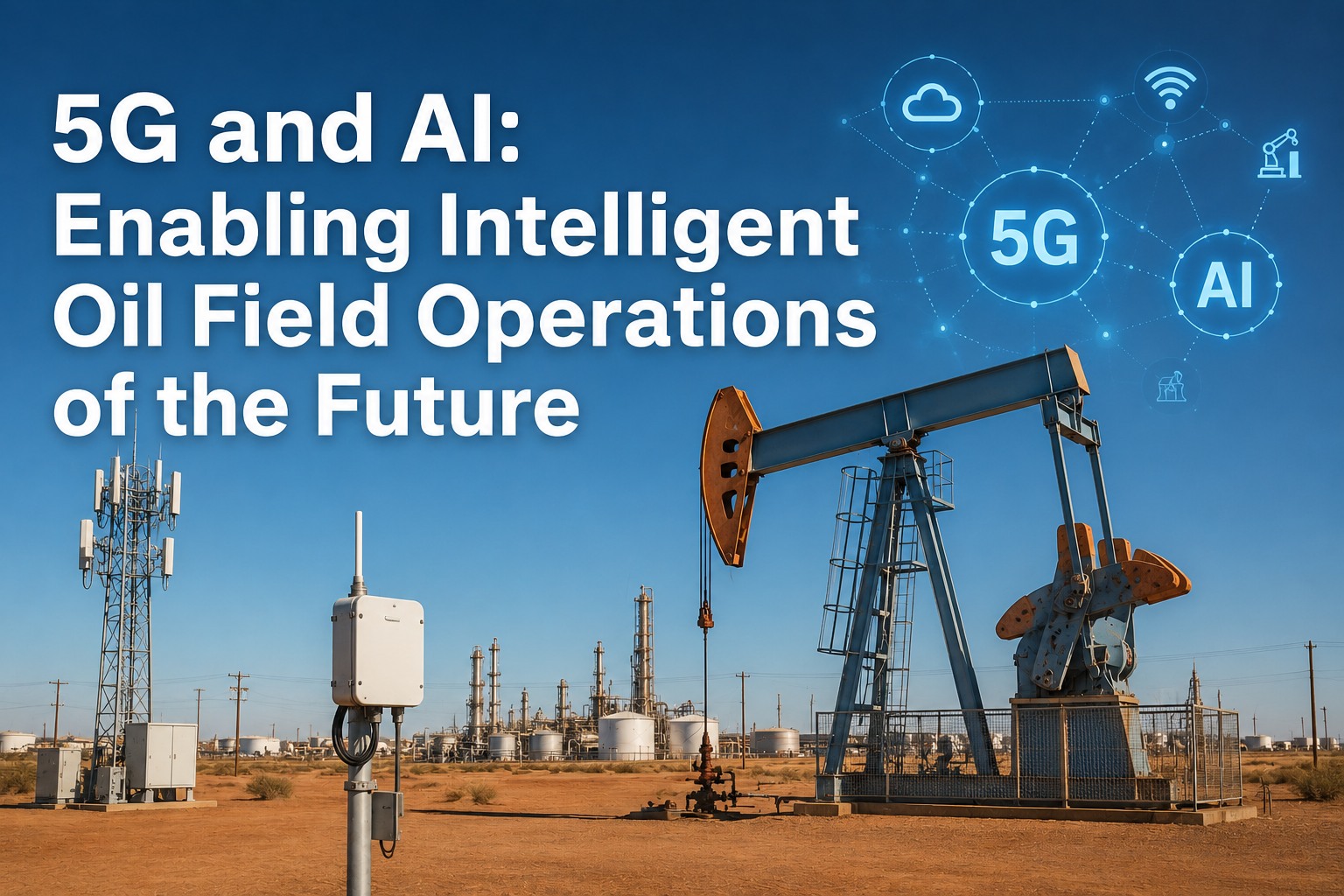
The 5G AI intelligent oilfield is no longer a future concept — it is the operational standard separating facilities that hit net-zero targets and energy efficiency benchmarks from those that miss both. Oil and gas operations consuming 2–4% of global energy production annually face escalating ESG compliance pressure while traditional monitoring misses 34–47% of energy efficiency opportunities, costing upstream operators $2.4–4.8M annually per facility in avoidable energy waste. 5G connectivity combined with AI optimization eliminates this gap — delivering real-time sensor data from every compressor, valve, pump and pipeline segment to AI engines that detect inefficiencies, predict failures, and reduce methane emissions before they escalate. Book a Demo to see how iFactory deploys 5G AI optimization across your oil and gas facility within 8 weeks.
What Is a 5G AI Intelligent Oilfield?
The 5G AI intelligent oilfield refers to a fully connected oil and gas facility where ultra-low-latency 5G wireless networks transmit continuous sensor data to AI engines that analyze, predict, and autonomously optimize operations — from wellhead compression to refinery furnace efficiency — in real time, without human intervention for routine optimization decisions.
Unlike traditional oil and gas operations relying on periodic manual inspection, calendar-based maintenance, and disconnected SCADA historians, the intelligent oilfield integrates thousands of IIoT sensors, edge computing nodes, and AI decision engines into a single operational intelligence layer. The facility responds to equipment degradation, energy waste, and emissions events within minutes — not months.
"The intelligent oilfield is not a technology upgrade — it is a fundamental shift from reactive to predictive operations where AI sees what human operators cannot, and 5G delivers the speed that makes real-time response possible at every asset across the facility."
Three core technology layers define the 5G AI intelligent oilfield. First, 5G wireless connectivity provides the ultra-low latency and bandwidth required to transmit sensor readings from hundreds of remote assets simultaneously without the data loss or communication gaps that plague 4G and legacy wired installations in industrial environments. Second, industrial IoT sensor networks — acoustic, thermal, pressure, flow, and vibration sensors installed on compressors, pipelines, pumps, valves, and furnaces — generate continuous equipment health and process efficiency data. Third, AI optimization engines trained on facility-specific equipment behavior patterns analyze incoming sensor data to identify efficiency losses, predict failures, detect methane leaks, and automate setpoint adjustments in real time.
Why Legacy SCADA Networks Are Holding Operations Back
The oil and gas industry has relied on SCADA systems and wired sensor networks for decades. These systems were designed for monitoring — not optimization. They collect data. They do not analyze it at the scale and frequency that AI energy optimization requires.
A midstream pipeline spanning 480 miles with valve interfaces, pump stations, and compression sites every few miles cannot maintain reliable data transmission across remote terrain using 4G or wired infrastructure. Coverage gaps create operational blind spots lasting hours or days. The result: actual fugitive emissions of 3.7% go unreported against EPA assumption-based estimates of 2.3%, and compressor energy waste accumulates undetected between quarterly reviews.
The financial consequence is direct. Traditional energy management missing 34–47% of efficiency opportunities costs upstream operators $2.4–4.8M annually per facility, midstream pipeline operations $1.8–3.2M in inefficient compression, and downstream refineries $3.6–6.8M in heat recovery and process optimization losses. If your facility is running on legacy SCADA without AI optimization, see exactly what you're leaving on the table — book a live iFactory demo today.
Key Technologies: 5G, Edge Computing, IIoT Sensors, and AI
The intelligent oilfield is built on four converging technology layers that each solve a distinct operational limitation. Understanding how they interlock is essential to evaluating any deployment.
5G Private Networks for OT Environments
Private 5G networks — deployed within a facility's operational technology (OT) security perimeter — provide the bandwidth, latency, and reliability that public carrier 5G cannot guarantee in industrial environments. Private 5G ensures sensor data from 300+ assets transmits continuously without competing with public network traffic or exposing OT data to external security risks. All data stays inside your security perimeter, meeting ISA/IEC 62443 OT security standards.
Edge Computing for Real-Time AI Inference
AI optimization cannot wait for data to travel to a cloud data center and return a recommendation. For compressor surge prevention, the AI response window is measured in seconds. Edge computing nodes physically located within the facility run AI inference models locally, processing sensor streams and generating setpoint recommendations or automated control adjustments within the latency window that safety-critical operations require.
IIoT Sensor Classes in Oil and Gas
The intelligent oilfield deploys multiple sensor classes simultaneously. Thermal imaging sensors detect heat signatures from micro-leaks and corrosion hot spots 6–8 weeks before visual detection. Acoustic emission sensors identify ultrasonic signatures of gas leaks through valve seats and pipe wall thinning. Vibration and condition monitors track compressor bearing condition and impeller degradation through continuous spectrum analysis. Pressure and flow transmitters provide real-time process data for AI compressor discharge optimization and pipeline integrity monitoring at 15-second or sub-second resolution.
AI Models Trained on Facility-Specific Equipment Behavior
Generic AI models do not optimize oil and gas operations — facility-specific models do. AI engines trained on 18–24 months of historical performance data from a specific facility's compressors, furnaces, and pipeline segments develop operational context enabling accurate anomaly detection calibrated to actual equipment behavior, not industry averages. Talk to our specialists about how AI models are trained and calibrated for your specific equipment portfolio.
How 5G Unlocks AI-Driven Optimization Across Upstream, Midstream and Downstream
The 5G AI intelligent oilfield delivers different optimization value at each segment of the oil and gas value chain. The common thread is continuous data — enabled by 5G — feeding AI engines that identify opportunities human operators cannot detect at scale.
Upstream: Well Pad and Wellhead Compression Optimization
Upstream operations involve geographically dispersed well pads in remote terrain with limited wired connectivity. 5G enables continuous wellhead sensor data transmission from hundreds of individual wells to AI optimization engines without the data gaps that cause missed compression inefficiencies and undetected casing leak events. AI compressor optimization in upstream gas production reduces energy consumption 18–28% by dynamically adjusting discharge pressure setpoints to actual demand rather than conservative fixed margins set months apart.
Midstream: Pipeline Integrity and Leak Detection at Scale
Midstream pipeline operators face the most challenging connectivity problem — monitoring hundreds of miles of pipeline across terrain where wired sensor infrastructure is prohibitively expensive. Private 5G combined with solar-powered IIoT sensor nodes enables continuous monitoring of valve interfaces, flange connections, and pump seals across pipeline segments previously inspected only during annual thermography surveys. The emissions impact is significant: AI thermal and acoustic imaging deployed via 5G connectivity detected 47 leaks in the first 6 months at one midstream operator — 31 of which were micro-leaks invisible to manual inspection. Discover how AI leak detection could close the gap between your reported and actual fugitive emissions — see a live iFactory demo.
Downstream: Refinery Process and Heat Recovery Optimization
Downstream refineries operate the most complex AI optimization environments — crude distillation units, catalytic crackers, hydrotreaters, and utility systems with thousands of sensor points requiring simultaneous analysis. 5G enables high-bandwidth sensor streams from furnace tube skin temperature profiles, crude inlet temperature sensing, and heat exchanger duty performance to reach AI engines continuously. AI detection of furnace tube fouling 2–3 weeks before threshold eliminates emergency shutdowns that consume 3–5x the energy of planned maintenance and preserves production continuity worth $3.2M or more per event avoided.
Real-World Results: 5G AI Deployments in Oil and Gas Operations
The following outcomes are drawn from iFactory deployments at operating oil and gas facilities across upstream, midstream, and downstream segments. Each result reflects 9-month post-deployment performance data. Request the full case study report for the facility type most relevant to your operations.
Traditional Monitoring vs. 5G AI Intelligent Oilfield
The performance gap between legacy SCADA monitoring and 5G AI optimization is measurable at every operational dimension. The Complete AI Platform for Oil and Gas Operations positions energy efficiency as a core strategic capability — not a periodic audit finding. Talk to our oil and gas energy optimization specialists and compare your current monitoring against AI-driven efficiency.
| Capability | Traditional SCADA Monitoring | 5G AI Intelligent Oilfield |
|---|---|---|
| Data Transmission Latency | 30-second to 5-minute polling intervals. Wired infrastructure limits remote asset coverage. | Sub-second 5G transmission from all assets simultaneously. AI inference at edge nodes within 10ms response window. |
| Sensor Coverage | Hard-wired sensor nodes at fixed monitoring points. Remote and offshore assets frequently unmonitored. | Wireless IIoT sensors deployable anywhere. 5G enables continuous data from all assets regardless of location or terrain. |
| Energy Optimization Frequency | Monthly or quarterly energy audits. Compressor setpoints fixed at conservative margins for 6–12 months between reviews. | Continuous AI optimization adjusting setpoints based on actual demand every few minutes. 28% energy reduction vs. fixed-setpoint operation. |
| Leak and Emission Detection | Annual thermography survey detecting large leaks only. 68% of small leaks missed between inspection cycles. | Continuous thermal and acoustic monitoring detecting micro-leaks 6–8 weeks before visual detection. 41% fugitive emission reduction. |
| AI Analysis Capability | Human operators cannot analyze 576 daily data points per sensor across 200+ sensors. Historian data sits unreviewed. | AI analyzes complete sensor history combined with real-time conditions. Optimization decisions impossible manually become automated. |
| ESG and Emissions Reporting | Manual emission calculation from EPA assumptions. 12–18 month delay from operations to audited ESG reporting. | Continuous measurement-based emission calculation. Monthly ESG dashboards formatted for TCFD and SEC climate disclosure. |
| Deployment to Value Timeline | 6–12 month implementation cycle. Energy savings achieved 12–18 months after project initiation. | 8-week deployment achieving 18–26% energy reduction by week 6. Energy savings evidence visible from week 4. |
Implementation Roadmap: Deploying 5G AI on Your Facility
iFactory follows a fixed 6-stage deployment methodology delivering pilot results in week 4 and full facility energy reduction by week 8. Deployment connects to existing DCS/SCADA infrastructure — no rip-and-replace of existing Honeywell, Emerson, Yokogawa, or Siemens systems required. Ready to map your facility against this roadmap? Book a 30-minute deployment scoping call with iFactory's oil and gas specialists.