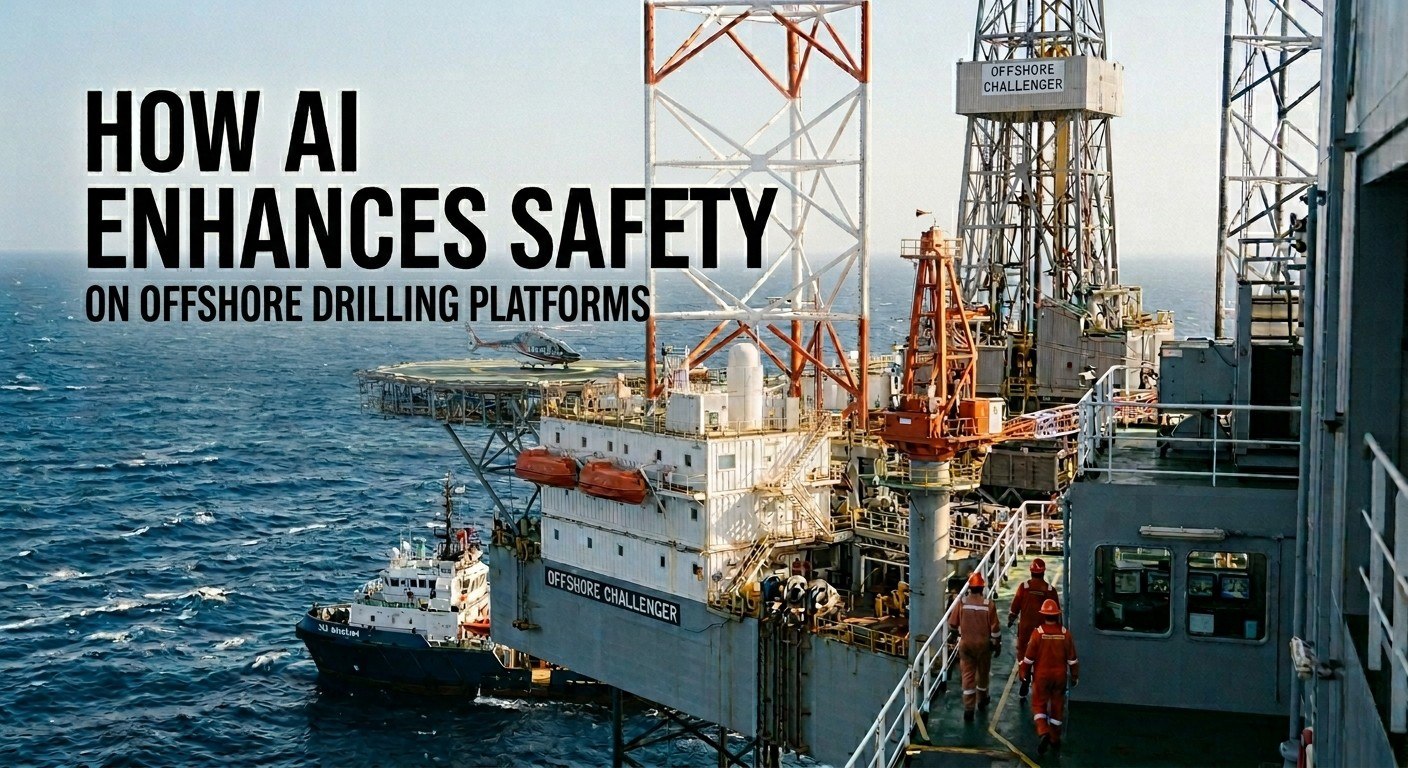
How AI Enhances Safety on Offshore Drilling Platforms
By Ethan Walker on May 16, 2026
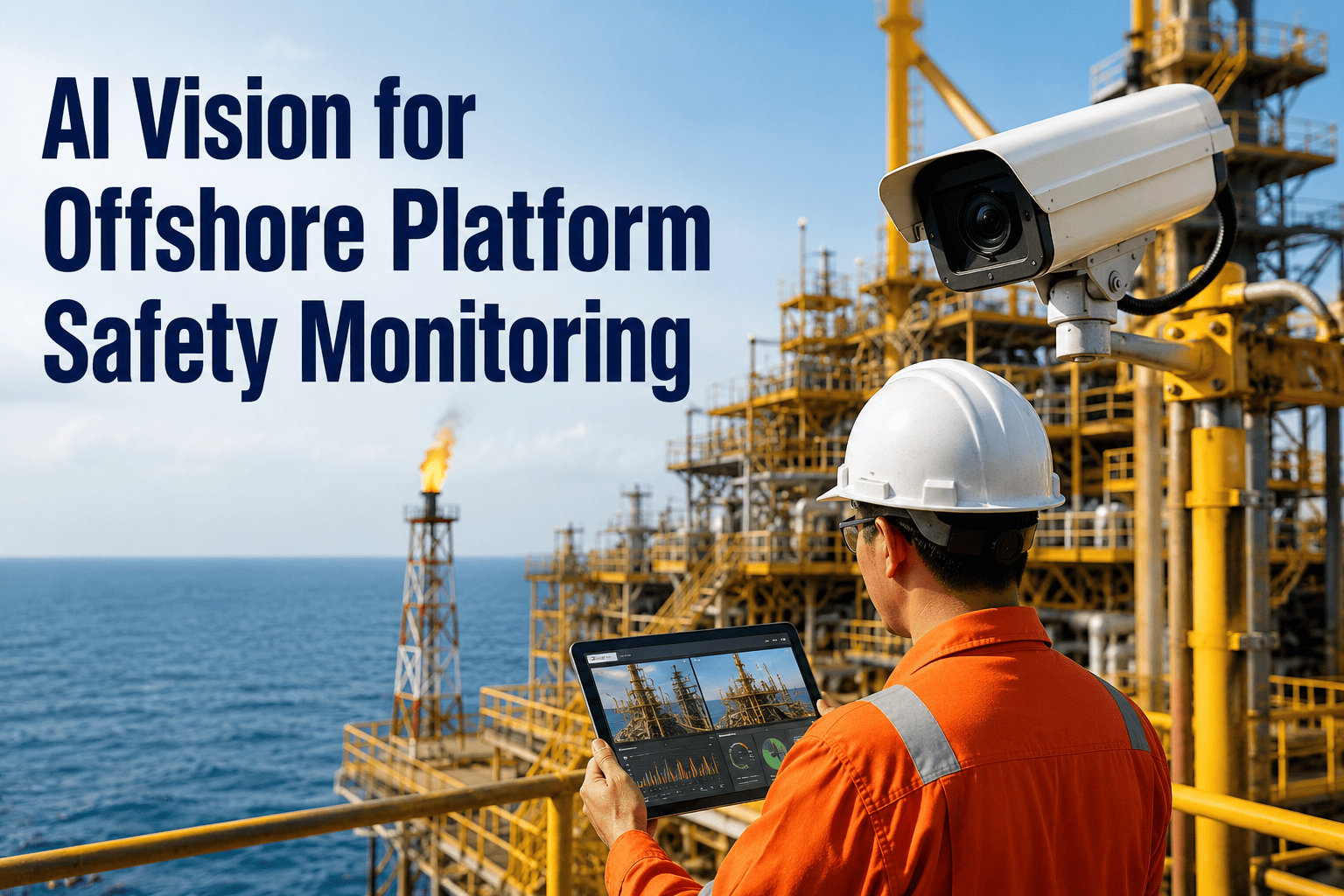
AI is transforming safety management across offshore drilling platforms — detecting equipment failures before they occur, monitoring hazardous conditions in real time, and reducing incident rates by 30–60%. For operators managing complex subsea and topside assets, AI-powered monitoring closes the gap between quarterly audits and continuous, actionable safety intelligence.
Offshore Safety at a Glance
60%
Reduction in unplanned shutdowns when AI predictive maintenance is deployed across offshore assets
2–4 wks
Advance warning AI provides before critical equipment failures on offshore rigs and FPSOs
$2.5M+
Average cost of a single offshore safety incident — preventable with real-time AI monitoring
35%
Improvement in regulatory compliance scores for offshore operators using AI-driven safety reporting
Quick Answer
AI enhances offshore drilling safety by continuously monitoring thousands of sensors across topside and subsea equipment, predicting mechanical failures 2–4 weeks in advance, detecting gas leaks and pressure anomalies in real time, and automating safety compliance reporting. Platforms using AI safety monitoring report 30–60% fewer unplanned incidents and achieve measurable HSE improvements within the first 8 weeks of deployment.
Offshore AI Safety Checklist: What to Verify on Your Platform
Before deploying or evaluating an AI safety solution for offshore drilling, operators should verify these critical capabilities are addressed. Use this checklist to assess readiness gaps and prioritize deployment focus areas.
Real-Time Equipment Health Monitoring
Continuous sensor data collection from compressors, pumps, BOP stacks, risers, and rotating equipment with sub-second anomaly detection — not batch-processed hourly reports.
Gas Leak and Pressure Anomaly Detection
AI pattern recognition distinguishing normal process variation from early-stage gas releases and pressure build-up events — with automatic alert escalation to safety personnel before thresholds are breached.
Predictive Maintenance Scheduling
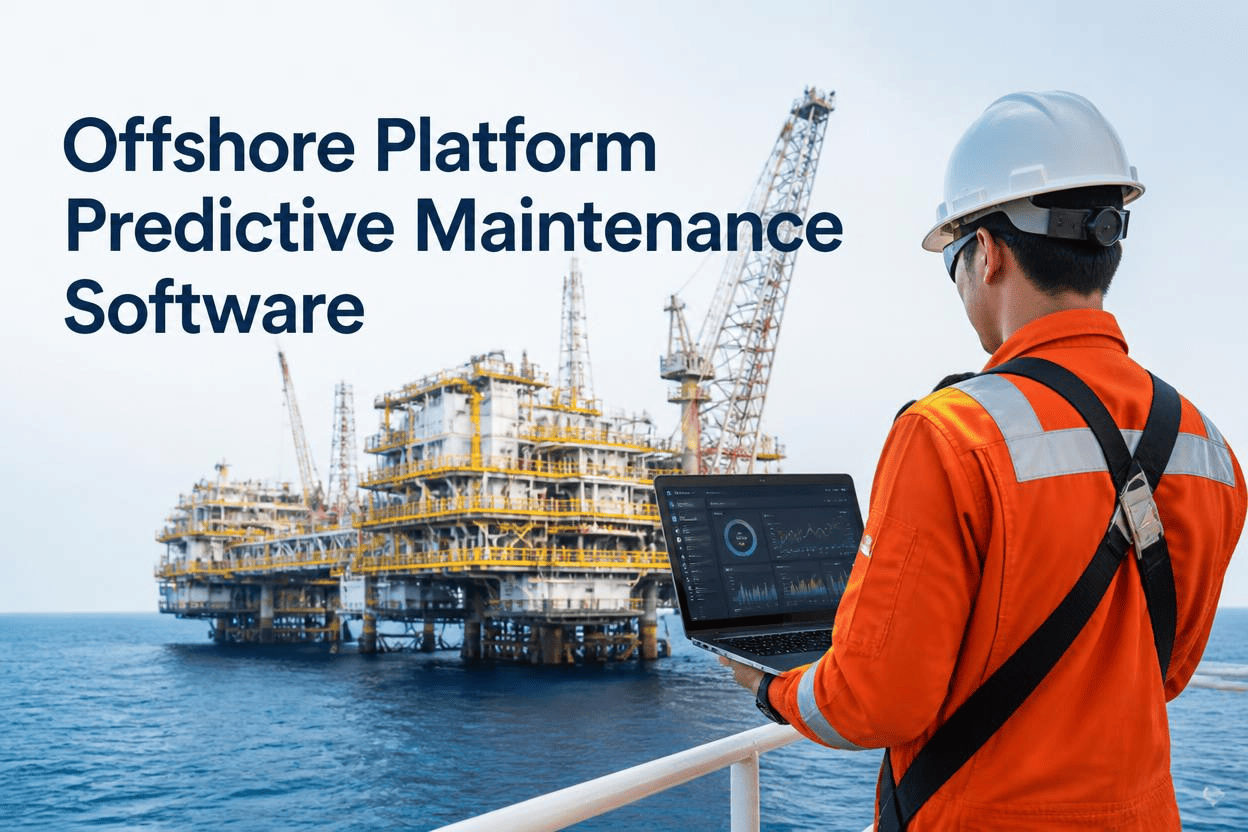
ML models trained on historical failure modes identifying 2–4 weeks of advance warning for critical equipment degradation — replacing reactive maintenance schedules that cause unplanned shutdowns.
Remote Inspection via AUV and Drone Integration
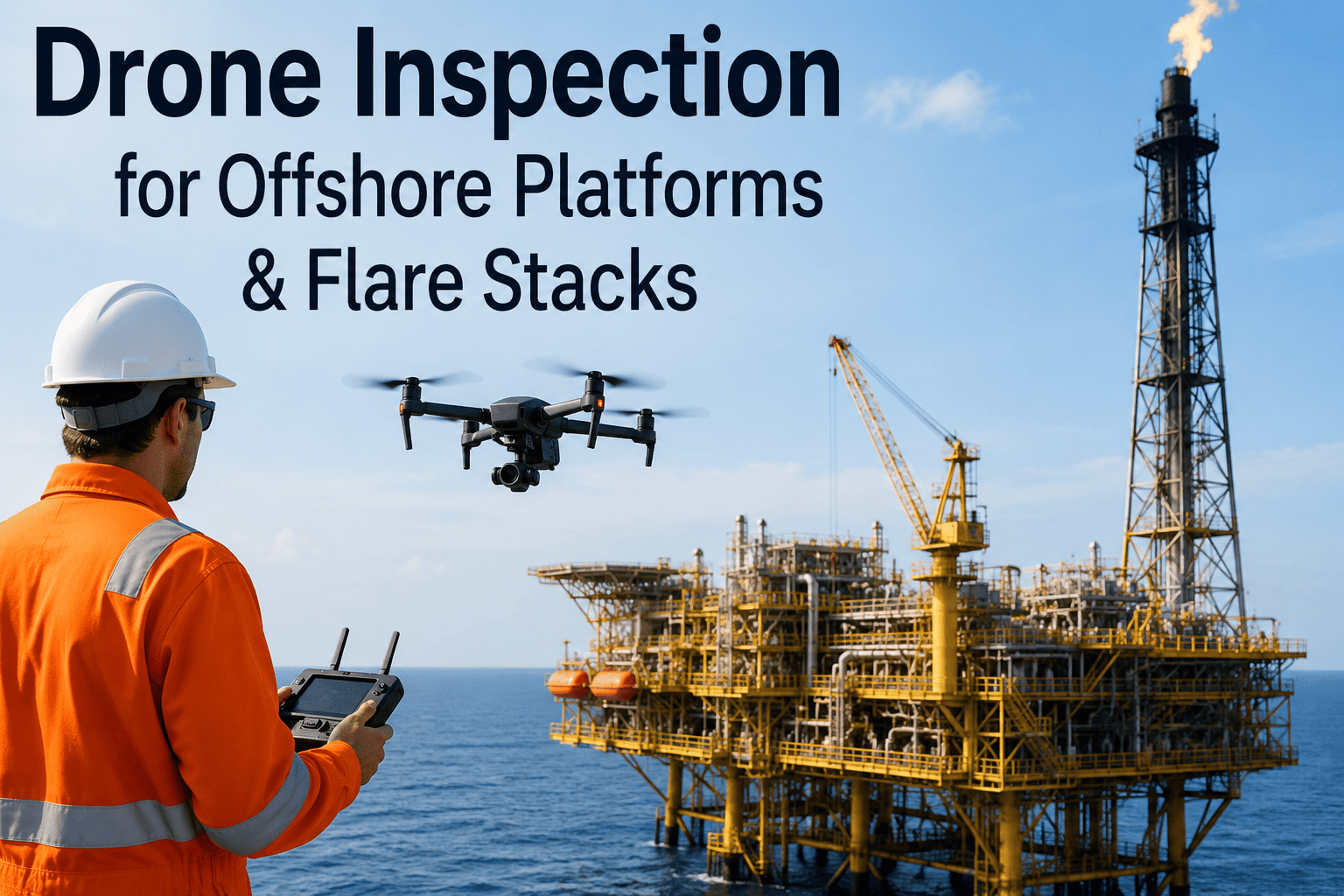
AI-guided autonomous underwater vehicles (AUVs) and topside drones performing structural inspections in hazardous zones — eliminating human exposure during high-risk inspection tasks.
Regulatory Compliance Automation
Continuous documentation of safety events, near-misses, and equipment status for automatic generation of BSEE, UKOOOA, and NORSOK compliance reports — eliminating manual audit preparation.
OT/SCADA Integration Without System Disruption
AI platform connects to existing DCS, SCADA, and historians without replacing operational systems — maintaining OT security perimeters while adding intelligent monitoring layers above existing infrastructure.
Digital Twin for Well and Riser Integrity
Physics-based digital twins of wellbore conditions and riser integrity updated continuously from real sensor data — enabling scenario modelling before interventions without physical risk exposure.
How AI Safety Monitoring Works on Offshore Platforms
Traditional offshore safety relies on periodic manual inspections, quarterly audits, and reactive maintenance responses. By the time an anomaly surfaces through these channels, it has already been developing for days or weeks — accumulating risk. AI fundamentally changes this by converting sensor streams into continuous risk intelligence.
Modern offshore platforms generate enormous volumes of real-time data from pressure sensors, vibration monitors, temperature probes, and flow meters across hundreds of equipment systems. Without AI, this data sits unused in historians. With AI, every data point is cross-referenced against baseline models, failure libraries, and physics-based digital twins to identify deviations that human operators would miss entirely until conditions deteriorate.
01
Sensor Data Ingestion
AI connects to existing SCADA and DCS systems, ingesting sensor streams from thousands of equipment points without any operational disruption or new hardware requirements.
02
Baseline Modelling
ML models establish normal operating envelopes for each equipment system, accounting for production rate changes, seasonal variation, and scheduled maintenance cycles.
03
Anomaly Detection
Continuous comparison of live sensor data against baseline models identifies deviations indicating equipment stress, seal degradation, corrosion, or incipient failure — weeks before operational impact.
04
Risk Prioritisation
AI ranks identified anomalies by safety criticality, production impact, and time to failure — directing operator attention to the highest-risk equipment first across a platform with hundreds of active alerts.
05
Automated Response Recommendations
System generates specific maintenance and operational recommendations, estimated time windows for safe intervention, and documentation for work order management integration.
06
Compliance Reporting
All safety events, equipment health data, and interventions automatically formatted into regulatory reporting outputs — reducing compliance preparation time from weeks to hours.
Core AI Safety Capabilities by Platform Type
Different offshore platform types present distinct safety challenges. AI monitoring solutions must be calibrated to the specific operational profile of fixed platforms, FPSOs, semi-submersibles, and deepwater drilling vessels. Here's how AI safety capabilities map to each context.
Fixed Platforms & Jackups
✓Structural integrity monitoring for jacket legs and topsides deck
✓Corrosion rate prediction with 6-month forward modelling
✓Gas turbine and generator health tracking with efficiency baselines
✓Wellhead pressure integrity monitoring across all production trees
FPSO Vessels
✓Hull stress and fatigue monitoring under dynamic mooring loads
✓Process plant equipment health across separation and compression trains
✓Riser and turret integrity with wave and current load modelling
✓Cargo and offloading system anomaly detection for tandem operations
Deepwater Drilling Vessels
✓BOP stack pressure and seal integrity monitoring 24/7
✓Mud weight and wellbore pressure management with kick detection
✓Riser angle and tension monitoring under variable sea states
✓Drillstring vibration analysis reducing stick-slip and bit damage
Across all platform types, AI safety monitoring connects to existing SCADA and DCS infrastructure without replacing operational systems. Operators managing multiple asset types can run a unified safety monitoring view across their entire offshore portfolio. Book a demo to see multi-asset offshore safety monitoring in action.
Real-World Case Studies: AI Safety Results on Offshore Platforms
The following outcomes reflect documented AI safety deployments across offshore upstream operations. Results measured over 6–12 month periods post-deployment.
Case 01North Sea Fixed Platform — Compressor Failure Prevention
A North Sea operator with six fixed platforms deployed AI monitoring across 42 compressor units. Within three months, ML models detected early-stage bearing wear on two critical export compressors — 19 days before scheduled inspection. Planned maintenance replaced bearings at a cost of £180K. Avoided failure cost estimated at £4.2M in unplanned shutdown and repair. Platform safety incident rate reduced 38% in the following 12 months as predictive maintenance replaced reactive response across the asset portfolio.
Case 02West Africa FPSO — Gas Leak Detection and Flaring Reduction
FPSO with 28 process modules experiencing 14 monthly gas release events detected by personnel — indicating significant undercounting of smaller leaks. AI sensor fusion across 3,400 process points identified 67 previously undetected low-level releases per month. Targeted seal and valve replacements based on AI prioritisation reduced detected events to 3 per month within 16 weeks. Flaring volume decreased 41% as upset prediction enabled preemptive pressure management. Annual safety cost savings estimated at $6.8M including avoided production losses and regulatory penalties.
Case 03Gulf of Mexico Deepwater — BOP Integrity and Wellbore Monitoring
Deepwater drilling vessel operating in 2,800m water depth integrated AI monitoring across BOP stack, riser system, and wellbore sensors. Digital twin modelling of wellbore pressure detected a slow-developing influx event 4 hours before mud weight adjustments would have become critical — allowing controlled well kill without emergency intervention. BSEE inspection compliance time reduced from 14 days quarterly manual preparation to 6 hours automated report generation. Drillstring vibration monitoring reduced bit replacement frequency by 28% and improved ROP by 11% on subsequent wells.
Frequently Asked Questions
QHow does AI safety monitoring integrate with existing offshore SCADA systems?
AI platforms connect to existing DCS and SCADA historians using standard OPC-UA, Modbus, and PI System interfaces without replacing operational systems or requiring new field hardware. OT data remains within the platform security perimeter — AI models run on edge servers or in secure cloud environments with encrypted data transfer. Integration typically requires 4–6 weeks depending on the number of data sources and historian configurations. Book a demo to review integration requirements for your specific setup.
QWhat offshore equipment types can AI safety monitoring cover?
AI monitoring covers rotating equipment (compressors, pumps, turbines, generators), static equipment (vessels, heat exchangers, separators), structural systems (jackets, risers, mooring), wellbore and BOP systems, process safety systems (pressure relief, flare), and utilities. Coverage scales from single-module deployments to full-platform integration across thousands of equipment points.
QHow long before AI safety monitoring produces measurable results?
Equipment anomaly detection and initial predictive maintenance recommendations are typically active within 4 weeks of deployment as AI models establish baselines from historical data. Measurable reductions in incident rates and unplanned shutdowns are generally observed within 3–6 months as predictive maintenance actions replace reactive responses across the platform.
QDoes AI monitoring support subsea inspection as well as topside equipment?
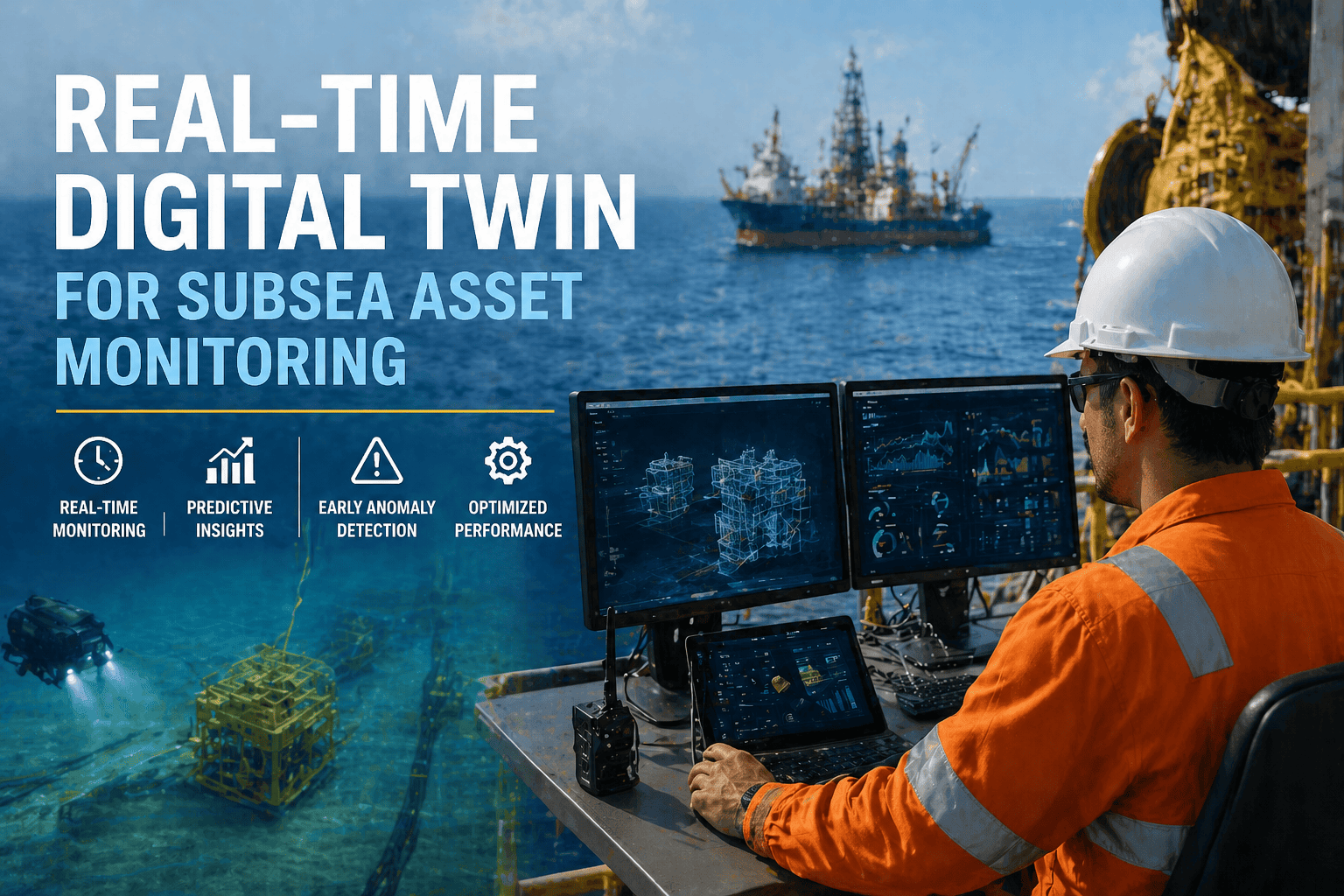
Yes. AI integrates with AUV and ROV inspection data to build continuous subsea asset health models — combining sensor data from subsea trees, manifolds, and flowlines with periodic visual inspection results. This creates a continuously updated structural integrity picture rather than point-in-time inspection snapshots.
QCan AI-generated safety reports be used for regulatory submissions?
AI-generated reports include full audit trails with timestamped sensor data, anomaly records, and intervention documentation. These are formatted for BSEE, NORSOK, UKOOOA, and other regulatory frameworks. Reports are exportable and auditable by third-party verifiers. Most operators report a 70–85% reduction in compliance documentation time after deployment.
QWhat is the typical ROI on an offshore AI safety deployment?
ROI depends on asset size and current safety performance, but offshore deployments typically break even within 6–9 months based on avoided unplanned shutdowns alone. A single prevented compressor failure on a producing platform typically exceeds the full-year cost of AI monitoring. When regulatory penalty avoidance, production recovery, and maintenance optimisation are included, documented ROI ranges from 4:1 to 12:1 across a 24-month deployment horizon.
Reduce Offshore Safety Incidents by 30–60%. Deploy AI in 8 Weeks.
Real-time equipment health monitoring, predictive failure detection 2–4 weeks ahead, gas leak and pressure anomaly alerts, AUV inspection integration, and automated regulatory reporting — fully connected to your existing SCADA and DCS with measurable safety improvements in week 4.
30–60% fewer incidents2–4 week failure predictionResults from week 4