The offshore oil and gas industry has always operated at the edge of what is physically possible. Platforms perched hundreds of miles from shore, subsea infrastructure sitting at depths exceeding 3,000 meters, FPSOs processing hundreds of thousands of barrels per day in sea states that ground all helicopter operations for days at a time. The traditional answer to managing these assets was headcount — put more engineers on the platform, run more inspection rounds, staff more control rooms. That model is no longer economically viable or operationally safe. AI-powered remote operations centers are replacing it. A modern AI remote operations center offshore consolidates monitoring, prediction, and decision support for dozens of geographically dispersed assets into a single onshore facility — one where machine learning models process sensor data 24/7, flag anomalies before they become failures, and give onshore engineers the situational awareness that previously required a flight to the platform. This article covers exactly how these centers are architected, what AI capabilities they run, how they compare to traditional offshore control, and what the implementation roadmap looks like for operators ready to make the transition in 2025.
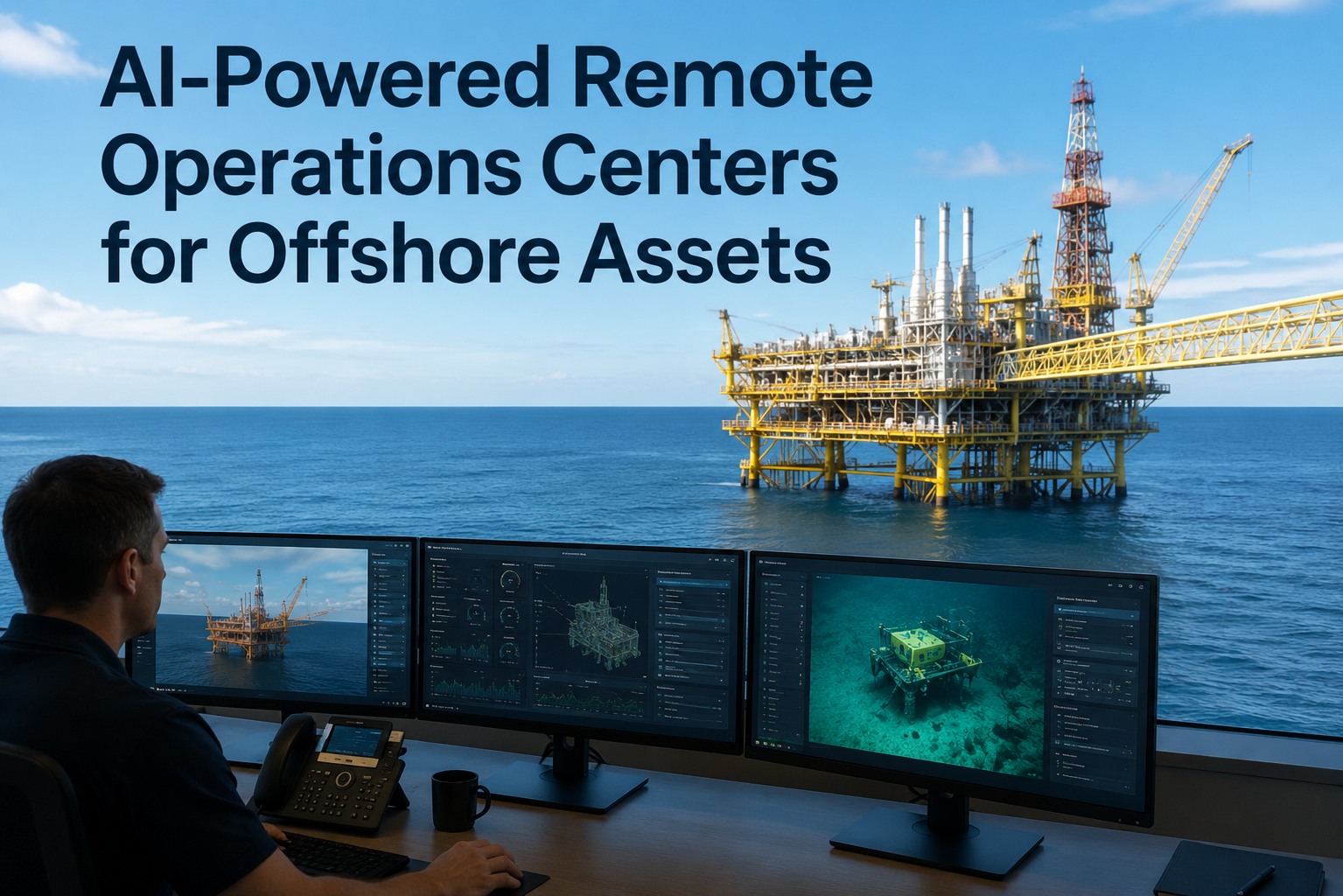
AI-Powered Remote Operations Centers for Offshore Assets
How onshore AI operations hubs are replacing traditional offshore control rooms — cutting costs, improving safety, and enabling real-time predictive decision-making across FPSOs, deepwater platforms, and subsea infrastructure.
40%
Reduction in offshore manning costs via remote ops
72hrs
Average AI failure prediction lead time
98.6%
Uptime achieved on AI-monitored FPSOs
60%
Fewer unplanned shutdowns with predictive AI
What Is an AI Remote Operations Center for Offshore Assets?
A traditional offshore control room sits on the platform itself — close to the assets, but also exposed to the same environmental, logistical, and safety constraints that govern everything else on that structure. An AI remote operations center (ROC) moves that control function onshore and augments it with machine learning models that process sensor streams, maintenance records, inspection data, and process variables continuously. The result is not just remote monitoring — it is AI-assisted situational awareness that no human crew on a platform can match at scale.
The architecture of a modern offshore AI ROC has four distinct layers: a data acquisition layer at the asset (sensors, PLCs, SCADA), a secure communications layer (satellite, subsea fiber, or VSAT), an onshore data processing layer (edge compute plus cloud analytics), and a decision support layer where AI models surface alerts, recommendations, and predictions to human operators. Each layer has specific technology requirements — and getting the architecture wrong at any one of them degrades the entire system's value.
AI Remote Operations Center — 4-Layer Architecture
Layer 1
Asset Data Acquisition
IoT sensors, vibration monitors, pressure transmitters, temperature arrays, flow meters, corrosion sensors, subsea acoustic systems. OPC-UA and MQTT protocol standardization across all field devices.
On-Asset · Subsea · Topsides
Layer 2
Secure Communications
VSAT, low-latency satellite (Starlink Maritime), subsea fiber where available. Encrypted tunnels, redundant paths, QoS prioritization for critical control data versus analytics traffic.
VSAT · Satellite · Subsea Fiber
Layer 3
Onshore Data Processing
Edge compute nodes aggregate and normalize data. Cloud analytics platform runs ML models, digital twin simulations, and historian functions. Real-time data lake feeds all AI workloads.
Edge Compute · Cloud · Data Lake
Layer 4
AI Decision Support
Predictive maintenance alerts, anomaly detection, digital twin dashboards, production optimization recommendations, safety event prediction. Human operators remain in the decision loop.
Onshore ROC · AI Dashboards · Human-in-Loop
Core AI Capabilities Running Inside a Modern Offshore ROC
The difference between a remote monitoring center and a true AI remote operations center is what the software does with the data. Monitoring centers display process variables and alarm on threshold breaches — the same function a DCS has performed since the 1980s. AI operations centers run machine learning models that learn equipment behavior, build probabilistic failure models, correlate multi-variable anomalies across assets, and surface actionable intelligence before a threshold is ever breached. These are the five AI capability categories that define what a world-class offshore ROC runs in 2025.
Predictive Maintenance AI
ML models trained on vibration, temperature, pressure, and flow data identify developing failures in rotating equipment, subsea christmas trees, wellhead components, and FPSO processing systems — typically 48–96 hours before failure occurrence. Models are retrained continuously as new failure data accumulates.
72hr avg. failure prediction lead time
Anomaly Detection & Alerting
Unsupervised learning models establish normal operating envelopes for each asset under all operating conditions. Multi-variate anomalies — where no single variable is out-of-range but the combination is statistically abnormal — are flagged automatically, catching issues that threshold alarms miss entirely.
93% reduction in false-positive alarms
Digital Twin Simulation
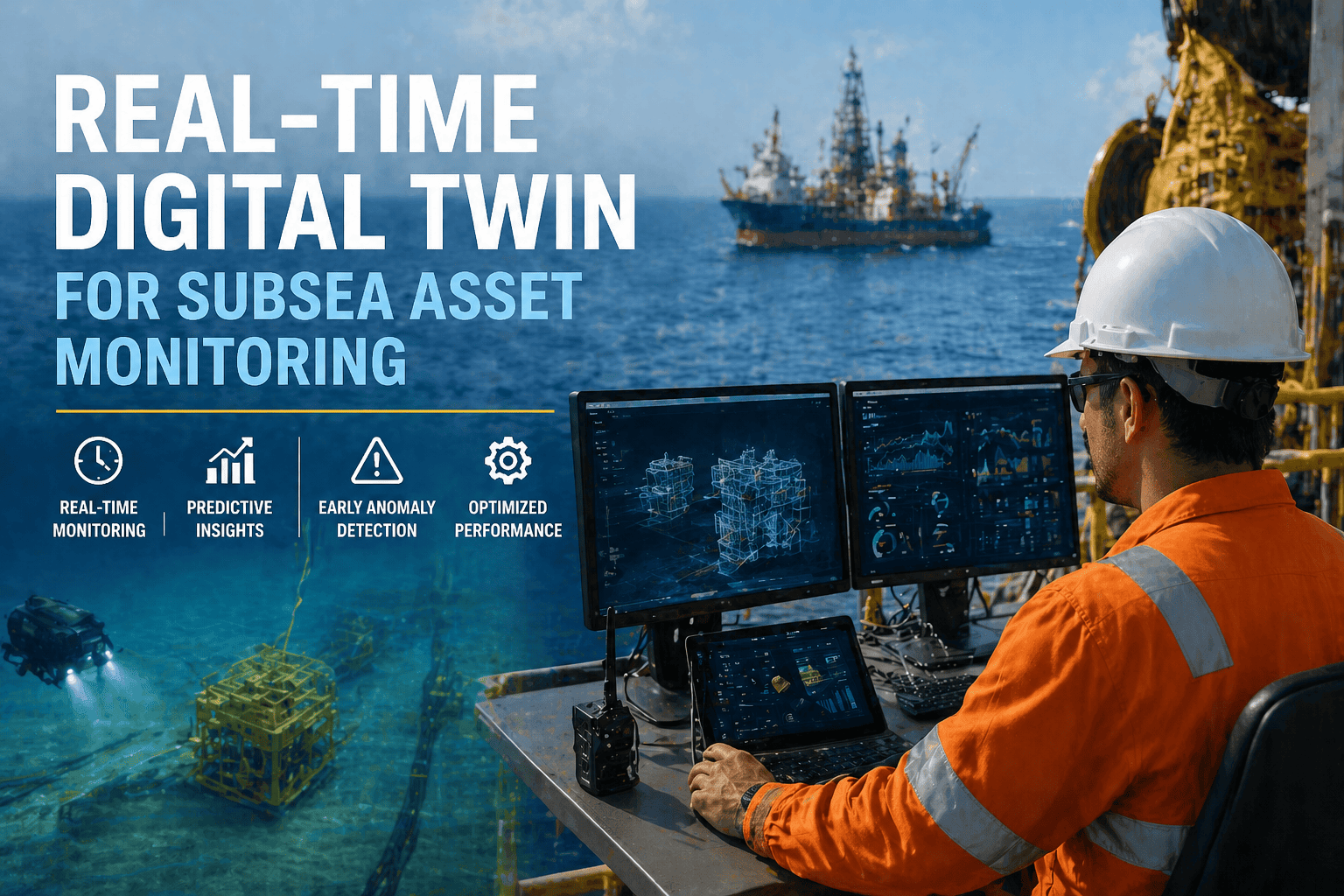
Physics-based digital twins of FPSOs, wellheads, and subsea systems are updated in real-time with live sensor data. Operators run what-if scenarios before executing production changes, well interventions, or maintenance activities — eliminating guesswork in high-consequence decisions.
35% improvement in production optimization decisions
AUV & Subsea AI Inspection
Autonomous underwater vehicles equipped with AI vision systems perform routine inspection of risers, pipelines, manifolds, and subsea structures. Computer vision models classify corrosion, crack propagation, biofouling, and structural anomalies from video feeds — replacing costly diver and ROV inspection campaigns.
65% reduction in subsea inspection costs
Production Optimization AI
Reinforcement learning and optimization models continuously tune choke settings, gas lift rates, injection pressures, and separator parameters to maximize production within operating constraints. Changes are recommended to operators, not executed autonomously — maintaining human authority over production decisions.
2–8% production uplift across monitored wells
Safety & Environmental AI
AI models monitor gas detector arrays, fire and smoke sensors, H2S levels, and environmental discharge parameters. Pattern recognition identifies pre-incident signatures — abnormal gas readings correlated with process upsets, or pressure transients indicating potential containment loss — hours before escalation.
80% earlier detection of safety-critical events
Managing a complex offshore portfolio without predictive AI is like flying blind. See how iFactory's offshore AI platform works — book a 30-minute product walkthrough.
AI Remote Operations vs. Traditional Offshore Control — Head-to-Head Comparison
Operators evaluating the transition from traditional offshore manning to AI-enabled remote operations need a clear, honest comparison of the two models across dimensions that actually drive the business case. The table below covers the eight dimensions that matter most: cost, safety, response time, data utilization, scalability, technology obsolescence risk, regulatory posture, and workforce implications.
Traditional Offshore Control vs. AI Remote Operations Center
Manning Cost
$150K–$400K per person/year offshore (rotation, accommodation, travel, risk premium)
Onshore engineer cost 60–70% lower; one ROC team covers multiple assets simultaneously
Equipment Monitoring
Periodic rounds — equipment monitored at inspection intervals, not continuously
Continuous 24/7 sensor monitoring with ML anomaly detection across all tagged assets
Failure Detection
Reactive — alarm on threshold breach, often after damage has begun
Predictive — 48–96 hour lead time on rotating equipment failures via ML pattern recognition
Subsea Inspection
Scheduled ROV/diver campaigns — expensive, weather-dependent, infrequent
AUV with AI vision — continuous or on-demand, independent of weather, 65% cost reduction
Safety Risk
All personnel exposed to offshore hazards; incident rate proportional to headcount
Reduced offshore headcount directly reduces lives at risk; AI pre-detects safety events
Scalability
Each new asset requires proportional increase in offshore crew and control room staffing
ROC scales across additional assets with marginal cost — software scales, not headcount
Data Utilization
Operators monitor dashboards — vast majority of sensor data never analyzed
100% of sensor data processed by ML models; cross-asset pattern detection impossible manually
Regulatory Posture
BSEE, HSE, NOPSEMA compliance through physical inspection regimes and manual records
Automated compliance logging, digital audit trails, AI-assisted integrity management documentation
Implementation Roadmap — From Legacy Offshore Control to AI ROC
Transitioning to an AI-powered remote operations center is not a single technology deployment — it is a phased program that typically runs 18–36 months depending on fleet size, existing infrastructure maturity, and the depth of AI capability the operator wants to achieve. Operators who try to compress this into a 6-month "big bang" deployment consistently fail. The phased model below reflects what the most successful offshore AI transitions actually look like in practice.
Asset Data Audit & Connectivity Baseline
Inventory all tagged assets, sensor coverage gaps, and SCADA/DCS integration points. Establish communications infrastructure (VSAT upgrade or satellite diversity). Define data schemas and historian architecture. Identify the 20% of assets that drive 80% of unplanned downtime risk.
Output: Asset data map, connectivity plan, historian specification
ROC Infrastructure Build & Data Integration
Build onshore ROC facility or integrate into existing operations center. Deploy edge compute nodes at priority assets. Stand up data lake and real-time historian. Integrate SCADA, process historians, and maintenance management systems. Run first dashboards with live data from pilot assets.
Output: Live ROC dashboards, integrated data pipeline, pilot asset monitoring active
AI Model Deployment — Predictive & Anomaly
Train predictive maintenance models on historical failure data for priority equipment classes (compressors, pumps, subsea trees). Deploy anomaly detection across sensor arrays. Validate model performance against holdout data before live alerting. Tune alert thresholds to minimize false positives.
Output: Live predictive maintenance and anomaly detection on pilot fleet
Digital Twin & Production AI Deployment
Build real-time digital twins of FPSOs and key production assets. Deploy production optimization AI on priority wells and processing systems. Integrate AUV inspection workflows with computer vision classification. Begin rolling fleet-wide expansion of AI coverage.
Output: Digital twins live, production AI recommendations active, AUV inspection program running
Fleet-Wide Scale & Offshore Manning Optimization
Expand ROC coverage to full asset portfolio. Revise offshore manning models based on demonstrated ROC capability — typically 25–40% reduction in steady-state offshore headcount. Establish continuous model improvement cycles. Achieve target state: AI ROC as primary operational intelligence layer for the full offshore fleet.
Output: Full fleet AI coverage, optimized offshore/onshore workforce model, continuous improvement operating
FPSO AI Monitoring — A Deep Dive on the Most Complex Offshore Asset
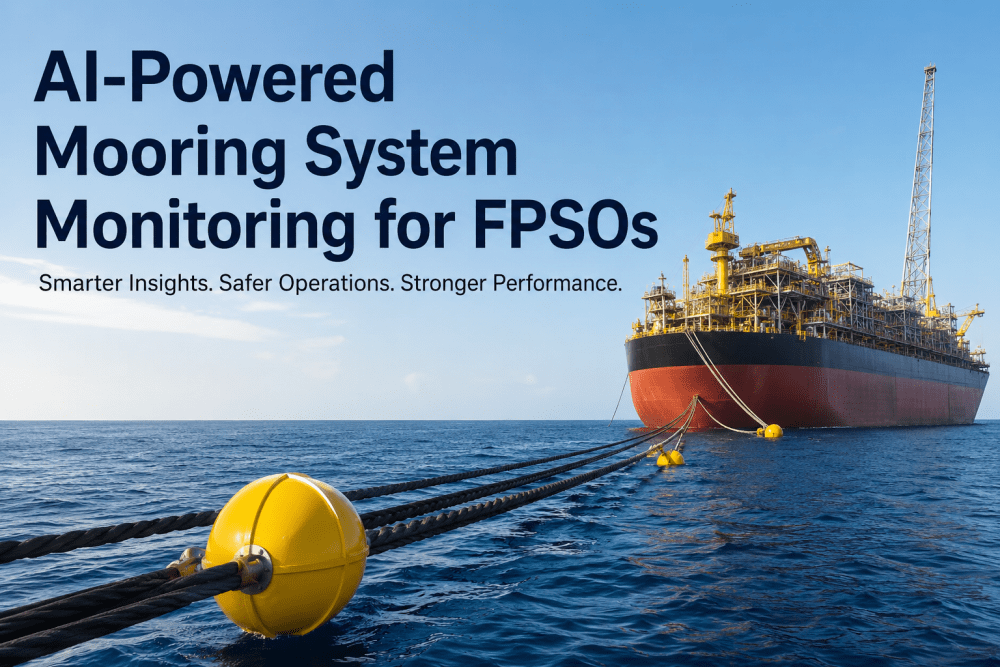
Floating Production Storage and Offloading vessels represent the most asset-intensive, operationally complex challenge in offshore AI monitoring. A single FPSO may house 300+ rotating machines, 50,000+ instrumentation tags, multiple process trains running in parallel, and subsea infrastructure connecting dozens of wells. The AI monitoring architecture for an FPSO is not a scaled-up version of a fixed platform deployment — it is a distinct architecture with specific requirements around process train modeling, turret and mooring monitoring, offloading prediction, and marine systems integration.
FPSO AI Monitoring Coverage Checklist
Topsides Processing
HP/LP separator train monitoring
Gas compression vibration AI
Crude oil export pump predictive ML
Water injection system optimization
Flare system AI monitoring and optimization
Chemical injection dosing AI
Subsea & Mooring
Turret & swivel monitoring AI
Riser stress and fatigue prediction
Mooring line load monitoring
Subsea tree & manifold condition monitoring
Flowline integrity and leak detection AI
AUV inspection route scheduling AI
Safety & Operations
Fire & gas detection pattern AI
Environmental discharge monitoring AI
Cargo & ballast optimization AI
Offloading tanker scheduling optimization
Power management and energy AI
Topsides corrosion mapping with AI vision
Your Offshore Fleet Is Generating Data 24/7 · Is Your ROC Using It?
See iFactory's AI Offshore Monitoring Platform in Action
Whether you operate a single FPSO or a portfolio of deepwater platforms, we will walk through exactly how AI predictive maintenance, digital twins, and remote operations technology would apply to your assets — with real numbers on cost reduction and uptime improvement.
40%
Manning cost reduction via remote ops
72hrs
Failure prediction lead time
60%
Fewer unplanned shutdowns
65%
Lower subsea inspection costs
Expert Review: What Makes an Offshore AI ROC Actually Work
The operators who succeed with AI remote operations centers share one characteristic: they treat the ROC as an operations transformation program, not a technology deployment. The platforms that fail treat it as an IT project — they buy the software, integrate the data streams, build the dashboards, and then wonder why operator behavior has not changed and why the predicted cost savings are not materializing.
The technology is not the hard part. The hard part is the change management that comes with shifting authority and decision-making from the platform to onshore. Experienced offshore operators are protective of their autonomy — and rightly so. The ROC has to earn their trust through demonstrated performance before it earns their deference. That trust is built by proving the AI calls are right — by catching a compressor bearing failure before the platform crew has even noticed an abnormality, three times in a row, before anyone fully commits to the remote-first operating model.
The operators who get this right instrument the change management as carefully as they instrument the equipment. They run ROC and platform control in parallel for 6–12 months before making the ROC primary. They build feedback mechanisms so offshore engineers can challenge AI recommendations and those challenges inform model improvement. They invest in ROC operator training on a par with their offshore training investment. And critically — they measure the performance of the AI continuously and transparently, so both onshore and offshore teams are working from the same evidence base.
The AI doesn't replace the offshore engineer's judgment. It gives them information they never had before — 72 hours before a failure, not 2 minutes after an alarm. That is the actual value proposition.
Conclusion: The Business Case for AI Remote Operations Is Now Definitive
The economics of AI-powered remote operations centers for offshore assets have crossed a threshold in 2025. The technology works — predictive maintenance models deliver consistent 48–96 hour failure prediction lead times, digital twins enable production optimization decisions that were previously impossible remotely, and AUV inspection programs have demonstrated 60–65% cost reductions against ROV/diver alternatives. The business case is no longer speculative: it is supported by three to five years of live deployment data from North Sea, Gulf of Mexico, and Asia-Pacific offshore operations.
What separates operators who realize the full value from those who achieve partial results is program design. The four-layer architecture must be correct, the phased implementation must respect the 18–36 month maturation timeline, and the change management investment must match the technology investment. Operators who get all three right are achieving 40% reductions in offshore manning costs, 60% reductions in unplanned shutdowns, and sustained production uptime above 98% — numbers that are transformative in an industry where a single unplanned shutdown on a major FPSO can cost $1–3M per day in lost production and emergency mobilization costs.
Ready to see how an AI remote operations center would apply to your offshore portfolio? Book a 30-minute session with iFactory's offshore AI team — no sales pitch, just a technical walkthrough of your specific assets and what the ROI looks like.
Frequently Asked Questions
What is an AI remote operations center for offshore oil and gas?
An AI remote operations center (ROC) is an onshore facility that consolidates monitoring, prediction, and decision support for offshore assets — FPSOs, platforms, subsea systems — using machine learning models processing continuous sensor data. Unlike traditional remote monitoring which displays process variables and alarms on threshold breaches, an AI ROC runs predictive maintenance models (typically delivering 48–96 hour failure lead times), multi-variate anomaly detection, digital twin simulations, and production optimization AI. The result is a single onshore team with better situational awareness than a full platform crew — at 60–70% lower cost per engineer.
Book a demo to see how iFactory's offshore AI ROC platform works.
What AI capabilities does a modern offshore ROC run?
The five core AI capability categories are: (1) Predictive maintenance — ML models on vibration, temperature, pressure data delivering 48–96 hour failure prediction for rotating equipment and subsea components. (2) Multi-variate anomaly detection — unsupervised learning establishing normal operating envelopes and flagging statistically abnormal multi-variable combinations before any threshold is breached. (3) Digital twin simulation — real-time physics-based twins of FPSOs and production systems enabling what-if scenario testing before production changes or interventions. (4) AUV/subsea AI inspection — autonomous inspection vehicles with computer vision classifying corrosion, cracks, and structural anomalies. (5) Production optimization — reinforcement learning models tuning choke settings, gas lift rates, and separator parameters to maximize production within operating constraints.
How long does it take to implement an AI remote operations center for offshore assets?
A full AI ROC implementation across a meaningful offshore portfolio typically runs 18–36 months depending on fleet size and existing infrastructure maturity. The implementation follows five phases: asset data audit and connectivity baseline (months 1–4), ROC infrastructure build and data integration (months 4–10), AI model deployment for predictive maintenance and anomaly detection (months 10–18), digital twin and production AI deployment (months 18–28), and fleet-wide scale with offshore manning optimization (months 28–36). Operators who attempt to compress this into 6-month deployments consistently underdeliver — the AI models need operational data to train and validate against, and the change management required to shift operating authority to the ROC takes time to earn.
Contact our support team to discuss your specific implementation timeline.
What are the communications infrastructure requirements for an offshore AI ROC?
The communications layer between offshore assets and the onshore ROC is one of the most critical and frequently underestimated infrastructure components. Requirements include: redundant satellite connectivity (VSAT plus low-latency LEO satellite such as Starlink Maritime for assets in coverage), Quality of Service prioritization separating critical real-time control data from analytics traffic, encrypted VPN tunnels with IEC 62443-compliant security architecture, and sufficient bandwidth to support continuous sensor data streaming from all tagged assets — typically 5–50 Mbps per major asset depending on sensor density. Subsea fiber is available for some assets in mature basins and dramatically simplifies the architecture. Edge compute nodes at the asset aggregate and buffer sensor data, ensuring continuity during communications disruptions.
What cost reductions do operators actually achieve with AI remote operations centers?
Operators who complete the full ROC implementation program consistently achieve: 35–40% reduction in offshore manning costs (driven by reduced steady-state headcount as the ROC takes over monitoring and decision support functions previously requiring platform presence), 55–65% reduction in subsea inspection costs (AUV programs replacing ROV/diver campaigns), 2–8% production uplift from AI production optimization on priority wells, and 50–65% reduction in unplanned shutdown frequency (driven by predictive maintenance catching failures before they cause production loss). On a major FPSO, the combined value of these improvements typically delivers payback on the full ROC program investment in 18–30 months. The maintenance cost savings alone — preventing a single major rotating equipment failure on a compressor — often exceed the annual cost of the AI platform.