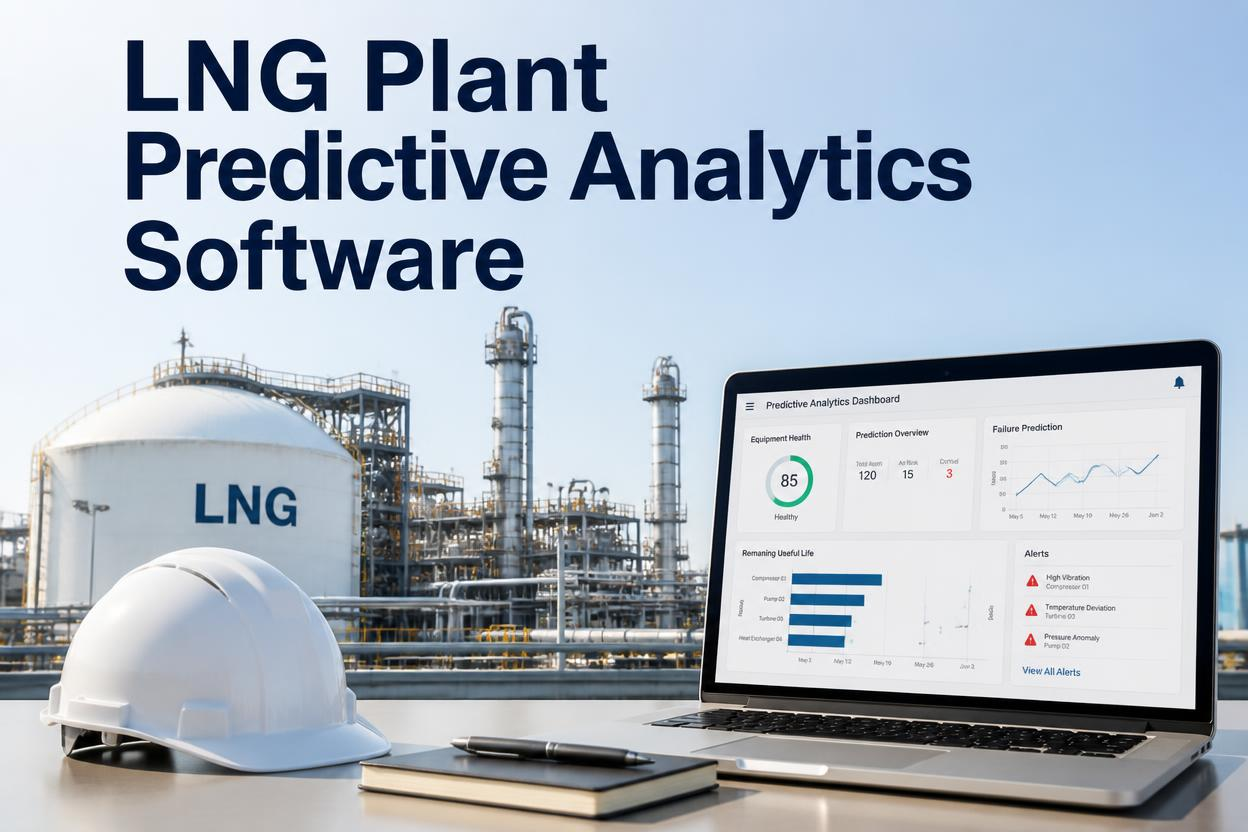
The main cryogenic heat exchanger at the heart of an LNG train is unforgiving: the moment fouling reduces its heat-transfer performance, liquefaction duty drops and the entire train throttles back, cutting into the one product the plant exists to make. Traditional protection relies on manual inspections during scheduled shutdowns, which means fouling deposits are usually discovered only after they've already forced a throughput reduction or an energy spike. Continuous predictive analytics catches that same degradation while it's still forming, and LNG operators who want to see this running against their own train configuration can book an LNG AI demo before their next planned turnaround.
LNG Operations · Predictive Analytics
Catch Cryogenic Equipment Degradation Before It Throttles Your Train
AI analytics that watch heat exchanger fouling, cryogenic valve performance, and shared utility strain continuously, deployed securely inside your own operations.
Why LNG Reliability Is a Different Problem Than Refinery Reliability
An LNG plant isn't just a collection of individual assets; it's a set of trains sharing power, cooling water, and refrigerant loops. When one train ramps up quickly or another limps along after maintenance, those shared utilities swing in ways that create hidden bottlenecks long before any single alarm fires. Historically, control rooms have watched each train's local indicators in isolation, leaving compressor load on the shared mixed-refrigerant loop unresolved until something downstream finally reacts.
Shared Utility Interdependence
A change on one train can quietly strain power, cooling, or refrigerant capacity shared across the whole complex.
Cryogenic Equipment Sensitivity
Heat exchangers and cryogenic valves degrade in ways that traditional time-based inspection intervals were never built to catch early.
High Cost of Throttling Back
Reduced liquefaction duty doesn't just cost maintenance dollars, it directly cuts the cargo volume the plant can produce and sell.
Where Predictive Analytics Delivers the Clearest Value
Main Cryogenic Heat Exchanger
Virtual sensing compares predicted clean performance against actual outlet temperatures, flagging fouling as subtle divergences appear rather than after throughput already drops.
Cryogenic Safety Valves
Machine learning models trained on real-time monitoring data predict anomalies and failures in safety valves before they compromise a critical protection layer.
Dehydration System Valves
Actuation time analysis and switching behavior reveal early valve wear, while sensor noise and drift patterns confirm instrumentation reliability.
Compressor Trains & Shared Loops
Continuous monitoring links live analyzer and plant data so shifting compressor load on the shared refrigerant loop gets caught before it becomes a bottleneck.
How the Analytics Framework Actually Works
1
Continuous Sensor Data Collection
Temperature, pressure, flow, and valve actuation data stream continuously from across every train and shared utility system.
2
Virtual Sensing Estimates Hidden Conditions
Models estimate values like fouling resistance that can't be measured directly, comparing expected clean performance against what's actually happening.
3
AI-Derived Anomaly Scores Surface on Live Dashboards
Deviations from expected behavior generate anomaly scores that operators can see and act on before a functional failure occurs.
4
Maintenance Is Planned Around the Next Turnaround
Early warning gives planners the lead time to schedule intervention during a planned shutdown instead of an emergency train trip.
Manual Inspection Cycles vs. Continuous Predictive Analytics
| Factor |
Manual Inspection Cycles |
Continuous Predictive Analytics |
| Heat exchanger fouling |
Discovered after throughput already drops |
Flagged as early divergence from clean performance |
| Cryogenic valve health |
Checked only during scheduled turnarounds |
Actuation and switching behavior tracked continuously |
| Shared utility strain |
Each train's indicators watched in isolation |
Cross-train utility load monitored as one system |
| Safety valve reliability |
Time-based inspection regardless of actual condition |
Condition-based prediction of emerging anomalies |
| Data location |
Varies by vendor and system |
Deployed on-premise, inside your existing security perimeter |
Fouling and valve wear don't wait for your next turnaround window. If your main heat exchanger and cryogenic valves are only checked on a fixed schedule, early degradation is going unnoticed between inspections.
LNG Reliability Perspective
The hardest part of LNG reliability isn't any single piece of equipment, it's the fact that everything shares power, cooling, and refrigerant with everything else. A control room watching each train's dials in isolation will always be a step behind a bottleneck that's forming across the shared loop. Once you have a model comparing actual heat exchanger performance against what clean operation should look like, fouling stops being something you discover during a turnaround and becomes something you schedule around.
LNG Process Reliability Engineer — Liquefaction Train Operations
Frequently Asked Questions
How does virtual sensing detect heat exchanger fouling before it affects output?
Virtual sensing models combine continuous temperature, pressure, and flow data with a prediction of what clean, unfouled performance should look like under current operating conditions. Even subtle divergence between predicted and actual outlet temperatures signals early deposit formation, well before it's severe enough to force a throughput reduction. Where available, spectroscopy data on exchanger surfaces can sharpen detection further.
Book a demo to see fouling detection modeled against your specific heat exchanger data.
Can this run entirely on-premise instead of sending LNG operational data to the cloud?
Yes, on-premise deployment is a common requirement for LNG operators given the sensitivity of operational and safety data, and the analytics platform is designed to connect to your existing DCS, SCADA, and historian without requiring data to leave your security perimeter. This keeps data sovereignty and cybersecurity requirements intact while still delivering real-time anomaly detection. Integration is layered on top of what you already run rather than replacing it.
Contact support for details on on-premise deployment architecture.
How are shared utility bottlenecks across multiple trains actually detected?
Rather than watching each train's local indicators in isolation, the platform links live analyzer data, plant data, and shared utility metrics like compressor load on the mixed-refrigerant loop into one continuous view. This makes it possible to catch the moment one train's ramp-up starts straining shared power or cooling capacity, instead of waiting for a downstream alarm to fire once the constraint has already caused a slowdown. Cross-train visibility is one of the biggest differences from single-asset monitoring tools.
Book a demo to see cross-train utility monitoring in action.
Does this replace scheduled turnaround inspections?
No, scheduled turnarounds remain necessary for physical inspection, certification, and maintenance tasks that only make sense with equipment offline. What continuous predictive analytics changes is the certainty around what needs attention during that turnaround, since anomaly scores and fouling trends give planners a prioritized list well ahead of the shutdown instead of a general inspection checklist. This typically shortens the scope and surprises found during the turnaround itself.
Contact support to discuss how predictive data feeds into your turnaround planning process.
How quickly can cryogenic safety valve anomalies be identified?
Safety valve prognostics models trained on real-time monitoring data are built specifically to catch behavioral pattern variations and irregular environmental responses as they emerge, rather than waiting for a scheduled inspection to reveal a problem. Because these valves sit in a critical protection layer, catching anomalies early is treated as a priority use case rather than a secondary benefit. Detection timelines depend on how much sensor history exists for the specific valve type in question.
Book a demo to see cryogenic safety valve monitoring for your train configuration.
Keep Every LNG Train Running at Full Liquefaction Duty
See how continuous predictive analytics catches heat exchanger fouling, valve wear, and shared utility strain before your next turnaround.