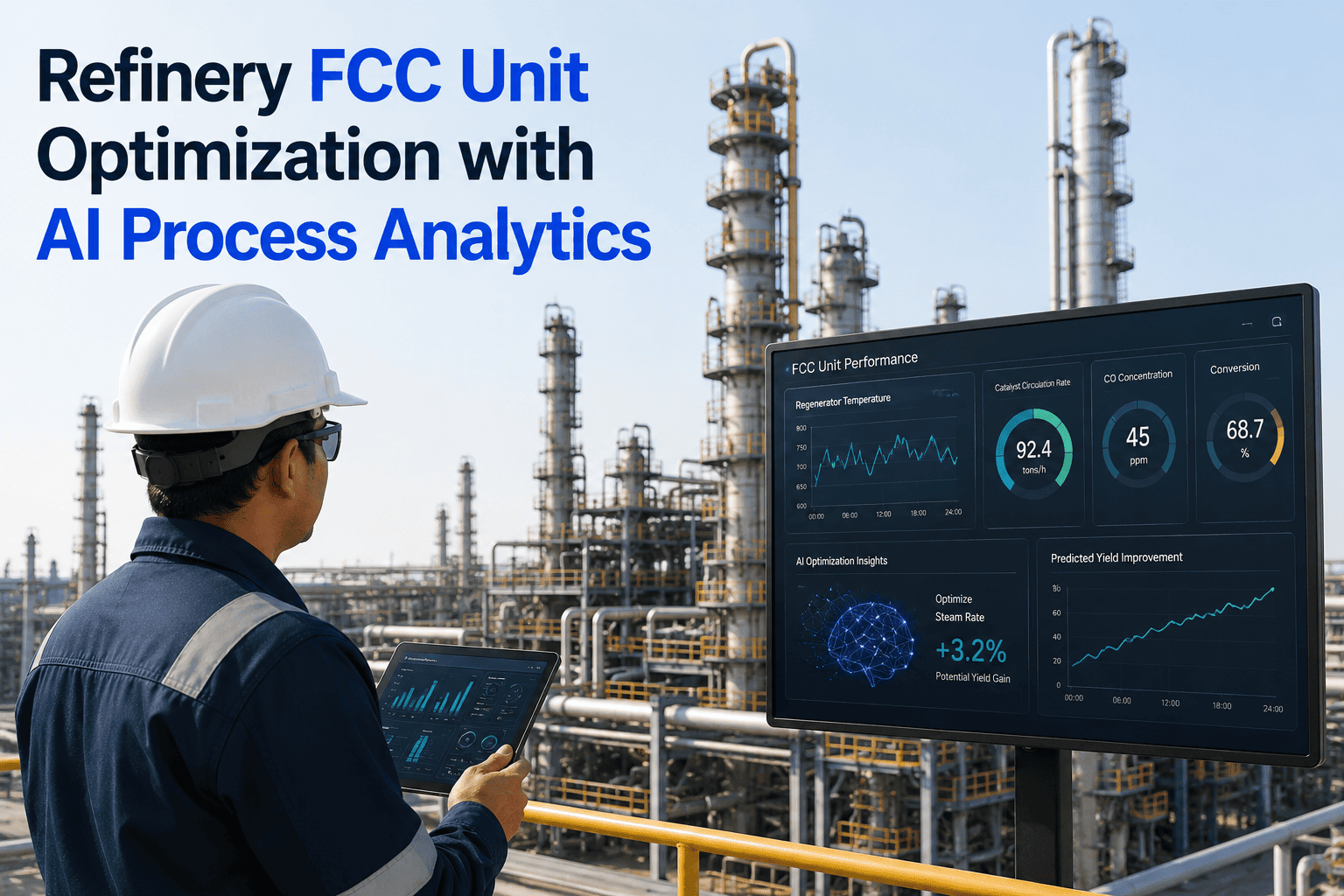
The fluid catalytic cracking unit is the highest-margin conversion process in most refineries — over 610 FCC units worldwide process more than 19 million barrels per day of feedstock, generating approximately 58% of the world's gasoline output. Yet even well-operated FCC units leave recoverable margin on the table because the process is inherently nonlinear: feed quality shifts alter cracking behavior and coke formation in ways that traditional advanced process control (APC) models approximate poorly, catalyst activity degrades continuously between additions, and competing process constraints — regenerator temperature, slide valve differential, wet gas compressor capacity, and environmental limits — interact in combinations that exceed the bandwidth of both APC and human operators. AI-driven process analytics trained on actual plant data capture these nonlinear interactions across reactor, regenerator, and fractionator in real time — closing the gap between achievable and actual yield, energy performance, and constraint handling that APC alone cannot reach. Book a Demo to see iFactory's AI process analytics running on FCC historian data.
Feed
Reactor
Regenerator
Fractionator
Products
Every FCC Has Recoverable Margin. AI Finds It.
iFactory's AI process analytics platform connects to your existing historian and DCS, learns the full nonlinear behavior of your specific FCC unit from years of operating data, and continuously optimizes yield, energy balance, and constraint navigation — in real time, across every feed campaign and catalyst age.
610+FCC units operating worldwide
19M bpdGlobal FCC feedstock processed
2–3%Yield boost from AI optimization
$0.10–0.50Per barrel margin improvement
The FCC Margin Gap: Why Your Unit Underperforms Its Capability
Every FCC unit has a theoretical yield frontier defined by its mechanical design, catalyst system, and feed slate. In practice, units operate well inside that frontier because APC maintains fixed safety margins around constraints, operators respond reactively to feed transitions rather than proactively adjusting severity, and the complex interactions between reactor-regenerator heat balance, catalyst circulation, and fractionator cutpoints are too nonlinear for traditional control models to optimize simultaneously. The gap between actual and achievable yield is recoverable margin — and for most FCC units, it represents millions of dollars per year.
Theoretical Design Yield
100%
Typical APC-Controlled Operation
91–94%
iFactory AI-Optimized Operation
97–99%
Illustrative yield frontier utilization. Actual margin recovery depends on unit design, feed variability, constraint profile, and current APC maturity.
Where Value Leaks in FCC Operations
FCC margin erosion is not caused by a single operating inefficiency — it results from the accumulation of small deviations across interconnected process variables that compound through the reactor-regenerator-fractionator system. Each of these value leak categories is addressable when the optimization model captures the full nonlinear dynamics of the unit rather than approximating them with linearized APC representations.
Feed Transition Lag
When crude slate or VGO quality changes, the FCC's cracking behavior, delta coke, and heat balance shift simultaneously. APC adjusts reactively — waiting for deviation before responding. AI models anticipate how feed property changes cascade through the reactor-regenerator system and adjust severity, catalyst circulation, and fractionator cutpoints proactively, reducing the transition period from hours to minutes.
Conservative Constraint Margins
APC maintains fixed safety offsets from regenerator temperature limits, slide valve differential pressure limits, and wet gas compressor capacity. These fixed margins are sized for worst-case conditions — meaning the unit operates conservatively under normal conditions when it could safely push closer to constraint limits. AI dynamically adjusts constraint proximity based on real-time process state, recovering the margin that fixed offsets sacrifice.
Catalyst Activity Estimation Drift
Catalyst activity declines continuously between additions and regeneration — but the rate of decline varies with feed metals content, operating temperature, and hydrothermal severity. APC models use a static catalyst activity assumption that drifts from reality between calibration updates. AI tracks effective catalyst activity in real time from process response data, adjusting severity targets and cat-to-oil ratio recommendations as activity changes.
Product Quality Giveaway
When the FCC operates independently from downstream blending economics, it produces gasoline octane well above blend targets and sulfur removal below blend limits — quality giveaway that represents excess processing severity converted into heat rather than margin. AI coordinates FCC severity with refinery-wide product slate targets, producing only the quality the blend pool actually needs.
Stop Leaving FCC Margin on the Table
iFactory's AI learns the complete nonlinear behavior of your FCC from years of historian data — then continuously optimizes yield, energy, and constraints in real time. No black-box models. Full operator visibility. Deployed on your network in 12 weeks.
APC vs. AI Process Analytics: What Changes for FCC Operations
Advanced process control has delivered significant value to FCC operations over the past three decades — reducing variability, managing constraint proximity, and enabling operators to run closer to targets. AI process analytics does not replace APC. It adds a layer of optimization intelligence that APC's linearized models cannot provide, addressing the nonlinear, time-varying, and multi-variable interactions that define FCC profitability.
| FCC Operating Challenge |
Traditional APC Approach |
iFactory AI Analytics |
| Feed Quality Changes |
Reacts after feed composition change is detected in process response — typically 2–6 hours lag |
Predicts impact of incoming feed properties on cracking severity, delta coke, and heat balance — adjusts proactively before deviation occurs |
| Constraint Navigation |
Fixed safety margins from regen temp, slide valve DP, and WGC limits — sized for worst-case, applied always |
Dynamic constraint proximity adjusted in real time based on current process state — safely recovers margin that fixed offsets sacrifice |
| Catalyst Activity Tracking |
Static activity parameter updated manually during model calibration — drifts between updates |
Continuous effective activity estimation from real-time process response — severity targets adjust as catalyst ages |
| Multi-Variable Optimization |
Linearized models optimize variables independently or in small groups — miss nonlinear interactions |
Deep learning models capture full nonlinear interactions across reactor, regenerator, and fractionator simultaneously |
| Downstream Coordination |
Optimizes FCC in isolation — unaware of downstream blend pool economics or alkylation feed needs |
Coordinates FCC severity with refinery-wide product targets — produces only the quality the blend pool requires |
AI Analytics Across the FCC Operating Envelope
iFactory's AI models are trained on your FCC unit's complete operating history — every feed campaign, catalyst age profile, seasonal condition, and upset recovery. The result is a continuously calibrated digital representation of how your specific unit behaves under your actual operating conditions, not generic industry assumptions.
01
Riser and Reactor Optimization
AI optimizes riser outlet temperature, cat-to-oil ratio, and feed preheat simultaneously — balancing conversion, delta coke, and dry gas make across the full reactor operating envelope as feed quality and catalyst activity change.
02
Regenerator Heat Balance
Continuous monitoring of regenerator temperature profile, CO/CO2 ratio, and catalyst circulation rate. AI predicts how delta coke changes will propagate through the heat balance and adjusts operating targets before regenerator limits are reached.
03
Fractionator Cutpoint Control
Main fractionator and gas recovery section cutpoints directly determine product distribution economics. AI adjusts reflux ratios, draw rates, and condenser duties to maximize the value of the cracked product slate against current market pricing.
04
Wet Gas Compressor Management
WGC capacity is the most common throughput-limiting constraint on FCC units. AI manages WGC loading dynamically — adjusting conversion severity and fractionator operation to maximize throughput without tripping the compressor or exceeding suction capacity.
05
Catalyst Performance Tracking
Effective catalyst activity, equilibrium metals level, and selectivity indicators are tracked from process response data — not periodic equilibrium catalyst samples alone. AI recommends catalyst addition rates and fresh/equilibrium blend ratios that optimize selectivity economics.
06
Energy and Emissions Optimization
Fired heater efficiency, air blower power, catalyst cooler duty, and CO combustion in the regenerator are optimized across the energy balance. AI identifies waste heat recovery opportunities and minimizes regen CO emissions without impacting coke burn capacity.
Turnkey On-Premise Deployment: AI on Your Historian in 12 Weeks
iFactory ships a pre-configured NVIDIA AI server — hardware and software bundled as a single turnkey appliance. Rack it in your refinery server room, connect power and Ethernet to your plant network, and the AI platform is live. No cloud dependency. The deployment scope covers historian connectivity, model training, operator dashboards, and 24/7 remote monitoring.
Weeks 1–3
Historian Integration and Data Baseline
NVIDIA AI server installed. Historian data connection established (OSIsoft PI, Honeywell PHD, Yokogawa Exaquantum). FCC unit tag mapping completed. 3–5 years of operating history ingested for model training. Baseline yield, energy, and constraint performance benchmarked.
Weeks 4–8
AI Model Training and Validation
Deep learning models trained on your FCC's actual operating data — every feed campaign, catalyst age, and constraint interaction. Models validated against known historical events and operator experience. Dashboard views configured for process engineers, shift supervisors, and management.
Weeks 9–12
Live Optimization and Continuous Learning
AI advisory recommendations go live — yield optimization, constraint navigation, and energy analytics in production. Models continuously retrain as new operating data flows in. 24/7 remote monitoring by iFactory process engineers. 1,000+ industrial clients. 99.9% platform uptime.
AI Process Intelligence in Conversation: What Your Operators See
FCC Process Engineer
We just switched to a heavier VGO feed from the vacuum unit — Conradson carbon is up 1.2 points. The board operator is seeing regen temp climbing toward the 1350F limit and is backing off severity. What does the AI recommend?
iFactory AI
The heavier VGO feed is increasing delta coke by 0.08 wt% — which will push regen bed temperature to 1347F within 90 minutes at current severity. Rather than reducing riser outlet temperature (which reduces conversion and gasoline yield by $14K/day), I recommend: increase catalyst cooler duty by 8% (you have 23% cooler capacity margin available), reduce feed preheat by 12F (shifts heat balance without reducing conversion), and increase cat-to-oil ratio by 0.3 (compensates for heavier feed crackability). These adjustments hold regen temperature at 1338F with 12F margin while maintaining 78.2% conversion — compared to the 74.6% conversion the board operator would achieve by backing off severity. Net margin difference: $41,000 per day retained at current product pricing. The heavier feed also increases bottoms yield by 0.4 vol% — I recommend adjusting fractionator HCO draw temperature to maximize slurry oil quality for the downstream blend.
Measured Impact: FCC AI Optimization ROI
Documented outcomes from refineries deploying AI-driven FCC optimization across the industry confirm that the margin recovery opportunity is both real and measurable. The results below reflect publicly reported improvements from refinery operators presenting at industry conferences and peer-reviewed publications.
Liquid Volume Yield Improvement
0.6%
Debutanizer Throughput Increase
2.0%
Diesel Flash Target Reduction
2.0 F
Sub-Optimal Coker Cycle Reduction
25%
Per-Barrel Margin Improvement
$0.10–0.50
Sources: Big West Oil (AFPM 2024), Delek US (AFPM Summit 2024), Marathon Petroleum Garyville (AFPM Summit 2024), Shell SHARC documentation.
Get a Turnkey FCC AI Quote — 12-Week Delivery
Pre-configured NVIDIA AI server, historian integration, deep learning model training on your FCC operating data, operator dashboards, and 24/7 remote monitoring. Rack it, plug it, optimize.
Expert Perspective: FCC Process Engineers on AI-Driven Optimization
Our 85,000 bpd FCC was running with a 15-year-old APC model that our process engineers recalibrated annually. It worked — it reduced variability and kept us away from constraints. But it also kept us away from the margin that sits near those constraints. iFactory's AI trained on five years of our historian data and identified that we were systematically over-cooling the regenerator during heavy feed campaigns — sacrificing 2.1% conversion to maintain a regen temperature margin we did not need under those specific conditions. The AI also found that our fractionator cutpoints were producing gasoline octane 1.8 numbers above blend requirement during 60% of operating hours — pure quality giveaway. In the first four months of advisory-mode operation, the AI recommendations recovered $0.34 per barrel in additional margin. On an 85K bpd FCC, that is $10.5 million annually. The APC still runs underneath — the AI sits on top, adjusting the optimization targets that APC executes. Our operators trust it because they can see exactly why the AI is making each recommendation and override anything that does not match their judgment.
FCC Unit Process Lead
U.S. Gulf Coast Refinery, 85,000 BPD FCC Capacity
Frequently Asked Questions
Does AI process analytics replace advanced process control (APC) on the FCC unit?
No. AI analytics operates as an optimization layer above APC, not a replacement for it. APC continues to execute control moves, manage regulatory loop performance, and handle constraint proximity at the DCS level. iFactory's AI adds a higher-level intelligence layer that adjusts the optimization targets APC works toward — accounting for the nonlinear, time-varying dynamics that APC's linearized models cannot capture. The two layers are complementary: APC provides fast, stable control execution while AI provides the optimal setpoint targets that maximize margin across the full operating envelope.
Book a Demo to see how AI layers onto your existing APC infrastructure.
What historian and DCS systems does iFactory connect to for FCC data?
iFactory integrates with all major process historians — OSIsoft PI, Honeywell PHD, Yokogawa Exaquantum, AspenTech InfoPlus.21, and any OPC-UA/DA compatible data source. DCS platforms including Honeywell Experion, Yokogawa CENTUM, Emerson DeltaV, and ABB 800xA are supported through standard OPC connectivity. The platform ingests 3–5 years of historical operating data for model training and then connects to the live historian feed for real-time optimization. No proprietary hardware or instrumentation changes are required — the AI works with the tags your historian already collects.
Contact our team to scope the data integration for your historian environment.
How does the AI model handle feed transitions and catalyst activity changes?
Feed transitions are handled proactively rather than reactively. When incoming feed properties change (detected from crude unit or vacuum tower operating data), the AI model predicts how those changes will cascade through delta coke, heat balance, and product distribution before the FCC's process response manifests — enabling preemptive severity and cutpoint adjustments that reduce transition losses from hours to minutes. Catalyst activity is tracked continuously from process response data — not periodic equilibrium catalyst samples — so the model always operates with the current effective activity rather than a stale calibration assumption.
Book a Demo to see feed transition prediction on your historian data.
Is the platform deployed on-premise and how long does full deployment take?
Yes — iFactory ships a pre-configured NVIDIA AI server that runs entirely on-premise inside your refinery network perimeter. All model training, real-time inference, and operator dashboards execute locally with zero cloud dependency. Full deployment from hardware installation to live AI advisory recommendations takes 12 weeks across three phases: historian integration and baseline (weeks 1–3), model training and validation (weeks 4–8), and live optimization with continuous learning (weeks 9–12). The platform supports air-gap operation for refineries with restricted OT network policies.
Contact our team to review the on-premise deployment architecture.
What ROI should a refinery expect from AI-driven FCC optimization?
Publicly reported results from U.S. refineries include 0.6% liquid volume yield improvement, 2% FCC debutanizer throughput increase, and per-barrel margin gains of $0.10–$0.50. For a 75,000 bpd FCC unit, even a conservative $0.15/bbl margin improvement generates $4.1 million in additional annual margin — payback on the deployment investment within the first 4–6 months. The specific return depends on your unit's current APC maturity, feed variability, constraint profile, and product pricing environment. Most refineries see the largest gains during feed transitions and when operating near multiple constraints simultaneously — exactly where APC's linearized models perform worst.
Book a Demo to build an FCC-specific ROI model using your historian data.
Your FCC Data Holds Millions in Recoverable Margin. AI Extracts It.
iFactory's AI process analytics platform learns the complete nonlinear behavior of your FCC from years of historian data — then continuously optimizes yield, energy performance, and constraint handling in real time. On-premise NVIDIA AI server. Live in 12 weeks.
Real-Time Yield Optimization
Dynamic Constraint Navigation
Feed Transition Prediction
On-Premise NVIDIA Server
12-Week Deployment