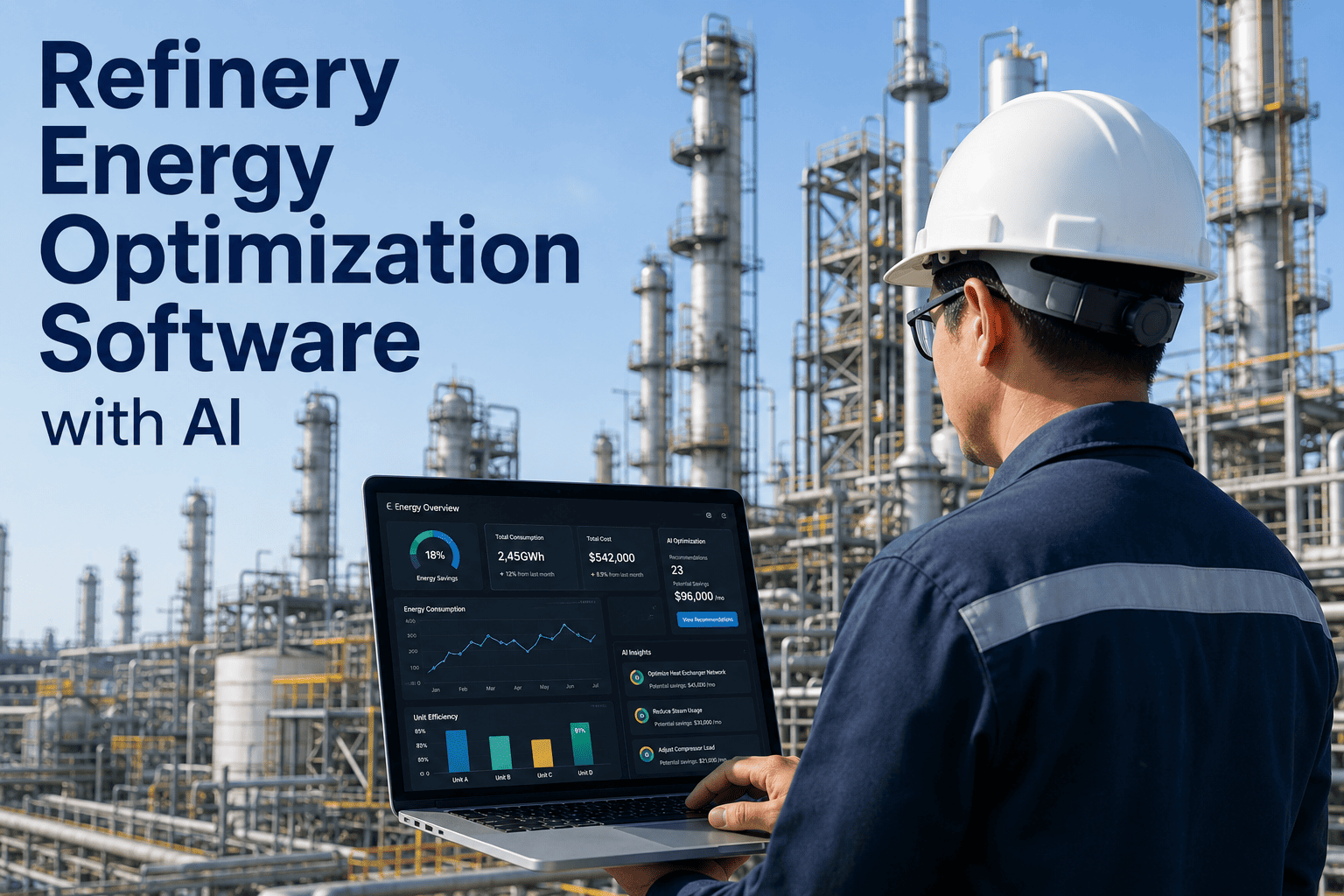
Refineries in the United States consume between 300,000 and 1.2 million BTU of primary energy per barrel of crude processed, with energy costs typically representing 30 to 50 percent of total non-crude operating expenditures. Despite decades of energy management programs, most refineries still operate with 15 to 25 percent more energy consumption than the thermodynamic minimum for their specific configuration and crude slate — not because the optimization opportunities are unknown, but because the opportunities are hidden in the interactions between process units, utility systems, and equipment operating conditions that change continuously with crude composition, ambient temperature, product demand, and equipment degradation. AI-powered energy optimization software identifies these dynamic opportunities by continuously analyzing process data against thermodynamic models and operational constraints, calculating the energy saving potential of specific adjustments to operating parameters, heat exchanger cleaning schedules, steam pressure levels, and compressor load distributions. Book a Demo to see how iFactory's AI energy optimization platform identifies and quantifies savings opportunities at your refinery.
Every Barrel of Crude You Process Carries 15 to 25 Percent Unnecessary Energy Cost — AI Finds It and Fixes It
iFactory's refinery energy optimization platform continuously analyzes process unit performance, steam system balance, compressor efficiency, and heat integration opportunities to identify and quantify real-time energy savings that static models and periodic audits cannot detect.
Where Refinery Energy Actually Goes — The Distribution That Drives Optimization Priorities
Understanding where energy is consumed across the refinery is the prerequisite for identifying where AI can have the greatest impact. The following breakdown represents the typical energy consumption distribution at a U.S. mid-size refinery processing a medium-sour crude slate. Each category represents a distinct optimization domain with different data sources, decision variables, and saving mechanisms that iFactory's AI models address with tailored analytical approaches.
Six Loss Mechanisms That Consume Millions in Unnecessary Energy — And How AI Detects Each One
The gap between actual and optimal energy performance at a refinery is driven by a set of recurring loss mechanisms that evolve over time as equipment degrades, operating conditions change, and the interactions between process units shift with crude slate and product demand. Each mechanism below represents a distinct analytical pattern that iFactory's AI models are designed to detect, quantify, and translate into specific corrective recommendations.
Heat Exchanger Fouling Degradation
Heat exchanger fouling reduces heat transfer efficiency progressively over weeks and months, increasing furnace fuel consumption to maintain target temperatures. The challenge is that fouling develops at different rates across hundreds of exchangers, and the energy penalty of each fouled exchanger depends on its position in the heat integration network. iFactory's AI monitors the heat duty and temperature approach of every exchanger in real time, calculates the incremental energy cost of fouling at each unit, and recommends the cleaning sequence that maximizes total energy recovery per cleaning dollar spent.
Steam System Imbalance and Venting
Refinery steam systems operate at multiple pressure levels that must be balanced continuously as process steam demand changes with unit throughput, ambient temperature, and equipment status. When the balance is lost, excess steam at one pressure level is either let down through pressure-reducing valves — wasting the energy difference — or vented to atmosphere — losing the entire enthalpy content. iFactory's AI monitors steam generation, consumption, and letdown flows across all pressure levels and identifies operating adjustments that reduce venting and letdown losses.
Compressor and Pump Inefficiency
Centrifugal compressors and pumps operate at efficiency points determined by the intersection of their performance curves with the system resistance curve. As process conditions change, the operating point shifts — often away from the best efficiency point. When multiple compressors or pumps operate in parallel, the load distribution between them may not match the most efficient combination for the current total flow requirement. iFactory's AI continuously calculates the optimal load distribution and identifies when a unit should be taken offline or brought online.
Suboptimal Furnace Air-to-Fuel Ratio
Fired heaters and boilers operating with excess oxygen above the optimal level lose energy through heating and exhausting unnecessary air volume through the stack. Operating below the optimal oxygen level risks incomplete combustion and CO formation. The optimal oxygen setpoint changes with furnace load, fuel composition, and burner condition. iFactory's AI continuously calculates the minimum safe oxygen target for each fired heater and recommends damper adjustments that maintain combustion safety while minimizing stack losses.
Missed Heat Integration Opportunities
When a refinery processes a different crude slate or changes product yields, the heat integration network that was optimized for the previous operating pattern may no longer be optimal. Hot streams that were previously matched with cold streams may now have excess heat that goes to cooling, while cold streams that were previously heated by process exchange may now require additional furnace duty. iFactory's AI continuously evaluates the current heat integration against the pinch analysis minimum and identifies stream matching adjustments that reduce external heating and cooling requirements.
Operating Margin Below Energy-Optimal Targets
Process units frequently operate at separation efficiencies or conversion levels above the energy-optimal target — producing marginally more product but at a disproportionately higher energy cost per incremental barrel. The energy-optimal operating point depends on the current value of incremental product versus the current cost of incremental energy, both of which change with market conditions. iFactory's AI calculates the energy-optimal operating target for each key process variable and displays the economic trade-off between product recovery and energy cost in real time.
How iFactory's AI Converts Raw Process Data Into Actionable Energy Savings Recommendations
The AI energy optimization pipeline operates as a continuous loop — ingesting process data, calculating performance deviations, quantifying energy cost impacts, evaluating corrective options, and delivering prioritized recommendations to operations teams. Each stage in the pipeline serves a distinct analytical function, and the output of each stage feeds the next to produce recommendations that are technically sound, economically justified, and operationally feasible.
Process Data Ingestion
Real-time process data is collected from the refinery DCS and historian systems — including temperatures, pressures, flow rates, compositions, and equipment operating parameters for every monitored process unit, utility system, and major equipment item. Data is validated against engineering limits and quality flags are applied to identify sensor drift, calibration issues, or communication failures before the data enters the analytical pipeline.
Performance Baseline Calculation
For each monitored equipment item and process unit, the AI calculates the current performance metric against a dynamic baseline that accounts for the current operating context — throughput, feed composition, ambient conditions, and equipment configuration. The baseline is not a fixed design value but a context-adjusted performance target derived from first-principles thermodynamic models calibrated to historical operating data.
Deviation Detection and Root Cause
When a performance metric deviates from the context-adjusted baseline by more than the configured threshold, the AI identifies the most probable root cause from a library of known loss mechanisms — fouling, imbalance, equipment degradation, suboptimal setpoint, or external condition change. The root cause identification uses pattern matching against historical cases supplemented by first-principles reasoning about the process physics.
Savings Quantification
For each identified deviation, the AI calculates the energy cost impact in dollars per hour, dollars per day, and projected dollars per month if the deviation persists. The calculation uses the current energy price — fuel gas cost, steam cost, or electricity rate — and accounts for any secondary effects such as increased emissions or reduced product yield that may result from the deviation or from the recommended correction.
Recommendation Delivery
Prioritized recommendations are delivered to the operations team through the iFactory dashboard and optional alert notifications — each recommendation includes the identified issue, the root cause, the quantified savings opportunity, the specific corrective action recommended, any constraints or risks associated with the action, and the estimated implementation effort. Recommendations are ranked by savings magnitude and implementation feasibility.
Energy Performance Benchmarks by Process Unit — What AI Optimization Targets at Each Refinery Unit
Each process unit in a refinery has a distinct energy consumption profile driven by the separation or conversion steps it performs, the thermodynamic properties of the streams it processes, and the design of its heat integration network. The table below presents the typical energy consumption ranges and AI-optimizable energy loss for the major process units at a U.S. refinery, providing the context for understanding where AI-driven optimization delivers the greatest return at each facility.
| Process Unit | Energy Intensity Range | Primary Energy Consumers | Typical AI-Recoverable Loss | Key AI Optimization Lever |
|---|---|---|---|---|
| Crude Distillation Unit | 80,000-150,000 BTU/bbl feed | Atmospheric furnace, vacuum furnace, pumparound circuits, reflux systems | 3-6% of unit energy | Heat exchanger network cleaning optimization, furnace air-fuel ratio control, pumparound heat recovery adjustment |
| Catalytic Reformer | 200,000-400,000 BTU/bbl feed | Reformer furnaces (charge and interheaters), compressor power, feed/effluent exchangers | 4-8% of unit energy | Furnace fuel optimization, feed-effluent exchanger fouling monitoring, recycle hydrogen compression efficiency |
| Fluid Catalytic Cracker | 120,000-250,000 BTU/bbl feed | Catalyst regeneration combustion air, wet gas compressor, main fractionator reboiler, slurry pumparound | 3-7% of unit energy | Regenerator air rate optimization, wet gas compressor load balancing, heat recovery from flue gas and slurry |
| Hydrocracker | 300,000-600,000 BTU/bbl feed | Charge heater, recycle gas compressor, fractionation reboilers, product air coolers | 4-9% of unit energy | Charge heater optimization, recycle hydrogen compression efficiency, reaction heat integration, air cooler fan control |
| Distillate Hydrotreater | 100,000-200,000 BTU/bbl feed | Charge heater, recycle gas compressor, product stripper reboiler, effluent cooling | 3-5% of unit energy | Charge heater optimization, heat integration between reactors and fractionation, cooling system adjustment |
| Alkylation Unit | 150,000-300,000 BTU/bbl feed | Refrigeration compressor power, feed and product chillers, deisobutanizer reboiler | 5-10% of unit energy | Refrigeration compressor staging and load optimization, chiller efficiency monitoring, ambient-dependent cooling adjustment |
| Delayed Coker | 250,000-500,000 BTU/bbl feed | Coker heaters, fractionator reboiler, steam injection, quench system | 3-6% of unit energy | Heater coil outlet temperature optimization, fractionator heat recovery, steam injection rate adjustment for coke quality |
| Sulfur Recovery Unit | 50,000-120,000 BTU/bbl equivalent | Thermal stage burner fuel, tail gas incinerator fuel, amine reboiler steam | 2-4% of unit energy | Air demand optimization for Claus reactors, tail gas incinerator temperature control, amine regeneration steam reduction |
Your Refinery Is Paying 15 to 25 Percent More for Energy Than the Thermodynamic Minimum — AI Identifies Exactly Where and How to Recover It
iFactory's energy optimization AI continuously monitors your process units, steam systems, compressors, and heat exchanger networks to find savings opportunities that static energy balances and periodic audits miss. Book a demo and see the AI analyzing live refinery process data to identify and quantify energy reduction opportunities in real time.
Steam System Optimization — The Highest-ROI Energy Opportunity at Most Refineries
The refinery steam system is typically the second-largest energy consumer after process heating, and it is often the least-optimized major energy system because its performance depends on the real-time balance between steam generation and consumption across multiple pressure levels, multiple generating units, and dozens of consumption points that change continuously with process operating conditions. iFactory's AI monitors the complete steam system as an integrated network rather than as isolated components, identifying optimization opportunities that are invisible when each boiler, turbine, and letdown station is managed independently.
Quantified Energy Savings From AI-Powered Refinery Optimization Deployments
The following metrics represent outcomes from iFactory's AI energy optimization deployments across refinery process units and utility systems. Each saving reflects a sustained reduction in energy consumption measured over a 12-month period after the AI recommendations were implemented, validated by the refinery's energy management team using standard energy balance methodology and metered fuel, steam, and electricity data.
Energy Optimization Is Carbon Reduction — The Emissions Impact of AI-Driven Energy Savings
Every BTU of energy saved at a refinery directly reduces CO2, NOx, and CO emissions from combustion sources — furnaces, boilers, and gas turbines. In the current regulatory environment where EPA is tightening greenhouse gas reporting requirements, states are implementing carbon pricing mechanisms, and investors are demanding emissions reduction roadmaps, the carbon reduction co-benefit of AI energy optimization has become a primary driver of executive investment decisions alongside the direct energy cost savings.
Common Questions About AI-Powered Refinery Energy Optimization Software
AI Energy Optimization Turns the Energy Cost You Are Already Spending Into a Source of Competitive Advantage
The energy that refineries waste through fouled heat exchangers, imbalanced steam systems, suboptimal compressor loading, and missed heat integration opportunities is not a fixed cost of doing business — it is a recoverable cost that exists because the optimization opportunities are too numerous, too dynamic, and too interdependent for manual analysis to track. Every day that a refinery operates without AI-driven energy optimization, it is spending 15 to 25 percent more on energy than the thermodynamic minimum for its current operating conditions — and the gap widens as equipment degrades, crude slates change, and ambient conditions shift.
iFactory's AI energy optimization platform closes this gap continuously by monitoring the complete energy system — process heating, steam generation and distribution, electrical drives, refrigeration, and heat integration — and delivering prioritized, quantified, constraint-checked recommendations that operations teams can implement within their existing decision-making workflows. The result is sustained energy reduction of 3 to 8 percent, annual cost savings of $8 to $25 million at a typical mid-size refinery, and carbon emission reductions of 30,000 to 50,000 tons CO2e per year — all without capital investment in new equipment. Book a Demo to see iFactory's AI energy optimization platform analyzing live refinery process data and identifying savings opportunities in real time.
Your Refinery's Energy Bill Includes Millions of Dollars in Recoverable Costs That Manual Methods Cannot Find — AI Can
iFactory's energy optimization AI continuously monitors every major energy consumer at your refinery, calculates the gap between actual and optimal performance, and delivers specific recommendations to close that gap with quantified savings in dollars per hour. Book a demo and see the AI identifying energy reduction opportunities at your refinery today.