AI Digital Twin for Refinery Operations Optimization
By Johnson on July 2, 2026
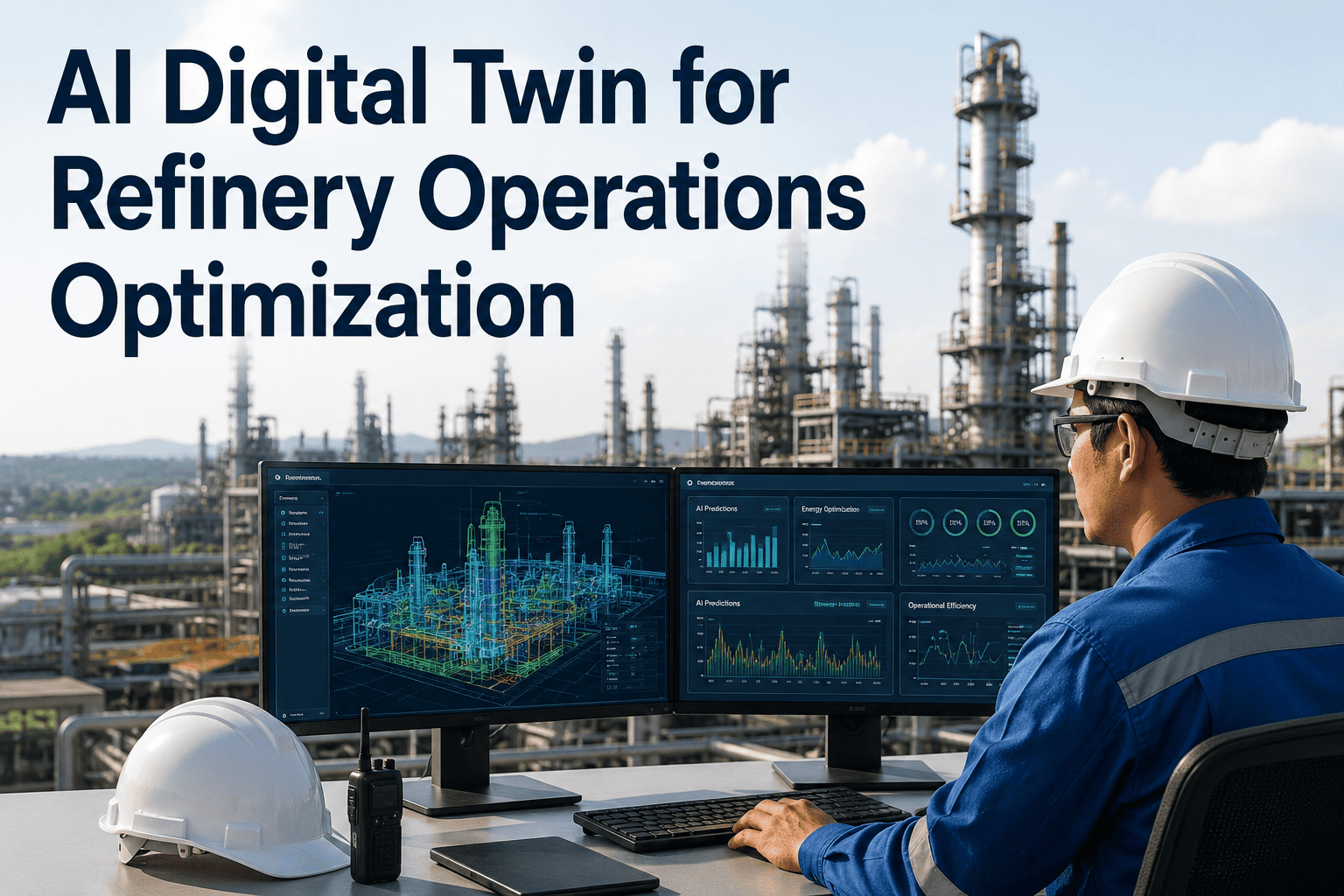
A refinery is not a single machine — it is a tightly coupled network of distillation columns, reactors, heat exchangers, compressors, and utilities where every operating decision in one process unit ripples across throughput, energy balance, product slate, and asset health in every other unit. Optimizing any one variable in isolation — crude blend, reactor severity, column reflux, or turnaround timing — without modeling the system-wide consequences leaves margin on the table and creates constraint violations that operators discover only after they hit. An AI digital twin models the entire refinery as a living, continuously updated virtual facility — synchronized with real-time SCADA, historian, and DCS data — so that operations, planning, and reliability teams can simulate what-if scenarios, predict constraint violations, optimize energy consumption, and schedule maintenance interventions before they impact throughput. Book a Demo to see iFactory's AI digital twin running on refinery process data.
Your Refinery. Modeled in Real Time. Optimized by AI.
iFactory's AI digital twin ingests live process data from every unit in your refinery — crude distillation, FCC, hydrocracker, reformer, sulfur recovery, utilities — and builds a continuously calibrated virtual plant that mirrors actual operating conditions. Simulate crude blend changes, debottleneck process constraints, predict equipment degradation, and optimize energy consumption across the entire facility from a single platform.
Digital twin market in oil and gas (2025), projected to reach $3.11B by 2033
7.3%
OEE improvement measured across refinery digital twin deployments
18%
Reduction in unplanned downtime at facilities using AI-driven digital twins
5.1%
Decrease in specific energy consumption versus traditionally operated refineries
317%
5-Year ROI from Digital Twin Deployment
25–55%
Maintenance Cost Reduction Across Implementations
Under 18 Mo
Typical Payback Period for Refinery-Scale Digital Twins
50%
Oil and Gas Operators Adopting Digital Twins by 2026
What an AI Digital Twin Actually Does Inside a Refinery
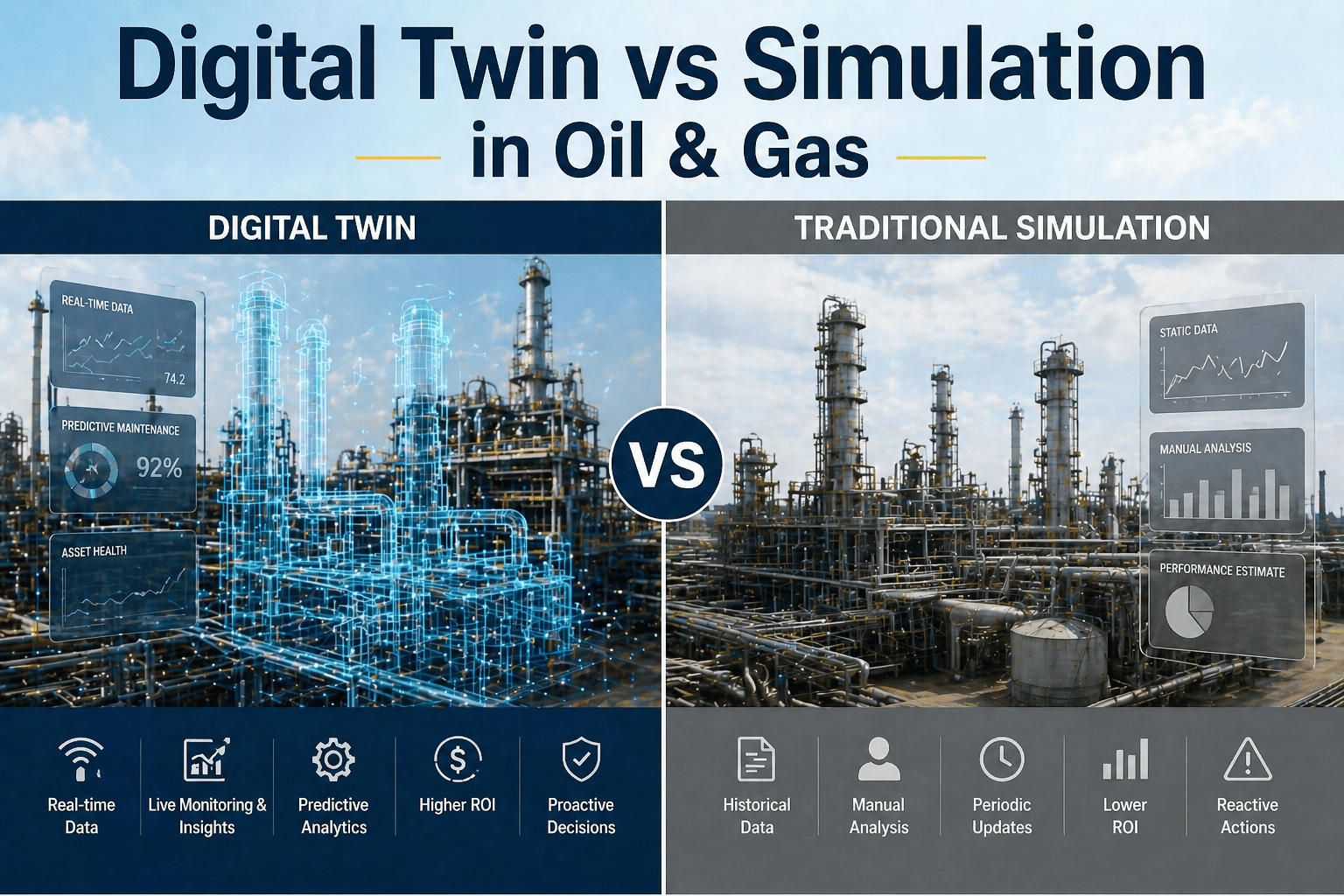
A digital twin is not a static process simulation or a 3D visualization dashboard. It is a continuously calibrated, data-driven model of your physical refinery that updates in real time from live sensor feeds — learning how your specific equipment behaves under your actual operating conditions, not generic textbook assumptions. The AI layer transforms this living model from a monitoring tool into a decision engine that identifies optimization opportunities, predicts constraint violations, and recommends operating adjustments before margin is lost.
Real-Time Process Calibration
The twin continuously reconciles its thermodynamic and kinetic models against live DCS data — column temperatures, reactor conversions, heat exchanger duty, compressor performance curves. When the physical plant drifts from model prediction, the AI recalibrates automatically, maintaining less than 1% deviation between virtual and actual operating state across all major process units.
What-If Scenario Simulation
Before changing crude blend, adjusting reactor severity, modifying column cutpoints, or rerouting product streams, operators run the scenario on the digital twin first. The AI models the full system-wide impact — energy balance, product yield, constraint proximity, equipment stress, and emissions — in minutes rather than the hours or days that offline simulation tools require.
Constraint Prediction and Avoidance
Refinery throughput is limited by whichever constraint binds first — column flooding, reactor temperature limit, compressor capacity, cooling water availability, or environmental permit. The digital twin forecasts when each constraint will bind under current operating trajectory and recommends the minimum adjustment to avoid the bottleneck without sacrificing throughput or margin.
Energy and Emissions Optimization
Heat integration, furnace efficiency, steam balance, and flare minimization are optimized across the entire facility simultaneously — not unit by unit. The AI identifies waste heat recovery opportunities, excess steam letdown that can be redirected, and furnace draft adjustments that reduce fuel gas consumption without impacting process throughput or product quality.
From Physical Plant to AI Intelligence: How the Data Flows
iFactory's digital twin architecture is built on a four-layer data pipeline that transforms raw sensor signals into actionable refinery-wide intelligence. Each layer adds context, validation, and analytical capability — ensuring that the optimization recommendations reaching your operations team are grounded in verified, reconciled process data rather than raw tag values.
Layer 1
Physical Plant Sensors
Temperature, pressure, flow, level, vibration, and analytical instrument signals from DCS, SCADA, and condition monitoring systems. Thousands of tags streaming at 1-second to 1-minute intervals across every process unit, utility system, and rotating asset.
Layer 2
Data Reconciliation Engine
Mass and energy balance reconciliation across unit boundaries. Gross error detection flags faulty instruments. Missing data imputation fills gaps from redundant measurements. The result is a clean, balanced dataset that eliminates the inconsistencies that cause static simulation tools to diverge from reality.
Layer 3
AI Digital Twin Model
Hybrid first-principles and machine learning models calibrated to your refinery's specific equipment characteristics, catalyst activity, fouling rates, and operating envelope. Continuously retrained as conditions evolve — not a snapshot frozen at commissioning.
Layer 4
Optimization and Decision Engine
AI-driven recommendations delivered to operations, planning, and maintenance teams through role-based dashboards. Scenario simulation, constraint forecasting, energy optimization, and asset health predictions — all running on the same unified digital twin model.
See Your Refinery in Digital Twin Resolution
iFactory builds a continuously calibrated virtual replica of your entire refinery — crude unit through product blending — synchronized with live process data and optimized by AI. No cloud dependency. No months of custom modeling. Live on your network in 12 weeks.
Six Refinery Optimization Use Cases Powered by the Digital Twin
The digital twin is not a single application — it is an optimization platform that serves multiple refinery functions simultaneously. Each use case draws from the same unified model, eliminating the data silos and conflicting recommendations that arise when separate point solutions operate on disconnected data.
Crude Blend Optimization
Simulate crude slate changes against the full refinery model before committing to cargo purchases. Predict yield shifts, energy impact, unit constraint proximity, and product quality across every downstream process unit — identifying the blend that maximizes margin, not just crude acquisition cost.
Throughput Debottlenecking
Identify which constraint is actually limiting refinery throughput at any given moment — column hydraulics, reactor metallurgy limits, compressor capacity, or utility availability — and simulate the operating adjustments or capital investments that relieve the binding constraint with the highest margin return per dollar spent.
Energy Network Optimization
Model the refinery's full energy network — fired heaters, steam system, heat exchangers, cooling water — as an integrated system. Identify waste heat recovery opportunities, optimize furnace excess air, rebalance steam headers, and minimize letdown losses across the entire facility in real time.
Asset Health and Turnaround Planning
Track equipment degradation — heat exchanger fouling, catalyst deactivation, compressor efficiency decay, column tray damage — and predict when performance loss justifies intervention. Optimize turnaround scope and timing against production economics rather than calendar schedules.
Product Quality Prediction
Predict final product properties — octane, sulfur, pour point, flash point — from upstream operating conditions in real time. Detect quality excursions before they reach the blend header, reducing off-spec product giveaway and reprocessing costs that erode refining margin.
Emissions Forecasting and Compliance
Model refinery-wide emissions — SOx, NOx, CO2, flaring events — as a function of operating decisions. Forecast environmental permit proximity and simulate operating adjustments that maintain compliance without throttling throughput, turning emissions management from a reactive constraint into an optimized variable.
Turnkey On-Premise AI: Rack It, Plug It, Model It
iFactory ships a pre-configured NVIDIA AI server — hardware and software bundled as a single turnkey appliance purpose-built for refinery digital twin workloads. Rack it in your refinery server room, connect power and Ethernet, and the digital twin platform is live on your plant network with zero cloud dependency. The deployment scope covers cabling, network integration, DCS/historian data bridging, PLC/SCADA connectivity, operator training, and 24/7 remote monitoring support.
Weeks 1–3
Infrastructure and Data Integration
NVIDIA AI server installed on-premise. Historian (OSIsoft PI, Honeywell PHD, Yokogawa Exaquantum), DCS, and SCADA data connections established via OPC-UA. Process unit hierarchy mapped. Baseline operating envelopes configured from historical data. No new field instrumentation required.
Weeks 4–8
Twin Calibration and Model Training
Digital twin models calibrated against live plant data. AI learns your refinery's specific equipment characteristics, catalyst activity profiles, fouling rates, and seasonal operating patterns. What-if scenario engine validated against known historical events. Role-based operator dashboards configured.
Weeks 9–12
Live Optimization and Continuous Learning
Digital twin goes live in production with real-time optimization recommendations, constraint forecasting, and energy analytics. Models continuously retrain as operating conditions evolve. 24/7 remote monitoring by iFactory's process engineering team. Full handover with ongoing model performance reporting.
Turnkey Appliance Includes
Pre-configured NVIDIA AI server — racked, cabled, ready to power on
On-premise deployment — zero cloud dependency for real-time inference
DCS, historian, and SCADA integration via OPC-UA/DA connectors
Operator training and 24/7 remote monitoring support
1,000+ industrial clients globally with 99.9% platform uptime
Digital Twin Intelligence in Conversation: What Your Team Sees
iFactory's digital twin delivers optimization intelligence through a natural language interface that operations engineers, process planners, and reliability leads can query directly — no data science expertise required. The AI responds with specific, quantified recommendations tied to your refinery's live operating state.
Process Planning Engineer
We have an opportunity crude cargo — 60,000 barrels of heavy sour at a $4.50 discount to WTI. If we blend it at 15% of throughput, what happens to our FCC yield, sulfur recovery load, and energy balance?
iFactory Digital Twin
At 15% blend ratio, the digital twin projects: FCC gasoline yield drops 1.8% due to higher residue feed, but FCC bottoms upgrade value increases net margin by $0.32/bbl. Sulfur recovery unit load increases 11% — within current SRU capacity but reduces your environmental permit margin from 14% to 6%. Fired heater duty on CDU increases 3.2% from heavier crude preheat requirements, adding $18,400/day in fuel gas cost. Net recommendation: the cargo is margin-positive at $0.87/bbl net after energy and SRU load adjustments, but only if processed within the next 21 days — beyond that, catalyst deactivation on your FCC shifts the breakeven. I recommend running a 10% blend ratio scenario as well, which keeps SRU permit margin above 10%.
Measured Impact: Digital Twin ROI at Refinery Scale
Research across 150+ refinery digital twin implementations quantifies the financial return. The numbers below reflect peer-reviewed and industry-reported outcomes from refineries ranging from 50,000 to 500,000 barrels per day capacity — demonstrating that the digital twin ROI case holds across facility scale, geographic region, and crude slate complexity.
7.3%
OEE Improvement
Overall Equipment Effectiveness gain measured at full-scale digital twin sites versus traditionally operated refineries of comparable capacity and complexity.
18%
Downtime Reduction
Unplanned downtime reduction from predictive asset health monitoring, constraint forecasting, and optimized turnaround planning integrated into the digital twin.
5.1%
Energy Savings
Specific energy consumption decrease through AI-optimized heat integration, furnace efficiency, steam balance, and waste heat recovery across the full energy network.
25–55%
Maintenance Cost Reduction
Range varies by refinery scale — small refineries achieve 25–30% reduction while mega-refineries (500K+ bpd) achieve 50–55% through condition-based intervention timing.
317%
5-Year ROI
Calculated from $52.3M annual OPEX reduction against total deployment investment, with payback period under 18 months at a major European refinery case study.
12–36 Mo
Average Payback Period
ROI timeline across 150+ implementations. Mega-scale refineries achieve 1.4-year payback with NPV exceeding $132M over the investment lifecycle.
Get a Turnkey Digital Twin Quote — 12-Week Delivery
Pre-configured NVIDIA AI server, historian and DCS integration, process model calibration, operator training, and 24/7 remote monitoring. Your entire refinery modeled, calibrated, and optimized by AI — live on your network in 12 weeks.
Expert Perspective: Refinery Operations Leaders on AI Digital Twin Deployment
We had been running LP models updated quarterly and offline Aspen simulations that took two engineers a week to recalibrate after every crude switch. The gap between the model and the actual plant was always wide enough that operators stopped trusting the recommendations. iFactory's digital twin calibrates against live DCS data continuously — the deviation between the twin and the physical plant stays under 1% on every major process variable. In the first six months, the scenario simulation engine identified a crude blend adjustment that increased our gross refining margin by $1.40 per barrel, and the energy optimization module reduced our fired heater fuel gas consumption by 4.3% without touching throughput. The process planning team now runs what-if scenarios in minutes instead of days, and the operations team trusts the recommendations because they can see the twin tracking the plant in real time. We recovered the full deployment cost in under 14 months.
VP of Refinery Operations
Mid-Continent U.S. Refinery, 145,000 BPD Capacity
Frequently Asked Questions
What is an AI digital twin for refinery operations and how does it differ from traditional process simulation?
A traditional process simulator (Aspen Plus, PRO/II, Petro-SIM) is an offline, steady-state model that requires manual recalibration after every significant operating change. An AI digital twin is a continuously calibrated, real-time virtual replica of your physical refinery that updates automatically from live DCS and historian data. The AI layer adds predictive capability — forecasting constraint violations, optimizing energy balance, predicting equipment degradation, and recommending operating adjustments in real time rather than after the fact. The twin learns your specific equipment behavior and catalyst activity, not textbook assumptions. Book a Demo to compare live digital twin output against your current simulation tools.
Which refinery process units does iFactory's digital twin model?
iFactory models the full refinery process chain — crude distillation (atmospheric and vacuum), fluid catalytic cracking, hydrocracking, catalytic reforming, hydrotreating, alkylation, isomerization, sulfur recovery, hydrogen generation, utilities (steam, cooling water, power), and product blending. Each unit model is calibrated to your specific equipment design, catalyst type, and operating constraints. The twin also models inter-unit heat integration and utility balance, ensuring that optimization recommendations account for system-wide energy and material flow impacts rather than optimizing individual units in isolation. Contact our team for a unit coverage assessment specific to your refinery configuration.
Does the digital twin require cloud connectivity or can it run entirely on-premise?
iFactory's digital twin runs entirely on-premise on a pre-configured NVIDIA AI server installed inside your refinery network perimeter. Real-time inference, scenario simulation, optimization recommendations, and operator dashboards all execute locally with zero dependency on external cloud infrastructure. This architecture meets the cybersecurity, data sovereignty, and air-gap requirements of refinery IT/OT environments. Remote monitoring by iFactory's process engineering team uses a secure, encrypted VPN tunnel configurable to your facility's network security policies — and can be disabled entirely if your security posture requires full air-gap operation. Book a Demo to review the on-premise deployment architecture.
How long does deployment take and what existing infrastructure does it connect to?
Full deployment from hardware installation to live optimization recommendations takes 12 weeks across three phases. iFactory integrates with your existing process historian (OSIsoft PI, Honeywell PHD, Yokogawa Exaquantum, AspenTech InfoPlus.21), DCS platforms (Honeywell Experion, Yokogawa CENTUM, Emerson DeltaV, ABB 800xA), and SCADA systems via OPC-UA or OPC-DA connectivity. No new field instrumentation is required for initial deployment — the platform works with the sensors and data infrastructure your refinery already has in place. Contact our team to scope a deployment plan for your specific historian and DCS environment.
What ROI should a refinery expect from deploying an AI digital twin?
Research across 150+ refinery implementations shows average payback periods of 12–36 months, with maintenance cost reductions of 25–55%, energy consumption decreases of 5–8%, and OEE improvements of 5–7%. A peer-reviewed case study at a major European refinery documented $52.3M annual OPEX reduction and 317% ROI over five years. The specific return depends on refinery capacity, crude slate complexity, current optimization maturity, and operating margin sensitivity — but even at conservative assumptions, most deployments achieve full payback within the first 18 months from avoided downtime and energy savings alone. Book a Demo to build an ROI model calibrated to your refinery's specific operating economics.
Your Refinery Has the Data. iFactory Turns It Into Decisions.
iFactory's AI digital twin models every process unit, energy stream, and equipment asset in your refinery — calibrated against live data, optimized in real time, and deployed on-premise in 12 weeks. Stop running offline simulations that are stale before they finish. Start operating with a continuously learning AI twin that sees what your operators cannot.
Real-Time Process TwinWhat-If Scenario EngineEnergy OptimizationOn-Premise NVIDIA Server12-Week Deployment