Refineries across the USA, Canada, UK, and Australia are losing 12–18% of productive capacity every year to equipment failures that could have been predicted — and prevented. Crude distillation units cycling through forced shutdowns, heat exchangers fouling undetected, compressors degrading under seasonal load swings, and furnace tube failures triggering unplanned outages that cost millions in lost throughput. The data to predict every one of these failures already exists inside DCS historians, SCADA systems, and maintenance records. The gap is not data availability. It is the absence of a continuously learning AI model trained to find failure signatures before they escalate into production loss. iFactory Digital Twin for Refineries closes that gap — creating virtual replicas of every critical asset, fusing live sensor telemetry with historical operational data, and forecasting failure events 1–8 weeks before they occur. Trusted by 500+ oil and gas facilities globally, iFactory delivers predictive maintenance, digital twin simulation, real-time asset health monitoring, and automated CMMS work order generation in a single platform deployed in 8 weeks. Book a Demo to see how iFactory deploys digital twin monitoring across your refinery operations within 8 weeks.
What Is a Digital Twin for Refineries — and Why It Changes Everything
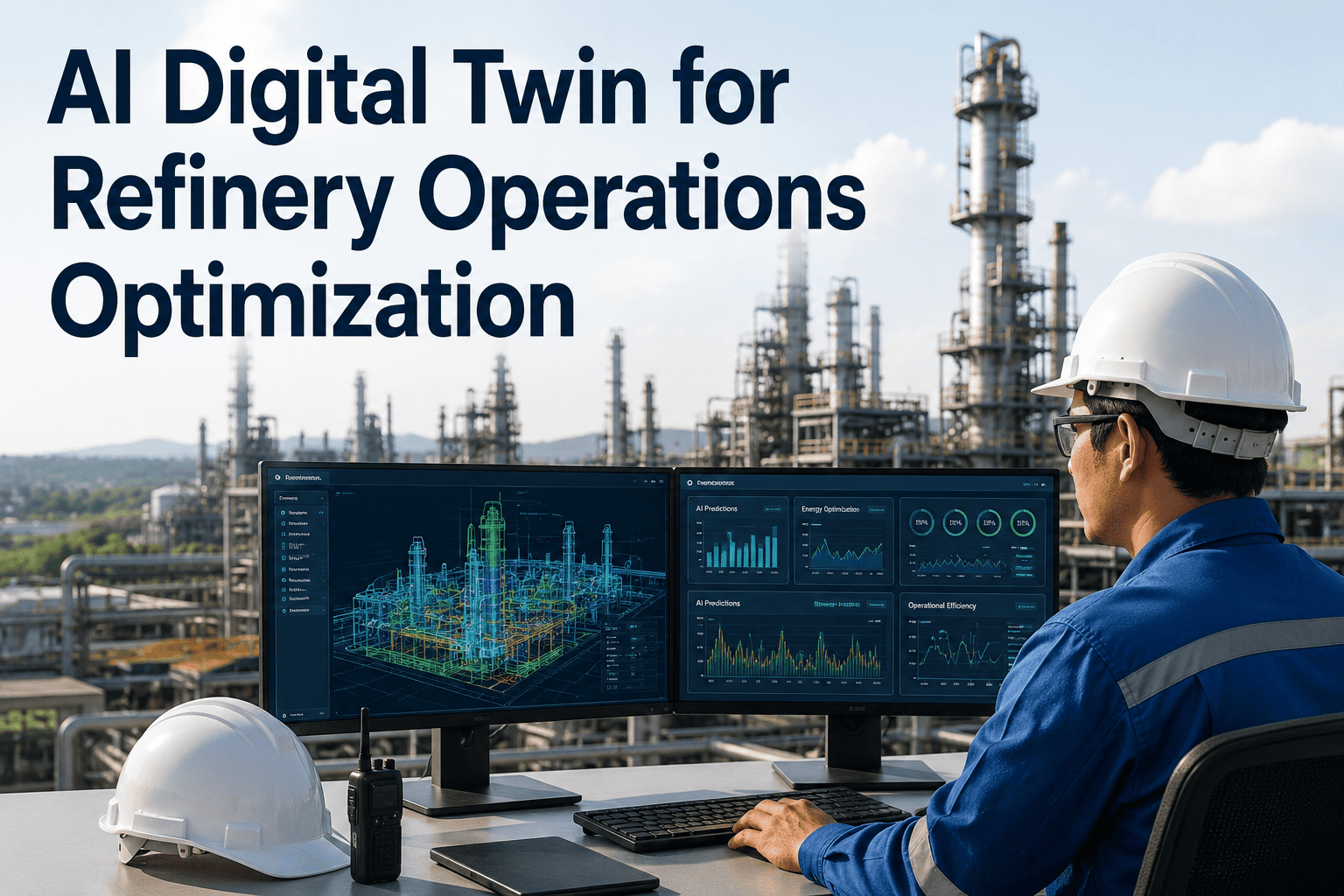
A digital twin is a continuously updated virtual replica of a physical asset — a crude distillation unit, a reactor, a heat exchanger network — that mirrors real-world performance in real time using live sensor data, operational telemetry, and AI-trained degradation models. Unlike static SCADA dashboards that report what has already happened, a digital twin forecasts what is about to happen based on multi-parameter trend analysis across vibration signatures, thermal profiles, pressure excursions, and flow anomalies simultaneously.
For refineries, this distinction is critical. A single forced shutdown of a crude distillation unit can cost $500,000 to $2 million in lost throughput, emergency repairs, and regulatory exposure. Calendar-based maintenance schedules treat every asset identically regardless of actual condition — over-servicing low-stress equipment while missing early degradation in high-load units. iFactory's digital twin platform eliminates this blind spot by training asset-specific ML models on your refinery's own historical failure data, operational records, and DCS archives — producing failure forecasts that reflect your facility's unique degradation physics, not a generic industry average. Refineries that want to see this in action can Book a Demo to walk through a live platform demonstration.
iFactory Digital Twin Platform: Core Modules for Refinery Operations
iFactory does not apply generic condition monitoring logic to refinery assets. It trains asset-specific machine learning models on your facility's own historian data, DCS archives, and confirmed failure events — producing a continuously improving predictive engine that understands your refinery's unique degradation signatures, seasonal load patterns, and feedstock-dependent failure modes. The platform is structured around six integrated modules that work together across the entire refinery asset envelope.
Refinery Asset Classes: Digital Twin Performance by Equipment Type
iFactory's digital twin platform covers the full refinery asset envelope — from rotating equipment and fired heaters to electrical systems and process columns. The following performance data reflects aggregated outcomes from live deployments at downstream refineries across the USA, Canada, UK, and Australia.
| Asset Class | Primary Failure Modes Detected | Prediction Lead Time | Cost Avoidance (Annual) |
|---|---|---|---|
| Crude Distillation Units | Furnace tube fouling, tray flooding, reboiler degradation, column flooding onset | 3–6 weeks | $210K–$380K per unit |
| Rotating Equipment (Compressors, Pumps) | Bearing wear, seal degradation, impeller imbalance, cavitation onset, rotor misalignment | 2–5 weeks | $140K–$260K per facility |
| Fired Heaters and Furnaces | Tube skin temperature excursions, coking signatures, combustion efficiency decline, refractory degradation | 3–8 weeks | $180K–$320K per unit |
| Heat Exchangers | Fouling factor escalation, thermal efficiency loss, tube bundle degradation, bypass valve drift | 2–4 weeks | $90K–$160K per train |
| Electrical Assets (Transformers, Switchgear) | Insulation degradation, partial discharge escalation, breaker wear, protection system drift | 4–8 weeks | $120K–$200K per facility |
| Cooling Water and Utilities | Tower performance degradation, pump cavitation, biofouling escalation, flow balance anomalies | 1–3 weeks | $60K–$110K per facility |
Reliability teams looking to quantify digital twin ROI for a specific asset class can Book a Demo and walk through a site-specific failure scenario with the iFactory engineering team.
iFactory vs. Generic Condition Monitoring: What Refineries Are Actually Comparing
Most refinery reliability teams evaluating predictive analytics platforms encounter three categories of tool: OEM-bundled condition monitoring packages, standalone vibration dashboards, and enterprise asset management suites with bolt-on analytics modules. iFactory is built differently — training asset-specific digital twin models on your refinery's own historian data rather than applying generic industry templates. Here is how the comparison looks in practice.
| Capability | Generic Condition Monitoring Tools | iFactory Digital Twin Platform |
|---|---|---|
| Model Training Approach | Generic industry templates applied to all assets. No site-specific training on your refinery's failure history or operational load profiles. | ML models trained exclusively on your facility's PI Historian, DCS archives, and confirmed failure events — reflecting your refinery's actual degradation physics. |
| Failure Forecasting | Reactive threshold alerts after breach. No probabilistic failure window forecasting or remaining useful life estimation. | 1–8 week failure probability forecasts per asset with urgency tiers, confidence scores, and recommended intervention timelines attached to every alert. |
| Scenario Simulation | No simulation capability. Changes to throughput or operating regime require live trial on physical equipment. | Full scenario simulation against digital twin asset models before operational commitment — test feedstock switches, load ramps, and shutdown sequences virtually. |
| Multi-Parameter Correlation | Single-sensor or dual-parameter monitoring. Compound degradation signatures across vibration, thermal, pressure, and electrical parameters are invisible. | Simultaneous correlation of 200+ sensor parameters per asset with false positive rate held below 3.5% through multi-stream cross-validation. |
| CMMS Integration | Standalone dashboards or manual alert exports. No native work order generation or parts procurement automation. | Native OPC-UA and REST connectors for SAP PM, Maximo, Infor EAM, and Oracle EBS. Auto-generates prioritised work orders with failure evidence packages on alert. |
| Deployment Timeline | 6–18 months for configuration, integration, and validation. High engineering overhead and open-ended implementation scope. | 8-week fixed deployment: data audit in weeks 1–2, pilot model in weeks 3–4, plant-wide rollout by week 8. Integration and team training included. |
| Continuous Improvement | Static models with periodic vendor updates. No learning loop from your confirmed failure events or maintenance outcomes. | Every maintenance event and failure confirmation feeds back into the ML training pipeline — increasing prediction accuracy by 12% per 6-month retraining cycle. |
Proven Results: KPIs from Live Refinery Deployments
iFactory's digital twin platform delivers measurable reliability and cost improvements within the first 60 days of full production rollout. The following KPIs reflect aggregated performance data from downstream refineries across the USA, Canada, UK, and Australia operating crude distillation, fluid catalytic cracking, hydrotreating, and gas processing units.
Financial Impact by Refinery Asset Class
Beyond maintenance cost reduction, iFactory's digital twin platform directly protects refinery throughput revenue and eliminates the compounding costs of reactive asset management — quantified below by asset class from live downstream refinery deployments.
Expert Review: What Refinery Reliability Engineers Say
The following review is from a head of reliability engineering at a crude refinery currently running iFactory's digital twin platform in the southeastern United States.
Conclusion: Your Refinery's Failure Data Already Exists. iFactory Makes It Work.
Every refinery operating today has years of historian data, DCS archives, and maintenance records that contain the precursor signatures of every past equipment failure. That data sits idle — not because it is unavailable, but because there has been no AI model trained to extract the patterns that matter before they escalate into forced shutdowns. The gap between world-class refinery reliability and the industry average is not a technology gap. It is a gap in what gets done with the data that already exists.
iFactory's digital twin platform closes that gap in eight weeks. Asset-specific ML models trained on your refinery's own sensor data, continuous model retraining that improves accuracy with every confirmed failure event, automated CMMS work order generation, and 1–8 week failure prediction lead times — deployed across full refinery asset envelopes without disrupting operations. The 34% reduction in unplanned downtime, 89% reduction in emergency maintenance spend, and 47% asset life extension are outcomes already measured at live downstream refinery deployments. Refineries ready to activate their existing data can Book a Demo with iFactory's refinery analytics team to see a site-specific platform demonstration.