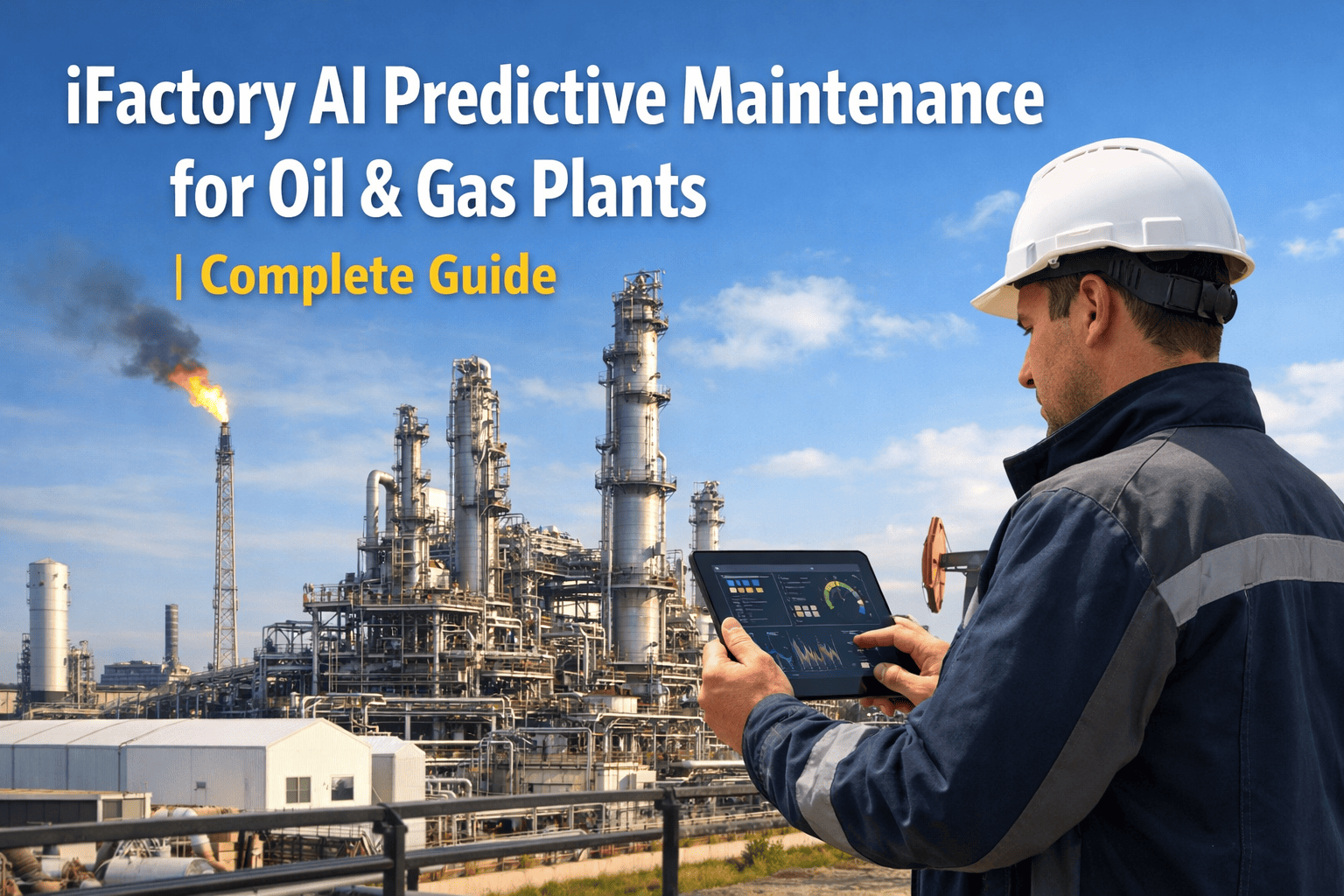
A mid-size oil and gas processing facility operating a gas compression train, crude separation units, and a network of centrifugal pumps across two process trains was losing an estimated 340 production hours annually to unplanned equipment failures. Despite a functioning CMMS and a structured PM program, rotating equipment failures between scheduled maintenance intervals were generating downtime events that the existing system had no mechanism to prevent. After deploying iFactory AI's predictive maintenance and digital twin platform, the facility achieved a 35% reduction in total unplanned downtime within the first 10 months — recovering production capacity, reducing emergency maintenance costs, and establishing a condition-based reliability program that continued to compound in performance improvement quarter over quarter.
A High-Throughput Gas Processing Operation With a Growing Reliability Problem
Why a Functioning CMMS Was Not Enough to Prevent Rotating Equipment Failures
The facility's CMMS was compliant, well-maintained, and actively used. PM schedules were followed. Inspection records were current. And yet the plant was still absorbing 34 unplanned downtime events per year — because 62% of rotating equipment failures in oil and gas occur in the interval between scheduled maintenance inspections, not at or near scheduled PM windows. The CMMS managed the maintenance calendar. It had no mechanism to monitor the actual condition of assets operating between those calendar events. Each failure that occurred mid-campaign was, from the CMMS perspective, an unexpected event — even though the physical degradation leading to it was a predictable, detectable process that had been building for days or weeks before the failure threshold was crossed. Book a Demo to see how iFactory AI closes this gap across your specific asset base.
iFactory AI Predictive Maintenance: Converting Existing Historian Data Into Asset Health Intelligence
The facility evaluated four industrial AI platforms before selecting iFactory AI based on its proven deployment methodology in midstream gas processing environments, its ability to connect directly to the existing OSIsoft PI historian without new sensor infrastructure, and its digital twin modeling capability for centrifugal compressor performance degradation — the highest-consequence failure mode in the plant's asset portfolio. The platform was configured to monitor 47 critical assets across both process trains, with differentiated monitoring depth assigned by asset criticality classification. To understand how iFactory AI structures historian-connected deployments for oil and gas operations, Book a Demo with the iFactory industrial analytics team.
From Historian Connection to First Predictive Alerts in 6 Weeks — No Production Interruption
All 47 target assets inventoried and criticality-ranked by failure consequence, historical failure frequency, and production throughput dependency. iFactory AI connected to the OSIsoft PI historian via read-only API integration — no changes to the existing DCS or SCADA configuration. 1,200+ active PI tags mapped to asset-level equipment models. Integration validated against 18 months of available historical process data to confirm data quality and tag coverage for each monitored asset class.
Asset-class ML models trained on the 18-month historical dataset to establish equipment-specific operating baselines for each compressor, pump, heat exchanger, and turbine unit. Operating regime classification configured to account for the facility's variable throughput profile across seasonal demand cycles — ensuring anomaly detection sensitivity was calibrated to distinguish genuine equipment degradation from normal process variation. Digital twin performance models configured for both gas turbine drivers using OEM performance curve data.
iFactory AI platform transitioned to live predictive alerting mode on Day 34 for the 12 highest-criticality assets. First condition-based maintenance alert generated on Day 38 — a bearing temperature deviation pattern on Compressor Train 1, Unit 3, flagged 22 days before predicted failure threshold. Maintenance team trained on alert interpretation, work order generation workflow, and dashboard navigation. Alert severity scoring and escalation protocols configured to integrate with existing shift supervisor communication chain.
Full 47-asset monitoring coverage live by Week 8. iFactory AI maintenance recommendation queue integrated with the facility's existing CMMS via API — enabling AI-generated work orders pre-populated with asset tag, failure mode, recommended action, estimated repair window, and required parts list to flow directly into the CMMS planning workflow. First condition-based compressor bearing replacement completed in Week 9 during a planned 6-hour weekend window — confirmed early-stage inner race spalling that would have caused unplanned failure within 12–18 days.
10 Months of Measured Performance Data: 35% Downtime Reduction and $2.1M in Avoided Costs
The shift from reactive CMMS-based maintenance to iFactory AI condition monitoring produced measurable, documented improvement across every tracked reliability metric within the first two post-deployment quarters. Unplanned downtime events fell from 34 per year to 22 per year — a 35% reduction. Total production hours lost to unplanned maintenance declined from 340 to 196 annually. And the compressor bearing and seal failure events that had driven 58% of prior downtime were reduced by 71% through predictive replacement scheduling. The financial impact was documented at $2.1M in avoided downtime cost — excluding the additional savings from emergency parts cost elimination and overtime labor reduction. Book a Demo to model what equivalent performance improvement would be worth at your facility's production economics.
| Performance Metric | Before iFactory AI | After iFactory AI | Improvement |
|---|---|---|---|
| Unplanned downtime events per year | 34 events | 22 events | −35% reduction |
| Total unplanned production hours lost | 340 hrs/yr | 196 hrs/yr | −144 hrs recovered |
| Compressor bearing/seal failure events | ~20 per year | 6 per year | −71% failure events |
| Mean time to detect equipment anomaly | Post-failure (reactive) | 18–28 days pre-failure | Predictive detection window |
| Emergency parts procurement events | ~41 per year | 9 per year | −78% emergency orders |
| Overall equipment effectiveness (OEE) | ~81% | ~89% | +8 percentage points |
| Annual avoided downtime cost | — | $2.1M | Documented avoided cost |
| Full ROI payback period | N/A | 9 months | Full cost recovery |
Why the 35% Downtime Reduction Was Achievable — and Why It Continues to Compound
The existing historian infrastructure contained the data needed to prevent most failures — it simply had no analytics layer to interpret it. The facility's OSIsoft PI historian had been collecting high-fidelity vibration, temperature, pressure, and flow data continuously across all critical assets. iFactory AI's value was not in generating new data but in connecting that existing data stream to an ML anomaly detection engine purpose-built for rotating equipment failure modes in oil and gas. The deployment required no new sensors in 82% of monitored assets — the necessary signal was already present in the historian and had been there for years.
Digital twin modeling transformed turbine performance monitoring from threshold alerting to genuine condition understanding. Fixed threshold alarms — the standard in DCS-managed gas turbine monitoring — alert when a parameter crosses a hard limit, by which point the degradation is advanced. iFactory AI's digital twin performance model for the gas turbine drivers compared actual compressor efficiency and turbine heat rate against the physics-based design envelope in real time, detecting efficiency losses from blade fouling accumulation that allowed the operations team to optimize online wash scheduling by 40% — reducing fouling-related performance losses before they were visible to conventional process monitoring.
Predictive maintenance prioritization gave the 12-person maintenance team the forward visibility to eliminate the reactive workload that had consumed the majority of their capacity. Prior to iFactory AI deployment, the team was allocating an estimated 65% of total maintenance labor hours to reactive response — arriving at failures already in progress, sourcing emergency parts, and executing unplanned repairs under time pressure. iFactory AI's ranked work order queue gave planners a 14–28 day forward maintenance horizon, enabling scheduled parts procurement, optimized crew assignments, and planned repair windows aligned with production schedule low points — recovering an estimated 840 hours of maintenance labor annually from reactive work to planned preventive activity.
Condition-based heat exchanger management eliminated emergency cleaning events that had been causing unplanned process train derates. Fixed-interval cleaning schedules were misaligned with actual fouling rates, which varied significantly with feedgas composition and ambient temperature across seasonal operating cycles. iFactory AI's fouling rate monitoring identified when each unit's heat transfer efficiency was approaching the threshold that would require a forced cleaning — enabling scheduled cleaning coordination with process operations that avoided the throughput restrictions imposed by emergency cleans executed without a planned production window available.
Operational, Financial, and Contractual Outcomes Beyond Downtime Reduction
Industry Perspective: What AI Predictive Maintenance Changes at the Reliability Level
From Reactive to Predictive: The Compounding Value of AI Condition Monitoring in Oil & Gas
This midstream gas processing facility's 35% downtime reduction was not the result of equipment replacement, facility expansion, or headcount addition. It was the result of connecting an existing, fully operational historian data infrastructure to an AI analytics platform that could extract the predictive maintenance signal that was already present in the data — and had been present for years before the deployment. The $2.1M in documented avoided downtime cost is a direct financial outcome of that connectivity. The 71% reduction in compressor bearing and seal failures is an equipment reliability outcome. The recovery of 144 annual production hours is a throughput outcome. And the improvement in pipeline nomination compliance is a commercial relationship outcome that opens contract renegotiation opportunities the prior reliability profile would not have supported.
iFactory AI's predictive maintenance and digital twin platform is deployed across 500+ oil and gas facilities globally — from upstream wellpad compression to midstream processing and downstream refinery rotating equipment. Each deployment connects to existing historian and SCADA infrastructure, requires no new sensor hardware in the majority of asset coverage, and generates first predictive alerts within 6 weeks of integration. To assess what a comparable deployment would deliver for your oil and gas facility's specific production economics and asset reliability profile, Book a Demo with the iFactory AI industrial analytics team.