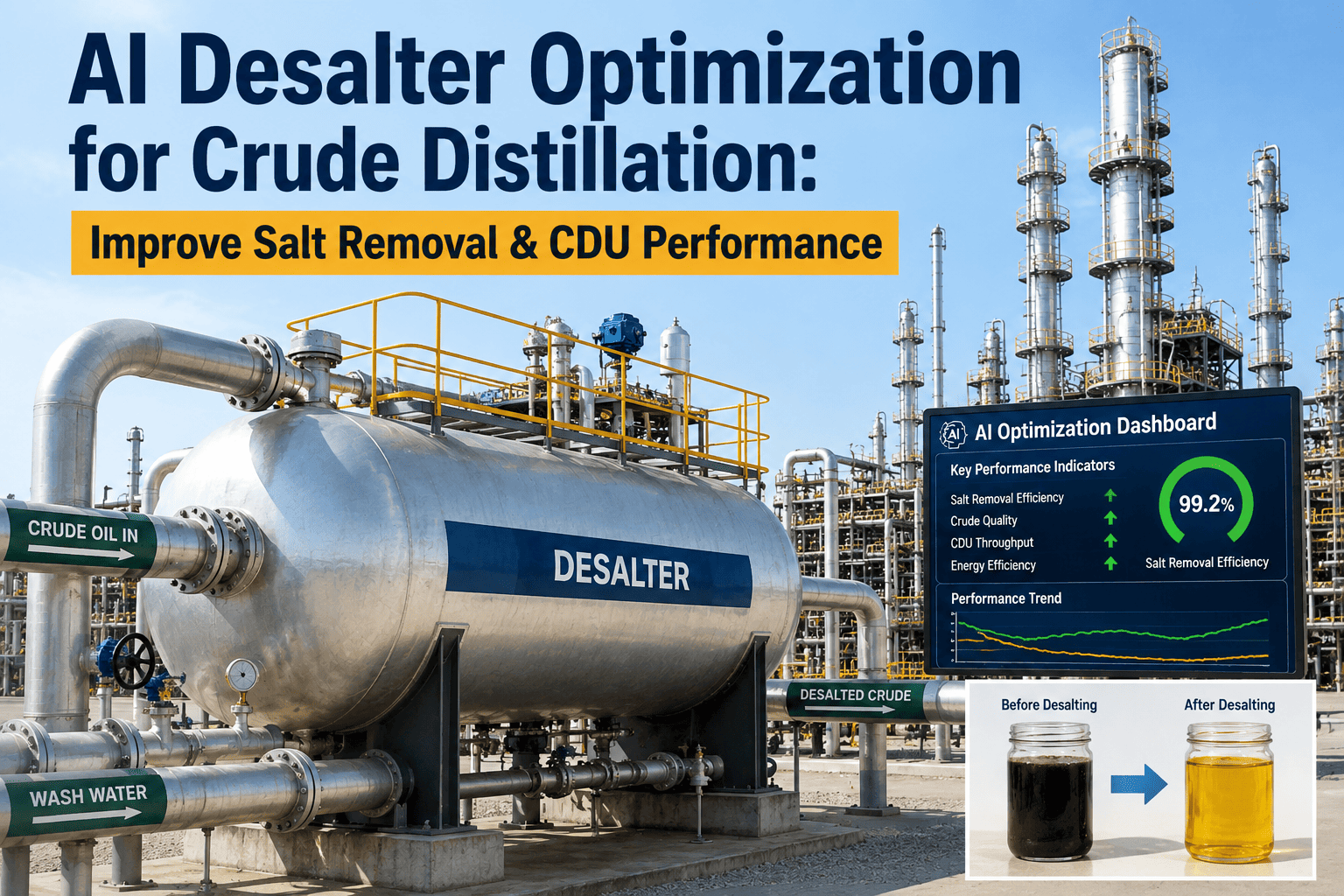
Every crude assay that hits the lab already tells you something the planning model will not update until tomorrow's run: the cut points you are holding right now are probably wrong for the crude actually flowing through the column. Not wildly wrong, just wrong enough. A half a percent of distillation yield lost to a conservative cut point sounds trivial until you multiply it across a two hundred thousand barrel per day slate, where that sliver of giveaway erases tens of millions of dollars a year in product value nobody ever sees on a shift report. The crude distillation unit is the largest energy consumer in the refinery and the unit with the most historian data sitting unused, which is exactly why it is where a CDU optimization demo tends to show the fastest and clearest payback.
Your Linear Program Set the Plan. Reality Changed an Hour Later.
Crude composition, ambient conditions, fouling state, and product demand all drift continuously, but most CDUs are still run against a plan built once a day. Independent studies estimate roughly a quarter of the energy consumed across US petroleum refineries could be recovered with better-implemented process technology, and the crude unit sits at the top of that opportunity list.
Where the Margin Actually Goes on a Crude Unit
None of this shows up as a single line item. It is scattered across conservative temperature cushions, a cut point held wider than it needs to be, and a furnace burning slightly more fuel than the current crude blend actually requires. Individually each one looks negligible. Added up across a full year of operation, they are usually the largest recoverable margin in the plant.
typical distillation yield giveaway from conservative cut points on a standard crude slate
of refinery energy use estimated recoverable with fully implemented optimization technology, per US DOE analysis
typical payback window reported for closed-loop AI optimization on fired heaters and distillation columns
estimated annual cost of unplanned industrial downtime, a large share tracing back to conservative operating margins
Where AI Actually Touches the Column, Draw by Draw
The optimization model does not manage the unit as one black box. It reads live historian data at every draw and furnace, learns how your specific column behaves as crude and rates shift, and continuously nudges setpoints within the same operating envelope your board already approved. Here is what changes at each part of the tower.
Reflux rate is trimmed continuously against real vapor-liquid behavior instead of a fixed ratio, holding naphtha spec tighter without over-refluxing the column.
Draw temperature and stripping steam are adjusted together as crude cut shifts, protecting flash point spec while releasing product that a fixed cut point would have held back.
Cut point and pumparound duty are optimized jointly, since moving one without the other is exactly where manual operation tends to leave the largest giveaway on the table.
Coil outlet temperature and air-to-fuel ratio are optimized against the actual crude slate in the furnace right now, not the slate the plan assumed this morning.
Stop Running the Column on Yesterday's Assay
See how continuous AI optimization reads your live historian data and recommends setpoints that track the crude actually in the column, not the plan built for it last night.
Daily LP Planning vs Continuous AI Optimization
A linear program is still the right tool for deciding which crude to buy and what the plant-wide target should be. The gap it leaves is between that daily plan and the minute-by-minute reality of the column, which is exactly the layer continuous optimization is built to close.
| What Changes | Daily LP Plan Alone | LP Plus Continuous AI Optimization |
|---|---|---|
| Update frequency | Once per day, sometimes less on stable slates | Continuous, recalculated as historian data streams in |
| Response to crude slate change | Held until the next planning cycle | Recognized and compensated for within minutes |
| Operating cushions | Fixed conservative margins to cover uncertainty | Adjusted based on actual, measured column behavior |
| Cut point and reflux coordination | Set independently, often leaving giveaway | Optimized jointly against real-time constraints |
| Energy consumption basis | Static targets from the last calibration | Live air-fuel and duty adjustments per current slate |
Four Levers That Move Together, Not in Isolation
Throughput, yield, energy, and quality are usually managed as four separate conversations across four different teams. Continuous AI optimization treats them as one coupled problem, because moving one without the others is exactly how refineries end up trading a yield gain for a quality giveaway somewhere downstream.
Throughput
Column and furnace constraints are tracked in real time so rate can be pushed closer to the true limit instead of a fixed conservative ceiling.
Yield
Cut points are optimized against the actual crude in the column, recovering the giveaway that a fixed daily plan leaves on the table.
Energy
Furnace duty, reflux, and pumparound rates are tuned continuously against the current slate rather than a static specific-energy target.
Quality
Product specs are held tighter to the true limit instead of an oversized cushion, converting quality giveaway into on-spec product value.
How It Sits on Top of the DCS You Already Run
Nothing about this requires ripping out your control system or your LP planning tool. The optimization layer reads from what already exists and writes recommendations, or closed-loop setpoints once trust is established, back into the same environment your operators already work in.
Historian and lab data flow into the model continuously: temperatures, flows, pressures, crude assay results, and product quality readings.
The model learns your specific column's behavior across crude slates, ambient conditions, and equipment condition, rather than applying a generic distillation formula.
Recommendations are surfaced to operators first in advisory mode, with the reasoning behind each one visible rather than delivered as a black-box number.
Once agreement with operators is established, setpoints write directly to the DCS in a closed loop, continuously re-optimizing as conditions change.
What a Phased CDU Rollout Typically Delivers
iFactory recommends starting with the crude unit and the steam system, since the CDU carries the largest energy footprint and the richest historian data of any unit in the refinery, and the steam system touches every other unit downstream.
Operators validate model recommendations against experience before any closed-loop control begins
Reflux, cut points, and furnace duty write directly to the DCS, re-optimizing continuously
Second phase, since it affects every downstream unit and typically shows the fastest payback
Later phases align cut points and blend targets across units to capture margin isolated optimization misses
Refinery Engineer Perspective
We had been holding a wider naphtha cut point for years because that is what the plan called for and nobody had a reason to question it. Once the model showed us the real margin sitting in that cushion, we recovered it within the same operating limits we already had approval for. Nothing about our safety case changed. The only thing that changed was how tightly we were willing to run against it.
— Process Optimization Lead, Mid-Continent Refinery
Frequently Asked Questions
Does this replace our linear program or planning team?
No. The linear program still decides which crudes to buy and sets the plant-wide production target, and your planning team's judgment on those calls is not something a continuous optimization layer replaces. What changes is the gap between that daily plan and how the column actually runs minute to minute, which is where AI closes the loop that a once-a-day plan cannot. You can book a CDU optimization demo to see exactly how the two systems work together on your unit.
How does the model handle a crude slate it has never seen before?
The model is trained on your full historian across the range of crude slates your unit has already processed, so it generalizes reasonably well to blends within that range. For a genuinely new crude, the system flags reduced confidence and defers more heavily to operator judgment and conservative defaults until enough operating data accumulates to extend the model with confidence.
Do operators lose control once the system moves to closed loop?
No. Every deployment starts in advisory mode, where recommendations are shown alongside the reasoning behind them and operators decide whether to act. Closed-loop control is only enabled after that trust is established, and operators retain override authority at all times. This phased approach is deliberate, since a refinery team that has not seen the model's reasoning validated has no reason to trust its setpoints.
Why start with the crude distillation unit instead of a downstream conversion unit?
The CDU is typically the single largest energy consumer in the refinery and has the most complete historian data of any unit, which means the model has the richest signal to learn from and the largest energy base to optimize against. Downstream units like the FCC or reformer are strong candidates for a second or third phase once the approach is validated and trusted on the crude unit.
What is a realistic payback timeline for a CDU optimization pilot?
Closed-loop AI optimization on fired heaters and distillation columns is commonly reported to pay back within about twelve months, though the exact timeline depends on your current operating margins, crude slate variability, and how conservative your existing cushions are. The iFactory support team can build a savings estimate specific to your unit before you commit to a pilot scope.
The Margin Was Never Missing. It Was Just Held Back
Every refinery already has the historian data needed to see this margin. What is usually missing is a model watching that data continuously enough to tell the difference between a cushion that is protecting the unit and a cushion that is simply leftover conservatism nobody has revisited. The crude distillation unit is where that gap is largest and the data is richest, which is exactly why it is the unit refineries start with when they decide to close it.
Ready to See What Your CDU Is Actually Capable Of?
Book a walkthrough of the CDU Optimization demo and see how continuous AI turns your existing historian data into recovered throughput, yield, and energy margin.