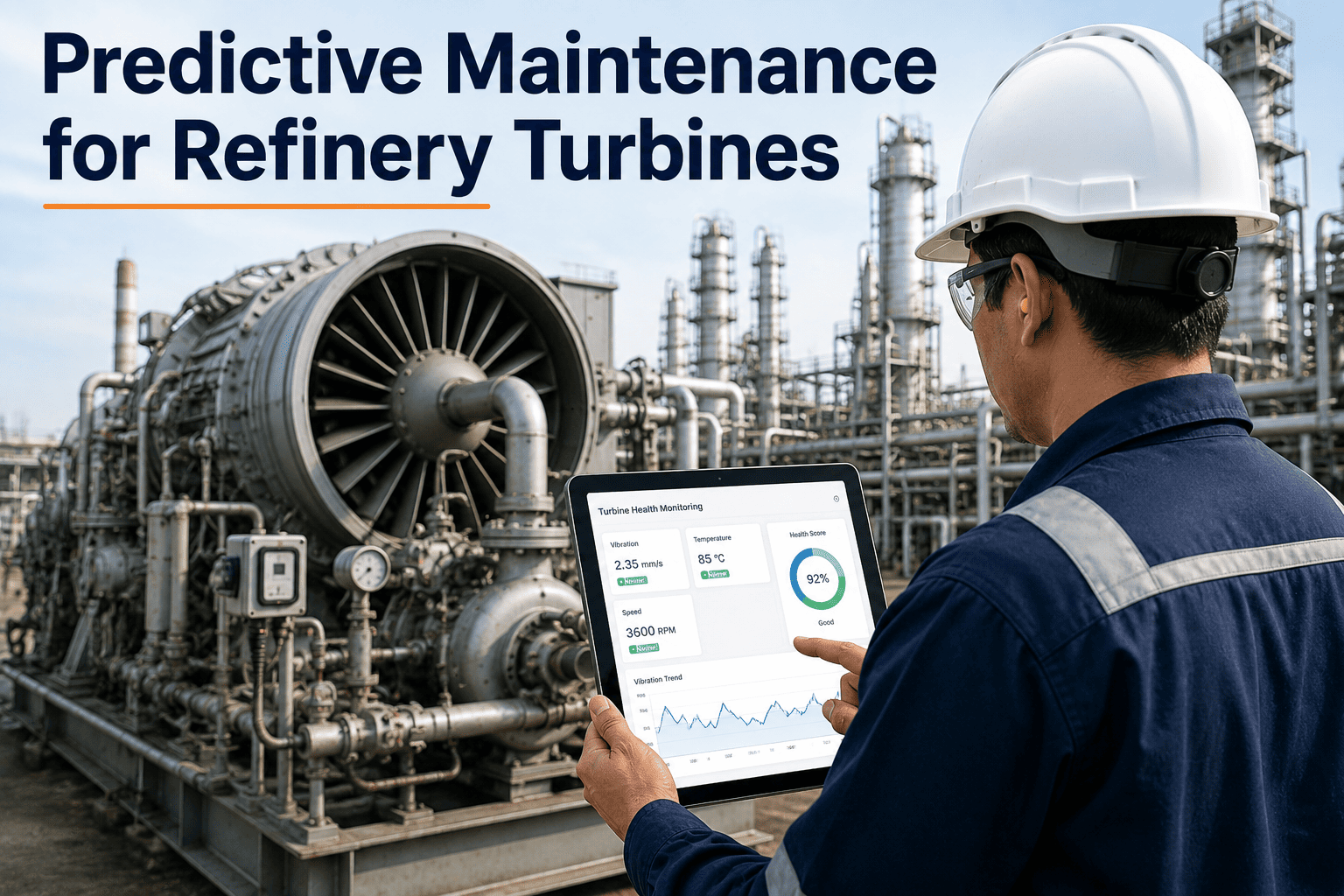
Predictive Maintenance for Refinery Turbines

By Johnson on July 3, 2026

predictive-maintenance-refinery-turbines

Refinery turbines — steam turbines driving process compressors, generators, and pumps, plus gas turbines in cogeneration service — represent the highest-consequence rotating equipment in any petroleum refinery. A single unplanned turbine outage can force a partial or total unit shutdown costing two to five million dollars per day in lost production, while the repair timeline for major turbine damage routinely extends from weeks to months depending on parts availability and rotor shop capacity. Most refineries monitor turbine vibration and bearing temperatures, but threshold-based alarm systems consistently detect degradation only after it has progressed beyond the point where a controlled shutdown can prevent consequential damage. AI-driven predictive maintenance changes this by learning each turbine's normal operating signature and detecting subtle deviations in vibration patterns, thermal performance, and lube oil condition weeks before threshold alarms activate. Book a demo to see how iFactory models your turbine fleet's degradation trajectories.

$2-5M
Daily production loss from an unplanned refinery turbine forced outage
3-6 Mo
Average repair timeline for major turbine rotor or blade damage requiring shop visit
72%
Of turbine forced outages preceded by detectable vibration or performance anomalies over 30 days prior
Stop Waiting for Turbine Vibration Alarms — AI Detects Degradation Weeks Before Thresholds Are Reached
iFactory's Predictive Maintenance platform trains asset-specific ML models on your turbine's vibration, thermal, and process data to detect bearing degradation, blade fouling, efficiency loss, and lube oil system deterioration with 2 to 6 weeks of lead time before failure conditions develop.

Why Turbine Failures Are the Costliest Events in Refinery Reliability

Turbine failures dominate refinery reliability cost rankings not because they occur frequently — they do not — but because the consequence severity of each event dwarfs every other failure mode in the facility. The cost structure of a turbine forced outage extends far beyond the repair itself, cascading through production losses, emergency procurement premiums, and delayed maintenance on other assets that were scheduled for the same turnaround window.

Production Losses
58%

$8.4M avg
Emergency Repair and Parts
22%

$3.2M avg
Delayed Turnaround Scope
12%

$1.7M avg
Secondary Equipment Damage
8%

$1.2M avg

Production losses account for 58 percent of total turbine failure cost because turbines drive process-critical compressors and generators. When a steam turbine driving a reformer hydrogen recycle compressor trips, the reformer must reduce rate or shut down entirely — and restart timelines are measured in days, not hours. The predictive maintenance business case for refinery turbines is straightforward: even one prevented forced outage per turbine per decade typically delivers a 10 to 20x return on the monitoring investment.

The Four Degradation Modes That AI Detects Before Forced Outages

Refinery turbine degradation follows four primary failure pathways, each producing distinct signature patterns in vibration, temperature, and process performance data. Traditional condition monitoring systems set individual alarm thresholds on each parameter, but the earliest degradation indicators are compound patterns that appear across multiple parameters simultaneously — patterns that single-variable threshold systems cannot detect until individual parameters cross their alarm limits.


Bearing Degradation
Journal and thrust bearing wear produces increasing vibration amplitude at 1x running speed, rising bearing metal temperatures, and changing shaft position measurements. AI detects the compound trend of simultaneously rising vibration and temperature with shifting shaft centerline position — a pattern that precedes the vibration alarm threshold by 2 to 4 weeks in most bearing failure sequences.
Lead Time: 2-4 Wks | Sensors: Vibration, BDT, Shaft Position

Blade Fouling and Erosion
Steam turbine blade fouling from silica deposition or erosion from wet steam causes gradual efficiency loss, increasing steam consumption for the same power output, shifting stage pressure ratios, and changing the vibration spectrum as mass distribution on the rotor changes. AI correlates steam flow rate, stage pressures, and power output to detect efficiency degradation trends that are invisible to alarm-based monitoring.
Lead Time: 4-8 Wks | Sensors: Steam Flow, Stage P, Power

Lube Oil System Deterioration
Lube oil degradation from oxidation, contamination, or filter bypass allows particle-laden oil to reach bearing surfaces, accelerating wear that would otherwise progress slowly. AI monitors lube oil temperature differentials across coolers, filter differential pressure trends, and bearing temperature patterns to detect oil system degradation before it accelerates bearing wear rates beyond the normal aging trajectory.
Lead Time: 3-6 Wks | Sensors: Lube Temp, Filter dP, BDT

Governor and Control Drift
Governor valve wear, hydraulic actuator deterioration, and control system calibration drift cause speed regulation instability, hunting during load changes, and failure to respond correctly to trip tests. AI detects increasing speed oscillation amplitude during steady-state operation and worsening response time during load transients — patterns that indicate degrading control system readiness before a governor malfunction occurs.
Lead Time: 2-5 Wks | Sensors: Speed, Valve Position, Load
Your Turbine Vibration Data Already Contains the Degradation Signature — AI Reads It Continuously
iFactory connects to your existing vibration monitoring systems, DCS, and historian to build asset-specific ML models that learn your turbine fleet's normal operating signatures and alert your reliability team when compound degradation patterns emerge — with a 2 to 6 week prediction lead time.

Vibration Signature Analysis: What the Data Reveals About Turbine Health

Vibration data is the richest single information source for turbine condition assessment — but only when analyzed as a complete signature across multiple frequency bands, measurement axes, and operating conditions rather than as individual amplitude values compared to alarm thresholds. The table below maps specific vibration signature patterns to their underlying degradation mechanisms, showing what AI models analyze versus what traditional alarm systems monitor.

Vibration Signature Pattern Degradation Mechanism Traditional Alarm Response AI Detection Approach
Rising 1x amplitude with increasing bearing temperature Journal bearing wear — clearance increasing allows greater shaft orbital motion Alarms when 1x amplitude crosses threshold — typically after 40 to 60 percent of bearing life consumed Detects compound trend of 1x rise correlated with temperature rise and shaft position shift — flags at 15 to 25 percent life consumed
Appearance of 2x component with phase shift Misalignment change — thermal growth shifting coupling alignment or bearing support distortion May not alarm if overall amplitude remains below threshold — 2x component often missed in overall value monitoring Tracks individual frequency components independently — alerts on 2x trend change even when overall amplitude is stable
Increasing sub-synchronous vibration Oil whirl or oil whip instability — typically indicates bearing clearance exceeding design limits or lube oil viscosity inadequate Alarms on sub-synchronous amplitude threshold — but instability onset is sudden and alarm may provide only minutes of warning Detects gradual shift in sub-synchronous energy content and shaft orbit shape changes that precede full instability onset by days to weeks
Changing blade pass frequency amplitude Blade fouling, erosion, or tip clearance change — alters aerodynamic forcing at blade pass frequency Rarely monitored separately — blade pass frequency changes typically lost in overall vibration trending Tracks blade pass frequency amplitude and phase as independent indicators of rotor aerodynamic condition change
Sudden broadband energy increase Casual contact — blade rubbing stator, foreign object damage, or bearing cage failure initiating Alarms on overall amplitude spike — but causal identification requires manual spectral analysis that takes hours Classifies broadband energy increase pattern against known failure signatures and generates probable cause assessment within minutes

The AI Prediction Pipeline: From Sensor Data to Maintenance Decision

Effective predictive maintenance for refinery turbines is not a single model — it is a structured pipeline that transforms raw sensor data into prioritized maintenance recommendations through four sequential stages. Each stage adds analytical value, and the pipeline runs continuously so that turbine health status is always current rather than requiring manual analysis initiation.


STAGE 01
Data Ingestion and Normalization
Vibration waveform data, bearing temperatures, shaft position readings, lube oil system parameters, process measurements including steam flow and stage pressures, and governor control signals are ingested from DCS, vibration monitoring systems, and historian archives. Data is time-synchronized, resampled to a consistent interval, and normalized against operating conditions — speed, load, and steam conditions — to ensure that model inputs reflect actual equipment health rather than operating point changes.


STAGE 02
Feature Engineering and Signature Extraction
Time-domain features including RMS amplitude, peak-to-peak, and crest factor are computed for each vibration axis. Frequency-domain features are extracted through spectral analysis — 1x, 2x, blade pass frequency, and sub-synchronous components. Cross-parameter features are computed by correlating vibration signatures with bearing temperatures, lube oil conditions, and process parameters. These engineered features form the input vector for ML models that can detect compound patterns no single parameter reveals.


STAGE 03
Asset-Specific Model Training and Scoring
ML models are trained on each individual turbine's historical data — capturing its unique baseline signatures, normal operating variations, and seasonal behavior patterns. Models produce a continuous health score from 0 to 100 for each degradation mode, along with a failure probability estimate for a defined future window. Scores are updated with each new data batch, providing real-time health visibility rather than periodic assessment snapshots.

STAGE 04
Maintenance Decision and Work Order Generation
When health scores cross defined intervention thresholds or failure probability exceeds acceptable limits for the planned operating window, the platform generates prioritized maintenance recommendations with supporting evidence — specific parameters driving the alert, trend duration, and projected degradation trajectory. Recommendations auto-generate CMMS work orders with assigned priority, recommended inspection scope, and parts procurement triggers calibrated to the predicted failure timeline.

Traditional Condition Monitoring vs AI Predictive Maintenance for Turbines

Monitoring Parameter Traditional Vibration Monitoring AI Predictive with iFactory
Analysis Method Single-parameter alarm thresholds on overall vibration amplitude and bearing temperature — set at 70 to 80 percent of trip setpoints Multi-parameter ML models correlating vibration signatures, temperatures, process data, and lube oil conditions against asset-specific baselines
Detection Horizon Hours to days before alarm threshold is reached — typically after 60 to 80 percent of remaining useful life is consumed 2 to 6 weeks before failure conditions develop — detecting degradation at 15 to 30 percent of remaining useful life consumed
False Alarm Rate High — threshold-based systems alarm on operating point changes, transient conditions, and sensor noise that mimic degradation signatures Low — multi-parameter cross-validation eliminates alerts caused by single-parameter variations unrelated to actual equipment degradation
Failure Cause Identification Requires manual spectral analysis by vibration specialist after alarm activation — typical turnaround time of 4 to 24 hours AI classifies degradation mode automatically at alert generation — bearing, blade, lube oil, or control system — with supporting evidence summary
Fleet-Wide Visibility Individual turbine dashboards reviewed periodically by reliability engineers — no systematic cross-turbine comparison or fleet trend analysis Fleet health dashboard ranking all turbines by health score, degradation mode, and predicted failure probability with drill-down to individual asset detail
Work Order Integration Manual work order creation after alarm investigation — no link between monitoring data and maintenance execution records Auto-generated CMMS work orders with degradation evidence, recommended inspection scope, and parts procurement triggers at alert generation
Regulatory Evidence Vibration trends exported manually for PSM mechanical integrity documentation — no structured evidence chain Continuous predictive maintenance records with health score history, alert evidence chains, and CMMS integration forming audit-ready MI documentation

Measured Impact of AI Predictive Maintenance on Refinery Turbine Fleets

Refineries that have deployed AI-driven predictive maintenance on critical turbine assets report consistent, quantifiable improvements across the metrics that define rotating equipment reliability program effectiveness. The most significant financial impact comes not from reduced repair costs — though those are meaningful — but from the prevention of production losses that dominate the turbine failure cost structure.

82%
Reduction in Unplanned Turbine Outages
Forced outage rate reduced from 0.18 per turbine-year to 0.03 per turbine-year across monitored fleet — with zero surprise trips on AI-covered assets in the deployment year
4.2 Wks
Average Prediction Lead Time
Degradation detected an average of 4.2 weeks before traditional alarm thresholds would have been reached — providing sufficient time for planned shutdown scheduling
$14.6M
Avoided Production Losses Per Year
Conservative estimate based on prevented forced outages across a 6-turbine refinery fleet — does not include repair cost avoidance or secondary damage prevention
3.5%
False Positive Rate
Multi-parameter cross-validation reduces false alerts to under 4 percent — compared to 25 to 40 percent false alarm rates typical of single-variable threshold systems

iFactory integrates directly with Bently Nevada, SKF, GE Bently, and Emerson vibration monitoring systems alongside OSIsoft PI Historian, AspenTech IP21, SAP PM, and IBM Maximo. Models train on your turbine fleet's specific operating data in the first three weeks of deployment, with initial health scores and baseline signatures established by week two. The platform requires no new sensor installation — it uses data your existing monitoring infrastructure already captures but does not analyze together.

Turbine Health Score Dashboard: How AI Ranks Fleet Condition

The turbine health score is a composite index from 0 to 100 that summarizes the overall degradation state of each turbine asset, broken down by individual degradation mode. This structured scoring approach gives reliability managers fleet-wide visibility in a single view while maintaining the detail needed to make specific maintenance decisions for each asset.
ST-101 Reformer Drive
91
Bearing

94
Blades

88
Lube Oil

96
Governor

90
Normal Operation — Next Assessment: 30 Days
GT-201 Cogen Unit
64
Bearing

58
Blades

72
Lube Oil

61
Governor

85
Watch — Bearing and Lube Oil Degrading, Plan Inspection Within 14 Days
ST-301 Crude Charge
31
Bearing

22
Blades

45
Lube Oil

28
Governor

70
Alert — Bearing Degradation Critical, Schedule Controlled Shutdown Within 72 Hours

What Turbine Reliability Engineers Report After AI Deployment

We had a Bently Nevada 3500 system on our main reformer drive turbine with all the standard alarm setpoints configured — overall vibration, bearing temperatures, thrust bearing axial displacement. The system worked exactly as designed. The problem was that by the time the overall vibration alarm fired, the bearing was already at a condition where we had maybe 12 to 24 hours before a forced trip. In 2019 we had a bearing failure on that turbine that resulted in a 17-day reformer outage because the repair required a rotor shop visit for journal grinding. When iFactory modeled the same vibration data retrospectively, the AI showed that the compound pattern of rising 1x vibration correlated with bearing temperature increase and shaft position shift had been developing for 23 days before the alarm threshold was reached. That 23 days would have given us time to schedule a controlled shutdown during a planned maintenance window instead of a forced outage during peak production.
Rotating Equipment Reliability Engineer
Gulf Coast Refinery — Steam Turbines and Compressors, 19 Years in Rotating Equipment
The insight that changed our maintenance strategy was not about individual turbine health — it was about fleet comparison. We had six steam turbines of similar size and vintage, and we were running essentially the same maintenance program on all of them based on OEM recommendations. When iFactory's fleet dashboard went live, it showed that two of the six turbines were aging significantly faster than the others in their bearing degradation trajectories — same operating hours, same maintenance, but different degradation rates. Investigation revealed that those two turbines had a slightly different lube oil supply configuration that was causing higher oil temperature at the bearing inlet. A piping modification that cost forty thousand dollars per turbine brought their degradation trajectories back in line with the rest of the fleet. Without the fleet comparison view, we would never have identified that root cause because each individual turbine's parameters were still within alarm limits.
Machinery Reliability Manager
West Coast Refinery — Turbine Fleet Management, 15 Years in Refinery Reliability

Frequently Asked Questions

iFactory uses data your existing monitoring infrastructure already captures — vibration waveforms or spectra from your installed vibration monitoring system, bearing metal temperatures, shaft position and thrust measurements, lube oil temperatures and filter differential pressures, and process parameters including steam flow rates, stage pressures, and power output from the DCS. The platform does not require new sensor installation. It extracts additional predictive value from the same data by analyzing parameters together in multi-parameter models rather than as independent alarm channels. Book a demo to review data requirements for your turbine fleet.
The key is operating condition normalization. iFactory's models are trained to understand how each turbine's vibration signatures, temperatures, and performance parameters vary with speed, load, steam conditions, and ambient temperature. When the model scores health, it compares current parameter values against the expected values for the current operating point — not against a fixed baseline. A vibration increase caused by a load change is recognized as normal operating variation because it matches the expected signature for that load point. A vibration increase at the same load point that does not match the expected signature is flagged as potential degradation. Contact iFactory support for technical details on normalization methods.
Yes — iFactory connects natively to Bently Nevada 3500 and 1900 series, SKF IMx, GE Bently ADAPT, and Emerson CSI 6500 vibration monitoring platforms, ingesting data directly through standard OPC interfaces or historian connections. On the maintenance side, the platform integrates with SAP PM, IBM Maximo, and Infor EAM to auto-generate work orders when predictive alerts are triggered. Your vibration analysts and maintenance planners continue using their existing tools — iFactory adds the AI analytics layer on top of your current infrastructure without replacing anything. Schedule a demo to review integration options for your systems.
iFactory deploys turbine predictive maintenance in four to six weeks from data audit to live fleet health dashboard. Weeks one and two cover historian and vibration system integration, data quality assessment, and operating condition normalization model development. Week three delivers initial health scores and baseline signatures for the highest-criticality turbines. Weeks four through six expand to full fleet coverage with CMMS work order integration and fleet comparison analytics. Initial degradation trend visibility is typically available by week three, enabling immediate use in maintenance planning decisions. Reach out to iFactory support to discuss your fleet deployment timeline.
AI augments vibration analyst capability by handling the continuous monitoring and pattern detection work that analysts cannot perform at scale across a fleet of turbines. Analysts spend significant time on routine baseline comparisons and threshold monitoring — work that AI automates. This frees analysts to focus on the high-value activities that AI cannot replace: investigating complex ambiguous signatures, recommending specific repair strategies based on degradation mode and remaining life, and providing engineering judgment on operating decisions for degraded equipment. Refineries typically redelocate analyst time from routine monitoring to failure prevention engineering rather than reducing analyst headcount. Book a demo to see how AI and analyst workflows integrate.
Your Turbine Fleet's Next Forced Outage Is Already Developing in Your Vibration Data — AI Finds It Before Your Alarms Do
iFactory's Predictive Maintenance platform trains asset-specific ML models on your refinery turbine fleet's vibration, thermal, and process data — delivering 2 to 6 weeks of failure prediction lead time with automatic CMMS work order generation and fleet-wide health ranking from your existing sensor infrastructure.
Bearing Degradation Detection
Blade Fouling Analytics
Fleet Health Dashboard
CMMS Work Orders
4-6 Week Deployment

Share This Story, Choose Your Platform!