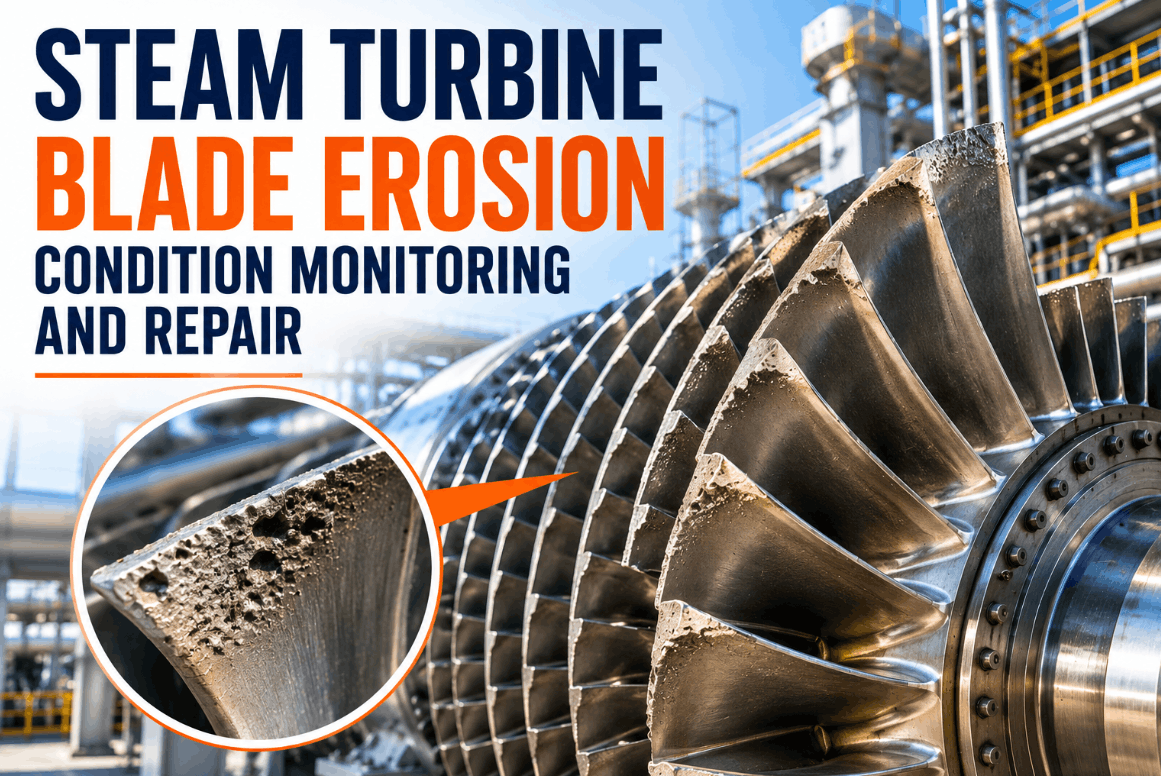
Wet steam erosion is one of the most consequential and least-detected failure mechanisms in industrial power generation. Low-pressure (LP) turbine blades — particularly last-stage blades — operate continuously in the wet-steam zone, where water droplets traveling at differential velocities strip material from leading edges, pit blade surfaces, and progressively compromise rotor balance. Left unmonitored, this process does not announce itself until a forced outage is already underway. For U.S. power facilities running coal, natural gas, or combined-cycle plants, the cost of a single unplanned steam turbine outage regularly exceeds $200,000 per day in lost generation and emergency repair costs. iFactory's industrial AI platform brings continuous, sensor-driven condition monitoring to LP blade health — so your team detects moisture carryover, pitting progression, and tip rub signatures weeks before they dictate your outage schedule. Book a Demo to see how real-time blade erosion intelligence changes the maintenance equation.
Stop Blade Erosion Before It Forces Your Hand
iFactory's AI condition monitoring platform detects moisture carryover, blade pitting, and tip rub signatures in real time — purpose-built for steam turbine reliability in U.S. power generation.
Why LP Blade Erosion Is the Highest-Consequence Failure Mode in Your Steam Path
LP last-stage blades carry the longest chord span in the turbine train and reach tip speeds above 500 m/s at full load. They operate in the phase-transition zone where steam quality drops and water droplet concentration peaks. At those velocities, even fine moisture droplets act as high-frequency ballistic impacts on blade leading edges and pressure-side surfaces. The result is a predictable but insidious sequence: initial surface roughening raises steam-path resistance, pitting sites become stress concentration points where stress corrosion cracking initiates, blade geometry departs from design, and rotor imbalance escalates. A blade liberation in the LP section does not just damage that blade — it cascades through downstream diaphragms, nozzle assemblies, and the condenser in a single event that can consume an entire quarter's maintenance budget.
Water Droplet Impingement
High-velocity rotation collides with low-velocity moisture droplets in the LP wet-steam zone, creating repetitive ballistic impacts on blade leading edges and pressure-side surfaces.
Surface Pitting & Roughening
Repeated impacts roughen the originally smooth blade surface into a martensite-needle matrix. This increases steam-path resistance, reduces stage efficiency, and seeds pitting sites for stress corrosion.
Profile Geometry Loss
As leading-edge material strips away, the blade's aerodynamic profile departs from design. Stage pressure ratios shift, inter-stage efficiency drops, and the rotor accumulates dynamic imbalance.
Cascade Failure Risk
A liberated LP blade damages all downstream diaphragms, nozzle assemblies, and the condenser in one event — the single highest-consequence failure mode in the entire steam turbine train.
Key Condition Indicators: What iFactory Monitors Continuously
Effective blade erosion monitoring is not a single sensor — it is the correlation of multiple live data streams against known failure-mode signatures. iFactory connects to your existing instrumentation and supplements it with edge IoT nodes where gaps exist, feeding a causal AI engine that understands the physics of wet-steam erosion. Here is what the platform watches, and why each signal matters.
| Condition Indicator | Sensor / Source | Erosion Signal | Action Threshold | iFactory Response |
|---|---|---|---|---|
| Shaft Vibration (1× amplitude) | X-Y Proximity Probes | Rising imbalance from geometry loss | >25% above baseline trend | Auto-flags borescope WO with 18-month lead time |
| Steam Quality / Wetness Fraction | Moisture extraction probes / exhaust enthalpy | Excess moisture carryover into LP stage | Wetness >12% at LSB row | Alerts operations; logs moisture exceedance event |
| Stage Pressure Ratio Deviation | SCADA pressure transmitters | Blade fouling / deposit buildup increasing resistance | >3% deviation from design curve | Initiates RCM causal tree; estimates efficiency penalty |
| Condenser Back Pressure | Condenser pressure transmitter | High back pressure drives LSB buffeting & nonsynchronous vibration | Trending above design spec | Correlates with vibration data; flags condenser fouling |
| Tip Clearance | Eddy-current / microwave tip probes | Shroud wear / tip rub events | Clearance reduction >15% from cold datum | Real-time alert; predicts blade-to-shroud contact window |
| Steam Inlet Temperature | Thermocouple array | Below-design temp causes condensation in IP/LP stages | Sub-design temp sustained >30 min | Triggers condensation erosion risk protocol |
The Four-Stage Blade Erosion Progression: From First Pitting to Forced Outage
Blade erosion is not a sudden event — it follows a predictable progression that iFactory's AI is trained to recognize at the earliest detectable stage, giving your team the maximum planning window before the asset dictates your schedule.
Moisture Carryover & Initial Impingement
Wet steam quality degrades below 88% dryness fraction at the LP inlet. Water droplets begin impinging on blade leading edges at high differential velocity. Surface roughening initiates. No vibration change yet — but steam quality sensors and stage efficiency trends begin to diverge from baseline. This is iFactory's earliest detection window.
Detection Window: 90–180 Days Before OutageSurface Pitting & Efficiency Degradation
The blade surface develops macro-pitting. Stage pressure ratios shift measurably. Turbine output begins to decline — a 30 MW turbine can lose 5% or more generating capacity at this stage from deposit-compounded blade roughening. Shaft vibration 1× amplitude starts an upward trend. Book a Demo to see how iFactory catches this inflection point automatically.
Detection Window: 45–90 Days Before OutageProfile Geometry Loss & Stress Corrosion Initiation
Leading-edge material loss is now measurable via blade tip timing deviation and worsening vibration spectrum. Pitting sites in the wet-steam zone initiate stress corrosion cracking at fir-tree root attachments. Borescope inspection at this stage will show visible material removal. Engineering review and procurement lead time tracking must be active.
Detection Window: 14–45 Days Before OutageRotor Imbalance & Imminent Liberation Risk
Severe vibration amplitude increase, possible tip rub contact, and cross-section weakening from notch propagation. Continued operation risks blade liberation — a single event that cascades damage through all downstream diaphragms, nozzle assemblies, and the condenser. Immediate controlled shutdown is the only correct response at this stage.
Emergency Intervention Required"We had a 500 MW coal unit where LP blade pitting had been progressing for two outage cycles without triggering any alarms — stage pressure deviation was masked by load-following adjustments. iFactory correlated the moisture carryover history with the vibration trend and surfaced the erosion risk 11 weeks before we would have otherwise scheduled an inspection. That planning window let us source replacement last-stage blades from the OEM on a standard lead time instead of an emergency order. The difference in parts cost alone was close to $180,000."
How iFactory AI Delivers Continuous Blade Erosion Intelligence
Most CMMS and EAM systems are passive record-keepers. They log what happened; they cannot tell you what is happening right now or what will happen in six weeks. iFactory is an active monitoring and prediction engine built on causal AI and live IoT data streams. For steam turbine blade erosion, this distinction is the difference between a planned repair and a $200,000-per-day forced outage.
180-Day Failure Foresight
iFactory's predictive models project blade remaining useful life based on cumulative moisture exposure, vibration trend trajectory, and stage efficiency loss — giving procurement and scheduling a genuine advance window, not a fire drill.
Causal AI Failure Trees
When a sensor threshold trips, iFactory does not just alert — it runs a live causal analysis linking the anomaly to the specific failure mode (moisture carryover, tip rub, deposit-induced roughening) and recommends a targeted inspection scope.
ERP-Integrated Procurement Triggers
Blade erosion alerts automatically generate purchase requisitions in SAP, Oracle, or Microsoft Dynamics — flagging long-lead items 18+ months before the predicted repair window so your team avoids premium emergency sourcing costs.
Mobile Inspection Workflows
Technicians receive AI-guided borescope inspection work orders on mobile devices, with condition-specific checklists triggered by live sensor data — not calendar intervals. Findings feed directly back into the RCM failure model.
Digital Twin of Blade Condition
Borescope images and sensor data combine to build a continuously updated digital twin of each blade row's health state — quantifying coating loss, pitting progression, and erosion depth between physical outage inspections.
Moisture Carryover Detection
Dedicated moisture exceedance logging correlates steam quality degradation events with subsequent vibration and efficiency changes — building an evidence-based erosion history that supports OEM warranty discussions and insurance claims.
The Business Case for Continuous Blade Erosion Monitoring
The financial argument for condition monitoring is not theoretical for steam turbine operations. The costs of reactive maintenance are well-documented and severe. A planned LP blade replacement during a scheduled outage and an emergency blade replacement following a forced outage involve essentially the same labor and parts — but the forced outage adds lost generation, rush freight on long-lead components, and potential cascade damage to downstream components. Book a Demo to walk through a site-specific ROI model with iFactory's engineering team.
From Reactive Outage Response to Proactive Blade Life Management
Steam turbine blade erosion is a deterministic process. Wet steam enters the LP section, water droplets impact blade surfaces, material is removed, and efficiency degrades — every time, on every turbine, in every operating regime that permits moisture carryover. What is not deterministic is whether your team detects it at Stage 01 or Stage 04. iFactory closes that gap by converting the physics of blade erosion into a continuous, AI-interpreted data stream that your reliability engineers can act on months before the asset forces the decision. For U.S. power generators facing capacity obligations, PPA commitments, and tight O&M budgets, the ability to plan a blade repair rather than respond to a forced outage is not a technical nicety — it is a direct contribution to EBITDA. Connect with iFactory's engineering team to map your existing instrumentation against the blade erosion monitoring framework and build a deployment plan that fits your outage schedule.
Steam Turbine Blade Erosion Monitoring — Frequently Asked Questions
What is the primary cause of LP turbine blade erosion in U.S. power plants?
Wet steam with high moisture content — typically exceeding 12% wetness fraction at the last-stage blade row — is the primary driver. Water droplets traveling at differential velocities relative to blade tip speed cause repetitive leading-edge impingement that strips material and initiates pitting.
How early can iFactory detect blade erosion before a forced outage?
iFactory's causal AI can flag moisture carryover anomalies and early efficiency degradation signatures up to 90–180 days before a blade condition reaches forced-outage severity, providing a genuine procurement and scheduling window.
Does continuous monitoring require replacing existing turbine instrumentation?
No. iFactory integrates with your existing proximity probes, pressure transmitters, and SCADA historians via standard OPC-UA and API connectors, supplementing gaps with lightweight IoT edge nodes where needed.
Can iFactory connect blade erosion alerts to our ERP for parts procurement?
Yes. iFactory features bidirectional API connectors for SAP, Oracle, and Microsoft Dynamics — predictive erosion alerts automatically generate purchase requisitions, closing the loop between sensor data and the procurement office.
Is this platform applicable to combined-cycle plants with heat recovery steam generators?
Absolutely. Combined-cycle LP turbines are particularly susceptible to condenser back-pressure-driven moisture recirculation events — a failure mode iFactory specifically models and monitors through condenser pressure and vibration correlation.
Detect Blade Erosion 90 Days Before It Costs You $200K Per Day.
iFactory's AI platform delivers continuous LP blade condition monitoring — from moisture carryover detection to automated procurement triggers — purpose-built for U.S. power generation reliability teams.