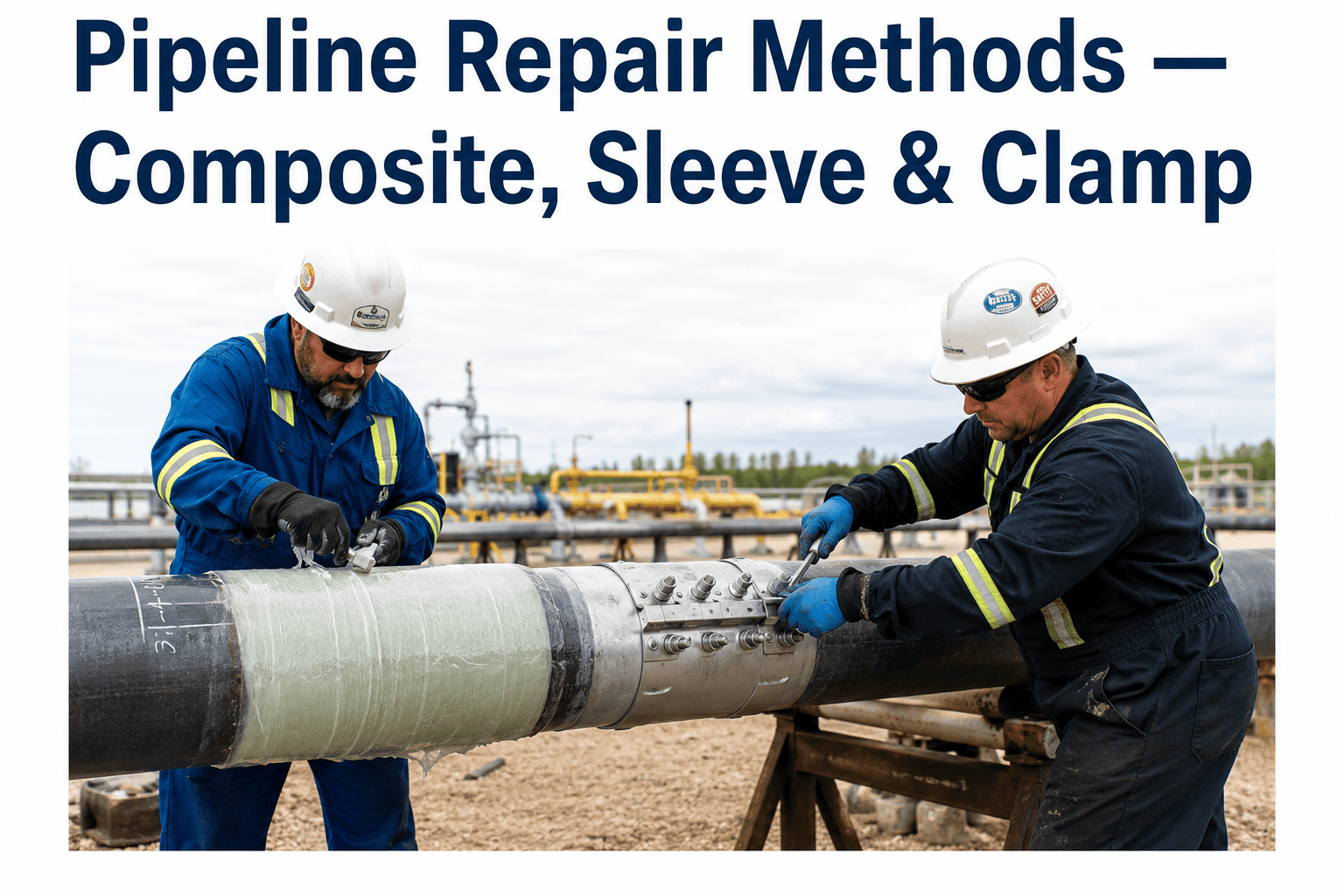
A corroded section, a mechanical dent, or a crack-like flaw found during an in-line inspection run rarely gives a pipeline operator the luxury of a single obvious repair choice. Composite wraps, full-encirclement steel sleeves, bolt-on clamps, and hot tap repairs each solve a different combination of defect type, pressure rating, and outage tolerance, and picking the wrong one can mean an unnecessary shutdown or, worse, a repair that doesn't actually restore the pipe to its required pressure containment rating. Getting this decision right starts with correctly classifying the defect against B31G or modified B31G remaining strength criteria before a repair method is even selected, a process covered in more depth in iFactory's support documentation.
01 / Four Repair Methods, Four Different Jobs
Each repair method restores pipe strength through a different mechanism, and understanding that mechanism is what determines whether a given method is even eligible for a specific defect type before cost or installation speed enter the decision at all.
02 / Comparing Repair Methods Side By Side
The right comparison table answers the question that matters most before any cost discussion — is this method even eligible for the defect type in question, and what pressure rating can it actually restore.
| Repair Method | Best Suited For | Key Limitation |
|---|---|---|
| Composite Wrap | External corrosion, shallow metal loss on stable defects | Not typically qualified for active cracks or leaking defects |
| Full-Encirclement Sleeve | Corrosion, dents, and most crack-like flaws needing full pressure restoration | Requires welding qualification and hot work permitting |
| Bolt-On Clamp | Rapid or temporary repair, locations restricting hot work | Often rated as temporary pending a permanent follow-up repair |
| Hot Tap Repair | Larger localized section replacement without a full shutdown | Higher complexity and cost than wrap or sleeve alternatives |
03 / Classifying The Defect Before Choosing A Method
Repair method selection should always start with correctly classifying what the defect actually is against recognized fitness-for-service criteria, since the same visual appearance can mean very different remaining strength depending on depth, length, and interaction with nearby features.
04 / Composite Wrap Repairs In Practice
Composite wrap repair has become one of the most widely used permanent repair methods for external corrosion because it requires no hot work, installs relatively quickly, and restores strength through the composite system's own engineered load capacity rather than relying on the underlying steel.
05 / Sleeves And Clamps — Permanent Versus Temporary Repair
Full-encirclement steel sleeves and bolt-on mechanical clamps are sometimes discussed interchangeably, but the distinction between a permanent and a temporary repair carries real regulatory and integrity management weight.
06 / Repair Standards And Qualification Testing
No repair method should be selected purely on past practice or contractor preference — each method sits under recognized repair standards that define qualification testing, design calculations, and installation requirements a given system must meet before it can be applied to a specific defect and pressure class. Composite systems in particular vary widely between manufacturers, and a system qualified for one defect type, temperature range, or pipe diameter is not automatically qualified for another without additional testing. Sleeve and clamp designs similarly need to be verified against the specific pipe grade, wall thickness, and operating pressure of the segment being repaired rather than assumed compatible from a prior job on a different line. Confirming current qualification status before specifying a repair method avoids installing a fix that looks correct but does not actually meet the engineering basis required for that defect.
07 / Common Mistakes In Repair Method Selection
A handful of selection mistakes show up repeatedly across pipeline integrity programs, and most trace back to skipping a step in the classification process rather than a fundamental misunderstanding of the repair methods themselves. Selecting a composite wrap for a defect later found to be crack-like rather than corrosion is one of the more consequential errors, since the repair may look successful initially while not actually addressing the failure mechanism at play. Another common gap is applying a repair method sized to the defect as measured at the time of the last inspection without accounting for continued corrosion or crack growth expected before the next scheduled reassessment. Leaving a bolt-on clamp installed well past its intended interim service life without a documented permanent repair plan rounds out the most frequently cited findings in integrity program audits.
08 / Documenting Repairs For Regulatory And Integrity Records
Every pipeline repair needs to be documented in a way that stands up to regulatory review years later, including the original defect classification, the engineering basis for the method selected, installation records, and any follow-up inspection confirming the repair is performing as designed. Operators managing repair records across a large network find that inconsistent documentation between different repair crews and years is one of the more common gaps regulators identify during integrity management program audits, particularly when a temporary clamp repair was never formally closed out with the planned permanent repair. Keeping defect classification, repair method justification, and installation records connected in one system, rather than scattered across separate work order and inspection databases, makes both routine audits and any future re-assessment of that pipe segment considerably more straightforward.
09 / Conclusion — Method Selection Starts With Correct Classification
The repair method that looks fastest or cheapest at first glance is only the right choice if it is actually eligible for the specific defect type, pressure rating, and outage tolerance involved, which is why defect classification against recognized fitness-for-service criteria has to come before method selection rather than after. Book a demo to see how your inspection findings could be run through a structured repair selection process.
Frequently Asked Questions — Pipeline Repair Methods
Remaining strength for corrosion metal loss is most commonly calculated using B31G or modified B31G criteria, which use the measured depth and length of the corroded area relative to the original pipe wall thickness and diameter to estimate the safe maximum operating pressure at that location. Modified B31G and newer effective area methods generally produce less conservative results than the original B31G calculation, which can affect whether a given defect is assessed as requiring immediate repair, scheduled repair, or continued monitoring under the applicable integrity management program. The specific method used should follow whatever calculation approach is accepted under the operator's regulatory jurisdiction and integrity management plan. iFactory's support documentation covers common calculation approaches in more detail.
Bolt-on mechanical clamps are frequently installed as an interim measure specifically because they can be applied quickly without hot work, but most integrity management programs require a documented plan and timeline for permanent follow-up repair rather than treating the temporary clamp as an indefinite solution. Leaving a temporary repair in place beyond its intended service life without formal re-assessment is a common finding in regulatory audits, since the original repair was typically engineered and qualified for interim rather than long-term service conditions. Operators should track temporary repairs specifically within their integrity management system to ensure the permanent follow-up repair doesn't get lost among other scheduled work.
Composite wrap repair systems are most widely qualified and used for external corrosion metal loss defects, and their suitability for crack-like flaws depends heavily on the specific composite system's qualification testing and the crack type involved, since cracks can propagate under conditions a corrosion repair was never designed to address. Some composite systems have qualification testing covering specific crack types, but this is manufacturer and system-specific rather than a general rule applicable to all composite repairs. Active or leaking defects of any type are generally not suitable for composite wrap repair regardless of the specific system's other qualifications, and typically require a different repair method entirely.
Hot tap repair typically becomes the preferred method when a defect or damaged section is too extensive for a sleeve or wrap to adequately address, or when a full section of pipe needs to be replaced while the line remains in service rather than reinforced in place. This is a higher complexity and cost repair than sleeves, clamps, or composite wraps, which is why it is generally reserved for situations where those simpler methods are not engineering-eligible for the defect involved rather than being a default first choice. The decision also depends heavily on line pressure, product, and site access, since hot tap work requires specialized equipment and a qualified contractor. Book a demo to discuss repair method eligibility for a specific defect scenario.
No — composite wrap, bolt-on clamps, and most full-encirclement sleeve installations can typically be performed with the pipeline remaining in service, provided pressure and safety conditions at the repair location allow it, which is a significant part of why these methods are so widely used for routine corrosion and mechanical damage repairs. Welded sleeve installation does require careful engineering review of weld procedures relative to line pressure and product to manage hot work safety, but does not inherently require a full shutdown in most cases. Hot tap repairs are specifically designed to avoid taking the line out of service despite involving cutting into the pipe, using specialized equipment to maintain containment throughout the procedure.