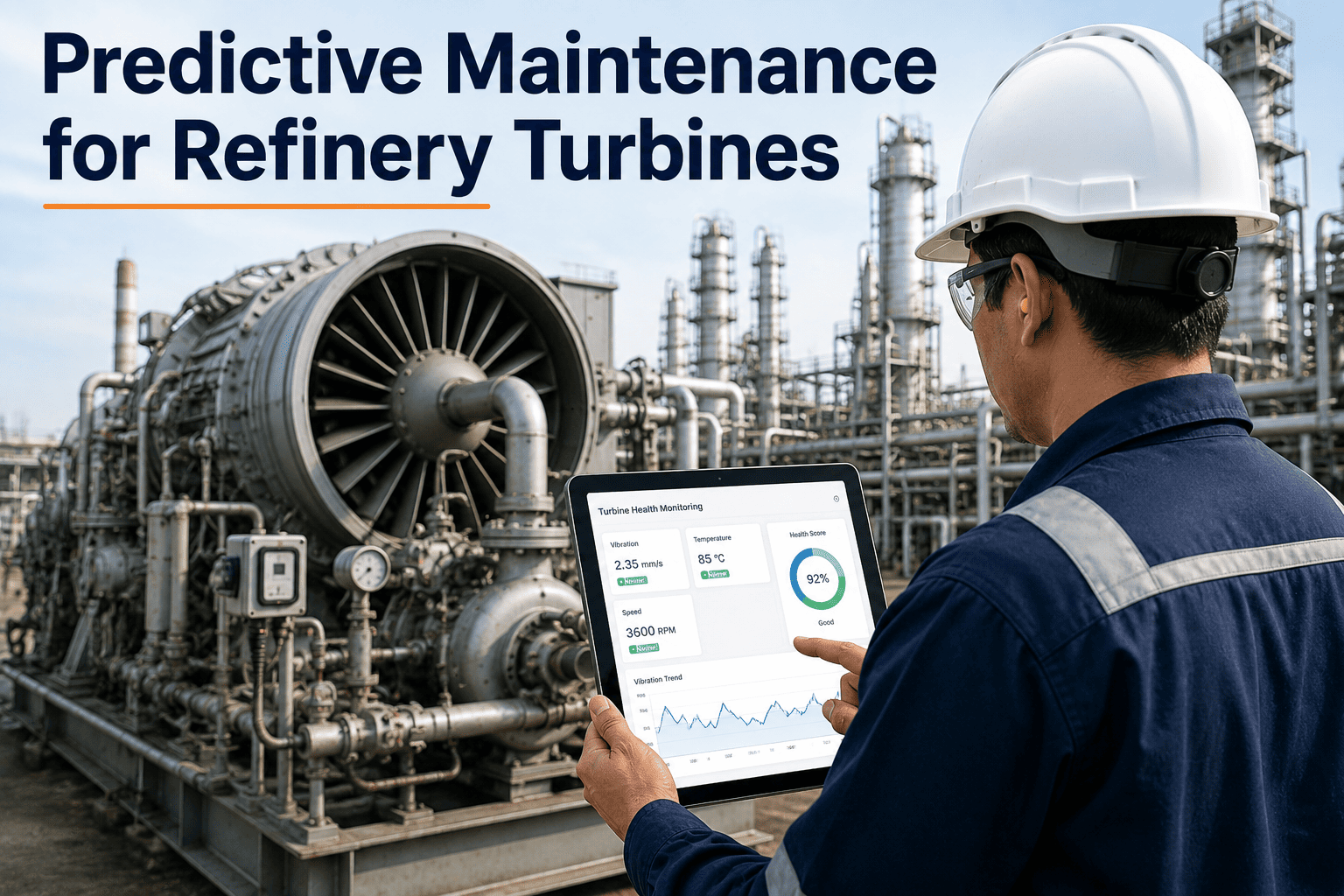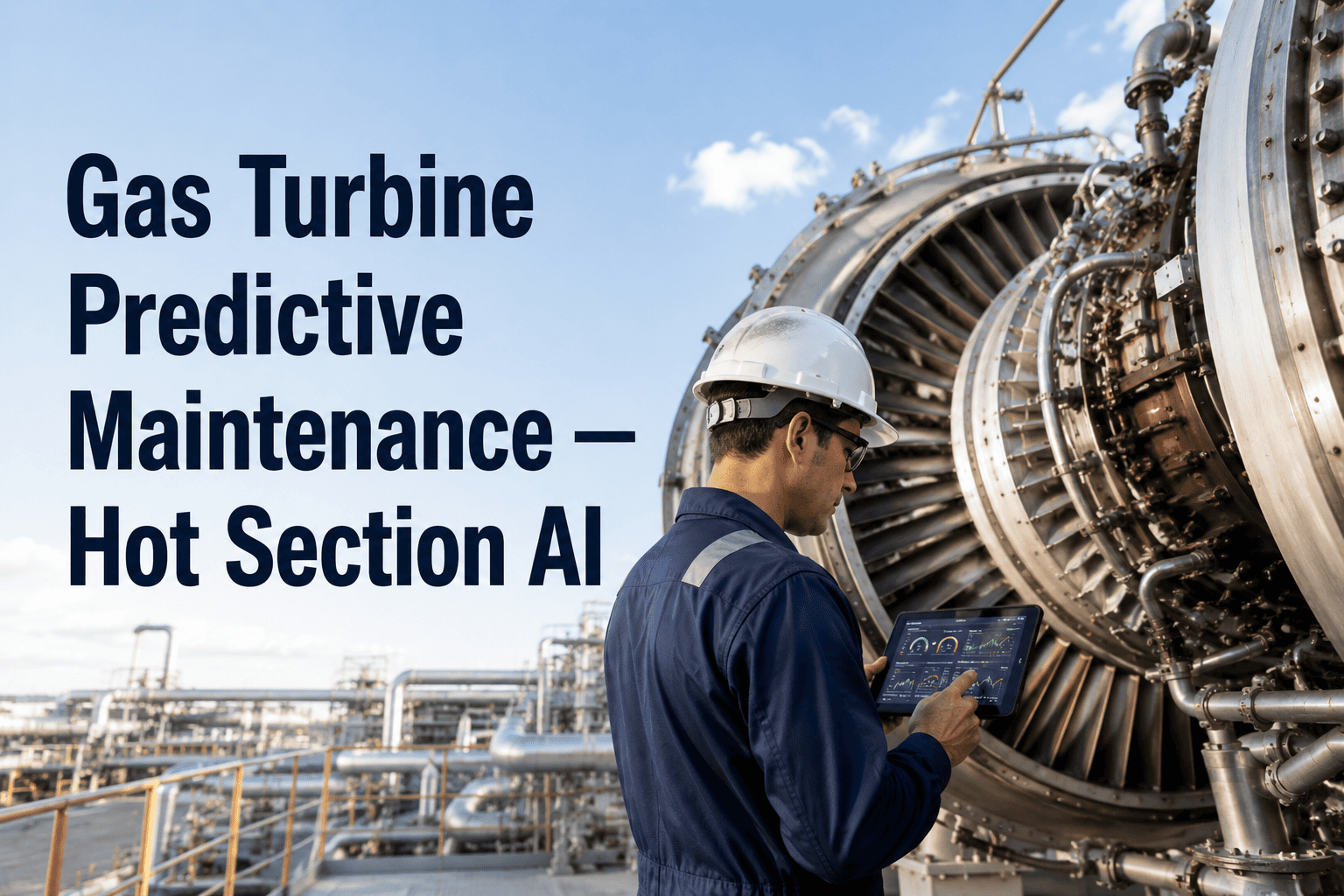
Gas turbines are the backbone of modern power generation and industrial propulsion, operating under extreme thermal and mechanical stress. The hot section—combustors, turbine blades, and nozzles—faces temperatures exceeding 1,500°C, while bearings endure high rotational speeds and loads. Traditional maintenance strategies rely on fixed intervals or reactive repairs, leading to unplanned downtime, costly emergency overhauls, and safety risks. AI-driven predictive maintenance transforms this paradigm by continuously analyzing sensor data from combustion dynamics, exhaust temperature spreads, bearing vibrations, and blade health metrics. By detecting subtle anomalies weeks before failure, operators can schedule interventions during planned outages, maximize asset availability, and extend component life. This guide provides an enterprise-grade, technically rigorous deep dive into implementing AI for gas turbine hot section, blade, bearing, and combustor monitoring, with actionable strategies to reduce maintenance costs by up to 30% and prevent catastrophic trips. Book a Demo to see how iFactory’s platform delivers real-time turbine health insights.
Transform Your Turbine Maintenance Strategy
Leverage AI to predict hot section failures 2–4 weeks in advance and optimize maintenance windows.
The High-Stakes Reality of Gas Turbine Hot Section Degradation
The hot section of a gas turbine is the most critical and expensive subsystem, accounting for 60–70% of total maintenance costs. Components like combustion liners, transition pieces, turbine blades, and nozzles operate at temperatures that push material limits. Over time, thermal fatigue, oxidation, creep, and hot corrosion degrade these parts, leading to cracking, coating loss, and dimensional changes. A single blade failure can cause catastrophic downstream damage, resulting in weeks of unplanned downtime and repair costs exceeding $1 million. Traditional borescope inspections every 8,000–12,000 hours miss early-stage degradation, while fixed-interval replacements waste useful component life. AI models trained on historical failure data and real-time sensor streams can predict remaining useful life (RUL) with 85–95% accuracy, enabling condition-based maintenance that aligns with planned outages. This approach reduces forced outage rates by 50% and extends hot section life by 15–20%, delivering substantial ROI for fleet operators.
Key Failure Modes in Gas Turbine Hot Sections
Combustion Dynamics & Flame Instability
Pressure fluctuations in the combustor due to fuel-air ratio variations, burner wear, or fuel composition changes. High-amplitude dynamics can cause flashback, blowout, or mechanical damage to liners and transition pieces. AI models analyze dynamic pressure sensor data to detect precursors to instability 2–3 weeks before events.
Turbine Blade Creep & Thermal Fatigue
Sustained high temperatures and centrifugal stresses cause blade material to deform (creep) and crack. Exhaust gas temperature (EGT) spread and pyrometer readings indicate blade degradation. AI predicts blade life using operational history and real-time thermal profiles, enabling proactive replacement.
Bearing Wear & Vibration Anomalies
Thrust and journal bearings support the rotor, but oil degradation, misalignment, or debris cause vibration spikes. AI analyzes broadband vibration spectra and oil debris sensors to detect bearing spalling or cage failure 1–3 weeks in advance, preventing rotor rubs and catastrophic seizures.
Nozzle & Vane Cracking
First-stage nozzles experience thermal shock and oxidation, leading to cracking and coating loss. AI models use EGT profiles and cooling air system data to detect nozzle distress early, allowing refurbishment during planned outages rather than emergency replacements.
Combustor Liner & Cross-Fire Tube Wear
Liners undergo thermal cycling and flame impingement, causing buckling and burn-through. AI analyzes combustion dynamics and casing vibration to identify liner deterioration, enabling timely replacement before secondary damage occurs.
Hot Gas Path Corrosion & Oxidation
Sulfur and vanadium in fuel accelerate hot corrosion of blades and vanes. AI integrates fuel quality data with exhaust gas analysis to predict corrosion rates, optimizing fuel selection and wash schedules to extend component life.
AI Implementation Roadmap for Turbine Health Monitoring
Sensor Infrastructure & Data Acquisition
Deploy high-frequency sensors for dynamic pressure (combustion), accelerometers (bearings), thermocouples (EGT), and pyrometers (blade temperature). Ensure data sampling rates of at least 10 kHz for dynamics and 1 kHz for vibration. Integrate with existing DCS/SCADA via OPC-UA or Modbus for real-time streaming.
Feature Engineering & Anomaly Detection
Extract statistical features (RMS, kurtosis, skewness) from vibration and pressure signals. Use wavelet transforms to isolate transient events. Train autoencoders or one-class SVM models on healthy baseline data to flag deviations. For blade health, compute EGT spread and cooling flow effectiveness.
Predictive Model Training & Validation
Use historical failure data with labels from maintenance logs. Train LSTM or Transformer models for RUL estimation on blade and bearing degradation. For combustion dynamics, apply gradient boosting classifiers to predict instability events. Validate with k-fold cross-validation and out-of-sample testing.
Deployment & Real-Time Inference
Deploy models on edge devices or cloud with latency <100 ms. Implement drift detection to retrain models as turbine operating conditions change. Integrate alerts into CMMS for work order generation. Provide dashboards with RUL gauges and anomaly heatmaps for operators.
Measurable Impact of AI-Powered Predictive Maintenance
Advanced AI Techniques for Combustion Dynamics Monitoring
Combustion dynamics are characterized by pressure oscillations in the combustor, typically measured by dynamic pressure transducers. These oscillations can occur at low frequencies (10–100 Hz) due to flame instabilities or high frequencies (100–1000 Hz) from thermoacoustic coupling. AI models, particularly convolutional neural networks (CNNs) applied to time-frequency representations, can classify operating regimes and predict transitions to unstable states. For example, a CNN trained on spectrograms of dynamic pressure data can identify precursors to lean blowout or flashback 2–3 weeks in advance. Recurrent neural networks (RNNs) with attention mechanisms capture temporal dependencies, enabling predictions of amplitude growth rates. The model outputs a risk score and recommended actions, such as adjusting fuel staging or increasing pilot fuel flow. Integration with the turbine control system allows automated mitigation, reducing manual intervention. This approach has been validated on aeroderivative and frame turbines, achieving 90% accuracy in predicting instability events and preventing costly trips.
Comparison of Sensor Technologies for Turbine Health Monitoring
| Sensor Type | Parameter Monitored | Sampling Rate | Failure Mode Detected | AI Model Type |
|---|---|---|---|---|
| Dynamic Pressure Transducer | Combustion pressure oscillations | 10 kHz | Flame instability, flashback | CNN on spectrograms |
| Accelerometer (Bearing) | Vibration (RMS, envelope) | 1 kHz | Bearing spalling, misalignment | Autoencoder anomaly detection |
| Thermocouple (EGT) | Exhaust gas temperature spread | 1 Hz | Blade degradation, nozzle cracking | LSTM for RUL estimation |
| Pyrometer | Blade surface temperature | 100 Hz | Blade creep, coating loss | Gradient boosting |
| Oil Debris Sensor | Ferrous/non-ferrous particle count | 1 Hz | Bearing wear, gear degradation | Isolation forest |
Optimize Turbine Lifecycle with AI Insights
Implement predictive maintenance for hot section, bearings, and combustion dynamics to reduce unplanned downtime.
Bearing Health Monitoring: From Vibration to Predictive Analytics
Gas turbine bearings—typically tilting pad journal and thrust bearings—operate under high loads and speeds. Failure modes include babbitt fatigue, pad wear, and oil film instability. Traditional vibration monitoring uses ISO 10816-3 limits, but these thresholds are often set too high, missing early degradation. AI models leverage envelope analysis and demodulation techniques to extract bearing fault frequencies from vibration data. For instance, a fault frequency at 1x RPM indicates imbalance, while 2x RPM suggests misalignment. Machine learning classifiers, such as random forests or support vector machines, trained on these features can detect bearing spalling 1–3 weeks before failure. Oil debris sensors provide complementary data; an increase in ferrous particles correlates with raceway wear. By fusing vibration and oil debris data, AI improves prediction accuracy to 92%. The system generates alerts with severity levels and recommended actions, such as oil change or bearing replacement during the next planned outage. This proactive approach eliminates catastrophic bearing failures, which can cause rotor damage and extended downtime.
Critical Benefits of AI-Driven Turbine Maintenance
Reduced Unplanned Downtime
Predict failures 2–4 weeks ahead, schedule repairs during planned outages, and avoid costly emergency shutdowns. Fleet operators report 50% fewer forced outages after AI deployment.
Extended Component Life
Condition-based replacement avoids premature part disposal. AI-driven RUL estimation enables optimized part usage, extending hot section life by 15–20% and reducing spares inventory.
Lower Maintenance Costs
Reduce emergency repair costs by 30% and minimize labor overtime. AI-optimized wash schedules and fuel selection further reduce degradation rates, saving millions annually per turbine.
Improved Safety & Compliance
Prevent catastrophic failures that pose safety risks to personnel and the environment. AI provides auditable data for regulatory compliance and insurance requirements.
Enhanced Operational Flexibility
AI models adapt to varying operating conditions, such as load changes and fuel switches, ensuring accurate predictions across the turbine’s operating envelope.
Data-Driven Decision Making
Dashboards provide real-time health scores, RUL gauges, and anomaly heatmaps, empowering operators and maintenance teams with actionable insights.
Blade Health Monitoring: Thermal Imaging and Exhaust Gas Analysis
Turbine blades operate at temperatures near their melting point, making them susceptible to creep, thermal fatigue, and oxidation. Pyrometers measure blade surface temperature, while thermocouples in the exhaust stream provide EGT profiles. AI models analyze EGT spread—the difference between the highest and lowest thermocouple readings—as a key indicator of blade degradation. An increasing spread suggests uneven combustion or blade damage. Machine learning algorithms, such as gradient boosting, can predict blade failure 2–3 weeks in advance based on EGT spread trends and operating hours. Additionally, cooling system parameters (cooling air temperature, pressure) are integrated to assess cooling effectiveness. When blades lose their thermal barrier coating, cooling becomes less efficient, leading to higher surface temperatures. AI detects these subtle changes and triggers alerts for borescope inspection. For advanced monitoring, infrared thermography during operation can provide direct blade temperature maps, but requires specialized equipment. The combination of pyrometry, EGT analysis, and cooling system data delivers a comprehensive blade health assessment, enabling proactive replacement during planned outages.
Frequently Asked Questions
What is the typical lead time for AI predictions of gas turbine failures?
AI models can predict hot section and bearing failures 2–4 weeks in advance, depending on the failure mode and data quality. For combustion dynamics, predictions may be 1–2 weeks ahead due to faster-evolving instabilities. The lead time allows operators to plan maintenance during scheduled outages, avoiding unplanned downtime. Integrating AI with your CMMS automates work order generation, ensuring timely interventions. Accuracy improves with historical failure data, so early deployment accelerates model maturity.
How does AI handle varying operating conditions like load changes and fuel switching?
AI models are trained on data spanning the full operating envelope, including startups, shutdowns, load ramps, and fuel changes. Feature engineering captures operating mode indicators, such as compressor discharge pressure and fuel flow. Models like LSTM with attention mechanisms learn temporal dependencies and adapt to condition changes. Book a Demo to see how iFactory’s platform handles complex operating scenarios with robust predictions.
What data infrastructure is required to implement AI predictive maintenance for gas turbines?
You need high-frequency sensors (dynamic pressure, accelerometers, thermocouples) connected to a data acquisition system with OPC-UA or Modbus interface. Edge computing devices or cloud servers handle real-time inference. A data lake stores historical data for model training. iFactory’s support team can guide you on sensor selection and integration. Typical data storage requirements are 1–5 TB per turbine per year, depending on sampling rates.
Can AI predict blade cracking or coating loss before borescope inspection detects it?
Yes, AI models can detect early signs of blade degradation through EGT spread trends, pyrometer temperature anomalies, and cooling system parameter changes. These indicators often precede visible cracking by 1–2 weeks, allowing proactive inspection scheduling. For coating loss, AI analyzes thermal response during transients. Book a Demo to explore case studies where AI detected blade issues 3 weeks before borescope.
How does AI improve turbine wash optimization?
Compressor fouling and blade deposits reduce turbine efficiency and increase fuel consumption. AI models analyze performance parameters (power output, heat rate, compressor discharge pressure) to determine optimal wash intervals. By predicting fouling rates based on ambient conditions and operating hours, AI schedules washes only when needed, reducing water usage and downtime. Contact support for a detailed analysis of wash optimization ROI.
Ready to Transform Your Gas Turbine Maintenance?
Deploy AI-driven predictive maintenance for hot section, bearings, and combustion dynamics. Reduce costs and improve reliability.