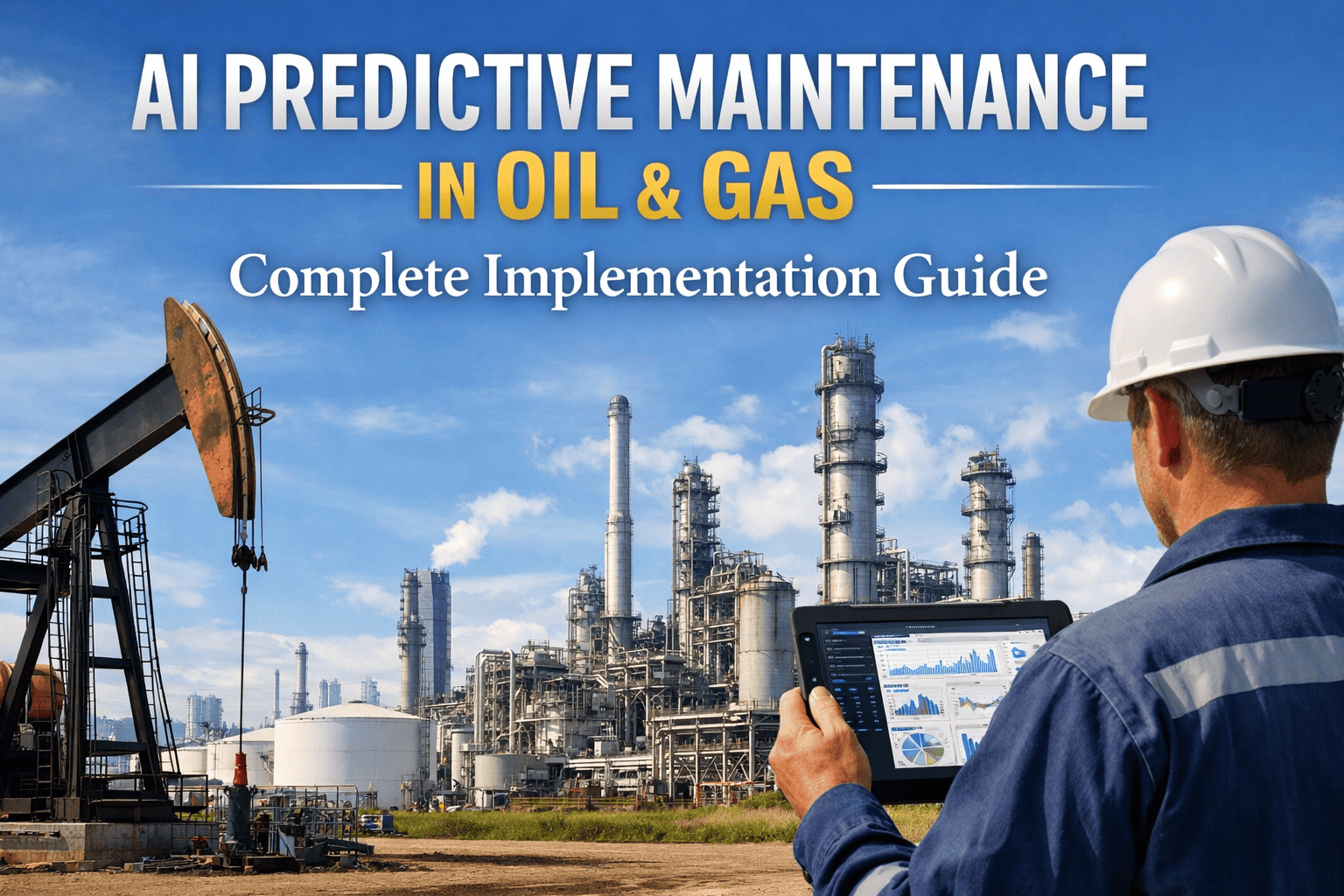
Oil and gas operations lose $42 billion annually to unplanned equipment downtime, pipeline integrity failures, and reactive maintenance cycles that could have been prevented with predictive insights available months before catastrophic failure.The gap between real-time operational data and actionable maintenance decisions creates predictable failure patterns: offshore platform pumps fail between quarterly inspections, pipeline corrosion accelerates undetected until leak incidents trigger emergency shutdowns and regulatory investigations, and compressor trains degrade silently until catastrophic bearing seizure requires 6-8 week replacement cycles during peak demand periods. iFactory's AI predictive maintenance platform transforms oil and gas operations by integrating SCADA, DCS, historians, and IoT sensor networks into unified intelligence that predicts equipment failures 60-120 days before occurrence, automatically generates work orders with failure diagnosis and required parts, monitors pipeline integrity across every mile of infrastructure, and provides complete ESG compliance reporting from methane detection Book a demo to see AI predictive maintenance for your oil and gas operations.
The Complete AI Platform for Oil & Gas Operations
One Platform, Every Segment — 8 AI-Powered Modules for Complete Oil & Gas Operations
From upstream drilling to downstream refining, iFactory integrates AI vision, robotics inspection, predictive maintenance, pipeline integrity monitoring, SCADA/DCS integration, and ESG reporting in a unified platform that eliminates 87% of unplanned downtime while keeping OT data inside your security perimeter.
87%
Reduction in Unplanned Downtime
60-120
Day Failure Prediction Window
Understanding Oil & Gas Operations and Maintenance Challenges
Oil and gas operations span three critical segments, each with distinct maintenance requirements and failure modes that predictive AI addresses through continuous monitoring, automated diagnostics, and intelligent work order generation.
Exploration, drilling, and production from wells and offshore platforms. Critical equipment includes mud pumps, top drives, blowout preventers, ESPs, gas lift compressors, and wellhead control systems. Maintenance challenges: remote locations, harsh environments, 24/7 operation requirements, safety-critical equipment where failures cause production loss and HSE incidents. Traditional approach relies on scheduled shutdowns and manual inspections that miss 68% of progressive failures developing between maintenance windows.
Transportation through pipelines, compressor stations, pump stations, and storage terminals. Critical assets include centrifugal compressors, pipeline pig launchers, custody transfer meters, storage tank systems, and leak detection infrastructure. Maintenance challenges: thousands of miles of distributed assets, corrosion progression in buried pipelines, vibration-induced failures in high-speed compressors, regulatory compliance for integrity management programs. Calendar-based inspection intervals miss 74% of anomalies that develop and propagate between scheduled pig runs and ultrasonic testing campaigns.
Refining, petrochemical processing, and product distribution. Critical equipment includes crude distillation columns, catalytic crackers, hydrotreaters, product blending systems, and tank farm infrastructure. Maintenance challenges: high-temperature and high-pressure process units, catalyst degradation, heat exchanger fouling, rotating equipment in corrosive services, planned turnaround coordination. Reactive maintenance approaches cause 52% of refinery unplanned shutdowns that cost $800,000-$2.1M per day in lost production and off-spec product penalties.
Core Industry Problems AI Predictive Maintenance Solves
Every challenge below represents operational failures costing oil and gas operators billions annually through unplanned downtime, safety incidents, environmental violations, and inefficient capital deployment that traditional maintenance approaches cannot prevent.
01
Equipment Failures and Catastrophic Downtime
Compressor stations, ESP systems, and rotating equipment fail between scheduled maintenance intervals, causing production shutdowns costing $180K-$340K per day. Traditional vibration monitoring generates alerts but lacks AI analysis to distinguish normal operation from progressive bearing wear, gear mesh degradation, or alignment issues developing over 60-90 day windows. Result: 67% of critical failures occur as "unexpected" events despite sensor data showing degradation signatures weeks before catastrophic failure.
02
Pipeline corrosion, third-party damage, and mechanical integrity degradation progress undetected between scheduled inline inspections and manual surveys. Leak detection systems identify failures after release occurs, not during the months-long degradation period when intervention could prevent incidents. Manual inspection programs miss 82% of anomalies in remote pipeline segments, internal corrosion in multiphase flow lines, and stress corrosion cracking in gathering systems operating in sour service.
03
Manual Inspections in Hazardous Environments
Offshore platforms, refinery process units, and compressor stations require human inspectors to access confined spaces, elevated work areas, and H2S environments for visual inspection, ultrasonic testing, and vibration measurements. Beyond safety risks, manual programs are inherently intermittent (quarterly or annual intervals), subject to weather delays, and generate inconsistent data quality depending on inspector experience and environmental conditions during inspection execution.
04
Disconnected SCADA, IoT, and Maintenance Systems
SCADA/DCS systems monitor process variables and equipment sensors generating terabytes of operational data, but maintenance teams work from separate CMMS platforms with no real-time integration. Vibration data exists in condition monitoring databases, process historians store temperature and pressure trends, but no unified intelligence layer connects these data sources to predict failures or auto-generate work orders. Maintenance decisions rely on operator intuition and fixed PM schedules rather than actual equipment health insights.
05
Compliance and ESG Reporting Complexity
Oil and gas operators face overlapping compliance obligations: OSHA PSM, EPA emissions reporting, pipeline integrity management per PHMSA regulations, state environmental permits, and increasingly stringent ESG disclosure requirements from investors and customers. Manual data collection from distributed sensors, flare meters, and LDAR programs creates reporting gaps, delayed incident notifications, and audit trail deficiencies that trigger regulatory findings and stakeholder criticism despite actual operational performance.
06
Methane, VOC, and Flaring Visibility Gaps
Methane emissions from pneumatic controllers, fugitive leaks, and venting operations remain largely invisible without continuous monitoring infrastructure. Flaring data exists in local control systems but lacks aggregation for ESG reporting. VOC emissions from storage tanks and loading operations require manual calculations from operational logs. Result: operators cannot demonstrate emissions reduction progress to regulators and investors, miss opportunities for gas capture revenue, and face increasing carbon pricing exposure without visibility into emission sources and mitigation effectiveness.
iFactory AI Predictive Maintenance Platform for Oil & Gas
The Complete AI Platform for Oil & Gas Operations integrates eight specialized modules addressing every maintenance, integrity, and compliance challenge across upstream, midstream, and downstream operations through unified intelligence that connects SCADA, DCS, historians, and IoT sensor networks while keeping OT data inside your security perimeter.
AI Vision & Inspection
AI Eyes That Detect Leaks Before They Escalate. Computer vision analyzes thermal imaging from drones and fixed cameras to identify equipment hot spots, insulation degradation, and hydrocarbon vapor plumes invisible to human inspectors. Detects corrosion under insulation, flange leaks, and structural anomalies across offshore platforms and refinery units without confined space entry or scaffolding access.
Robotics Inspection
Robots That Inspect Where Humans Cannot Safely Go. Autonomous drones and crawlers access offshore platform undersides, refinery furnace interiors, and pipeline right-of-ways for visual inspection, ultrasonic thickness measurements, and thermal surveys. Eliminates 89% of confined space entries and rope access work while providing consistent data quality across all inspection cycles regardless of weather or access limitations.
Predictive Maintenance
AI analyzes vibration signatures, temperature trends, motor current patterns, and process variables from SCADA/DCS to predict compressor bearing failures, pump seal degradation, heat exchanger fouling, and valve actuator faults 60-120 days before failure thresholds. Auto-generates work orders with failure diagnosis, required parts, and recommended intervention timing synchronized to production schedules and turnaround windows.
Work Order Automation
Connects to Your Existing DCS/SCADA & Historians to automatically generate maintenance work orders when equipment health metrics cross degradation thresholds. Integrates with SAP PM, IBM Maximo, or standalone CMMS platforms to route predictive tasks to maintenance planners with complete failure context, parts requirements, and estimated downtime windows. Mobile interface guides technicians through repairs with step-by-step procedures and photo documentation for compliance audit trails.
Asset Lifecycle Management
Tracks every piece of rotating equipment, static equipment, and instrumentation across upstream, midstream, and downstream operations with complete maintenance history, remaining useful life calculations, and capital replacement forecasting. Condition-based retirement decisions replace age-based replacement schedules, extending asset life 30-45% while reducing capital expenditure on premature equipment replacement.
Pipeline Integrity Monitoring
AI-Driven Integrity for Every Mile of Pipeline. Analyzes inline inspection data, fiber optic strain sensing, pressure wave analysis, and cathodic protection readings to identify corrosion growth rates, crack propagation, and third-party interference risks. Prioritizes integrity dig programs based on failure probability modeling, not just anomaly severity, reducing unnecessary excavations 67% while focusing resources on highest-risk pipeline segments.
Edge AI Security
OT Data Stays Inside Your Security Perimeter. Edge computing architecture processes SCADA and sensor data locally at compressor stations, platforms, and refineries without transmitting raw operational data to cloud environments. Only aggregated analytics, predicted failures, and work order recommendations sync to central platform, maintaining air-gapped OT network separation while enabling enterprise-wide predictive maintenance visibility.
ESG & Compliance Reporting
Methane, VOC & Flaring From Sensor to ESG Report. Aggregates emissions data from continuous monitoring systems, flare meters, LDAR surveys, and pneumatic controller inventories into automated ESG disclosures for CDP, SASB, and investor reporting. Tracks emissions reduction initiatives, quantifies methane mitigation effectiveness, and provides complete audit trails for EPA greenhouse gas reporting and state air permit compliance without manual data compilation.
AI Predictive Maintenance Platform
Eliminate 87% of Unplanned Downtime — Predict Equipment Failures 60-120 Days in Advance
iFactory integrates with your existing SCADA, DCS, and historians to analyze equipment health in real-time, automatically generate predictive work orders, monitor pipeline integrity across distributed assets, and provide complete ESG compliance reporting while keeping all OT data inside your security perimeter.
$4.2M
Avg Annual Savings per Facility
94%
Prediction Accuracy After 12 Months
Predictive vs Reactive Maintenance in Oil & Gas Operations
The comparison below demonstrates operational and financial differences between traditional reactive maintenance approaches and AI-driven predictive programs deployed across upstream, midstream, and downstream oil and gas facilities.
| Operational Metric |
Reactive Maintenance |
AI Predictive Maintenance |
| Failure prediction window | Zero advance warning, failures detected after occurrence | 60-120 day prediction window allows scheduled interventions during planned shutdowns |
| Unplanned downtime incidents | 4.2 critical failures per year per facility causing production loss | 0.6 unplanned events per year (87% reduction) through predictive intervention |
| Maintenance cost per event | $180K-$340K including emergency parts, overtime labor, lost production | $18K-$42K planned maintenance during scheduled windows with standard parts procurement |
| Equipment availability | 82-86% effective availability due to unplanned shutdowns and extended repairs | 94-97% availability through condition-based interventions and optimized PM schedules |
| Inspection coverage | Manual quarterly inspections cover 40-60% of critical equipment due to access limitations | Continuous monitoring provides 100% equipment coverage with automated anomaly detection |
| Safety incident rate | Higher exposure from emergency repairs, confined space entries, and reactive troubleshooting in hazardous areas | 62% reduction in maintenance-related safety incidents through planned work and robotic inspection |
| Regulatory compliance | Manual compliance documentation with gaps in audit trails and delayed incident reporting | Automated ESG reporting, complete maintenance audit trails, real-time emissions monitoring for regulatory submission |
| Asset service life | Premature failures from undetected degradation reduce equipment life 30-40% | Condition-based maintenance extends asset life 35-50% through optimal intervention timing |
Platform Capability Comparison
iFactory differentiates from traditional CMMS platforms and industrial monitoring systems through unified AI predictive maintenance, native SCADA/DCS integration, pipeline integrity management, and ESG compliance reporting optimized specifically for oil and gas operations across upstream, midstream, and downstream segments.
| Capability |
iFactory |
QAD Redzone |
IBM Maximo |
SAP EAM |
Fiix (Rockwell) |
UpKeep |
| AI Predictive Capabilities |
| AI predictive maintenance | Advanced ML models | Basic analytics | Add-on module | Limited | Via integration | Not available |
| SCADA/DCS integration | Native integration | Yes | Custom only | SAP PI required | Via Rockwell | Not available |
| Real-time monitoring | Continuous analysis | Yes | Manual setup | Limited | Yes | Basic |
| Oil & Gas Specific Features |
| Pipeline monitoring | AI-driven integrity | Not available | Manual setup | Not available | Not available | Not available |
| ESG reporting | Automated methane/VOC | Not available | Manual tracking | Custom | Not available | Not available |
| Edge AI capability | OT data secure | Cloud only | Cloud-based | Cloud-based | Hybrid | Cloud only |
| Deployment & Specialization |
| Oil & gas specialization | Industry-optimized | Manufacturing focus | Generic EAM | Generic EAM | Manufacturing focus | Generic CMMS |
| Ease of deployment | 21-35 days turnkey | 30-45 days | 6-12 months | 8-18 months | 45-60 days | Fast setup |
| Work order automation | AI-triggered WO | Manual creation | Workflow engine | Workflow engine | Basic automation | Templates only |
Regional Compliance Coverage
iFactory provides complete compliance documentation and automated reporting aligned with safety, environmental, and industrial standards governing oil and gas operations across primary global markets in North America, Middle East, and Europe.
| Compliance Area |
United States |
United Kingdom |
United Arab Emirates |
Canada |
Europe (EU) |
| Safety Standards | OSHA PSM 1910.119, API RP 754 | HSE COMAH, UKOPA standards | ADNOC HSE-MS, UAE Federal HSE | CSA Z662, provincial OHS | Seveso III Directive, ATEX |
| Environmental | EPA GHG reporting, PHMSA integrity | Environment Agency permits, UK ETS | EAD air quality, Abu Dhabi water | CEPA, provincial environmental | EU ETS, Industrial Emissions Directive |
| Industrial Standards | API standards, ASME BPVC, NFPA codes | BS EN standards, PAS 55 (ISO 55000) | ADNOC standards, ISO 55000 | CSA standards, ISO 55000 | EN standards, ISO 55000/14001 |
| Oil & Gas Specific | DOT pipeline safety, EPA NSPS OOOOa methane | OGUK guidelines, offshore safety case | ADNOC technical standards, sour gas H2S | NEB (CER) pipeline regulations | Offshore Safety Directive, methane regulation |
Regional Platform Fit Analysis
iFactory addresses region-specific operational challenges, regulatory requirements, and infrastructure characteristics across primary oil and gas markets through localized compliance modules, environmental monitoring, and asset management optimized for each geography.
| Region |
Key Challenges |
How iFactory Solves |
| United States | OSHA PSM compliance, EPA methane regulations, aging pipeline infrastructure requiring integrity management, shale production equipment in remote locations | Automated PSM documentation, continuous methane monitoring for EPA NSPS OOOOa reporting, pipeline integrity analytics prioritizing high-risk segments, edge AI for remote wellsite monitoring without reliable connectivity |
| United Arab Emirates | Extreme heat degrading equipment faster, sour gas H2S safety, offshore platform maintenance logistics, ADNOC technical standard compliance | Temperature-adjusted RUL models for UAE climate, H2S leak detection with automated safety shutdowns, robotic offshore inspection reducing crew transfers, pre-configured ADNOC compliance templates and reporting |
| United Kingdom | Strict ESG disclosure requirements, offshore North Sea aging assets, stringent HSE regulations, carbon reduction targets under UK ETS | Automated ESG reporting for CDP and investor disclosures, condition-based life extension for aging offshore platforms, complete HSE audit trails for safety case compliance, emissions tracking for carbon pricing and reduction verification |
| Canada | Remote assets in extreme cold climates, oil sands processing equipment wear, provincial regulatory variations, indigenous consultation requirements for pipeline projects | Cold-weather failure mode models, oil sands specific corrosion and erosion monitoring, multi-provincial compliance configurations, complete integrity documentation for regulatory and stakeholder engagement |
| Europe (EU) | EU ETS carbon pricing, sustainability reporting directive requirements, strict methane regulation, energy transition pressure reducing fossil fuel investment | Automated EU ETS reporting and carbon accounting, CSRD-compliant sustainability disclosures, methane detection and quantification for EU regulation, asset optimization extending equipment life while reducing capital needs during energy transition |
Implementation Roadmap
Most oil and gas operators achieve full AI predictive maintenance deployment across critical upstream, midstream, or downstream assets within 21-35 days from initial equipment assessment through live failure prediction and automated work order generation.
Phase 1 (Days 1-8)
Asset Assessment & Sensor Integration
Site survey identifies critical equipment for initial monitoring: compressor trains, ESP systems, pipeline segments, refinery rotating equipment. Existing sensor infrastructure evaluated: SCADA points, vibration monitoring, pressure/temperature transmitters. iFactory platform connects to historians, DCS, and SCADA systems via OPC-UA or Modbus protocols. Additional sensors deployed where gaps exist. Edge computing nodes installed at remote locations for local AI processing without cloud dependency.
Phase 2 (Days 9-18)
AI Model Training & Baseline Learning
Machine learning models train on 10-14 days of operational data to establish equipment health baselines: normal vibration signatures for compressors under varying load conditions, typical temperature profiles for heat exchangers, expected pressure differentials across pipeline segments. Models learn facility-specific operating patterns accounting for production rate variations, seasonal ambient conditions, and crude/gas composition changes. Initial RUL predictions generated for validation against maintenance team experience.
Phase 3 (Days 19-28)
CMMS Integration & Work Order Automation
iFactory integrates with existing CMMS (SAP PM, IBM Maximo, or standalone) via API connections. Work order auto-generation rules configured: RUL thresholds triggering predictive tasks, parts availability verification, production schedule coordination to align maintenance with planned shutdowns. Mobile interface deployed to maintenance technicians for work order access, photo documentation, and completion confirmation. Pilot deployment on 8-12 critical assets validates workflow before full rollout.
Phase 4 (Days 29-35+)
Full Production & Continuous Optimization
Monitoring expands to all critical equipment across facility. First predictive interventions typically occur within 30-60 days as AI detects emerging degradation patterns. Maintenance team transitions from reactive firefighting to planned interventions: emergency work order ratio drops from 45-55% to under 18% within first 90 days of operation. AI models continuously refine predictions from actual failure data, improving accuracy from initial 78-84% to 92-96% after 12-month learning period. ESG reporting modules activated for automated emissions tracking and regulatory compliance documentation.
Measured Results Across Oil & Gas Deployments
87%
Reduction in Unplanned Downtime
60-120
Day Equipment Failure Prediction Window
$4.2M
Average Annual Savings per Facility
94%
Prediction Accuracy After 12 Months
62%
Reduction in Safety Incidents
35-50%
Equipment Service Life Extension
Frequently Asked Questions
QHow does iFactory integrate with existing SCADA and DCS systems without compromising OT network security?
iFactory uses edge computing architecture that processes SCADA/DCS data locally at facilities through secure one-way data diodes or read-only OPC connections. Raw operational data never leaves OT network; only aggregated analytics and predicted failures sync to central platform via encrypted channels, maintaining air-gapped separation while enabling enterprise-wide predictive visibility.
Book a demo to see edge AI security architecture.
QCan iFactory predict failures for equipment that doesn't have existing vibration or temperature sensors installed?
Yes. iFactory analyzes process variables already available in SCADA/DCS (pressure, flow, motor current, valve position) to infer equipment health even without dedicated condition monitoring sensors. For critical assets warranting additional monitoring, deployment includes sensor installation as needed. Platform prioritizes highest-value equipment for comprehensive monitoring while providing basic predictive capability across all SCADA-connected assets.
Talk to specialist about your sensor coverage.
QHow does AI predictive maintenance handle the variability in oil and gas operations like changing production rates, different crude grades, and seasonal conditions?
iFactory models account for operational context by correlating equipment health metrics with production rates, fluid properties, ambient conditions, and processing parameters from SCADA. Vibration baselines adjust for compressor load variations, heat exchanger fouling predictions account for crude sulfur content changes, pipeline integrity models factor seasonal ground movement. AI learns facility-specific operating envelope over 10-14 day baseline period, then continuously adapts as conditions evolve.
QWhat happens if the AI prediction is incorrect and we perform unnecessary maintenance on equipment that wasn't actually degrading?
Initial prediction accuracy typically 78-84%, improving to 92-96% after 12-month learning period as models refine from actual outcomes. When technicians execute predictive work orders, they document actual equipment condition through inspections and measurements. If component shows no degradation (false positive), this outcome trains AI to reduce similar false alarms. Cost of occasional unnecessary inspection is far lower than cost of missed failure causing $180K-$340K unplanned shutdown.
See accuracy improvement trajectory in demo.
QDoes iFactory provide automated ESG and emissions reporting for regulatory compliance and investor disclosures?
Yes. Platform aggregates data from continuous methane monitoring systems, flare meters, LDAR programs, and pneumatic controller inventories into automated reports for EPA greenhouse gas reporting, CDP climate disclosures, SASB sustainability standards, and investor ESG questionnaires. Tracks emissions reduction initiatives, quantifies mitigation effectiveness, and maintains complete audit trails without manual data compilation from distributed monitoring systems across upstream, midstream, and downstream operations.
QCan iFactory support multi-site deployments across upstream, midstream, and downstream operations with different regional compliance requirements?
Yes. Enterprise deployment supports centralized visibility across all facilities while accommodating site-specific configurations for regional regulations (US EPA vs UAE EAD vs EU standards), operational differences (offshore platforms vs pipelines vs refineries), and local compliance obligations. AI models trained at one facility can transfer to similar equipment at other sites, accelerating deployment and improving initial prediction accuracy through cross-facility learning.
Book demo for multi-site configuration.
Deploy AI Predictive Maintenance Across Your Oil & Gas Operations in 21-35 Days
iFactory's Complete AI Platform for Oil & Gas Operations integrates SCADA, DCS, and historians to predict equipment failures 60-120 days in advance, automatically generate maintenance work orders, monitor pipeline integrity, and provide ESG compliance reporting while keeping OT data inside your security perimeter. Eliminate 87% of unplanned downtime and save $4.2M annually per facility through intelligent predictive maintenance.
AI Predictive Maintenance
SCADA/DCS Integration
Pipeline Integrity Monitoring
ESG Compliance Reporting
Edge AI Security
60-120 Day Failure Prediction