Floating production platforms — FPSOs, FLNGs, FSRUs, MODUs, and drillships — represent the most operationally demanding, geographically isolated, and personnel-cost-intensive segment of global offshore energy infrastructure. A single FPSO processing 150,000 barrels per day in deepwater West Africa or the North Sea carries a crew rotation cost, a safety incident exposure, and a maintenance backlog that no calendar-driven inspection regime or static monitoring system can adequately address. The convergence of humanoid robots, quadruped autonomous platforms, and AI-driven inspection analytics is changing that calculus — and iFactory's floating production robotics integration platform is purpose-built for the unique physical, environmental, and regulatory demands of this vessel class. FPSO and FLNG operations are emerging as the highest-ROI segment for offshore robotics deployment: the combination of extreme crew costs, structural complexity, continuous hydrocarbon processing hazards, and the physical accessibility challenges of topsides equipment creates exactly the conditions where autonomous robotic inspection and intervention delivers measurable returns within a single mobilization cycle. Operators deploying robotic platforms on floating production vessels are reporting 40–60% reductions in confined space entry events, 35% reductions in offshore crew headcount for inspection functions, and early detection of structural and process anomalies averaging 72 hours before conventional monitoring would have triggered an alert. Book a Demo to see how iFactory's platform integrates with your FPSO or FLNG vessel configuration.
Why Floating Production Vessels Are the Highest-ROI Segment for Offshore Robotics Deployment
The economic and operational case for robotics on floating production infrastructure is stronger than any other offshore asset class. Fixed platforms benefit from periodic crew access. Pipeline systems use pigging tools. But FPSOs, FLNGs, and FSRUs combine continuous hydrocarbon processing with structural complexity, extreme marine environment exposure, and crew rotation costs that run $800 to $1,400 per person per day including logistics. Every inspection function that can be transferred to a robotic platform produces a direct, quantifiable reduction in both cost and personnel exposure risk.
The physical environment on an FPSO or FLNG topsides — salt spray, high humidity, thermal cycling, deck motion from wave-induced vessel movement — has historically been cited as a barrier to robotics deployment. That barrier has largely been eliminated by the current generation of purpose-built marine-grade robotic platforms, which are rated to IP67 or higher, designed for deck motion compensation, and validated for operation in 4-meter significant wave height conditions. The remaining integration challenge — connecting robotic sensor output to the vessel's existing DCS, historian, and safety management systems — is exactly where iFactory's platform delivers its core value.
Four Robotic Platform Types Deployed on Floating Production Vessels — and What Each Does
No single robotic platform covers every inspection and monitoring requirement on a floating production vessel. The physical geometry of FPSO and FLNG topsides — open deck areas, confined processing modules, vertical risers, cryogenic piping runs, and enclosed void spaces — requires a coordinated multi-platform approach. iFactory's integration layer supports all four principal platform types and aggregates their output into a single vessel safety and condition monitoring dashboard.
Quadruped Robots: Continuous Deck Patrol and Gas Detection
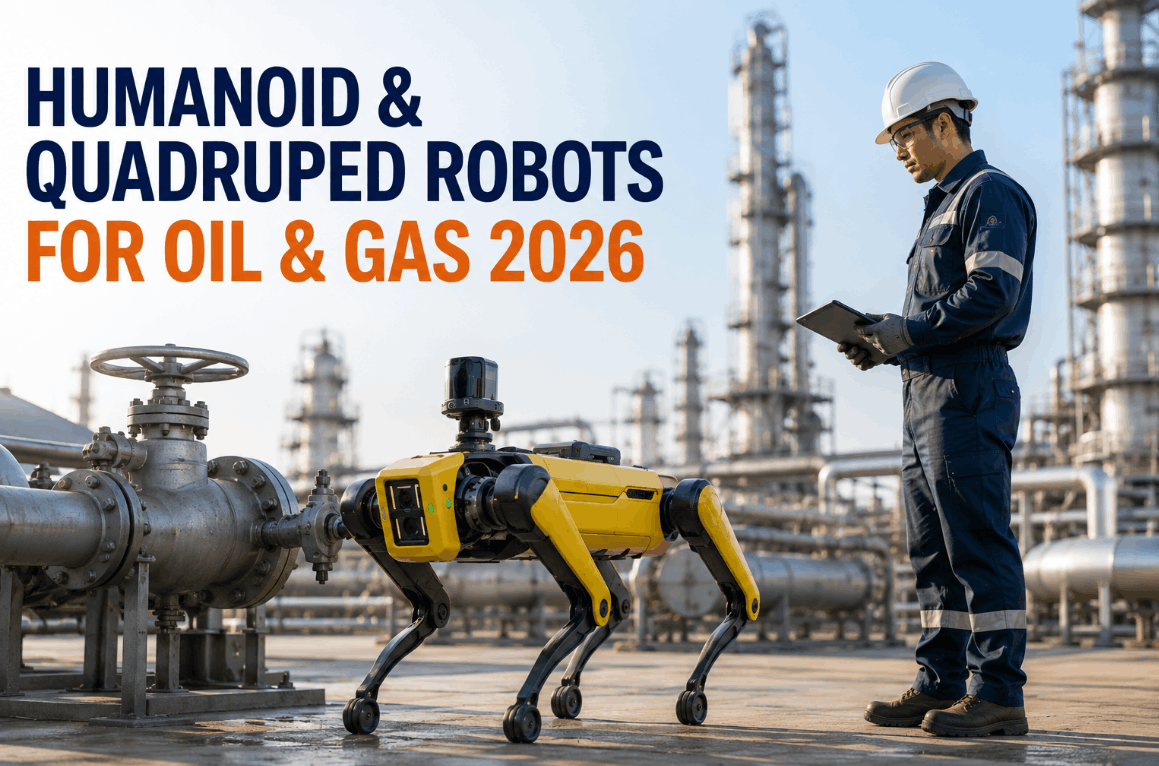
Four-legged robotic platforms — Boston Dynamics Spot, ANYbotics ANYmal, and equivalent marine-grade quadrupeds — are the primary continuous-patrol platform for FPSO and FSRU open deck areas. Their ability to navigate stairs, gratings, pipe racks, and irregular deck surfaces makes them the closest functional equivalent to a human walk-around inspection. iFactory integrates quadruped sensor payload data — gas detection, acoustic leak detection, infrared thermal imaging, and visual inspection — directly into the vessel's safety management system with GPS-tagged anomaly logging.
Humanoid Robots: Valve Operation, Tool Handling, and Manual Task Execution
The current generation of offshore-capable humanoid platforms — Figure 02, Agility Robotics Digit, and purpose-built marine variants — is being evaluated and piloted on FPSO and FLNG vessels for tasks that require dexterous manipulation: manual valve operation, sample collection, filter changes, and fire extinguisher inspection. iFactory's humanoid integration module provides task sequencing, remote supervision, and work order linkage so humanoid-completed maintenance tasks flow directly into the vessel's CMMS with timestamped completion records.
Crawler Robots: Hull, Riser, and Structural Inspection
Magnetic-track and vacuum-adhesion crawlers are the primary platform for FPSO hull inspection, riser base examination, and structural weld assessment in the waterline and splash zone. These platforms eliminate the combination of rope access, saturation diving, and ROV mobilization that conventional hull inspection requires, delivering UT thickness measurements and visual inspection data to the iFactory platform with real-time trendline comparison against the vessel's previous inspection record and class survey baseline.
Aerial Drones: Flare, Vent, and Elevated Structure Inspection
Tethered and free-flying aerial platforms address the inspection of elevated structures on FPSO and FLNG topsides that are inaccessible to deck-level robotic platforms: flare stacks, flare tips, vent systems, crane booms, helideck structural supports, and accommodation block rooftop equipment. iFactory integrates UAV inspection data — thermal, visual, and gas detection — with the vessel's planned maintenance system to automate inspection record generation and flag anomalies for work order creation.
FLNG Cryogenic Systems: The Highest-Stakes Application for Robotic Inspection
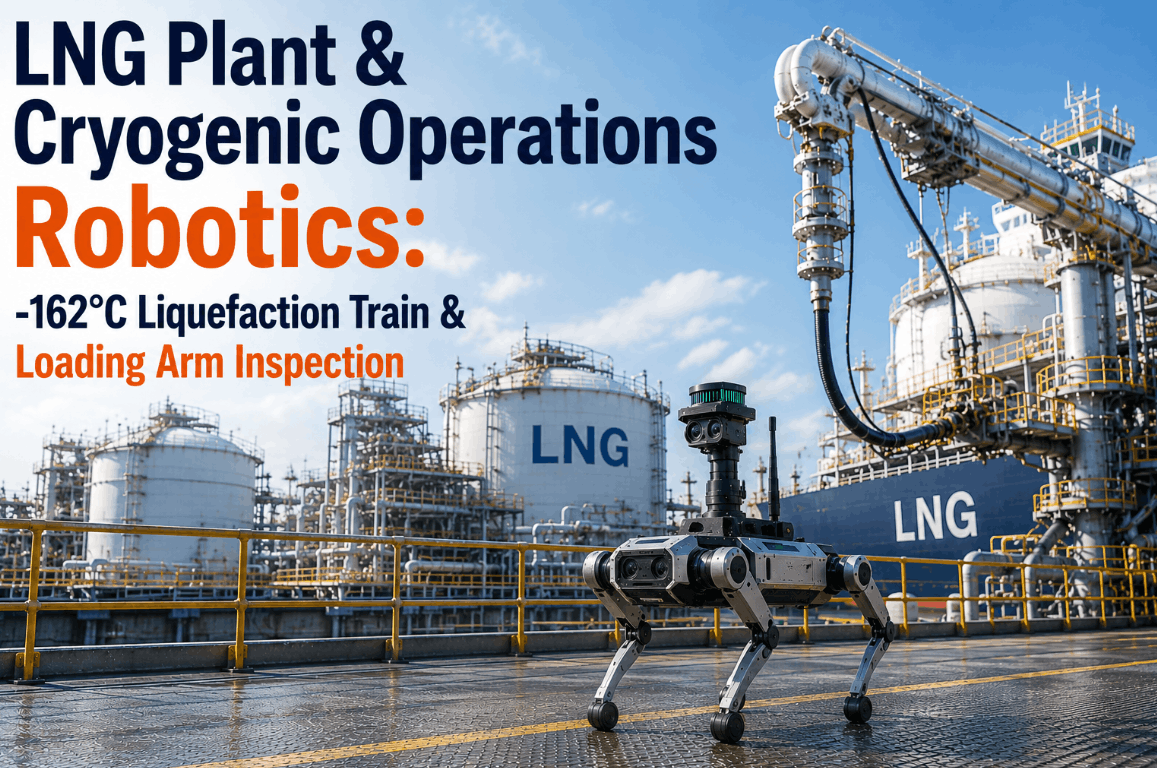
Floating LNG production vessels present a robotic inspection challenge that exceeds any other offshore asset class in consequence severity. Cryogenic hydrocarbon release on an FLNG — LNG at −162°C, LPG, or condensate from a liquefaction train leak — presents simultaneous cryogenic burn, rapid phase transition explosion, and vapor cloud ignition hazards in a confined topside environment over open water. The inspection requirements for FLNG cryogenic piping, heat exchanger trains, BOG compressor systems, and loading arm articulations are extensive, and the consequence of missing a developing defect is catastrophic. Operators who want to Book a Demo can see how iFactory's cryo-monitoring module integrates robotic sensor data from FLNG topsides with the vessel's process safety management system.
FPSO Turret, Mooring, and Topsides Inspection: What Robotic Platforms Replace and What They Enable
The FPSO turret system — whether external spread moored or internal swivel-bearing turret — is the most structurally complex and inspection-intensive component on any floating production vessel. Turret structural steel, swivel stack seals, mooring chain tension monitoring, and riser I-tube condition assessment require inspection access that is costly, weather-dependent, and personnel-intensive under conventional methods. Robotic crawler and quadruped platforms now provide continuous monitoring and targeted inspection access that makes condition-based turret inspection intervals achievable for the first time. Operators considering the transition to condition-based turret inspection can Book a Demo to review iFactory's FPSO turret monitoring configuration library.
| Inspection Task | Conventional Method | Robotic Platform | Crew Exposure Reduction | Detection Improvement |
|---|---|---|---|---|
| Turret Structural Weld Inspection | Rope access team, 2-week campaign, weather-dependent | Magnetic crawler with ACFM weld inspection module | 90% reduction in rope access personnel days | Continuous vs. biennial survey |
| Mooring Chain Visual Inspection | ROV deployment from standby vessel, $18,000–35,000/day | Tethered underwater crawler with visual and acoustic payload | Eliminates standby vessel mobilization | Monthly vs. annual survey frequency |
| Riser I-Tube Condition Assessment | Saturation diving, 6–12 week mobilization window | ROV-tethered crawler with UT and visual package | Eliminates saturation dive requirement | Condition-based vs. 5-year interval |
| Topsides Deck Structural Survey | Scaffolding erection, 4-person team, 3–5 days | Quadruped with thermal + visual payload, autonomous route | 100% scaffolding elimination for routine survey | Weekly vs. quarterly frequency |
| Process Module Gas Leak Survey | Two-person gas detection walk, manual logbook | Quadruped multi-gas patrol with iFactory data integration | Eliminates confined approach for routine patrol | 4-hour cycle vs. once-per-shift manual |
| Flare Stack Condition Inspection | Rope access, vessel out-of-service window required | Tethered UAV with IR and visual payload | Eliminates rope access team and production impact | Quarterly vs. annual capability |
IMO MEPC Compliance and ISM Code Integration: How Robotic Inspection Supports Regulatory Documentation
Floating production vessels operating under flag state registration and SOLAS/ISM Code requirements face inspection documentation obligations that are not satisfied by robotic deployment alone — the data generated by robotic platforms must be formatted, attributed, and archived in a way that satisfies flag state inspectors, class society surveyors, and IMO MEPC audit requirements. iFactory's vessel compliance module is built specifically to convert robotic sensor output and inspection records into the structured documentation format required by ISM Code Element 10 (Maintenance of the Ship and Equipment) and class society planned maintenance system (PMS) requirements.
- Robotic inspection task completion records formatted to ISM Code Element 10 template — timestamped, asset-linked, and stored in iFactory's vessel record archive
- Defect identification records from robotic detection linked to corrective maintenance work orders — closed-loop audit trail from detection to repair completion
- Non-conformity documentation auto-generated when robotic inspection detects condition outside acceptable limits — ready for flag state submission
- Annual ISM audit preparation report compiled automatically from iFactory inspection record database
- iFactory PMS connector maps robotic inspection records to DNV, Lloyd's, ABS, and Bureau Veritas planned maintenance system formats — no manual re-entry of inspection data
- Continuous survey status tracking — class-required items approaching interval expiry flagged 90/30/14 days in advance with automated work order generation
- Thickness measurement data from crawler UT surveys exported in class-compatible format for corrosion margin trending and steel renewal planning
- Survey attendance scheduling automated based on iFactory condition data — class surveyor notified when inspection findings warrant attendance
- Methane and VOC emissions monitoring data from robotic gas detection patrols integrated into iFactory's MEPC 80 compliance reporting module
- Flare system condition data from UAV inspections linked to SEEMP Part III operational carbon intensity documentation
- Fugitive emissions detection records from quadruped patrol routes formatted for DCS/MARPOL Annex VI reporting submissions
- EEXI and CII documentation supported by iFactory's operational data aggregation from robotic and SCADA sensor integration
- iFactory inspection record database provides structured evidence package for SIRE 2.0 vetting inspections — reducing preparation time from 3–4 weeks to under 5 days
- OCIMF OVMSA alignment evidence generated automatically from iFactory's maintenance and inspection closure records
- Condition monitoring trending reports formatted for charterer due diligence requirements — reduces inspection friction for contract award and renewal
- Vetting deficiency history and corrective action closure tracked in iFactory — complete audit trail available for inspector review on vessel arrival
Expert Review: Why FPSO and FLNG Operators Are Moving to Robotic Inspection Now
I have been involved in FPSO and FLNG operations for over two decades — integrity management, inspection planning, and PSM for vessels operating in West Africa, the North Sea, and Southeast Asia. The argument against robotic inspection on floating production vessels used to be environmental durability and data integration: robots couldn't survive the marine environment, and even if they could, their data went nowhere useful. Both objections are now obsolete. The current generation of marine-grade quadruped and crawler platforms operates reliably in conditions that would suspend a conventional rope access campaign, and the integration platforms — iFactory being the most mature I have reviewed for vessel applications — connect robotic sensor output to the vessel's DCS and CMMS in a way that produces genuinely actionable safety information, not another data stream that sits unreviewed in a server. The economics are unambiguous for any vessel with a daily crew rotation cost above $150,000. The inspection function that previously required four offshore technicians flying in every two weeks can be covered by a robotic patrol fleet managed from an onshore control center at a fraction of the personnel cost and with materially better detection frequency. The operators who are moving now will build a three-to-five-year head start on the condition data baseline that makes predictive maintenance on floating production assets genuinely viable. The ones waiting for the technology to mature further are waiting for something that has already arrived.
Conclusion: The Operational Case for FPSO and FLNG Robotics Is Already Closed
The transition to robotic inspection and monitoring on floating production vessels is not a future consideration for offshore operators — it is a current deployment decision with a clear and quantified ROI case. The combination of extreme crew rotation costs, structural inspection complexity, cryogenic process hazards, and regulatory documentation requirements creates an operating environment where robotic platforms deliver measurable returns from the first patrol cycle. The technology durability barrier that previously prevented marine deployment has been resolved by the current generation of IP67-rated, motion-compensated robotic platforms. The integration challenge — connecting robotic sensor output to vessel safety management systems, CMMS, and class society compliance records — is exactly what iFactory's floating production integration platform is designed to solve.
Operators who deploy now capture the condition data baseline that makes predictive maintenance on floating production assets viable within 18–24 months of continuous monitoring. Those who defer the decision continue to absorb crew rotation costs, confined space entry exposure, and inspection interval limitations that robotic deployment eliminates on day one of operation. The 48-to-72-hour detection lead time advantage that robotic multi-sensor patrol delivers over conventional fixed-point monitoring is not marginal — it is the difference between a detected developing anomaly and a filed process safety incident report. iFactory is ready to support your FPSO, FLNG, FSRU, or MODU robotic integration. Book a Demo to begin the vessel configuration assessment.
Frequently Asked Questions
Boston Dynamics Spot, ANYbotics ANYmal, and several purpose-built marine quadruped platforms hold ATEX/IECEx Zone 1 certification for use in hazardous areas on offshore vessels; iFactory integrates with all major certified platforms through its open sensor API.
iFactory connects to vessel DCS and historian via OPC-UA, Modbus, and PI historian connectors — no changes to existing control system architecture are required, and integration is typically completed within the first two weeks of deployment.
DNV, ABS, Lloyd's Register, and Bureau Veritas have all published guidance accepting robotic crawler and UAV inspection data as primary survey evidence for specific structural and coating inspection items, subject to surveyor attendance or remote review protocols.
Operators report 30–40% reductions in offshore inspection and integrity technician headcount within 18 months of full robotic fleet deployment — translating to $4–8M per year in crew rotation cost savings on a mid-size FPSO.
A full FPSO or FLNG robotic integration with iFactory — including DCS connectivity, patrol route configuration, risk matrix setup, and ISM Code record templates — typically reaches operational readiness in 10–14 weeks from project kick-off.