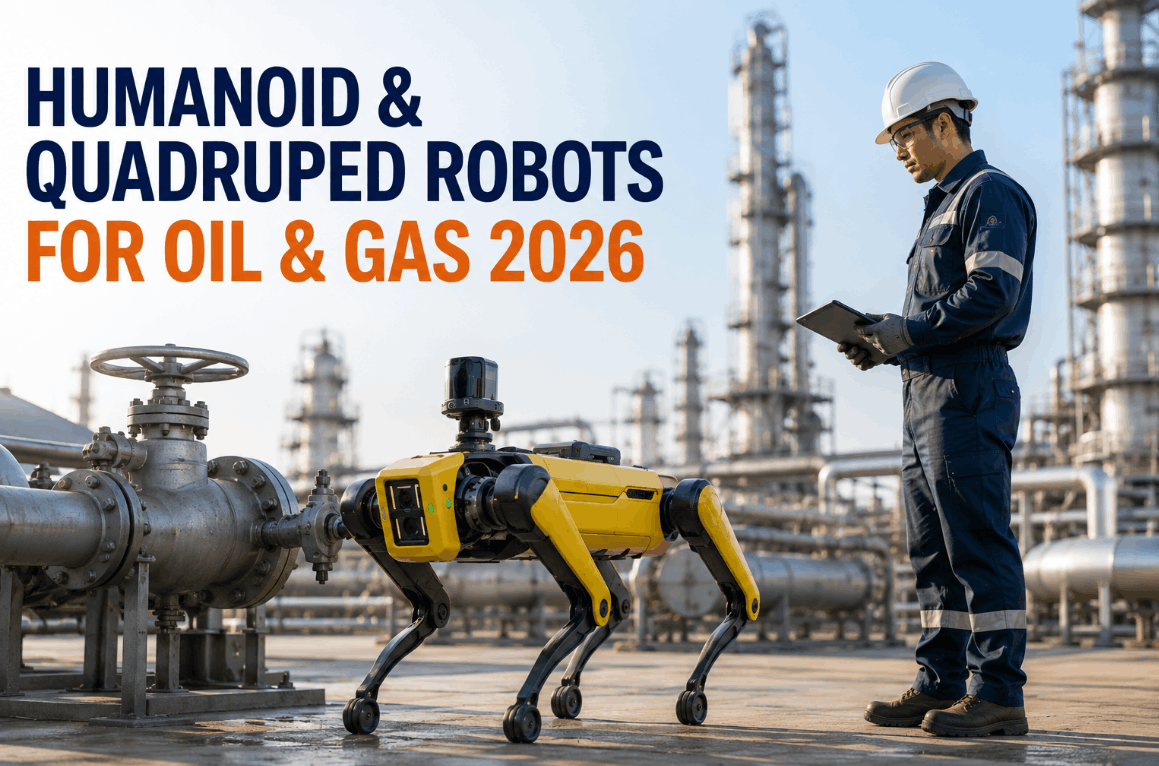
The oil and gas industry is undergoing a fundamental operational shift in 2026. Humanoid and quadruped robots are moving beyond pilot programs and into live production environments — at refineries, on offshore platforms, and across upstream drilling operations. Driven by workforce safety mandates, hazardous area access constraints, and the relentless pressure to reduce unplanned downtime, energy majors like BP, Equinor, TotalEnergies, Petronas, and ADNOC are now committing to multi-year robotic deployment roadmaps. This guide covers the key platforms, deployment segments, and the AI-driven software layer that makes it all work — including how solutions like iFactory connect robot-generated data directly into predictive maintenance workflows. Book a Demo to see how iFactory integrates with robotic inspection systems in your facility.
Why Oil & Gas Is the Largest Robotics Vertical in 2026
No other industry combines the physical risk, geographic scale, and maintenance complexity that oil and gas operations demand every day. Offshore platforms sit 200 kilometers from shore. Refinery units run at temperatures and pressures that make routine human inspection genuinely dangerous. Upstream wellheads in remote basins require constant monitoring but are impossibly expensive to staff. These conditions make oil and gas not just a logical robotics market — they make it the most urgent one.
The industry's robotics adoption is accelerating on multiple fronts simultaneously. Quadruped robots that navigate grated platforms, climb stairs, and conduct autonomous inspection rounds are now certified for Zone 1 hazardous areas. Tracked inspection robots developed from the ARGOS Joint Industry Project are operating autonomously on live production platforms. Humanoid platforms designed for valve manipulation and equipment interaction are entering advanced trials. And AI-powered software layers are beginning to close the last remaining gap — turning robot-generated sensor data into actionable maintenance workflows without any human relay in between. If you want to see how iFactory connects this data pipeline end-to-end, Book a Demo with our integration team.
The Key Platforms: Spot, ANYmal X, Taurob Inspector & ARGOS Robots
Understanding the robotic landscape in oil and gas requires knowing which platforms have actually been deployed — and what each one is certified to do. The table below maps the leading systems against their key capabilities, certifications, and real-world deployment history in the energy sector.
| Platform | Type | ATEX/Zone Cert. | Key Capabilities | Real Deployment |
|---|---|---|---|---|
| Boston Dynamics Spot | Quadruped | Zone 1 (select configs) | Visual inspection, thermal imaging, gas detection, remote telemetry, autonomous navigation | BP Whiting Refinery, BP Mad Dog (Gulf of Mexico) |
| ANYbotics ANYmal X | Quadruped | Zone 1 (Ex-certified) | 90-min runtime, 20x optical zoom, thermal camera, LiDAR/SLAM, gas & acoustic sensing | Petronas Dulang B (offshore Malaysia), Equinor Northern Lights facility |
| Taurob Inspector | Tracked / Wheeled | ATEX Zone 1 | Autonomous rounds, gauge reading, corrosion inspection, video & IR recording, arm manipulation | TotalEnergies K5CC (Netherlands), Shetland Gas Plant (Scotland) |
| ARGOS Operator Robot | Heavy-duty operator | Designed for Zone 1 | Valve turning, gauge operation, lifting industrial equipment, precision manipulation in hazardous areas | ADNOC Taweelah Gas Plant (deployment by end 2026) |
| ANYmal XD (2026) | Quadruped (next-gen) | Zone 1 (forthcoming) | Enhanced version of ANYmal X with greater payload and terrain handling | Pre-commercial trials, energy sector partnerships ongoing |
Deployment Segments: Upstream, Midstream & Downstream Use Cases
Robots do not deploy uniformly across the oil and gas value chain. Each segment presents unique environments, risk profiles, and inspection requirements that determine which robotic platform is appropriate — and how the data it collects must be processed and acted upon. The following breakdown maps the three major segments to their robotic deployment realities.
Drilling, Wellheads & Remote Extraction
Upstream environments present the most physically demanding conditions for robotics. Wellheads in remote basins, subsea trees, and drilling rigs need continuous monitoring but cannot be economically staffed around the clock. Quadruped robots are increasingly deployed to perform autonomous inspection rounds across wellhead clusters — checking pressure gauges, detecting hydrocarbon leaks, and capturing thermal imagery of pump jacks and rod drive systems. AI systems like iFactory then ingest this telemetry to monitor for developing failures, triggering maintenance work orders before catastrophic equipment loss occurs.
- Autonomous wellhead pressure & temperature monitoring
- Hydrocarbon leak detection via gas sensors
- Pump jack and rod drive thermal inspection
- Remote site perimeter surveillance
Pipelines, Compressor Stations & Storage
Midstream assets span thousands of kilometers of pipeline, dozens of compressor stations, and vast storage tank farms. The inspection challenge is one of scale: no human workforce can consistently walk every meter of pipe or audit every valve and actuator at regular intervals. Tracked and wheeled inspection robots are well-suited for compressor station rounds, while aerial drones cover linear pipeline routes. Robotic data feeds into digital twin models that track pressure profiles, vibration signatures, and corrosion progression — detecting pipeline stress patterns 8 to 14 weeks before rupture risk becomes acute.
- Compressor station autonomous gauge reading
- Pipeline corrosion and external damage detection
- Storage tank roof and shell inspection
- Valve position verification and actuation monitoring
Refineries, Petrochemical Plants & LNG Facilities
Downstream facilities are the densest robotic deployment environment in oil and gas. Refineries combine extreme heat, chemical hazards, complex multi-level structures, and thousands of rotating assets that must be monitored continuously. Boston Dynamics Spot completed multi-week trials at BP's Whiting refinery, proving autonomous navigation through live production units. ANYmal X is the first quadruped certified for Zone 1 hazardous areas — a prerequisite for independent operation inside process units where explosive atmospheres may be present. The Taurob Inspector, originating from the ARGOS challenge, has operated autonomously in MEG (gas dehydration) units at TotalEnergies' Shetland Gas Plant. Downstream robots feed refinery EAM systems — and with iFactory, that data translates directly into scheduled or urgent digital work orders for the maintenance team. Book a Demo to see how iFactory connects refinery robots to your maintenance workflow.
- Furnace and heat exchanger thermal inspection
- Rotating equipment vibration and acoustic monitoring
- ATEX-compliant autonomous rounds in process units
- Valve manipulation and filter cartridge handling (advanced)
The ARGOS Legacy: From Competition to Live Platform Operations
The ARGOS (Autonomous Robots for Gas and Oil Sites) challenge, launched by TotalEnergies in 2014, fundamentally shaped the trajectory of robotics in oil and gas. The competition's goal was to develop the first fully autonomous surface robot capable of operating on unmanned offshore platforms — a robot that could read gauges, detect leaks, scan the horizon, and identify anomalies without any human guidance.
Closing the Last Gap: From Robot Data to Maintenance Action
Deploying a quadruped robot on an offshore platform or refinery unit solves the data collection problem. The robot reads gauges, captures thermal images, records acoustic signatures, and detects gas traces — continuously, autonomously, and safely in Zone 1 environments. But raw sensor data by itself does not fix anything. The critical challenge that most robotics deployments have not yet fully solved is the integration layer: how does robot-detected data become an immediate, context-rich maintenance action?
Consider a quadruped robot detecting an elevated bearing temperature on a refinery centrifugal pump during an autonomous inspection round. Without an integrated EAM layer, that data sits in a robot dashboard log — waiting for an engineer to review it, make a judgment, and manually create a work order. That delay can be hours. iFactory eliminates it entirely. By ingesting the robot's live sensor feed, iFactory's threshold logic evaluates the temperature signature in real time and, when a sustained deviation is detected, automatically generates a digital work order — complete with the asset ID, the parameter history graph, required spare parts, and the responsible technician's mobile device. The bearing gets addressed before the pump fails. Book a Demo to see the integration live.
Robot Conducts Autonomous Round
Quadruped or tracked robot navigates its programmed inspection route — reading gauges, capturing thermal data, recording vibration signatures, and detecting gas traces across the facility or platform deck.
iFactory Ingests Live Sensor Feed
Robot telemetry is streamed into iFactory's AI platform via standard protocols. Each sensor reading is matched to the corresponding asset in the digital registry and evaluated against configured threshold logic in real time.
Anomaly Detected, Work Order Dispatched
When a parameter deviation meets the threshold condition, iFactory automatically generates a digital work order. The assigned mechanic receives a mobile push notification with the asset ID, sensor graph, maintenance history, and required parts — in under 3 seconds.
Closed-Loop Resolution & Digital Twin Update
The technician completes the repair, closes the work order via barcode scan, and the resolution data feeds back into the asset's digital twin — continuously improving failure prediction models for the next inspection cycle.
Condition-Based Maintenance vs. Calendar-Based Inspection in Oil & Gas
One of the most significant operational benefits that robotic deployment delivers — when paired with an intelligent EAM platform — is the transition from calendar-based preventive maintenance to true condition-based maintenance. The difference in efficiency and cost impact is substantial across all three segments of the oil and gas value chain.
Expert Perspective: What the Industry Is Saying in 2026
Operators who have moved through the pilot phase and into sustained robotic deployment consistently report that the hardware is no longer the hard part. The challenge is the data integration layer — and the organizational shift from reactive to predictive maintenance culture.
"We managed to run missions at our Northern Lights facility after just two or three days. The deployment speed was a genuine surprise — but the more important realization was that the robot's value isn't in the inspection itself. It's in what you do with the data it generates. Without the right EAM layer to catch and act on every anomaly it flags, you've built a very expensive data logger." — Equinor Robotics Operations, Northern Lights Facility (paraphrased from public statements)
"ADNOC's contribution to the ARGOS Joint Industry Project brought an essential regional dimension. Extreme heat, challenging terrain, and a strong focus on digital transformation enabled us to apply advanced technologies in ways that enhance safety and efficiency, while supporting the shared ambition to reduce emissions through expanded robotics." — Matthias Biegl, Managing Director, Taurob GmbH
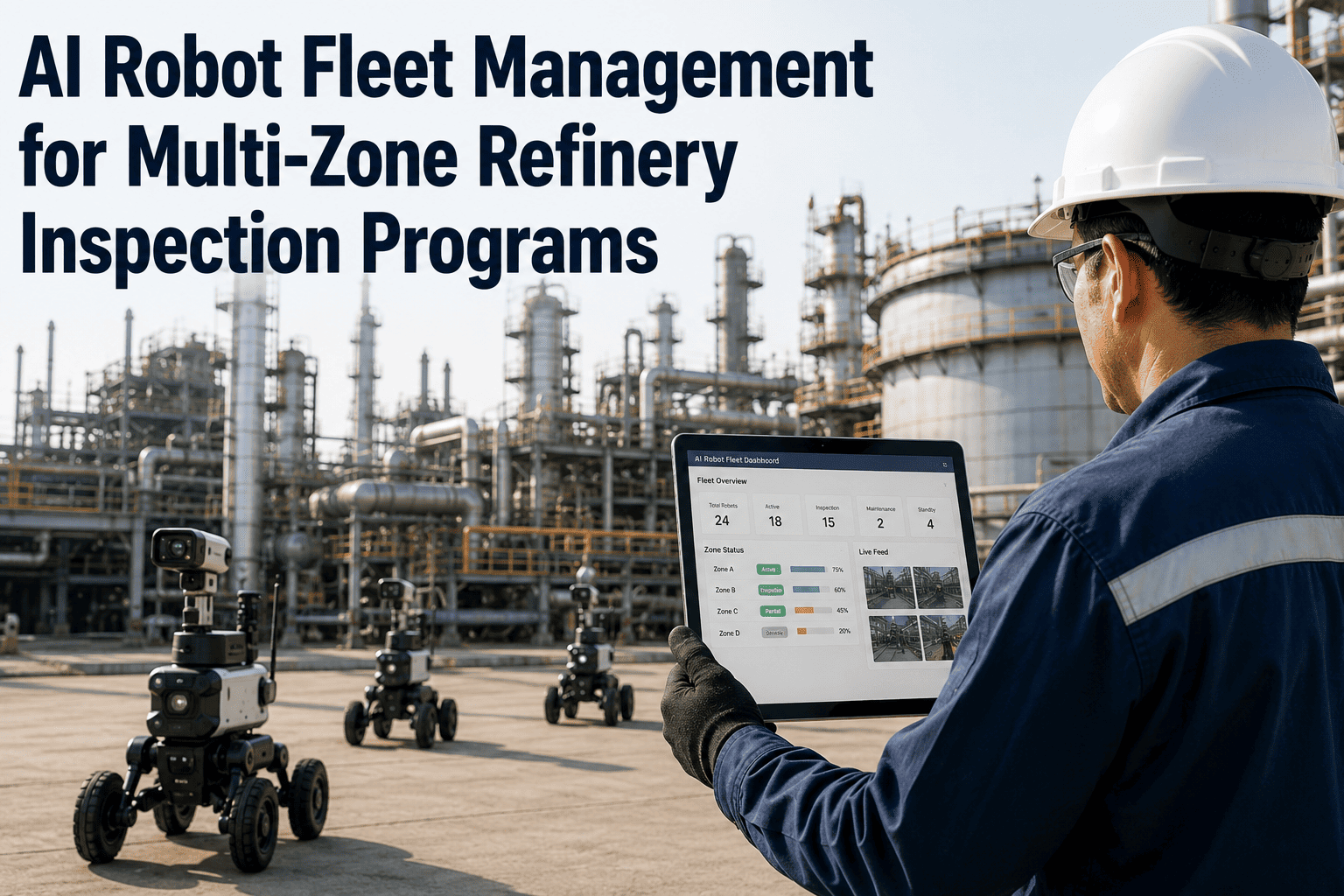
iFactory operates as the AI-driven intelligence layer above robotic inspection platforms. While Spot, ANYmal, or Taurob Inspector executes the physical inspection round, iFactory ingests the resulting telemetry and applies threshold logic, trend analysis, and digital twin comparison to determine whether a maintenance action is required. The result is a closed-loop system where a robot detecting an anomaly at 2:00 AM automatically dispatches a work order to the duty technician's mobile device before the start of the morning shift — without any human relay in the loop. Book a Demo to explore how iFactory integrates with your robotic inspection program.
Oil & Gas Robotics in 2026: What Comes Next
The oil and gas robotics market is at an inflection point. The foundational challenges — platform navigation, ATEX certification, communications integration, and autonomous mission execution — have been solved in the field by systems like ANYmal X, Spot, and the Taurob Inspector. The next wave of development is moving up the capability stack in two directions simultaneously.
The first is physical capability: the heavy-duty ARGOS operator robot, expected to be fully operational at ADNOC's Taweelah Gas Plant by the end of 2026, represents a significant leap beyond inspection into manipulation — lifting industrial equipment, turning valves, and operating gauges in hazardous environments that would ordinarily require a suited worker. Taurob has already indicated that future versions of the Inspector will support changeable arm attachments for tasks like gas content measurement and filter cartridge replacement.
The second direction is software sophistication. Raw autonomous inspection is a solved problem; the competitive differentiation for operators in 2026 will come from how intelligently robot-generated data is processed. Digital twin integration, predictive yield analytics, and condition-based maintenance scheduling — powered by platforms like iFactory — represent the layer where the majority of ROI will be realized. Operators who have robotics hardware but lack the EAM intelligence layer to act on what those robots find will not achieve the operational transformation that the technology is capable of delivering.
Frequently Asked Questions
Are quadruped robots like ANYmal X and Spot approved for Zone 1 hazardous areas in oil and gas?
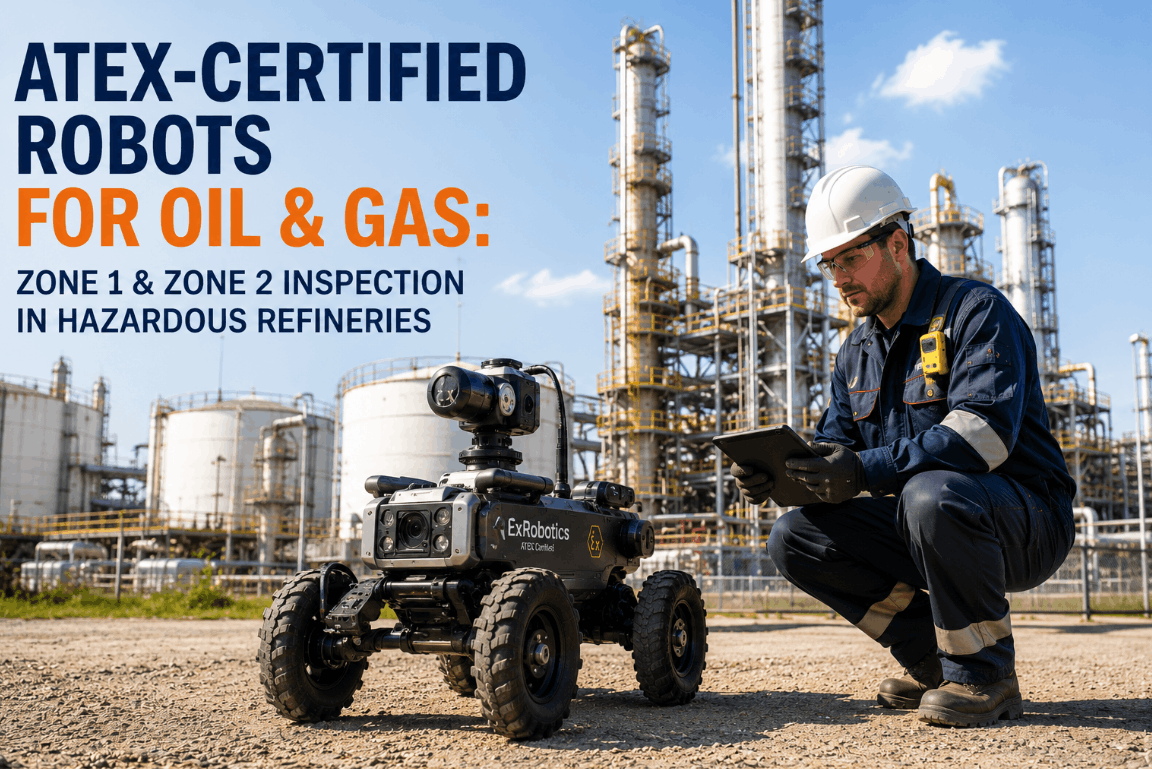
ANYmal X holds Zone 1 ATEX certification, making it currently the only ex-certified quadruped for that classification. Boston Dynamics Spot has been deployed in refineries and offshore with specific certified configurations, though Zone 1 coverage varies by payload and setup.
What was the ARGOS challenge and why does it matter for oil and gas robotics?
ARGOS (Autonomous Robots for Gas and Oil Sites) was a 2014–2017 challenge by TotalEnergies to develop the first autonomous surface robot for offshore platforms. Taurob won, and the resulting ecosystem of certified robots and JIP partnerships has shaped nearly every commercial deployment in the sector since.
How does iFactory connect to robotic inspection platforms in oil and gas facilities?
iFactory ingests robot telemetry via standard industrial protocols and APIs, mapping sensor readings to digital asset records and applying threshold logic to automatically trigger work orders when anomalies are detected — with dispatch latency under 3 seconds.
Can these robots operate on offshore platforms in extreme heat or cold?
Yes — platforms like the Taurob Inspector are rated for −20°C to 60°C operating temperatures, and ANYmal X has been deployed in environments ranging from cold Norwegian platforms to Middle Eastern facilities through the ADNOC ARGOS JIP program.
What is the difference between a condition-based and a calendar-based maintenance approach in robotics-enabled oil and gas?
Calendar-based maintenance runs fixed schedules regardless of equipment state; condition-based maintenance triggers intervention only when real sensor data indicates deviation. Robots enable 24/7 condition monitoring that makes calendar-based inspection largely redundant for covered assets.


-for-offshore-environmental-monitoring.png)