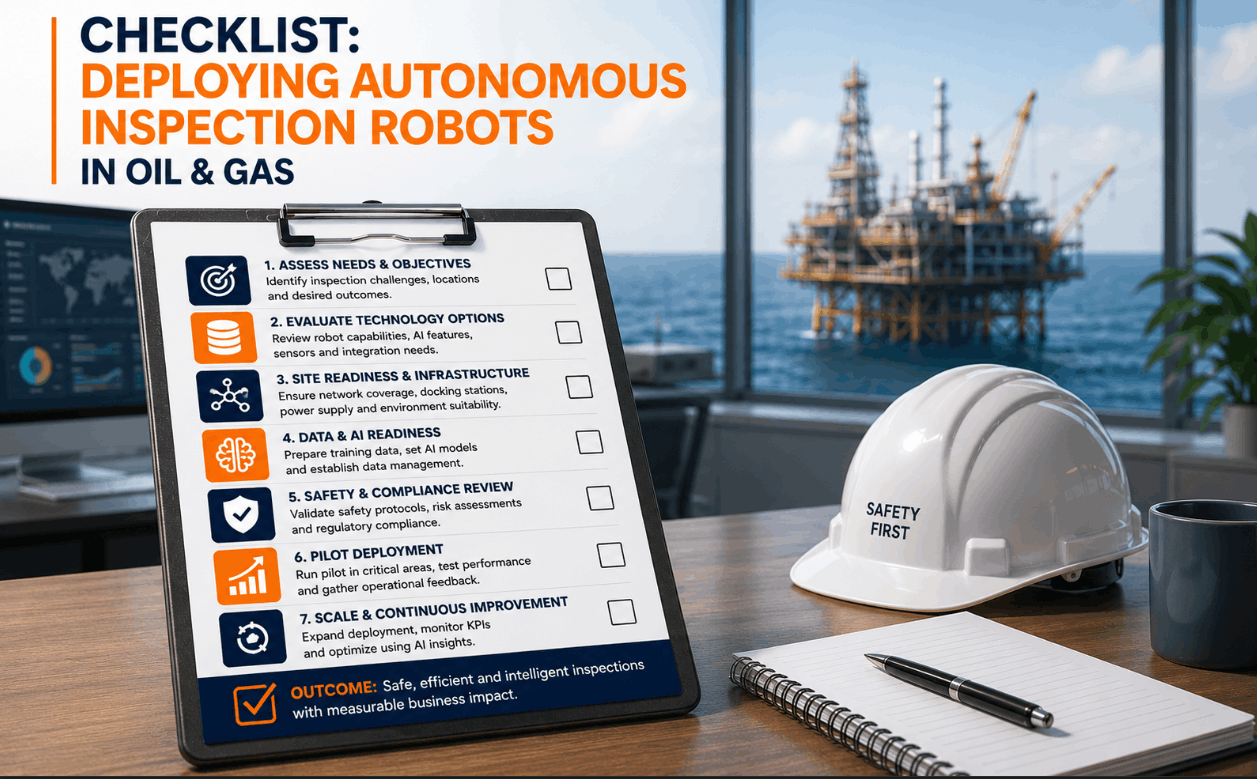
Deploying autonomous inspection robots in oil and gas facilities is one of the highest-impact decisions a reliability or operations team can make — and also one of the most technically complex. From ATEX zone classification and sensor payload selection to CMMS integration and regulatory compliance, a structured deployment checklist is what separates a successful rollout from a costly pilot that stalls before it scales. Book a Demo to see how iFactory AI's autonomous inspection platform is purpose-built for upstream, midstream, and downstream oil and gas environments.
Why a Structured Deployment Checklist Is Critical in Oil & Gas
Hazardous Zone Compliance Cannot Be Improvised
Oil and gas facilities span ATEX Zone 1 and Zone 2 environments where a single non-certified robot deployment can trigger a regulatory shutdown, invalidate your Process Safety Management program, or create direct ignition risk. Every hardware and software decision must be validated against IECEx and ATEX standards before a robot is commissioned on-site.
Unstructured Pilots Create Integration Debt
Facilities that skip pre-deployment planning routinely discover that robot data cannot connect to their existing CMMS, historian, or asset management systems — requiring expensive custom middleware months after go-live. A deployment checklist forces data architecture decisions before hardware is ordered, not after it arrives on the platform.
The Deployment Checklist: 6 Phase-by-Phase Steps
Manual Inspection vs. Autonomous Robot Inspection
| Inspection Dimension | Manual Inspection | Autonomous Robot Inspection |
|---|---|---|
| Frequency | Weekly or monthly cycles | Daily or continuous patrols |
| Hazardous Zone Access | Requires PPE, permits, shutdown windows | ATEX-certified robots operate continuously in Zone 1 |
| Data Consistency | Variable — inspector-dependent | Repeatable, sensor-calibrated readings every mission |
| Anomaly Detection Speed | Lag between inspection cycles | Real-time alerts on thermal, gas, and visual deviations |
| Compliance Documentation | Paper or manual digital entry | Automated, timestamped, CMMS-linked records |
| Cost Over 5 Years | High — labor, PPE, permit-to-work overhead | Lower total cost with platform amortization |
"The facilities that struggle most with autonomous robot deployments are the ones that treat it as a hardware procurement exercise rather than an operational transformation. The checklist discipline — from zone certification to AI model validation to CMMS handoff — is what determines whether you get a robot that creates data or one that drives decisions."
The iFactory AI platform is designed specifically to close the gap between robot-collected inspection data and actionable maintenance decisions — with native integrations for leading CMMS platforms, AI visual inspection tuned for oil and gas asset classes, and digital twin capabilities that give your reliability team continuous facility visibility without adding inspection headcount. Book a Demo to see the full platform in a live oil and gas environment.
Conclusion: From Pilot to Production-Scale Deployment
Autonomous inspection robots are no longer emerging technology in oil and gas — Book a Demo to see how operators like Shell, Petrobras, and others have moved from single-unit pilots to fleet-scale deployment. The operational gap between facilities that are succeeding and those still running inconclusive pilots is almost always a deployment discipline gap, not a technology gap. Working through this checklist systematically — from ATEX zone mapping through 90-day performance audits — is what converts a robot procurement into a sustained reliability advantage. The iFactory AI platform exists to make every step of that journey structured, measurable, and audit-ready.



-in-oil-&-gas-back-office.png)