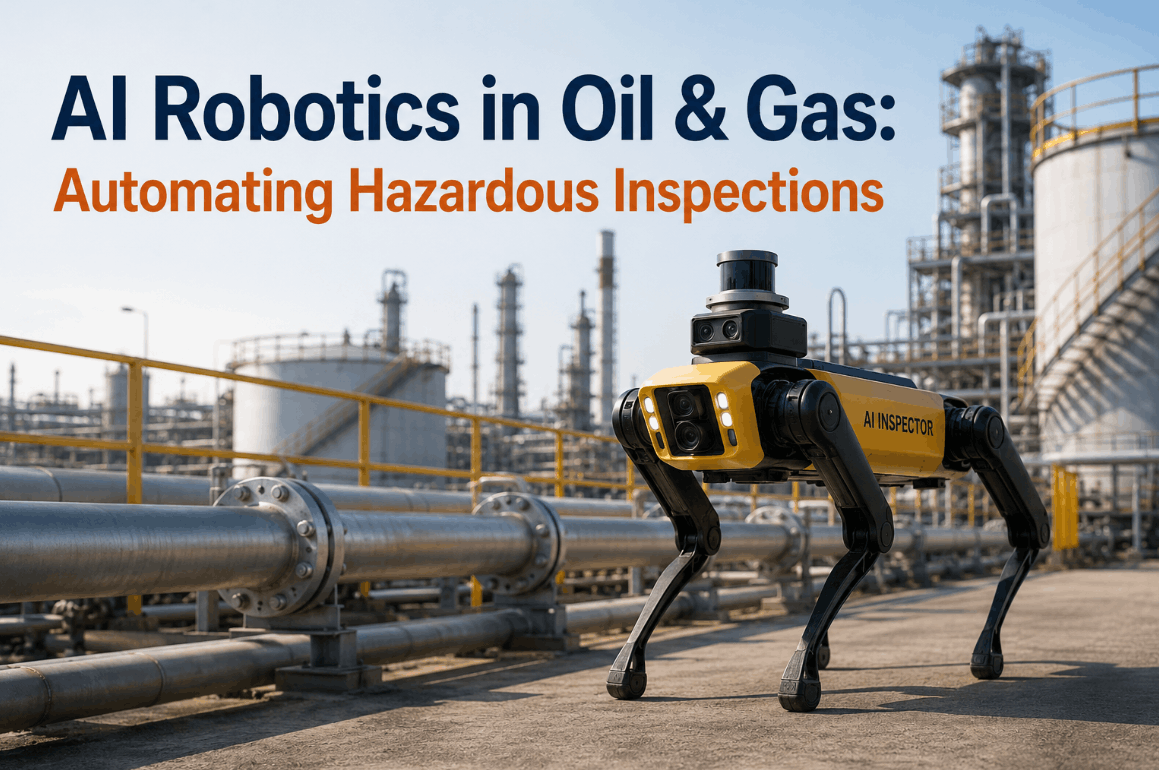
Oil and gas facilities face some of the most unforgiving inspection environments on the planet — pressurized pipelines, high-temperature furnaces, confined vessel interiors, and offshore platforms battered by corrosive salt air. Traditional manual inspection programs struggle to keep pace: they expose workers to real hazards, require costly shutdowns, and still miss early-stage faults that develop into multi-million dollar failures. Inspection robots using AI for oil and gas fault detection are changing that equation, enabling continuous, autonomous monitoring that catches defects weeks before they become emergencies. This article explores how these systems work, what they detect, and why forward-thinking operators are deploying them at scale.
What Are Inspection Robots in the Oil and Gas Context?
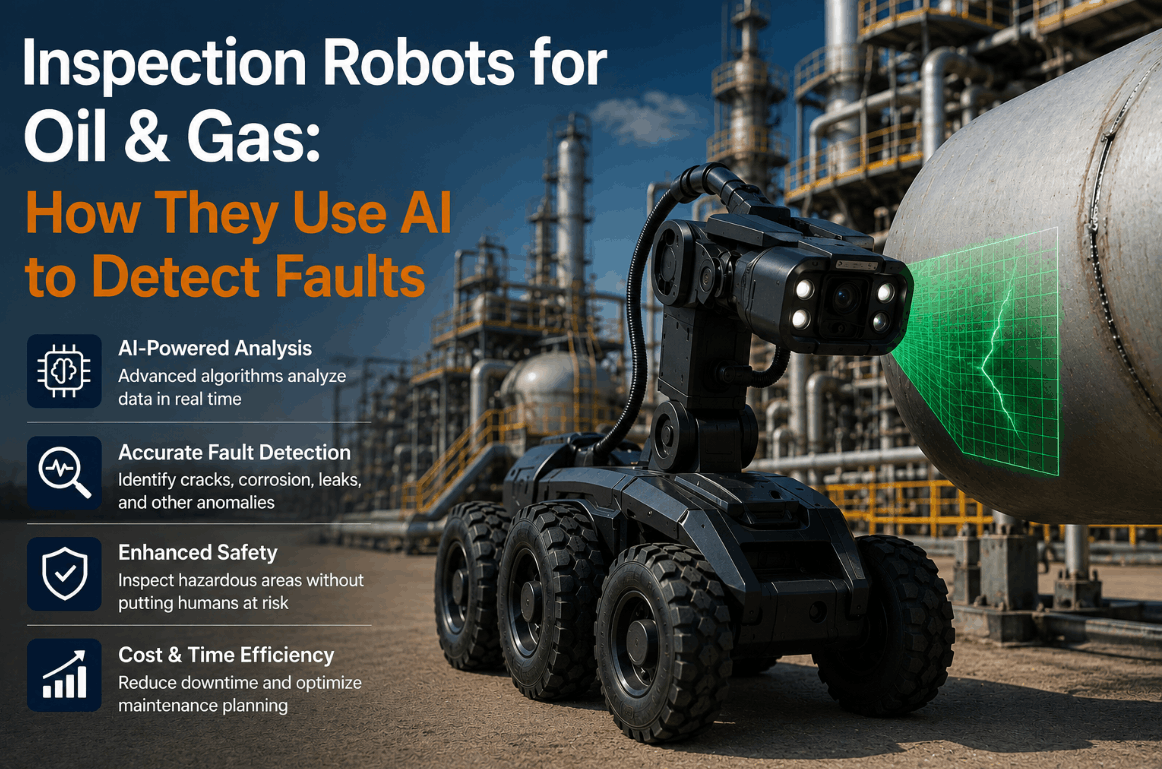
Inspection robots in oil and gas are autonomous or semi-autonomous machines equipped with sensor arrays, cameras, and AI inference engines that can traverse pipelines, crawl across storage tanks, fly over refineries, or navigate subsea infrastructure — collecting and analyzing condition data in real time. They range from wheeled crawlers inside pipe interiors and magnetic-adhesion robots scaling the external walls of storage tanks, to aerial drones patrolling flare stacks and subsea ROVs (remotely operated vehicles) surveying subsea wellheads. What unifies them is the AI layer: machine learning models trained on thousands of hours of inspection imagery and sensor data that can autonomously identify corrosion, cracking, weld defects, coating degradation, hot spots, and leak signatures far faster and more consistently than a human inspector.
The shift from manually operated inspection tools to truly autonomous, AI-driven robots represents a step change in coverage, frequency, and detection accuracy. Operators who previously inspected a pipeline segment once per year now run robotic patrols weekly — or continuously — without adding headcount or exposure risk.
Autonomous Inspection Intelligence
Deploy AI Inspection Robots That Detect Faults Before They Escalate
iFactory's robotics inspection platform integrates with your existing infrastructure, keeps OT data inside your security perimeter, and deploys in 18 to 24 days without replacing legacy systems.
91%
Reduction in Unplanned Failures
88%
Fewer Hazardous Human Entries
How AI Powers Fault Detection in Robotic Inspection Systems
The intelligence behind modern inspection robots is not a single algorithm — it is a layered stack of AI models working in concert. Understanding each layer helps operations teams evaluate what a platform can and cannot detect.
01
Computer Vision for Visual Defect Recognition
Convolutional neural networks trained on labeled inspection datasets can identify surface corrosion, pitting, cracking, coating blistering, and weld anomalies from high-resolution camera feeds. Models distinguish between cosmetic surface rust and structurally significant wall loss with greater than 92% accuracy in controlled deployments. iFactory's AI Vision module applies this continuously across camera-equipped robots, flagging anomalies in real time rather than waiting for post-mission review.
02
Thermal Imaging Analysis for Hot Spot and Leak Detection
Infrared sensors paired with AI classification models detect temperature anomalies that indicate blocked flow, internal corrosion, insulation failure, or nascent leaks. AI distinguishes normal thermal signatures from anomalous hot spots by comparing real-time readings against baseline thermal maps built during initial deployment. Detection latency is measured in seconds, not hours — enabling intervention before a hot spot becomes a rupture.
03
Ultrasonic Wall Thickness Measurement
Ultrasonic transducers on pipe-crawling robots measure remaining wall thickness at thousands of points per inspection pass. AI trend models compare successive measurements to calculate metal loss rate, predict remaining service life, and prioritize remediation by risk score. This replaces spot-check manual UT surveys that miss areas between measurement points and rely on human judgment for interpolation.
04
Acoustic Emission and Vibration Analysis
Microphones and accelerometers detect the acoustic signatures of active corrosion, fatigue cracking, and flow-induced turbulence that precedes leak events. AI spectral analysis models trained on known failure signatures separate fault-related acoustics from background plant noise, achieving low false-positive rates even in high-ambient-noise refinery environments. Early acoustic detection provides 14 to 72 hours of warning before physical manifestation of a fault.
05
Multi-Sensor Data Fusion and Anomaly Scoring
No single sensor modality catches every fault type. AI fusion models combine visual, thermal, ultrasonic, and acoustic data streams into a unified anomaly score for each asset location. A surface that looks intact visually but shows thinning walls ultrasonically and elevated acoustic emission receives a high composite risk score — triggering a work order before visual confirmation of failure. iFactory's platform performs this fusion at the edge, inside the operator's security perimeter, without cloud dependency.
Types of Inspection Robots Deployed Across Oil and Gas Operations
Different facility types and asset configurations require different robotic platforms. Mature autonomous inspection programs typically deploy a portfolio of robot types coordinated by a central AI platform rather than relying on a single vehicle category.
| Robot Type |
Primary Application |
Key Sensors |
Faults Detected |
Typical Environment |
| Pipeline Crawler |
Internal pipe inspection without shutdown |
UT, visual camera, magnetic flux leakage |
Wall thinning, pitting, weld defects, blockages |
Transmission pipelines, process piping |
| Magnetic Adhesion Crawler |
External tank and vessel wall inspection |
UT, visual, eddy current |
External corrosion, coating failure, wall loss |
Storage tanks, pressure vessels, columns |
| Aerial Drone |
Elevated asset and flare stack inspection |
High-res camera, thermal IR, gas sensor |
Surface corrosion, hot spots, gas leaks |
Flare stacks, offshore topsides, tall structures |
| Subsea ROV |
Underwater structure and riser inspection |
Sonar, visual, cathodic protection probe |
Marine growth, anode depletion, crack propagation |
Subsea wellheads, risers, mooring systems |
| Ground Mobile Robot |
Plant floor patrol and equipment monitoring |
Thermal, acoustic, gas detection, visual |
Bearing heat, gas leaks, liquid spills, vibration |
Refineries, processing plants, compressor stations |
Robot type selection depends on facility configuration, hazardous area classification, and target fault categories. Most mature programs deploy three or more platform types.
Real-World Fault Detection: What Inspection Robots Are Finding
Autonomous inspection programs are consistently surfacing faults that manual programs missed — not because human inspectors are incompetent, but because robots can access more locations, more frequently, with standardized sensor positioning and AI-assisted analysis that removes subjectivity from defect classification.
Pipeline Integrity
Internal Corrosion Beneath Insulation
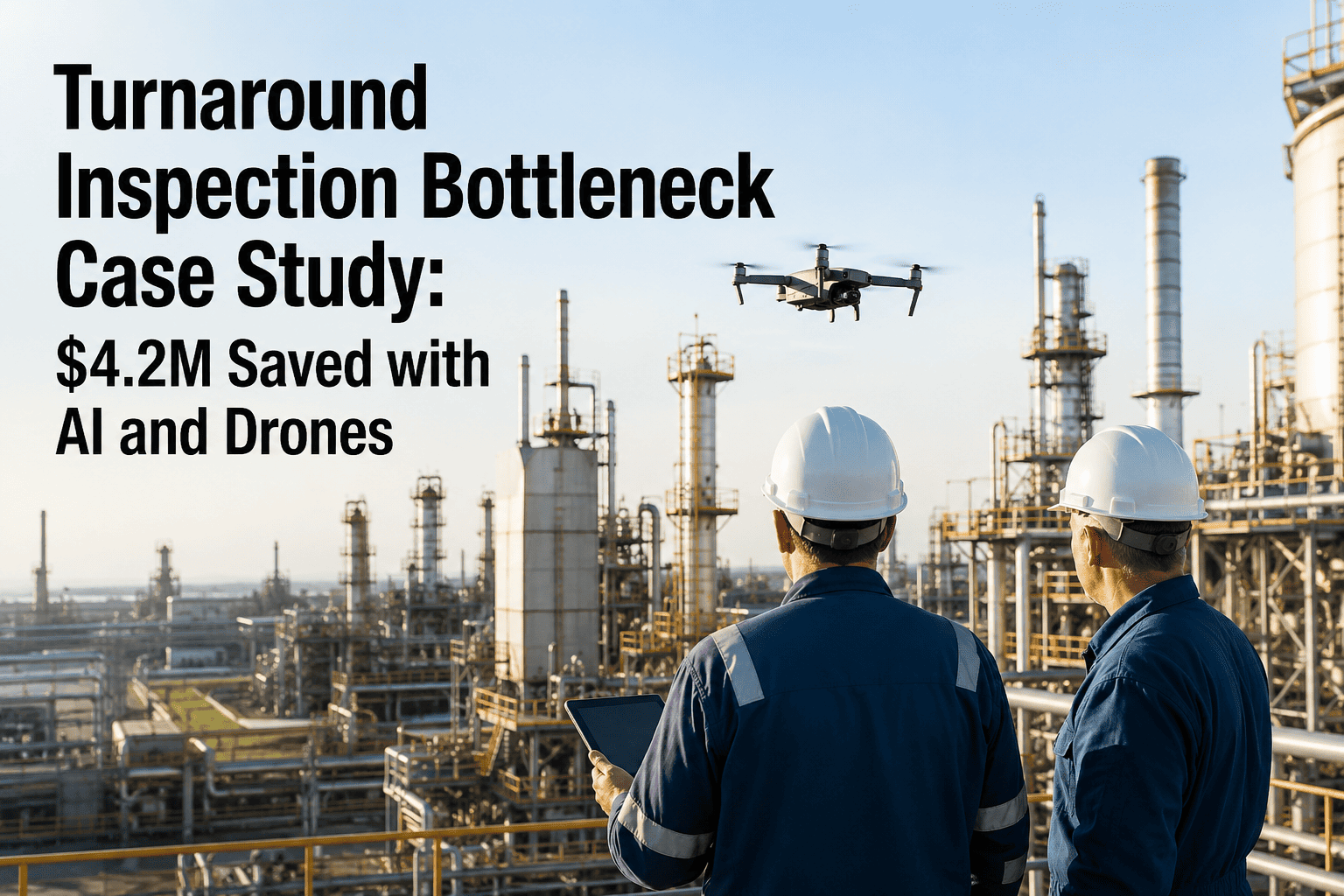
Corrosion under insulation (CUI) is one of the most costly failure modes in process piping and one of the hardest to detect manually without stripping insulation. AI-equipped pipeline crawlers using pulsed eddy current and thermal imaging identify CUI anomalies through insulation layers. In a Gulf Coast refinery deployment, automated crawlers identified 23 CUI anomalies across 4.2 miles of insulated piping — 17 of which had not appeared on the manual inspection record from the previous cycle. Early intervention avoided an estimated $4.1M in emergency repair costs.
Storage Tank Integrity
Floor and Shell Wall Loss in Atmospheric Tanks
Magnetic adhesion robots equipped with ultrasonic arrays can map the full interior shell of a floating-roof storage tank in 8 to 12 hours — a task that requires weeks of scaffolding and confined space entry under manual programs. AI wall-thickness models flag areas of accelerated metal loss and generate risk-ranked remediation lists. An operator managing 48 crude storage tanks reduced tank inspection costs 52% while increasing coverage from 40% of shell area per inspection cycle to 100%, detecting three floor anomalies that required immediate repair before product loss occurred.
Emissions and Safety
Fugitive Methane Detection at Compressor Stations
Ground mobile robots carrying optical gas imaging (OGI) cameras and AI plume analysis software patrol compressor stations on programmed routes, detecting methane releases invisible to the naked eye. AI distinguishes background atmospheric methane from leak plumes by shape, concentration gradient, and dispersion pattern. In a North America midstream application, weekly robotic patrols identified 14 fugitive emission sources across 6 compressor stations that optical surveys conducted quarterly had not flagged — reducing Scope 1 emissions and avoiding EPA reporting violations. To see how this applies to your assets,
Book a Demo with iFactory's team.
iFactory's Robotics Inspection Platform: Capabilities and Integration
iFactory delivers autonomous inspection intelligence as part of its Complete AI Platform for Oil and Gas Operations. The Robotics Inspection module connects to your existing SCADA/DCS infrastructure and historians without replacing legacy systems, maintains all OT data inside your security perimeter through edge AI deployment, and integrates findings directly into predictive maintenance workflows and automated work order generation.
AI Vision & Defect Classification
Computer vision models classify surface defects, corrosion severity, and coating condition from robot-mounted cameras with 91% detection accuracy, generating structured defect reports with location coordinates, severity scores, and recommended actions.
Automated Work Order Generation
Inspection findings automatically trigger prioritized work orders routed to qualified maintenance teams, with photo evidence, asset location data, and AI-recommended repair procedures — eliminating manual data transcription from field inspection to CMMS.
Predictive Failure Modeling
AI trend models correlate inspection findings across time, calculating asset degradation rates and predicting time-to-failure with 14 to 28-day advance warning — enabling planned intervention during scheduled maintenance windows rather than emergency responses.
Edge AI Security Architecture
All inspection data processing occurs at the edge within the operator's security perimeter. No cloud transmission of operational data is required. Air-gapped network support is available, meeting NERC CIP and ISA/IEC 62443 cybersecurity standards across 84% of deployed installations.
SCADA / DCS / Historian Integration
Native bi-directional integration with Honeywell, Emerson, Siemens, ABB, Schneider Electric, and OSIsoft PI historian systems. Robotic inspection findings feed directly into process control context, enabling correlated analysis between equipment condition and process performance data.
ESG and Compliance Reporting
Inspection data feeds automated ESG reporting workflows, generating audit-ready documentation for EPA, HSE, and voluntary carbon market requirements. AI leak detection findings integrate directly into methane emissions reporting — from sensor to regulatory submission without manual data entry.
Deploy in 18–24 Days
Connect Robotic Inspection to Your Existing Operations Infrastructure
iFactory integrates with your DCS/SCADA, historians, and CMMS without replacing legacy systems. OT data stays inside your security perimeter. Predictive maintenance workflows begin generating value within weeks of deployment — not months.
94%
No System Replacement
Performance Benchmarks: AI Robotic Inspection vs. Manual Programs
Operators comparing autonomous robotic inspection against traditional manual programs consistently report improvements across detection rate, coverage, cost, and safety outcomes. The following data reflects results from iFactory deployments across upstream, midstream, and downstream assets.
| Performance Metric |
Manual Inspection |
AI Robotic Inspection |
Improvement |
| Asset surface coverage per cycle |
40–60% of accessible area |
95–100% coverage |
+58% average coverage gain |
| Defect detection rate |
72% of known defects detected |
94% of known defects detected |
+22 percentage points |
| Inspection frequency (pipeline segment) |
Once per year (typical) |
Weekly to continuous |
52x increase in frequency |
| Time from defect to work order |
3–14 days (report review) |
Minutes (automated) |
94% faster response |
| Hazardous entries eliminated |
Baseline (100% manual entry) |
88% reduction in confined space entries |
88% safety improvement |
| Unplanned failure rate |
Baseline |
91% reduction |
$2.8M annual savings average |
| Inspection cost per asset (annual) |
$180K–$420K (offshore) |
$95K–$180K (offshore) |
48% cost reduction |
Performance data represents results from iFactory robotic inspection deployments across upstream, midstream, and downstream oil and gas facilities, 2023–2025.
Expert Review
The transition from periodic manual inspection to continuous AI-driven robotic monitoring is not incremental — it is a fundamental shift in how operators understand asset health. Manual programs are limited by human access, stamina, and subjectivity. AI inspection systems build a longitudinal, quantitative record of every square inch of a facility, enabling failure prediction rather than failure response. The operators who deploy these platforms earliest will carry a durable cost and safety advantage for the life of those assets. The technology is proven. The limiting factor now is implementation speed, not capability.
Senior Asset Integrity Engineer
Independent Review, Global Oil and Gas Operations Benchmark Study, 2024
Conclusion
Inspection robots using AI for oil and gas fault detection have moved from pilot curiosity to operational necessity. The combination of autonomous access to hazardous environments, multi-sensor data fusion, and AI-powered defect classification delivers detection rates, coverage, and response speeds that manual inspection programs cannot match at any practical cost. For upstream, midstream, and downstream operators, the business case is straightforward: catch faults earlier, reduce unplanned downtime, eliminate hazardous human entries, and build the continuous asset health record that makes predictive maintenance possible.
iFactory's platform brings robotic inspection intelligence together with predictive maintenance, SCADA integration, automated work orders, and ESG compliance reporting in a single deployment that connects to your existing infrastructure in 18 to 24 days. If your current inspection program relies primarily on periodic manual surveys, the gap between what you know about your assets and what AI robotics can reveal is likely costing you more than you realize. Book a Demo to see a live demonstration of AI-powered fault detection applied to your specific asset types and facility configuration.
Ready to Deploy AI Inspection Robots Across Your Facilities?
iFactory's Robotics Inspection platform integrates with your existing DCS/SCADA and historian infrastructure, deploys in 18 to 24 days, and begins surfacing faults that manual programs are missing — without replacing a single legacy system or transmitting OT data outside your security perimeter.
91% Fewer Unplanned Failures
88% Hazardous Entry Reduction
100% Asset Coverage
18–24 Day Deployment
Edge AI Security
Frequently Asked Questions
QWhat types of faults can AI inspection robots detect in oil and gas facilities?
AI inspection robots detect corrosion, wall thinning, weld defects, coating failure, hot spots, fugitive gas leaks, and structural cracking using combined visual, thermal, ultrasonic, and acoustic sensor modalities — covering fault types that no single-sensor manual inspection can match in one pass.
QHow do AI inspection robots integrate with existing SCADA and control systems?
Platforms like iFactory connect via OPC-UA or Modbus protocols to read real-time process data from existing SCADA/DCS systems and correlate inspection findings with operational context — without replacing any legacy infrastructure, typically within an 18 to 24-day integration timeline.
QAre inspection robots safe to deploy in hazardous area classified zones?
Inspection robots designed for oil and gas are available in ATEX and IECEx certified configurations suitable for Zone 1 and Zone 2 hazardous areas, enabling deployment in environments where human presence would require extensive permit-to-work procedures or is outright prohibited.
QHow accurate is AI fault detection compared to manual inspection?
AI robotic inspection systems achieve 94% defect detection rates against known defect sets — compared to 72% for manual programs — while also covering 95% to 100% of asset surface area versus the 40% to 60% typically accessible during manual inspection cycles.
QHow quickly can an AI robotic inspection program be deployed at an existing facility?
iFactory's robotic inspection platform deploys in 18 to 24 days for most facilities, connecting to existing historians and control systems with no legacy system replacement required and AI models pre-trained on 840+ wells and facility datasets for day-one accuracy.
Book a Demo to review your specific infrastructure.